A particle is a small function word that must attach to another word or phrase to contribute grammatical meaning, and it usually can't change form like a noun or verb. In English, common examples include to in infinitives, not in negation, and words such as up in phrasal verbs.
Why, then, can the same word sometimes be called a particle, a preposition, or an adverb? Conventional definitions often treat “particle” as one broad category, but English uses particles for several different jobs. The answer becomes clearer when you separate those jobs, test the word's position in a sentence, and compare English with languages such as Japanese, where particles often mark grammatical roles that English signals through word order.
A Simple Definition of Particle in Grammar
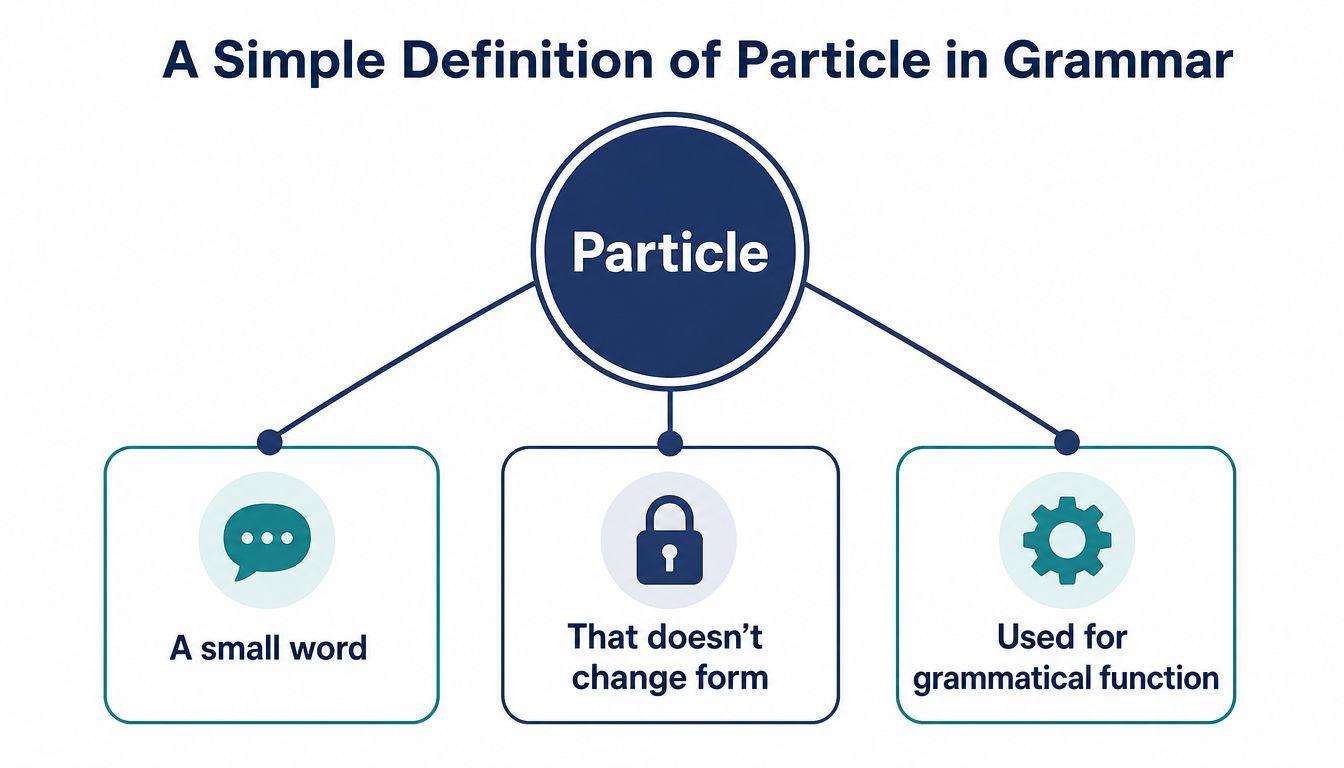
A grammatical particle is a small, usually unchangeable function word that contributes meaning through its connection with another word, phrase, or clause. A function word helps organize grammar rather than naming a person, object, action, or quality. Unlike a noun or verb, a particle generally doesn't take markers for number, tense, case, or agreement.
Consider the sentence:
She picked up the book.
The verb picked tells us about an action. The word up is a particle because it works closely with the verb and helps create the meaning pick up, meaning to lift or collect something. If you remove it, the sentence changes:
She picked the book.
That sentence can be grammatical, but it doesn't express the same action. The particle isn't decorative. It changes how the reader interprets the verb.
Why particles confuse learners
A particle often looks like an ordinary adverb or preposition. Words such as on, off, out, down, and back can perform different grammatical jobs in different sentences. Their spelling doesn't tell you their category. Their distribution, meaning where they appear and what they connect to, provides the better clue.
Modern grammar references describe particles as function words that attach to another word or phrase to express grammatical features such as negation, mood, or tense, while keeping them distinct from adpositions, conjunctions, and auxiliary verbs. The Universal Dependencies description of particles also treats the category as structurally important even though particles generally don't carry independent lexical meaning.
A useful working definition is:
A particle is a small, invariable word whose meaning depends on the grammatical construction around it.
Particles form a closed class, which means English uses a relatively limited set of recurring forms rather than creating new particles as freely as it creates nouns and verbs. Common examples include up, out, down, off, in, back, on, away, over, around, about, and along. You can explore related explanations of how grammar organizes words through the 1chat grammar and language resources.
The Three Functions Particles Serve in English
English grammar uses the label particle for several distinct functions. Keeping them separate prevents the common mistake of assuming that every particle behaves like the up in pick up.
The infinitive marker to
In I want to learn, to marks the infinitive. An infinitive is the basic form of a verb, such as learn, read, or write, used in a construction that doesn't show ordinary tense or agreement.
Compare these examples:
- I hope to travel soon.
- They decided to wait outside.
If you remove to, the structure becomes incomplete or changes into a different grammatical pattern:
- I hope travel soon.
- They decided wait outside.
Here, to doesn't indicate a destination. It signals how the following verb functions in the sentence. That's why the to in to learn is analyzed as an infinitive particle.
The negator not
The word not is a negator, a word that reverses or rejects the positive meaning of a clause. In She did not go, not marks negative polarity, meaning the sentence says the going did not happen.
Other examples include:
- We are not ready.
- He could not open the door.
Removing not changes the meaning directly:
- She did go.
- We are ready.
The negative word doesn't name an object or action. It modifies the grammatical force of the clause, which is why it belongs among function words and is commonly treated as a particle.
Particles in phrasal verbs
A phrasal verb combines a verb with a small particle to create a meaning that may differ from the verb alone. Examples include:
- pick up the book
- turn off the light
- look after the child
- bring back the photograph
In He picked up the book, up contributes a result or direction associated with the action. In Please turn off the light, off changes the meaning of turn into an instruction to deactivate something.
The particle can sometimes move:
- He picked up the book.
- He picked the book up.
That movement doesn't make up an ordinary adverb. Its close relationship with the verb and its role in forming a new verb meaning identify it as a phrasal-verb particle. For more guided practice with these combinations, phrasal verbs on Cathoven offers examples organized around phrasal-verb usage.
Particle vs Preposition vs Adverb
The fastest way to classify a small word is to examine its relationship with the rest of the sentence, not the word by itself. Try a move-and-replace test.
Start with a possible preposition:
The book is on the table.
A preposition is a word that introduces a phrase showing a relationship such as place, direction, time, or association. The phrase on the table connects the book with a location. You can move that phrase to the front:
On the table is the book.
The result may sound formal, but on still introduces the noun phrase the table. That is strong evidence that on is functioning as a preposition.
Now compare:
He picked up the book.
Here, up is part of the verb meaning. You can move it after the object:
He picked the book up.
But you can't move it to the front and preserve the same phrasal-verb meaning:
Up he picked the book.
That version may be interpreted as a marked literary inversion, but it isn't the ordinary structure meaning that he lifted the book. The particle remains tightly connected to picked up.
A practical diagnostic
Use these questions:
- Does the word introduce a noun phrase? If it connects a noun or pronoun to another part of the sentence, it's likely a preposition.
- Does it combine with a verb to create a special meaning? If yes, it's likely a phrasal-verb particle.
- Can it move freely to answer when, where, or how? If so, it may be an adverb.
- Does it mark negation, an infinitive, or another grammatical relation? That points toward a particle.
An adverb modifies a verb, adjective, another adverb, or a whole clause. It often answers questions such as when, where, or how, and it usually has more freedom of position than a phrasal-verb particle.
| Word | As particle | As preposition | As adverb |
| on | Turn on the light | The book is on the table | The show went on |
| off | Take off your coat | The bird flew off the roof | The alarm went off |
| up | Pick up the bag | Walk up the hill | Prices went up |
| out | Find out the answer | He ran out the door | Please go out |
| down | Write down the address | Sit down the stairs | She looked down |
| in | Let in the dog | Come in the house | Please come in |
| back | Give back the key | Step back from the edge | Come back tomorrow |
| over | Think over the problem | A bridge over the river | The game is over |
| around | Move around the boxes | Walk around the park | Look around |
| away | Put away the dishes | Move away from the fire | Go away |
Classification can still depend on the grammar of a particular sentence. A dictionary may label a form differently across constructions because the same spelling can have different syntactic behavior. For additional language and research tools, visit the 1chat research resources.
How Particles Work in Other Languages
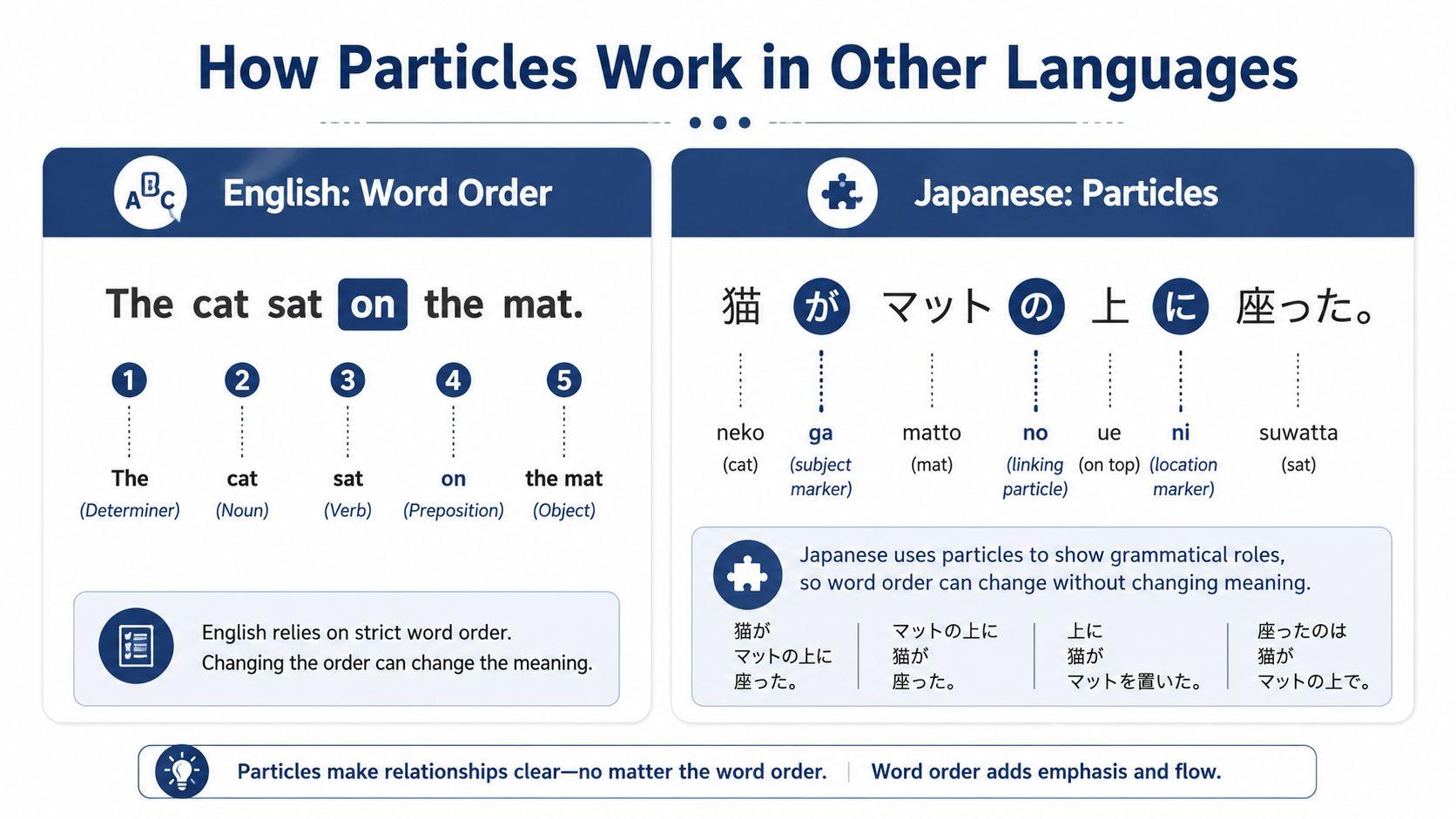
The English label particle doesn't describe one universal job. It names a broad type of small grammatical element, and different languages use such elements in different ways. English often relies heavily on word order, while Japanese uses particles to mark relationships between words.
English usually signals roles through position
Compare:
The dog chased the cat.
The cat chased the dog.
The nouns are the same, but their positions change their grammatical roles. The noun before the verb commonly functions as the subject, while the noun after the verb commonly functions as the object. English particles still matter, but they often mark a verb construction, polarity, or clause function rather than marking every noun's role.
English also uses prepositions to express relationships:
- The student went to the library.
- The student studied in the library.
The prepositions help identify destination and location, but the sentence still depends strongly on word order.
Japanese places particles after the marked word
Japanese particles commonly follow the word or phrase whose grammatical role they identify. Common examples include は, が, を, に, で, and へ. Educational explanations of Japanese particles and their grammatical roles emphasize that these markers can show topic, subject, object, destination, location, and other relationships.
The contrast between は and が is especially important:
- は marks the topic, the thing the sentence is about.
- が marks a grammatical subject, often bringing attention to the specific subject.
English can express related differences through word order, stress, context, or additional wording, but it doesn't use a direct equivalent of は or が in ordinary sentences.
The distinction between に and で provides another useful comparison:
- に can mark a destination, as in going to school.
- で can mark the place where an action happens, as in studying at the library.
This doesn't mean Japanese particles are interchangeable with English prepositions. Japanese particles can carry broader grammatical and pragmatic information, while English prepositions usually introduce phrases that relate one element to another.
The word “particle” is a category label, not a promise that every language uses particles in the same way.
That difference helps explain why an English learner studying Japanese may search for “particles” and find rules that seem unrelated to to, not, or pick up. The shared label points to small grammatical words, but the actual functions depend on the language.
Common Mistakes Students Make With Particles
Students usually struggle with particles because small words seem easy to ignore. Their short length doesn't make their grammatical effect small.
Leaving out a phrasal-verb particle
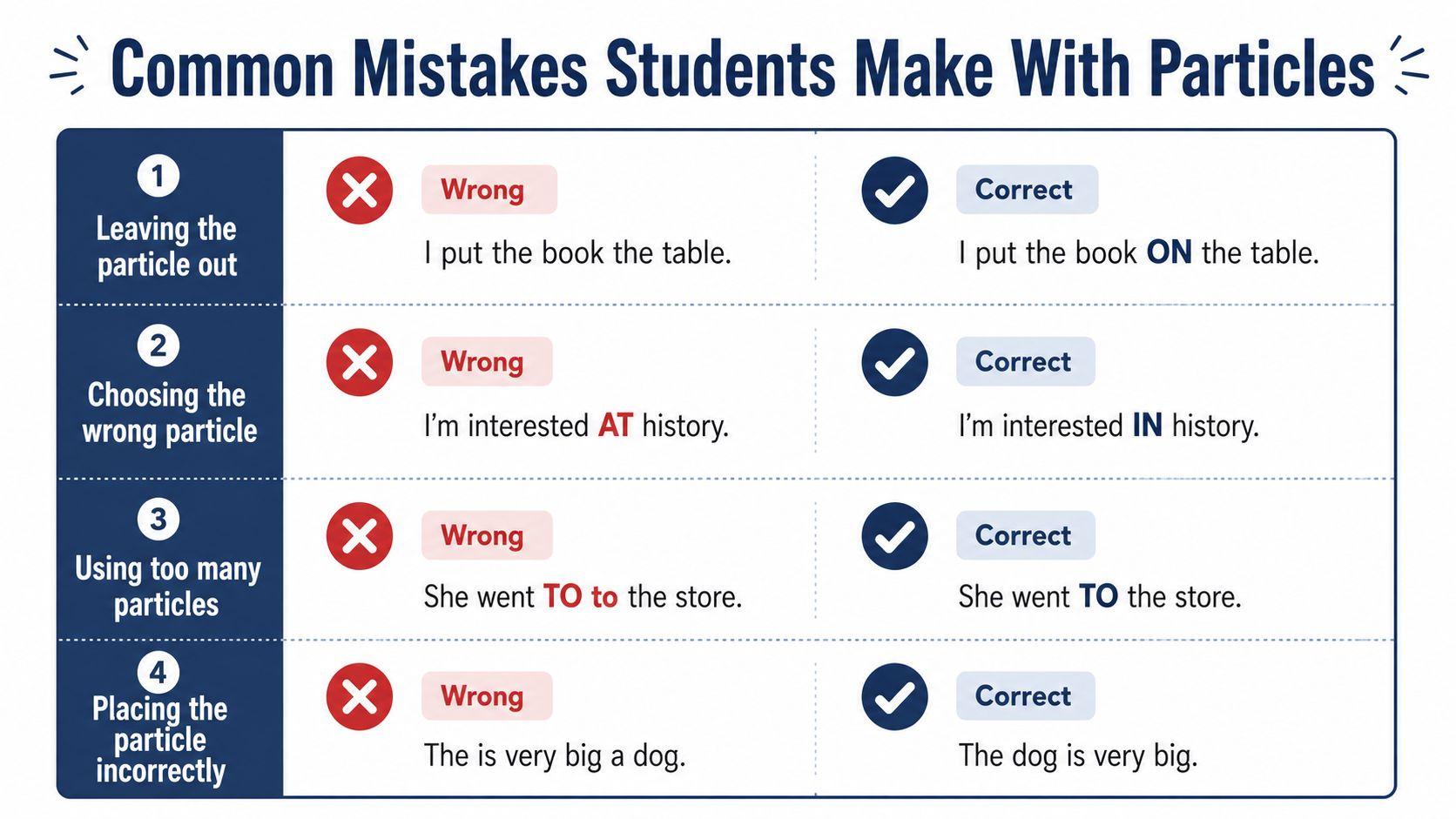
A learner may write:
I picked the book.
If the intended meaning is “lifted the book,” the clearer sentence is:
I picked up the book.
Rule of thumb: learn the verb and particle as a meaningful unit when the combination has a specialized meaning. The verb pick and the phrasal verb pick up aren't always interchangeable.
Choosing the wrong particle
Some combinations require a particular particle or preposition:
I'm interested at history.
I'm interested in history.
The second sentence uses the established construction. Learners often translate directly from their first language, but English combinations don't always match another language's pattern. A resource on how to fix grammar mistakes for TOEFL can help students review these recurring usage problems in a broader writing context.
Adding a duplicate word
The following sentence contains an unnecessary repetition:
She went to to the store.
She went to the store.
One to is a preposition introducing the destination. The other would be an infinitive marker, but no verb follows it, so the duplication has no grammatical role.
Misplacing a small word
A sentence such as this is not grammatical:
The is very big a dog.
The corrected version is:
The dog is very big.
The problem isn't specifically a particle, but it illustrates the same learning challenge. English depends on stable word order, so learners must check what each small word connects to rather than placing words according to meaning alone.
Discourse particles create another source of confusion. Words such as well and you know can signal hesitation, transition, shared knowledge, or speaker attitude. They may not change the basic facts of a sentence, but removing them can change its conversational force and register.
Practice Items and a Teacher Checklist
Try classifying the bold word in each sentence.
- They turned off the radio.
- The keys are on the desk.
- I want to read tonight.
- She did not answer.
- He put the coat away.
Show the answers
- Off is a phrasal-verb particle.
- On is a preposition because it introduces the desk.
- To is an infinitive particle.
- Not is a negative particle.
- Away is a phrasal-verb particle.
Teacher checklist
- Identify the host: Ask which verb, phrase, or clause the small word attaches to.
- Check movement: Test whether a phrase can move without destroying the relationship.
- Look for an object: A following noun phrase may indicate a preposition.
- Test the meaning: Remove the word and see whether the clause changes meaning or force.
- Check the construction: Distinguish infinitive to, negative not, and phrasal-verb particles.
Students can continue by checking part-of-speech labels in a reliable dictionary and comparing English examples with Japanese particle guides. For additional writing and study resources, browse the 1chat resource sitemap.
Use this checklist on your next grammar exercise. Circle every small word, identify what it attaches to, apply the movement test, and write one sentence explaining whether it functions as a particle, preposition, or adverb.