You've got an essay due tomorrow. Your notes are incomplete, your sources are open in several tabs, and an AI tool is waiting in another one. It could suggest an outline, explain a difficult idea, or produce paragraphs that sound polished enough to submit. The difficult question isn't just whether using AI is “cheating.” It's what kind of help preserves your learning, and what kind replaces it?
That question sits at the center of what is academic integrity. Academic integrity means doing academic work with integrity, acknowledging the ideas and words you use, following assessment rules, and taking responsibility for what you submit. It protects more than a grade. It helps teachers assess your actual understanding, helps students trust one another's achievements, and helps institutions issue qualifications that mean something.
Academic integrity has also developed into a system-level concern in higher education. UNESCO's International Institute for Educational Planning and the European Network for Academic Integrity have contributed to broader policy and coordination work across countries, showing that integrity is part of academic infrastructure rather than an optional set of reminders. For a clear introductory explanation, Access Courses Online explains academic integrity in accessible terms. Students using digital tools can also benefit from learning how to evaluate AI-assisted information, including the practical guidance available through 1chat's educational resources.
Introduction Beyond Just 'Don't Cheat'
Academic integrity isn't a dusty rulebook that only matters when an instructor suspects misconduct. It's the system that makes learning credible. If a submitted essay, laboratory result, or examination answer doesn't represent the student's own permitted work, the grade can no longer show what that student knows or can do.
That's why integrity applies to everyone involved. Students must make honest choices, teachers must explain expectations clearly, institutions must create fair policies, and families must support learning without taking over the work. Researchers, administrators, and professional teams carry the same responsibility when they report evidence or present conclusions.
Why the principle matters
A university qualification carries an implied promise: the holder completed meaningful assessment under stated conditions. That promise becomes weaker when copied work, unauthorized assistance, fabricated information, or undisclosed third-party writing becomes normal. Academic integrity protects the provenance of work, meaning other people can understand where an idea, claim, calculation, or piece of writing came from.
The issue is not new. Digital tools have made copying and assistance easier to access, but universities have long had to address dishonest collaboration, false records, purchased work, and improper attribution. The modern challenge is that assistance can now look like ordinary study support, especially when a tool can explain, translate, summarize, outline, or draft text in seconds.
A useful test: Can you explain what you submitted, how you produced it, and which assistance your course permits?
Pressure deserves attention, but it doesn't erase responsibility. A student who is confused about citation or overwhelmed by a deadline needs support, not humiliation. At the same time, submitting work created by someone else, or hiding prohibited assistance, prevents the assessment from measuring the intended learning.
Academic integrity therefore works best as a habit of transparent work. Keep track of sources, ask questions before using unfamiliar tools, preserve drafts, and treat uncertainty as a reason to seek guidance rather than guess.
The Five Pillars of Academic Integrity
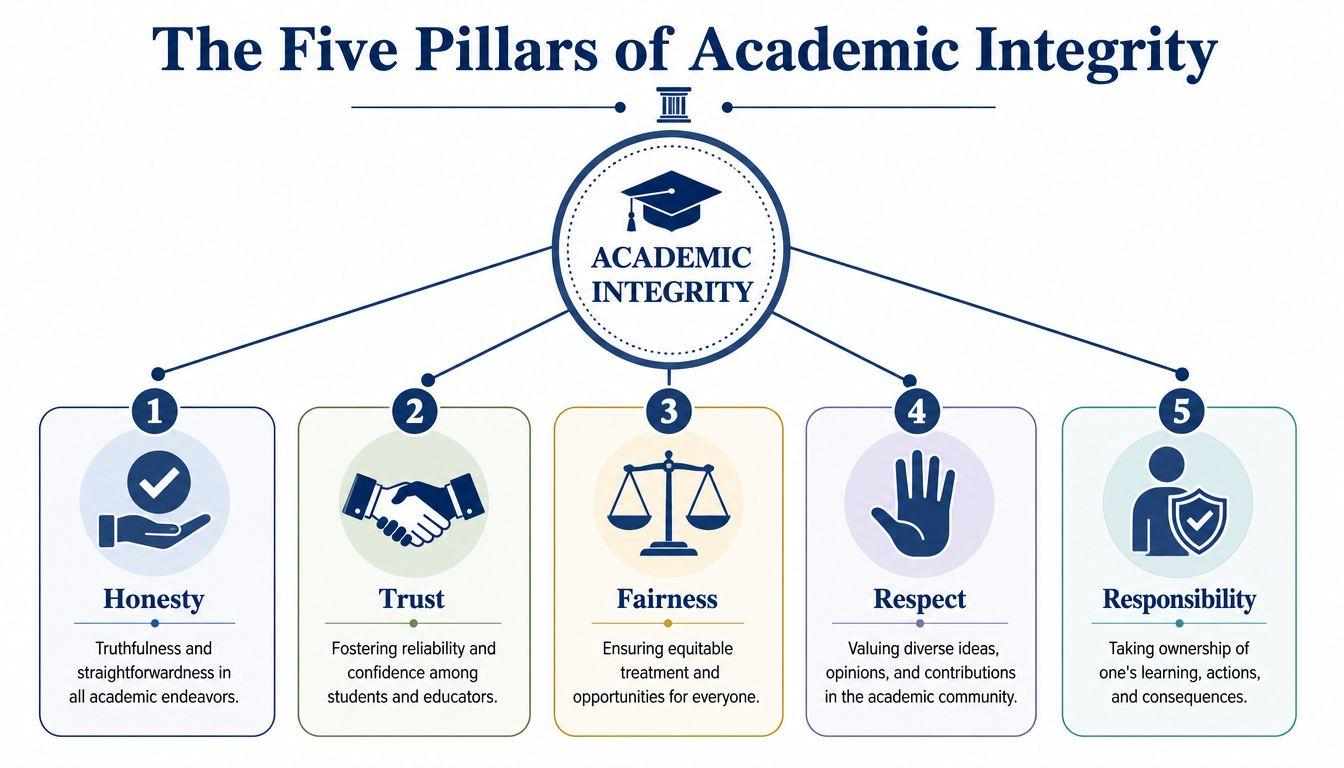
Academic integrity is often understood through five connected values: honesty, trust, fairness, respect, and responsibility. The values act like pillars supporting a building. If one is ignored, the academic environment becomes less reliable for everyone.
Honesty
Honesty means representing your work truthfully. In mathematics, that can mean showing the method rather than presenting an unexplained answer. In an essay, it means distinguishing your ideas from a source's ideas and acknowledging assistance that your course requires you to disclose.
Honesty also includes admitting uncertainty. If you didn't conduct an experiment, you can't present invented results. If a source doesn't support a claim, you shouldn't cite it as though it does.
Trust
Trust develops when students and educators can rely on academic work. A teacher needs to trust that an assignment reflects the student's understanding. Students need to trust that classmates aren't receiving an unfair advantage through unauthorized help.
Trust doesn't mean assuming everything is perfect. It means creating procedures and relationships in which people can check work, ask questions, and correct mistakes without concealing them.
Fairness
Fairness ensures that assessment conditions apply consistently. If one student uses prohibited notes during an examination while others follow the rules, the results no longer provide an equitable comparison.
Fairness also requires institutions to explain their expectations in language students can understand. A rule that says “use technology responsibly” may leave important questions unanswered. Students need to know whether translation software, grammar correction, generative AI, shared notes, or previous assignments are permitted.
Respect
Respect means valuing other people's contributions, identities, research, and intellectual effort. Citation is one practical expression of respect because it gives credit to the person whose words or ideas shaped your work.
Respect also affects collaboration. A group member shouldn't claim another student's contribution, and a student shouldn't share completed individual work in a way that enables unauthorized copying.
Responsibility
Responsibility connects the other pillars to action. You're responsible for reading the assignment instructions, protecting your account and files, checking sources, and making sure the final submission follows the rules.
The Australian higher education regulator defines academic integrity through these core values and connects them to traceable authorship and acknowledged source use. That traceability matters because assessment and credentialing depend on knowing whose work was evaluated and how it was produced.
Common Violations and How to Avoid Them
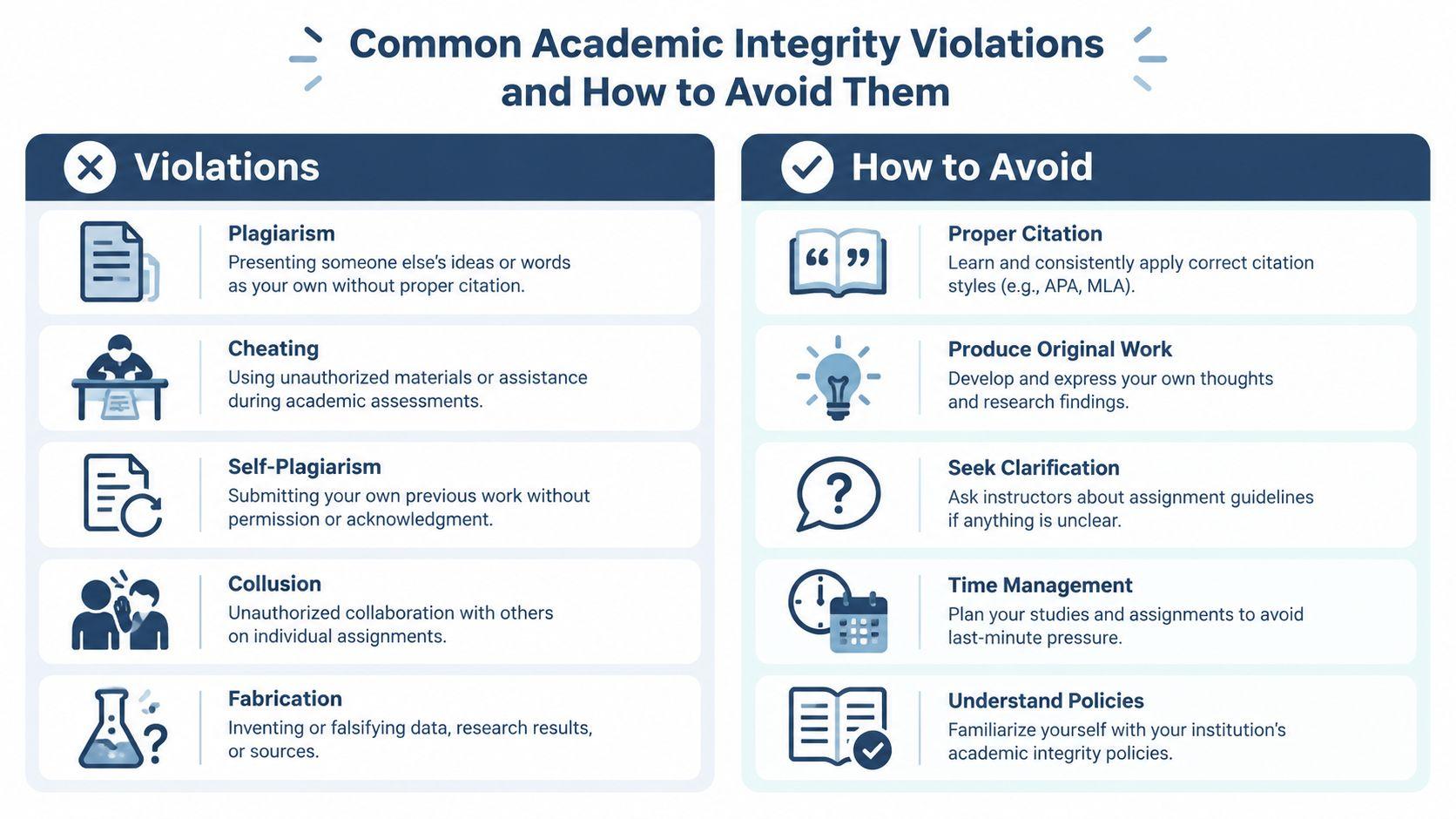
Most integrity problems begin with a practical decision that seems small. A student copies a sentence without recording its source, shares answers in a private message, reuses an old assignment, or fills a gap in research data because the expected result seems obvious. The consequence can be serious because each action distorts the evidence of learning.
Plagiarism and self-plagiarism
Plagiarism means presenting another person's words, structure, ideas, images, or findings as your own without appropriate acknowledgment. Copying a paragraph from a website without quotation marks and a citation is an obvious example. Close paraphrasing can also be plagiarism if the original source remains uncredited.
Self-plagiarism is different in ownership but similar in effect. If you submit a paper written for an earlier course without permission or disclosure, you're asking the teacher to award credit for work that wasn't produced for the current assessment.
Use a source log while researching. Record the author, title, publication details, page or section information, and the exact wording of copied notes. When you paraphrase, close the source and rewrite the idea in your own structure before checking that your meaning remains accurate. Students working with visual material can also review this art student copyright guidance for help thinking about ownership and permitted use.
Cheating and unauthorized assistance
Cheating includes using materials, devices, answers, or assistance that an assessment explicitly prohibits. The same principle applies online and in person. An open textbook may be legitimate during one test and forbidden during another, so the assessment instructions control.
Ask before the assessment begins if you're uncertain. During preparation, use practice questions, office hours, and permitted study groups rather than trying to obtain answers to the live task.
Collusion and contract cheating
Collusion occurs when students work together in a way an individual assignment doesn't allow. Discussing concepts may be acceptable, while exchanging finished answers may not be. Contract cheating is more severe because a third party produces work that the student submits as their own.
Write individual assignments independently after any permitted discussion. Don't upload completed work to public answer sites or send it to classmates if you know it could be submitted as theirs.
Fabrication and falsification
Fabrication means inventing data, sources, observations, or results. Falsification means altering genuine information to create a misleading impression. Both practices damage the record that other students, teachers, and researchers may rely on.
Keep original measurements, drafts, interview notes, and calculations. If results are incomplete or unexpected, report that accurately and ask your instructor how to proceed.
A large study associated with Donald McCabe and the International Center for Academic Integrity surveyed more than 63,700 U.S. undergraduates and 9,250 graduate students across 2002 to 2005. It reported that 68% of undergraduates admitted some form of cheating, while 36% admitted paraphrasing or copying a few sentences from an internet source without footnoting it, and 7% admitted turning in work done by another person, as documented by the International Center for Academic Integrity. These findings don't excuse misconduct. They show why prevention, clear instruction, and timely support matter.
Consequences and Institutional Policies
Academic misconduct can lead to outcomes ranging from a required rewrite or failing grade to suspension, expulsion, or a formal record, depending on the institution and the circumstances. A student may also lose trust with an instructor, struggle to explain their work, or face professional questions later if the qualification no longer reflects their abilities.
Institutions take these cases seriously because assessment results affect progression, scholarships, professional entry, and the reputation of the qualification itself. If students can obtain grades without demonstrating the required learning, honest students are disadvantaged and employers receive less reliable information.
Read the policy before you need it
Your institution's academic integrity policy should explain prohibited conduct, permitted collaboration, citation expectations, examination rules, reporting procedures, and possible outcomes. Course-level instructions may add restrictions, particularly for take-home tests, group projects, use of translation tools, and generative AI.
Look in the student handbook, learning platform, course outline, library guidance, or assessment brief. If two documents appear inconsistent, ask the instructor or academic integrity office for a written clarification. Keep that response with your assignment materials.
The pressures behind misconduct are often practical rather than purely moral. A 2025 student survey reported that the leading reasons students gave for peers violating integrity policies were pressure to get good grades, at 37%, and being pressed for time, at 27%. Those figures are reported in coverage of research integrity developments. Students still make the final choice, but institutions can reduce risk through realistic workloads, accessible support, clear instructions, and assessment designs that reward genuine thinking.
Before submitting: Check the policy, identify every outside contribution, confirm your citations, and ask about any tool or collaboration you're unsure about.
For digital services, users should also understand the rules governing permitted and prohibited activity. 1chat's usage policies offer an example of why tool users need to review platform expectations alongside their school's rules.
Academic Integrity in the Age of AI
Generative AI has created a gray zone because the same tool can support learning or replace the work being assessed. Asking an AI system to explain a difficult concept may help you study. Asking it to produce the final essay for submission may prevent your instructor from evaluating your writing and reasoning.
The tool itself doesn't determine integrity. Purpose, permission, disclosure, and the amount of intellectual work you contribute all matter. Your institution or instructor may permit some uses, restrict others, or require you to document your prompts and outputs.
A practical comparison
| Activity | Ethical Assistance, usually OK with permission or citation | Academic Misconduct, usually a violation |
| Brainstorming | Asking for possible research questions, then selecting and developing your own direction | Submitting AI-generated ideas or arguments without checking, adapting, or disclosing them where required |
| Outlining | Using a tool to organize your own notes into a possible structure | Asking the tool to create the full argument and treating it as your plan without meaningful evaluation |
| Explanation | Requesting a plain-language explanation of a difficult concept for study | Copying an explanation into assessed work without verification or attribution |
| Paraphrasing | Comparing an AI suggestion with the original source, then writing an accurate paraphrase yourself | Using automated paraphrasing to disguise copied material or avoid citing the source |
| Proofreading | Checking grammar or clarity when the course permits it | Allowing a tool to rewrite the submission so extensively that the final voice and reasoning aren't yours |
| Research | Generating search terms or questions to investigate through reliable sources | Citing invented references, unverified claims, or AI output as though it were authoritative research |
| Full drafting | Using your own draft for limited feedback where permitted | Submitting an AI-generated essay, answer, code, or reflection as your original work |
The policy always wins. Save your drafts, keep notes showing how your thinking developed, verify every factual claim, and disclose AI use in the format your instructor requests. Don't assume that grammar software, translation tools, or writing assistants are automatically exempt.
The policy gap is visible in recent UK reporting. Proven AI-related cheating cases rose from 1.6 per 1,000 students in 2022 to 2023 to 5.1 per 1,000 students in 2023 to 2024, while more than 27% of responding universities didn't track AI misuse as a separate category, according to The Guardian's reporting on AI-related university cheating. Institutions are still refining definitions while students are already making daily decisions about these tools.
If you're researching with AI, use a service's documentation and research features carefully, then verify results against primary sources and your course materials. A broader machine-readable content guide can also help educators and teams think about how structured information is interpreted by AI systems, although it doesn't replace academic citation rules. For research workflows, 1chat's research tools should likewise be treated as assistance, not as a substitute for source checking or your own judgment.
A Practical Guide for Everyone Involved
Academic integrity improves when each person knows what to do before a problem occurs. Students need workable study habits, parents need supportive boundaries, teachers need clear assessment design, and small teams need reliable attribution practices.

For students
Start early enough to leave room for questions. You don't need perfect confidence before beginning, but you do need a process that makes last-minute shortcuts less tempting.
- Map the assignment: Write down the task, format, deadline, permitted resources, collaboration rules, and AI requirements before researching.
- Separate notes from quotations: Mark copied wording clearly in your notes, add the source immediately, and label your own reactions separately.
- Keep a work trail: Save outlines, drafts, calculations, reading notes, and revision history so you can explain how the submission developed.
- Ask specific questions: Instead of asking whether AI is “allowed,” ask whether brainstorming, grammar review, translation, outlining, or feedback is permitted and how it must be disclosed.
- Check before submitting: Compare the final work with the rubric, confirm every borrowed idea is acknowledged, and remove claims you can't support.
If you're behind, contact the instructor, tutor, disability support service, or academic adviser. A difficult conversation before submission is safer and more educational than hiding a problem afterward.
For parents
Parents can support integrity without becoming the student's ghostwriter. The aim is to reduce panic while keeping ownership of the work with the learner.
- Ask about process: “What have you tried so far?” encourages reflection better than “What grade will you get?”
- Discuss assistance openly: Ask what tools the school permits and whether the student knows the disclosure rules.
- Help with planning: Offer a quiet workspace, calendar reminders, or transport to support services, rather than writing or editing the assignment yourself.
- Treat mistakes as teachable: If a student admits copying or misusing a tool, help them contact the appropriate educator and understand the repair process.
For teachers
Clear rules prevent avoidable confusion. Put expectations in the assignment brief, not only in a general handbook, and give examples of acceptable and unacceptable assistance.
- Define tool boundaries: State whether students may use AI for ideas, explanations, language correction, translation, coding, or drafting.
- Assess thinking: Use drafts, annotated sources, reflections, oral explanations, process notes, or staged submissions where appropriate.
- Make collaboration visible: Explain which activities are group learning and which work must be individual.
- Respond proportionately: Investigate context and evidence rather than treating an automated detection result as conclusive proof.
- Teach citation directly: Show students how to record sources, paraphrase accurately, and acknowledge tools.
Good assessment design doesn't remove responsibility from students. It gives them fewer reasons to misunderstand the rules and more opportunities to demonstrate genuine learning.
For small teams
The same principles apply to workplace reports, marketing copy, proposals, and internal analysis. A team can produce original work while using digital assistance, but members should know which material came from a client, a colleague, a public source, or an AI system.
- Track ownership: Record who created, reviewed, and approved each major section.
- Verify evidence: Check claims, references, quotations, and summaries against the underlying documents.
- Disclose assistance internally: Note where tools helped with brainstorming, editing, translation, or analysis.
- Protect confidential information: Don't paste private client, employee, or student data into a tool unless the organization has approved that use.
- Review before release: A human owner should confirm that the final document is accurate, original, and suitable for its audience.
Conclusion Building a Culture of Integrity
Academic integrity means more than avoiding plagiarism. It means acting with honesty, trust, fairness, respect, and responsibility, while keeping authorship and source use traceable. Those principles still apply when the assistance comes from a classmate, a website, a proofreading tool, or generative AI.
Students face real pressure, and institutions must respond with clear policies, fair assessment, and practical support. Yet students, families, teachers, and teams all have a role in protecting meaningful work.
Don't wait for an allegation to decide what responsible tool use looks like. Read your policy, ask precise questions, keep your drafts, verify your sources, and disclose assistance when required. Choose tools that support your thinking rather than replace it, including the privacy-first, family-friendly and team-oriented AI workspace offered by 1chat.
Start your next assignment with a written plan for permitted assistance, a source record, and a clear boundary around what you must produce yourself. That small decision turns academic integrity from a rule you fear into a standard you can carry confidently into further study and professional life.