So, can you actually send an email that’s completely anonymous? It’s a question that feels like it should have a simple "yes" or "no" answer. The reality, however, is a bit more complicated. While you absolutely can send an email without your name attached, achieving true, untraceable anonymity is a whole different ballgame.
Think of your standard email account, whether it's Gmail or Outlook, as a digital postcard. Anyone who handles it can see not just the message, but also who sent it and where it came from. It's designed for convenience, not for secrecy.
The Reality of Sending an Anonymous Email
Every time you send an email from a mainstream provider, you're leaving behind a trail of digital fingerprints. These aren't in the body of your email, but in the hidden information that travels with it, known as metadata.
This metadata paints a surprisingly detailed picture. It includes your IP address (which can pinpoint your general location), the kind of device and browser you're using, and precise timestamps for your activity. For a giant like Gmail, with over 1.8 billion active accounts, logging this data is fundamental to how its services work and integrate.
Why Your Standard Email Isn't Private
The simple truth is that privacy isn't the main selling point for these free email services. Their business models often depend on collecting user data for advertising, feature improvements, and creating a seamless (and trackable) experience across all their products. Anonymity just doesn't fit into that equation.
Here’s another way to look at it: Sending a normal email is like shipping a package and writing your full name, home address, and the exact time you dropped it at the post office right on the box. An anonymous email, done correctly, is the equivalent of leaving an unmarked box at a neutral drop point, with no way to connect it back to you.
The goal of anonymous communication isn't just to hide your name. It's about severing the link between the message and its origin, making it nearly impossible to connect the digital "who" and "where" to the real-world you.
To give you a better sense of the differences, here’s a quick breakdown:
Anonymous vs. Standard Email: A Quick Comparison
This table lays out the fundamental differences you'll find when comparing a standard email service with the anonymous methods we'll be covering. It highlights the privacy you gain by taking a few extra steps.
| Feature | Standard Email (e.g., Gmail, Outlook) | Anonymous Email (Using Recommended Methods) |
| Personal Information Required | Often requires a name, phone number, and recovery email for signup. | Minimal to no personal information needed. |
| IP Address Logging | Your IP address is recorded and often included in email headers. | Your real IP address is hidden or masked. |
| Tracking & Metadata | Collects extensive metadata (device, location, timestamps). | Designed to minimize or eliminate metadata collection. |
| Encryption | Basic encryption in transit, but the provider can often access emails. | End-to-end encryption is standard, meaning only you and the recipient can read it. |
| Link to Real-World Identity | High. Easily linked to you through account details and usage patterns. | Low to none. The connection to your real identity is deliberately broken. |
Ultimately, choosing an anonymous method is a deliberate trade-off. You might sacrifice some of the convenient integrations of a service like Gmail, but what you gain is control over your digital footprint.
The Scale of Digital Exposure
This lack of built-in privacy is happening on an unbelievable scale. Projections show that by 2026, the world will have over 4.73 billion email users, firing off a mind-boggling 376.4 billion emails every single day.
With a single provider like Gmail handling a massive 72.1% of all email reception, you can see how your "private" messages become part of a vast, logged, and analyzed data ecosystem. You can explore the full scope of email usage statistics to get a sense of just how big this digital world is.
So, the question isn't just "can you send an email anonymously?" but "how do you erase the trail that standard services create by default?" That’s exactly what the rest of this guide will walk you through, step by step.
Understanding Your Email's Digital Footprint
Every time you hit "send" on an email, you’re leaving a trail. It's a digital breadcrumb path, and it can often lead right back to you. Before we can even talk about sending an email anonymously, we have to pull back the curtain on what a standard email gives away.
Think of it like sending a package. You have the contents inside—your message—but the shipping label and all the tracking stickers on the outside tell a detailed story of where it came from and every stop it made along the way. Your email has the exact same thing, a sort of digital shipping label called the email header.
What Your Email Header Actually Reveals
You don't normally see the header. Email clients like Gmail or Outlook keep it tucked away to give you a clean, simple interface. The problem is, this hidden block of code is where your personal information lives. It’s the digital equivalent of footprints in the sand.
Here are a few key pieces of data that your email header almost always contains:
- Your IP Address: This is the big one. Your IP address is a unique number that points to your internet connection, which can be used to pinpoint your internet provider and a surprisingly accurate geographical area.
- Mail Server Path: The header records every single server your email hops through on its journey. This creates a step-by-step digital map from your device to the recipient's inbox.
- Email Client & Browser Info: Details about the software you used, like Outlook, Apple Mail, or even your web browser version, can also be embedded in the header.
This data trail makes it incredibly easy for someone to connect an email directly to its source. A regular email isn't just a message; it's a message with a full travel itinerary attached.
The Postcard Problem
If a normal email is like a postcard that anyone can read, the header is the collection of postmarks and routing stamps plastered all over it. It tells a detailed story of the message's origin and the exact path it took.
Anonymity isn't just about hiding your name. It’s about sending a message with no return address, no postmarks, and no tracking history. The whole point is to make the email’s origin impossible to trace.
This infographic does a great job of showing the difference between a typical email's data trail and the path of a truly anonymous one.
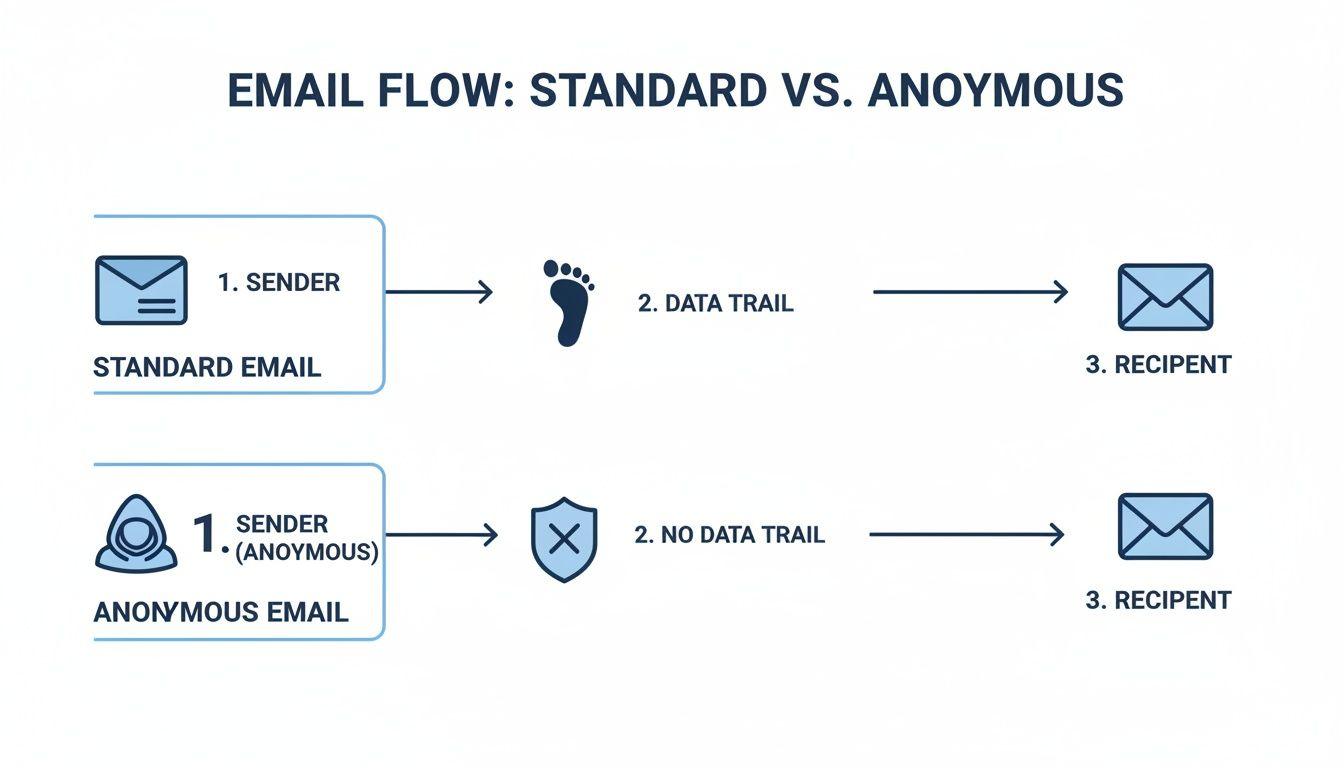
As you can see, the anonymous email is designed to break that chain of data, while the standard email leaves a clear, identifiable path right back to the sender.
Getting a handle on this digital footprint is the most important first step. Once you know what information is being shared, you start to see why mainstream services like Gmail and Outlook just aren't built for true privacy. This is the foundation you need before exploring the methods that actually work.
If you’re curious about protecting yourself beyond just email, our guide on how to protect your privacy online offers a broader look at digital security. With this knowledge, you can start choosing tools that truly erase those digital footprints and put you back in control of your information.
Proven Methods for Sending Anonymous Emails
Alright, now that we've pulled back the curtain on how easily standard emails can be traced, let's get to the practical solutions. How do you actually send an email without leaving a trail of digital breadcrumbs?
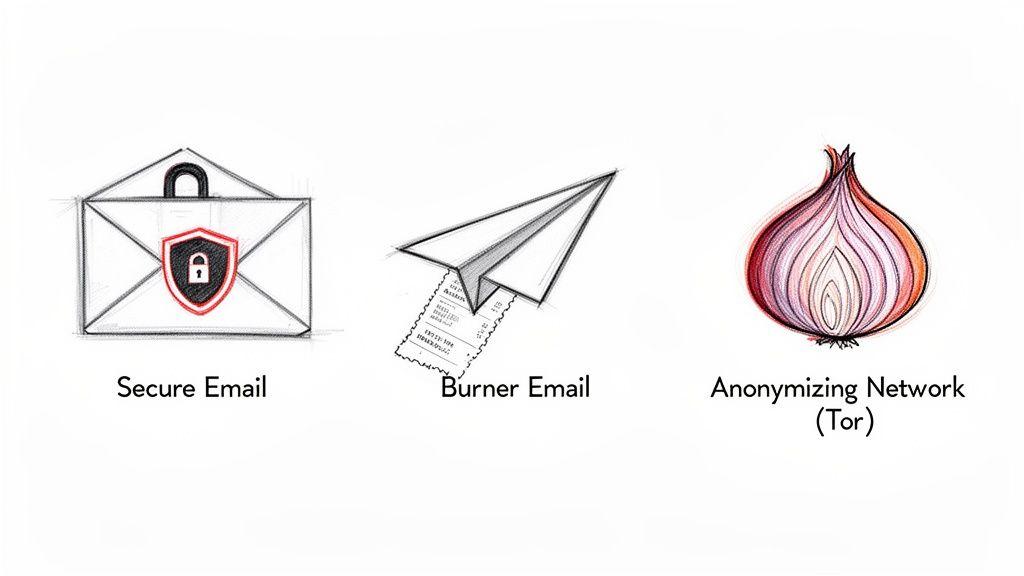
It's all about picking the right tool for the job. There isn't a one-size-fits-all answer here. Instead, you have a few different strategies, each offering its own balance of privacy and convenience. We’ll walk through three solid approaches, covering everything from protecting a sensitive source to simply keeping spam out of your main inbox.
Method 1: Secure Email Providers
Think of a secure email provider as a digital armored car for your messages. Unlike your standard email, which is more like sending a postcard that anyone can read along the way, these services are built from the ground up with privacy as their number one mission. They use heavy-duty encryption and other privacy tricks to shield both your identity and the content of your messages.
Providers like ProtonMail and Tutanota are champions of end-to-end encryption (E2EE). This is a crucial concept. It means your email is scrambled into unreadable code on your device and can only be unscrambled by the person you send it to. The provider themselves can't peek at your messages, even if they were forced to try.
The true magic of end-to-end encryption is that it makes your message completely useless to anyone but the recipient. If someone intercepts it, all they get is a jumble of garbled text without the specific key to unlock it.
What’s more, these services often let you sign up with minimal—or even zero—personal information. Many are also based in countries with robust privacy laws, like Switzerland and Germany, giving you an extra layer of legal protection. As part of their privacy focus, they automatically strip identifying data, like your IP address, from the email’s technical headers.
Best For:
- Journalists and Whistleblowers: When protecting a source’s identity is non-negotiable, E2EE is the only way to guarantee your conversations stay private.
- Small Businesses: You can securely discuss sensitive client projects, financials, or strategy without worrying about corporate espionage. Keeping this data locked down is vital for client trust. For more on this, check out our guide on encrypted document sharing.
- Privacy-Minded Individuals: If you’re just tired of advertisers and data miners snooping on your personal life, these services are perfect for your day-to-day communications.
Method 2: Burner Email Services
A burner email is the digital version of a prepaid, no-contract cell phone. It's a temporary, throwaway address you can spin up in seconds without handing over any personal details. You use it for a single purpose and then, you "burn" it.
Services like Temp-Mail or Guerrilla Mail are perfect for those one-off situations where you need to receive something—like a download link or an account confirmation—but have no desire for a lasting relationship. The inbox is typically temporary and self-destructs after a short time, often anywhere from 10 minutes to a few hours.
The main goal here is to shield your real email address from the inevitable flood of spam, data breaches, and marketing trackers. Every time you sign up for a newsletter, a "free" trial, or a coffee shop's Wi-Fi, you're rolling the dice with your primary email. A burner acts as a simple, effective firewall.
How Burner Services Work
It couldn't be simpler. You just visit the site, and it instantly gives you a temporary email address. Use that address for whatever you need, check the inbox for the email you're waiting for, and then just walk away. The account will disappear on its own, taking any associated junk with it.
Method 3: Anonymizing Networks Like Tor
For the highest possible level of anonymity, you'll need to use an anonymizing network. The most famous of these is Tor (The Onion Router). If secure email is an armored car, using Tor is like sending your message through a global, labyrinthine network of secret couriers who don't know each other.
Tor works by bouncing your internet traffic through a worldwide network of volunteer-run servers, called relays. It wraps your data in multiple layers of encryption (like an onion) and sends it on a random, zig-zagging path. Each relay only knows the server that came before it and the one that comes next. No single point in this chain can see both where the data came from and where it's going.
When you access an email service through the Tor Browser, you completely hide your real IP address. To the email provider, it will look like you're connecting from the final "exit node" in the Tor circuit, which could be in a totally different country. This makes tracing the email back to your physical location incredibly difficult.
Pros and Cons of Using Tor for Email
| Pros | Cons |
| Maximum Anonymity: The best IP address masking you can get. | Slower Speeds: All that bouncing around really slows down your connection. |
| Bypasses Censorship: Unlocks services that might be blocked in your country. | More Complicated: It’s not as simple as just opening a website. |
| Breaks the Data Trail: It severs the link between who you are and what you do online. | Can Get You Blocked: Some websites automatically block traffic from known Tor exit nodes. |
Combining Tor with a secure email provider is the gold standard for true anonymity. However, because of its slowness and complexity, it's probably overkill for just avoiding spam. It's a specialized tool for high-stakes situations where being found is not an option.
How to Choose the Right Anonymous Email Service
With so many privacy-focused tools popping up, picking the right anonymous email service can feel a bit like navigating a minefield. It's not just about a cool name or a sleek interface; the devil is in the details, and those details are what will actually keep you safe. Think of it less like picking an app and more like choosing a vault for your most sensitive information—you need to be sure it’s built to withstand pressure.
To make a smart choice, you have to look past the flashy marketing and dig into the core features that really matter. When I vet a service, I always focus on three non-negotiable criteria: its legal jurisdiction, the type of encryption it uses, and its data logging policy.
Examine the Provider's Legal Jurisdiction
Where an email provider is legally based has a massive impact on your privacy. It's like choosing which country to build your fortress in. Some nations have strong legal walls that protect individual privacy, while others have built-in backdoors for government surveillance.
Services based in countries like Switzerland or Germany, for instance, operate under some of the world's strongest data privacy laws. These legal shields make it incredibly difficult for authorities to demand user data without going through a strict, transparent court process.
On the flip side, providers headquartered in countries within intelligence-sharing pacts (like the Five Eyes alliance of the US, UK, Canada, Australia, and New Zealand) can be subject to far-reaching surveillance laws. A provider's home country ultimately dictates who can come knocking and what they are legally forced to hand over.
Understand the Encryption Type
Not all encryption is created equal. For any service that claims to offer true anonymity, the absolute gold standard is end-to-end encryption (E2EE). This method scrambles your message the moment you hit send and ensures only the intended recipient’s device can unscramble it.
With E2EE, not even the email provider can read your messages. If a court ordered them to hand over your communications, all they could produce is a bunch of unreadable, scrambled code. This is fundamentally different from services that only encrypt data "in transit," where the provider holds the keys and can access your content at will.
Without E2EE, you're simply trusting the company not to peek at your data. With E2EE, you don't have to trust them—they technically can't.
Scrutinize the Logging Policy
A provider’s logging policy is their official promise about what information they do and don't record about you. What you're looking for is a genuine "no-logs" policy. This means the service doesn't keep records of your IP address, connection times, or any other metadata that could potentially trace an email back to you.
Watch out for vague wording. Some services might claim "no content logging" but quietly track metadata, which can be just as revealing as the message itself. The best providers are completely transparent about what, if anything, they store. Paying a few dollars for a service is often a great investment, as it means their business model is to protect you, not to sell your data. Of course, solid password security is just as crucial; you can learn more by reading our guide on how password managers work.
To give you a head start, we've put together a comparison of some of the top secure email providers you should be looking at for 2026.
Comparing Top Secure Email Providers for 2026
Choosing between top-tier services often comes down to specific needs. The table below breaks down the key differences between leading providers to help you decide which one is the right fit for you.
| Provider | Jurisdiction | Encryption Type | Logging Policy | Best For |
| ProtonMail | Switzerland | End-to-End Encryption (E2EE) | Strict No-Logs (IP addresses are not logged) | Journalists, activists, and anyone needing maximum legal and technical protection. |
| Tutanota | Germany | End-to-End Encryption (E2EE) | Strict No-Logs (IP addresses are stripped) | Privacy-conscious individuals and businesses who value a strong legal framework. |
| StartMail | Netherlands | PGP Encryption (user-side option) | Minimal logging for operations (can be limited) | Users who want robust encryption features with the ability to create unlimited aliases. |
Ultimately, each of these providers offers a significant upgrade in privacy over standard email services. By weighing their jurisdiction, encryption, and logging policies, you can confidently pick the one that best aligns with your personal security goals.
Navigating the Legal and Ethical Lines of Anonymity
When people first start looking into anonymous email, one of the first questions they ask is, "Wait, is this even legal?"
The short answer is yes. In most places around the world, there's absolutely nothing illegal about the act of sending an email without tying it to your real identity. But the legality isn't about the tool itself; it's all about what you do with it. Your intent and the content of your message are what really matter.
Think of it this way: anonymity is a shield, not a sword. The law draws a very clear line based entirely on your actions.
The Right Side of the Law
Legitimate uses for anonymous communication are crucial for a free and open society. It offers a vital layer of protection for people in vulnerable situations, giving them the confidence to speak up without fearing retaliation.
These aren't just hypotheticals—they happen every day:
- Whistleblowing: An employee can report corporate fraud or dangerous work environments without putting their job or their family’s safety on the line.
- Investigative Journalism: A reporter can securely exchange information with a source, protecting them from powerful people or organizations who want to keep things quiet.
- Personal Safety: Someone can escape online stalking, harassment, or even domestic abuse by hiding their digital footprint and location.
- Political Dissent: Activists living under repressive governments can organize and share information without risking imprisonment or worse.
In every one of these scenarios, anonymity is a tool for justice and protection. It's about safety, not harm.
Anonymity empowers the vulnerable by leveling the playing field. It gives a voice to those who would otherwise be silenced, ensuring that truth can emerge even in high-stakes situations.
Crossing the Ethical and Legal Boundary
The conversation takes a sharp turn the moment anonymity is used to hurt someone. The technology might be the same, but the intent flips from protection to aggression. And that's exactly where you step over the line into illegal territory.
Using an anonymous email for things like sending threats, committing fraud, blackmail, or distributing malicious content isn't just unethical—it's a crime. Law enforcement agencies have ways to track these activities, and the legal shield of anonymity disappears when it's used to break the law. Once your message becomes a weapon, you lose any ethical high ground.
The constant flow of digital data makes these privacy tools more essential than ever. Email is woven into the fabric of our lives—a staggering 99% of us check it daily, with some checking it as often as 20 times. This constant engagement makes our inboxes a treasure trove for data trackers.
In fact, research shows that nearly 75 million Americans have unknowingly allowed advertisers to track them just by sharing their email address, a practice that 38% of people find deeply invasive. As you can see from these recent email usage findings, our reliance on email makes us prime targets.
Ultimately, sending an email anonymously is about more than just technology. It’s a question of responsible digital citizenship. Use these tools to protect yourself and others, but never, ever to cause harm.
Frequently Asked Questions About Anonymous Email
Even when you've chosen a method, you're bound to have some questions. Sending an email anonymously is a topic filled with myths and a few valid concerns. Let's clear the air and tackle the most common questions I hear.
Getting these answers straight will help you separate fact from fiction, so you can use these privacy strategies the right way.
Can Police Trace an Anonymous Email
This is the big one, and the answer is complicated. While services like secure email providers and the Tor network make tracing incredibly difficult, they don't make it impossible—especially when a serious crime is on the table.
If someone uses an anonymous email for illegal activities, like making credible threats or committing fraud, law enforcement can absolutely launch an investigation. It’s not easy for them. The process usually requires court orders to force a service provider to hand over any data they might have.
True anonymity is a technical challenge, but legal actions can create pathways for investigation. Even if a service has a "no-logs" policy, legal cooperation, combined with other digital forensics, can sometimes reveal a user's identity, especially if the user makes mistakes.
For instance, if you access your secure email account from your home Wi-Fi just once without a VPN, you’ve created a digital breadcrumb linking that account to your IP address. While it takes a determined effort, "untraceable" is a very high bar to clear once legal authorities are involved.
Is Using a VPN Enough to Stay Anonymous
A Virtual Private Network (VPN) is a fantastic privacy tool, but it's not a silver bullet for email anonymity. A VPN works by encrypting your connection and routing it through a different server, which hides your real IP address. That’s its main job.
But if you use that VPN to log into your normal Gmail account, you've only hidden your location. Google still knows it's you because you're logged in. The email itself is still tied to your name, and its headers will point right back to Google's servers.
Think of it this way: using a VPN alone is like wearing a very convincing disguise to go to the post office. The clerk won't recognize your face, but you're still mailing a letter with your real return address on it. For genuine anonymity, you have to combine a VPN with an anonymous email method, like a secure provider or a burner account.
Are Burner Emails Completely Untraceable
Burner or temporary email services are great for quick, disposable messages, but they aren't built for high-stakes, untraceable anonymity. Their main job is to shield your real inbox from spam, not to hide your identity from a determined adversary.
Here’s where they fall short:
- Server Logs: The services themselves might keep logs, including the IP address you used to create the account. Without a VPN, that’s a direct link back to you.
- No Encryption: Most burner services don't offer end-to-end encryption. This means the provider can often see the content of your messages.
- Website Tracking: The websites for these burner services can use cookies and other trackers, just like any other site you visit.
Burners are perfect for low-risk tasks, like signing up for a newsletter or grabbing a one-time discount code. For anything that requires real privacy and security, they simply aren't the right tool for the job. They’re a tool for convenience, not for bulletproof anonymity.