The first sentence of your essay, your hook, is a powerful tool. It’s the moment you convince your reader, whether a teacher, professor, or admissions officer, that your words are worth their time. A weak opening risks your entire message being overlooked, while a strong one grabs attention, builds credibility, and frames your argument for maximum impact. Getting this right is a fundamental skill for students at all levels, from high school to college and beyond.
This guide is designed to give you a strategic advantage by providing a deep dive into good hook examples for essays. We will move past simple definitions and offer a curated collection of eight powerful hook types you can immediately apply to your writing. You won't just see examples; you'll understand the mechanics behind them.
Inside, you will find a detailed breakdown for each hook category, including:
- High-quality examples with clear analysis.
- Adaptable templates and variations for different essay types.
- Specific guidance on when to use each hook for the best effect.
- Common mistakes to avoid that weaken your introduction.
- Quick editing tips to make your opening sentences stronger.
Our goal is to equip you with the insights and practical tools needed to craft introductions that are not just good, but unforgettable. By understanding these strategies, you'll ensure your essays begin with the confidence and authority they deserve, making your reader eager to see what you have to say next.
1. The Startling Statistic Hook
Opening an essay with a surprising or powerful statistic is a classic technique for a reason: it works. This method immediately establishes your credibility by grounding your argument in concrete data. It grabs the reader's attention with a quantifiable fact, making them curious to understand the story behind the numbers. This approach is one of the most effective and good hook examples for essays, particularly for argumentative, research-based, or persuasive papers.
A startling statistic hook works by presenting a data point that is unexpected, counterintuitive, or emotionally resonant. The key is to choose a statistic that directly supports your thesis and creates a sense of urgency or importance around your topic.
Strategic Breakdown
Let's analyze how this hook functions with a few examples:
- For a Business Essay: "A staggering 92% of consumers trust peer recommendations over all other forms of advertising."
- Why it works: This number immediately invalidates traditional advertising as the top-tier method, forcing the reader to reconsider marketing strategies. It perfectly sets up an essay on the power of influencer marketing or user-generated content.
- For a Psychology Paper: "According to the American Psychological Association, chronic loneliness can be as damaging to one's health as smoking 15 cigarettes a day."
- Why it works: The comparison to a well-known health risk (smoking) makes an abstract concept (loneliness) tangible and alarming. This creates an immediate emotional connection and establishes the seriousness of the topic.
Key Insight: The best statistic hooks don't just present a number; they create a narrative. They frame a problem, highlight a surprising trend, or challenge a common assumption, compelling the reader to seek the explanation your essay will provide.
How to Write Your Own
- Find Relevant Data: Use academic databases or a reliable AI assistant to find statistics related to your topic. For instance, using a tool like 1chat, you could ask, "Find a surprising statistic about the impact of remote work on employee productivity."
- Verify and Cite: Always double-check the source of your statistic. Note the source and the year, as you will need to cite it properly. An outdated statistic can weaken your credibility.
- Frame for Impact: Don't just drop the number. Introduce it with context. For example, instead of "50% of people...", try "While most believe otherwise, a recent study revealed that a full 50% of people..."
- Connect to Your Thesis: Your next sentence must bridge the gap between the statistic and your main argument. Explain why this number matters and how it leads to the point you are about to make.
This hook is exceptionally strong for essays that rely on evidence and logic. For a deeper exploration of how to integrate hooks into your writing, you can find more guidance on how a hook in an essay functions to capture reader interest. By starting with a verified, impactful fact, you position yourself as an authority and give your reader a compelling reason to keep reading.
2. The Provocative Question Hook
Starting your essay with a thought-provoking question is a powerful strategy to engage your reader directly. This method invites them into the conversation, prompting them to consider their own stance on your topic before you present your argument. It creates an immediate sense of curiosity and personal relevance, making it one of the most effective and good hook examples for essays, especially for persuasive, argumentative, or reflective papers.
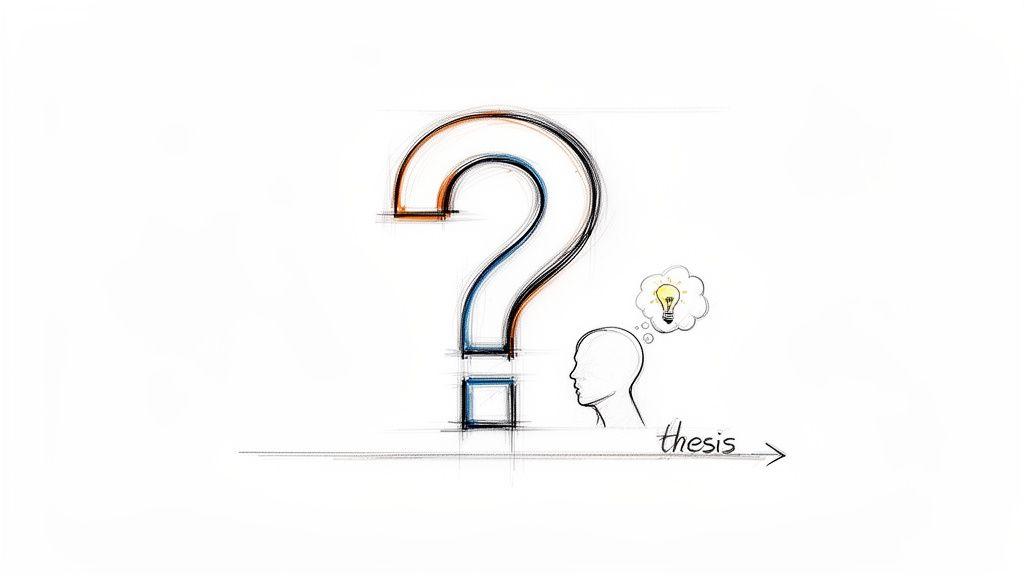
A provocative question hook works because it shifts the reader from a passive audience member to an active participant. The best questions are not easily answered with a simple "yes" or "no"; instead, they open up a complex issue that your essay promises to explore and ultimately answer.
Strategic Breakdown
Let's analyze how this hook functions with a few examples:
- For a Business Essay: "What if you could eliminate five hours of administrative work from your team's weekly schedule?"
- Why it works: This question speaks directly to a common pain point in business: wasted time. It presents a desirable outcome, making the reader eager to learn the solution your essay will propose, likely about a new software or efficiency strategy.
- For a Student's Persuasive Paper: "How many hours per week do you spend on repetitive homework tasks that could be streamlined?"
- Why it works: This targets the student audience directly by referencing a shared experience. It makes the abstract idea of "efficiency" personal and immediate, setting the stage for an argument about study techniques or educational tools.
Key Insight: A strong question hook does more than just ask something; it frames a problem in a way that makes your thesis feel like the necessary solution. It creates an intellectual itch that only the rest of your essay can scratch.
How to Write Your Own
- Identify Your Core Argument: What is the central problem your essay is solving or the main point it is making? Your question should lead directly to this core idea.
- Draft Several Questions: Brainstorm different ways to phrase your question. Try open-ended questions (starting with "What if," "How," or "Why") that encourage deeper thought.
- Refine for Specificity: Avoid overly broad questions like "Is technology good?" Instead, be specific: "Would you feel more comfortable with an AI tool designed with your family's privacy in mind?" This is more targeted and engaging.
- Bridge to Your Thesis: The sentence following your question must connect it to your main point. Hint at the answer or introduce the perspective your essay will take.
This hook is ideal for essays that aim to persuade, challenge assumptions, or explore complex social issues. To see more ways to craft compelling openings, you can find other good intros for essays with examples that build on these principles. By posing a question that matters to your reader, you ensure they are invested in finding your answer from the very first line.
3. The Relatable Anecdote or Story Hook
Beginning with a brief, personal story creates an immediate human connection, drawing the reader into a real-world scenario before you introduce your core argument. This technique makes abstract ideas feel concrete and relatable. It is one of the most powerful good hook examples for essays because it builds empathy and trust, making it highly effective for persuasive essays, personal narratives, and even business communications.
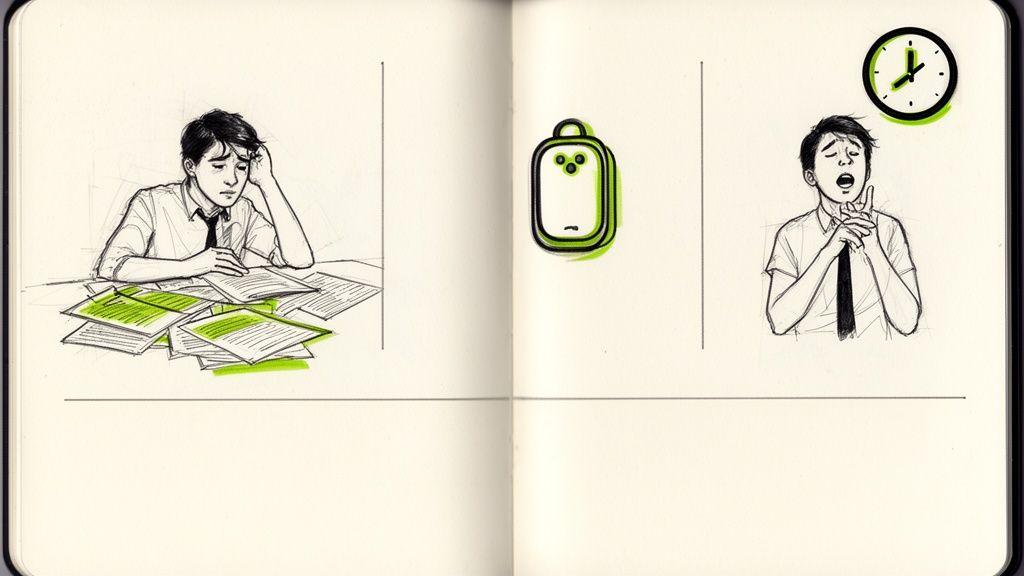
A relatable anecdote hook works by presenting a miniature story that mirrors a problem or situation your audience understands. The key is to select a specific, vivid scenario that directly illustrates the central theme of your essay, making the reader feel seen and understood.
Strategic Breakdown
Let's analyze how this hook functions with a few examples:
- For a Student Essay: "When Marcus discovered a family-friendly AI tool, his research paper writing time dropped from 8 hours to 3 hours."
- Why it works: This story is hyper-specific and outcome-oriented. It doesn't just mention a problem (long study hours); it presents a clear, desirable solution that any student can appreciate. It sets the stage for an essay on effective study tools.
- For a Business Essay: "Last month, Sarah spent two hours scheduling team meetings manually. With AI tools, that task now takes 10 minutes."
- Why it works: The anecdote quantifies a common workplace inefficiency and its solution. It speaks directly to professionals looking for productivity gains, making the subsequent argument about AI in business immediately relevant and compelling.
Key Insight: A successful anecdote isn't just a story; it's a strategic entry point. It frames your essay's topic as the solution to a tangible, human problem, giving the reader a personal stake in what you have to say next.
How to Write Your Own
- Identify a Core Problem: Think about the central issue your essay addresses. Who experiences this problem? Create a short, fictional (or real) scenario around that person.
- Keep it Brief and Focused: Your anecdote should be no more than two or three sentences. Get straight to the point: present the character, their problem, and the hint of a solution.
- Use Vivid Details: Instead of "a student was stressed," use a name like "Marcus" and specific numbers like "8 hours to 3 hours." Specifics make the story more believable and memorable.
- Bridge to Your Thesis: After the anecdote, smoothly transition to your main point. For example: "Marcus's story is not unique. Across the country, students are discovering how new technologies can..."
This hook is ideal for essays aiming to connect on an emotional level before diving into facts and figures. For more guidance on building a strong opening, see these tips on how to write an introduction to a research paper. By starting with a story, you transform a dry topic into a compelling human experience.
4. The Bold Statement or Claim Hook
Launching your essay with a bold statement or a provocative claim is a powerful way to command attention. This hook immediately establishes a strong authorial voice and challenges the reader to engage with a confident, and perhaps controversial, perspective. It signals that the essay will not merely explore a topic but will argue a definite point of view, making it one of the most effective and good hook examples for essays, especially for persuasive and argumentative writing.
A bold statement hook works by presenting an assertion that is debatable, forward-thinking, or contrary to popular belief. The goal is to make the reader stop and think, "Can they really prove that?" This immediate intellectual challenge creates an incentive for them to continue reading to see how you defend your position.
Strategic Breakdown
Let's analyze how this hook functions with a few examples:
- For a Business Essay: "Traditional task management is dead- AI-powered collaboration is the only way modern teams can remain competitive."
- Why it works: The word "dead" is definitive and grabs attention. It dismisses a universally accepted practice and presents a single, high-stakes solution, forcing the reader to confront the future of work and consider the argument that follows.
- For an Education Paper: "Privacy-first AI tools do not just support learning; they represent the only ethical future for educational technology."
- Why it works: This claim elevates the conversation from utility to morality. By framing the issue around ethics and declaring a specific approach as the "only" future, it creates a sense of urgency and importance, setting the stage for a compelling argument.
Key Insight: The power of a bold claim lies in its confidence. It’s not just an opinion; it's a declaration. This hook promises a well-supported, decisive argument, inviting the reader to see if you can live up to the promise you made in the first sentence.
How to Write Your Own
- Identify Your Core Argument: What is the single most important, debatable point of your thesis? Distill it into one clear, forceful sentence.
- Raise the Stakes: Use strong, active verbs and confident language. Instead of "I think remote work is better," try "The office-centric work model is an obsolete relic that actively harms employee well-being and productivity."
- Ensure it's Defensible: A bold claim is not an unsubstantiated opinion. Make sure your statement is specific enough to be interesting but broad enough that you can support it with evidence and reasoning throughout your entire essay.
- Follow Up Immediately: Your next sentence must begin to unpack the claim. Bridge the bold statement to your thesis by providing context or a hint of the evidence you will present.
This hook is ideal for essays where you want to take a firm stance from the outset. By starting with a confident assertion, you position yourself as a thought leader and challenge your reader to engage with your ideas critically from the very first word.
5. The Definition or Redefinition Hook
Opening by defining or, more powerfully, redefining a key term is an intellectually engaging way to begin an essay. This technique immediately positions you as a thoughtful writer who is not content with surface-level interpretations. By challenging a common understanding or offering a more nuanced perspective, you invite the reader to think critically from the very first sentence. This method is one of the most compelling good hook examples for essays, especially for analytical, philosophical, or argumentative papers where clarity of terms is central to the entire argument.
A redefinition hook works by taking a familiar word or concept and peeling back its conventional layers to reveal a deeper, more specific meaning relevant to your thesis. It signals to the reader that your essay will explore familiar territory through a new and more insightful lens.
Strategic Breakdown
Let's analyze how this hook functions with a few examples:
- For a Business Essay: "When we talk about 'productivity tools,' we're not discussing software that works harder; we're discussing tools that eliminate unnecessary work entirely."
- Why it works: This hook immediately shifts the focus from effort (working harder) to efficiency (eliminating work). It sets up an argument for minimalist workflows, automation, or strategic software adoption over simply adding more apps.
- For an Education Paper: "True collaborative learning isn't about working in groups; it's about leveraging diverse perspectives to achieve individual growth."
- Why it works: The redefinition moves beyond the simple action (group work) to the underlying purpose (individual growth through diversity). This creates a perfect foundation for an essay analyzing effective pedagogical strategies versus performative classroom activities.
Key Insight: A strong definition hook doesn't come from a dictionary. It comes from your unique argument. By redefining a term, you are essentially providing a miniature thesis statement, giving the reader a clear preview of the critical perspective your essay will defend.
How to Write Your Own
- Isolate a Key Term: Identify the most important concept in your essay prompt or thesis. This might be a word like "success," "justice," "innovation," or "community."
- Challenge the Common View: Think about how most people understand this term. Then, formulate a definition that challenges or refines that common understanding in a way that serves your argument.
- Frame Your Redefinition: Present the conventional definition first, then introduce your new take. Use phrases like "While many see X as..., a more accurate view is Y" or "We often think of X in terms of..., but its true meaning lies in..."
- Connect to Your Thesis: Your following sentence must explicitly link this new definition to the main point of your essay. Show the reader why this specific understanding of the term is essential for the argument that will follow.
This hook is ideal for essays that aim to deconstruct ideas and build new arguments. By starting with a thoughtful redefinition, you establish intellectual authority and promise a reader an essay that is both focused and original.
6. The Surprising Contradiction or Paradox Hook
Presenting a surprising contradiction or an unexpected paradox is a sophisticated way to begin an essay. This method immediately creates intellectual tension by presenting two seemingly opposing ideas that both appear to be true. It challenges the reader's assumptions and makes them curious to understand how the contradiction can be resolved, a resolution your essay promises to deliver. This is one of the most intellectually engaging and good hook examples for essays, especially for argumentative, analytical, or philosophical topics.
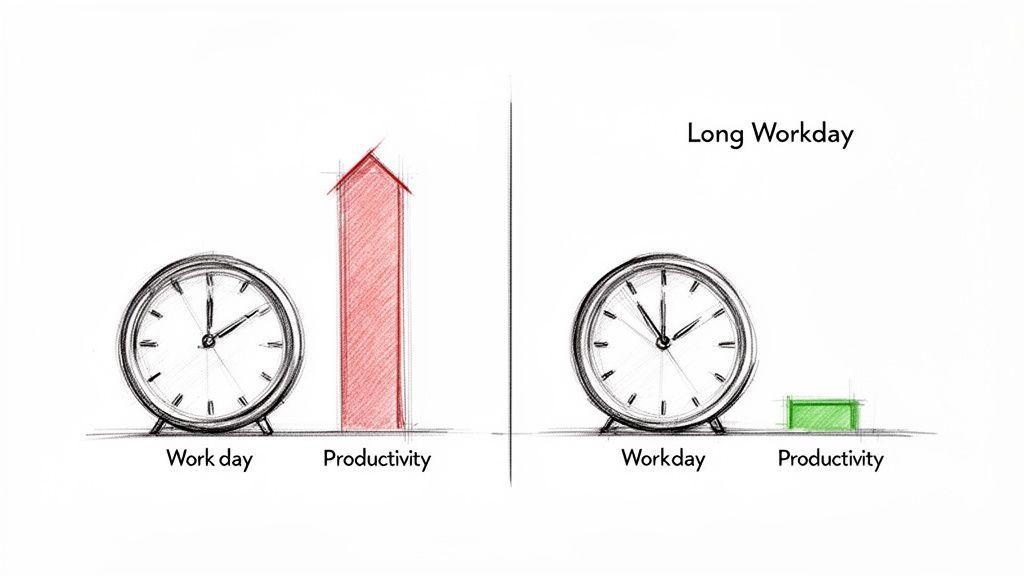
A paradoxical hook works because it disrupts a reader's mental equilibrium. The human brain seeks patterns and logic, so when faced with a statement that defies common sense, it instinctively wants to find the underlying explanation. The key is to present a genuine paradox that is central to your thesis, not a manufactured or trivial one.
Strategic Breakdown
Let's analyze how this hook functions with a few examples:
- For a Business Essay: "The most productive teams often work fewer hours than their competitors-and it's not because they're lazy."
- Why it works: This directly confronts the "more hours equals more output" work culture. It creates immediate intrigue, prompting the reader to question their own beliefs about productivity and setting the stage for an essay on efficient work strategies, deep work, or the importance of rest.
- For a Student-Focused Paper: "Students who use AI tools for research often produce better work, yet many educators view these tools with suspicion."
- Why it works: This hook frames a current, relevant debate. It acknowledges the valid concerns of educators while simultaneously presenting a counterintuitive benefit, creating a nuanced starting point for a discussion on academic integrity and the role of technology in modern learning.
Key Insight: A paradox hook is an invitation to a deeper conversation. It signals to the reader that your essay will not offer a simple, one-sided argument but will instead explore a complex issue with nuance and critical thinking.
How to Write Your Own
- Identify a Core Tension: Think about your topic. What common beliefs does your argument challenge? Where do counterintuitive truths exist? Look for a central conflict.
- State the Paradox Clearly: Phrase the contradiction in a single, concise sentence or two. Use words like "yet," "but," "despite," or "while" to create the contrast. For instance, "While we seek more connection through social media, studies show it often leaves us feeling more isolated."
- Hint at the 'Why': Your hook should present the problem, not the solution. Imply that an explanation exists, which your essay will explore. This creates a forward momentum that pulls the reader into your first paragraph.
- Transition to Your Thesis: The sentence following your hook must begin to unravel the paradox and connect it directly to your main argument. For example: "This strange reality exists because..." This bridge is critical for maintaining reader engagement.
7. The Vivid Sensory Description or Scene Hook
Opening an essay by painting a picture with words can be incredibly powerful. This hook drops the reader directly into a scene, using descriptive language to appeal to their senses and emotions. By creating a mental image or a specific atmosphere, you can make your topic feel immediate and relatable. This technique is one of the most compelling and good hook examples for essays, especially for narrative, descriptive, or persuasive pieces where establishing a mood is key to your argument.
A scene-based hook works by making an abstract concept tangible. Instead of telling the reader what to feel, you show them a situation that evokes the desired emotion or intellectual curiosity, pulling them into the world of your essay from the very first sentence.
Strategic Breakdown
Let's analyze how this hook functions with a few examples:
- For a Business Essay on AI Efficiency: "Picture your team member staring at their screen at 6 PM, still wrestling with manual data entry that could have been completed in minutes with AI."
- Why it works: This creates a relatable image of workplace frustration and inefficiency. The reader immediately understands the problem (wasted time, employee burnout) on a personal level, making them receptive to a solution.
- For an Argumentative Essay on Teen Online Safety: "Watch your teenager confidently navigate an AI tool designed with their privacy and safety as the primary concern, not an afterthought."
- Why it works: This scene addresses a common parental fear (online dangers) and contrasts it with a positive, secure alternative. It creates a sense of relief and hope, setting the stage for an essay arguing for family-oriented technology.
Key Insight: A vivid description isn't just decoration; it's a strategic entry point. It frames the central problem or solution of your essay in human terms, making your argument feel not just logical but necessary. The goal is to make the reader feel something first, so they are primed to think about your ideas.
How to Write Your Own
- Isolate a Core Moment: Think of a single, impactful moment that encapsulates your essay's main idea. What does your topic look or feel like in action?
- Focus on Sensory Details: Use specific words that appeal to sight, sound, touch, or emotion. Instead of "a tired worker," describe their "slumped shoulders" and the "blue glow of the monitor" on their face.
- Keep It Brief but Potent: A good scene hook is a snapshot, not a short story. Aim for two to four sentences to set the scene without losing momentum.
- Transition to Your Thesis: After the scene, create a clear bridge to your main point. For example: "This scenario is all too common, but it doesn't have to be the norm. The implementation of a new generation of AI tools is set to redefine productivity..."
This hook is perfect for essays that need to connect with the reader on an emotional level before diving into facts and analysis. By starting with a carefully crafted scene, you draw the reader in, making them a participant in your narrative and giving them a powerful reason to care about your argument.
8. The Reference to Current Events or Trending Topic Hook
Opening your essay by connecting it to a recent news story, viral moment, or timely event taps into conversations your audience is already having. This method immediately establishes your essay's relevance and urgency, showing that your topic has real-world importance. Tying your argument to current affairs is an excellent strategy and one of the best good hook examples for essays, especially for persuasive, sociological, or political science papers where demonstrating contemporary awareness is key.
A current events hook works by creating an immediate bridge between a well-known public issue and your specific thesis. The key is to select an event that is widely recognized and directly relates to the core argument of your essay, making your topic feel immediate and significant.
Strategic Breakdown
Let's analyze how this hook functions with a few examples:
- For a Business Essay: "As companies worldwide grapple with the AI revolution, smart leaders are choosing tools that enhance their team's work while protecting privacy."
- Why it works: This hook references the broad, ongoing "AI revolution," a topic on every business leader's mind. It immediately frames the essay as a practical guide for navigating a current, high-stakes challenge, promising a solution.
- For an Education Paper: "The growing debate about AI in education often misses the real point: students need trusted tools, not banned ones."
- Why it works: This opening taps directly into a contentious and timely debate happening in schools and universities globally. It takes a clear stance and promises to offer a more nuanced perspective than the standard "for or against" arguments, drawing the reader in.
Key Insight: The most effective current event hooks do more than just name-drop a recent headline. They use the event as a launchpad to introduce a specific angle or a deeper, less-obvious problem that your essay will explore and solve.
How to Write Your Own
- Identify a Relevant Event: Brainstorm recent news stories, social media trends, or cultural shifts related to your essay topic. Think about what people are actively discussing online or in the media.
- Provide Brief Context: Don't assume your reader knows every detail. In one sentence, summarize the core of the event to ensure everyone is on the same page. For example, "Following the recent data privacy scandals that dominated headlines..."
- Frame for Relevance: State the event, then immediately pivot to its significance for your argument. Use transitional phrases like, "This event highlights a deeper issue..." or "What this trend reveals is..."
- Connect Directly to Your Thesis: Your follow-up sentence must explicitly link the current event to your main argument. Explain why this news story makes your thesis particularly important to consider right now.
This hook is exceptionally powerful for essays aiming to be persuasive and relevant. By grounding your argument in the present moment, you show your reader that your ideas are not just academic but essential for understanding the world today.
Comparison of 8 Effective Essay Hooks
| Hook | Implementation complexity 🔄 | Resource requirements ⚡ | Effectiveness ⭐ | Expected outcomes 📊 | Ideal use cases | Key advantages / tip 💡 |
| The Startling Statistic Hook | Moderate — needs accurate sourcing | Moderate — data access and verification tools | High ⭐ — builds credibility quickly | Establishes authority; smooth lead-in to thesis | Research essays, business reports, academic audiences | Verify stats (use 1chat), include source/year |
| The Provocative Question Hook | Low–Moderate — craft precise, relevant question | Low — brainstorming and audience testing | Medium–High ⭐ — drives curiosity | Engages readers mentally; sets up argument | Persuasive essays, opinion pieces, student work | Ask specific, non-obvious questions; answer them later |
| The Relatable Anecdote or Story Hook | Low–Moderate — requires concise storytelling | Low — personal examples or collected scenarios | High ⭐ — strong emotional engagement | Creates human connection; improves recall | Personal narratives, persuasive pieces, business comms | Keep brief and relevant; polish with 1chat |
| The Bold Statement or Claim Hook | Moderate — must be defensible under scrutiny | Moderate — evidence to support assertive claim | High ⭐ — clarifies stance immediately | Sets argumentative tone; provokes debate | Argumentative essays, position papers, opinion pieces | Avoid absolutes; ensure strong supporting evidence |
| The Definition or Redefinition Hook | Moderate–High — demands nuance and clarity | Moderate — reference to authoritative sources | Medium–High ⭐ — shows intellectual depth | Frames discussion; prevents misinterpretation | Analytical and academic essays, complex topics | Offer conventional + unique framing; use 1chat comparisons |
| The Surprising Contradiction or Paradox Hook | High — careful balancing to avoid confusion | Moderate–High — research multiple perspectives | High ⭐ — signals sophistication and nuance | Promotes critical thinking; memorable tension | Analytical, argumentative, multi-perspective pieces | Ensure genuine contradiction; plan clear resolution |
| The Vivid Sensory Description or Scene Hook | Moderate — needs strong descriptive skill | Low — creativity and careful wording | High ⭐ — immersive and memorable | Establishes mood; fosters emotional investment | Narrative, descriptive, some persuasive writing | Be vivid but concise; avoid overwriting; test with 1chat |
| The Reference to Current Events or Trending Topic Hook | Moderate — timing and contextual accuracy required | Moderate — up-to-date research and sources | Medium–High ⭐ — leverages existing interest | Adds urgency and relevance; increases credibility | Opinion pieces, persuasive/business writing | Choose durable events; provide brief context and update as needed |
From Good to Great: Turning Your Hook into a Powerful Opening
You have now explored a comprehensive toolkit filled with good hook examples for essays, from the data-driven precision of a startling statistic to the emotional pull of a personal anecdote. We’ve moved beyond simply listing types; we have dissected why they work and provided a strategic blueprint for you to build your own compelling introductions. The journey from a blank page to a finished essay begins with a single, powerful moment: the hook. Mastering this initial step is not just about grabbing attention; it’s about setting a promise for the intellectual journey ahead.
Think of each hook type we covered as a different key for a different lock. A bold statement might be perfect for a persuasive essay where you need to establish authority immediately. Conversely, a vivid scene-setting description could be the ideal entry point for a narrative or descriptive piece, inviting the reader to experience the world you are creating. The power lies in the selection. Your choice signals your intent, tone, and the very nature of the argument or story you are about to present.
Synthesizing Strategy: The Core Takeaways
To truly elevate your writing, remember these foundational principles drawn from the examples we analyzed:
- Context is King: The best hook is never chosen in a vacuum. It must align perfectly with your essay's type (argumentative, expository, narrative), your specific thesis statement, and the expectations of your audience, whether it's a professor, a college admissions officer, or a curious reader.
- Revision is a Requirement, Not an Option: Your first attempt at a hook is rarely your best. Great hooks are sculpted. Draft it, read it aloud, and ask: Does this sound intriguing? Is it directly relevant to my main point? The process of refining your hook sharpens your understanding of your own thesis.
- Authenticity Builds Trust: Whether you’re telling a story, presenting a statistic, or asking a question, your voice must feel genuine. Forced cleverness or an overly dramatic claim can backfire, making your reader skeptical from the start. A hook that feels true to you and your topic will always be more effective.
Actionable Next Steps: Putting Knowledge into Practice
Information is only useful when applied. Here’s how you can start using these strategies today to see immediate improvement in your writing:
- The "Three-Hook" Challenge: For your next essay, don't settle on the first hook you write. Instead, challenge yourself to draft three different types of hooks. Try a statistical hook, an anecdotal one, and a paradoxical one. This exercise forces you to think about your topic from multiple angles and often reveals the most potent entry point.
- Create a Hook "Swipe File": As you read articles, books, or even well-written marketing copy, start collecting powerful opening lines. Don't just copy them; jot down a note about why they worked on you. This personal collection of good hook examples for essays will become an invaluable source of inspiration when you're feeling stuck.
- Peer-Test Your Openings: Before you commit to a hook, read it to a friend, a family member, or a classmate without any context. Their immediate reaction is pure gold. Do their eyes light up with curiosity? Do they ask a follow-up question? Or do they just look confused? This instant feedback is the quickest way to know if your hook is landing its punch.
Ultimately, a great opening line does more than just prevent the reader from putting your essay down. It establishes your credibility, frames your entire argument, and generates the momentum needed to carry your reader all the way to your conclusion. It is the single most important sentence in your entire essay because it determines whether the rest of your sentences will even be read. By moving beyond generic templates and applying the deeper strategic analysis we've discussed, you are no longer just looking for a good hook. You are learning to craft an unforgettable opening. Start strong, be bold, and make that first sentence count.