You’re often not starting with a blank page. You’re starting with a reason.
A student needs to write about a historical figure without turning the paper into a lifeless timeline. A family wants to preserve a grandparent’s story before details fade. A business owner needs a founder bio that sounds credible, not inflated. The task looks simple until you sit down and realize biography is one of the hardest forms to get right. It asks for research, judgment, structure, and restraint at the same time.
That’s why many biography drafts fail in predictable ways. They either become a fact dump, or they become so polished that the person disappears under the prose. To write a biography well, you need both accuracy and shape. You need to know what happened, why it mattered, and what belongs on the page versus what belongs in your notes.
Laying the Foundation for Your Biography
A founder needs a website bio by Friday. A student has one week to profile a historical figure. A family finally decides to record a grandparent’s life after years of saying they should. In each case, the writing problem looks similar at first, but the project itself is different.
Good biography work starts before research notes pile up. It starts with definition. If you do not set the job clearly, you collect too much, miss what matters, and end up writing in the wrong voice for the wrong reader.
Define the assignment before you define the person
Writers often start with traits. Inspiring. Resilient. Successful. Private. Those labels feel useful, but they do not give you a workable biography brief.
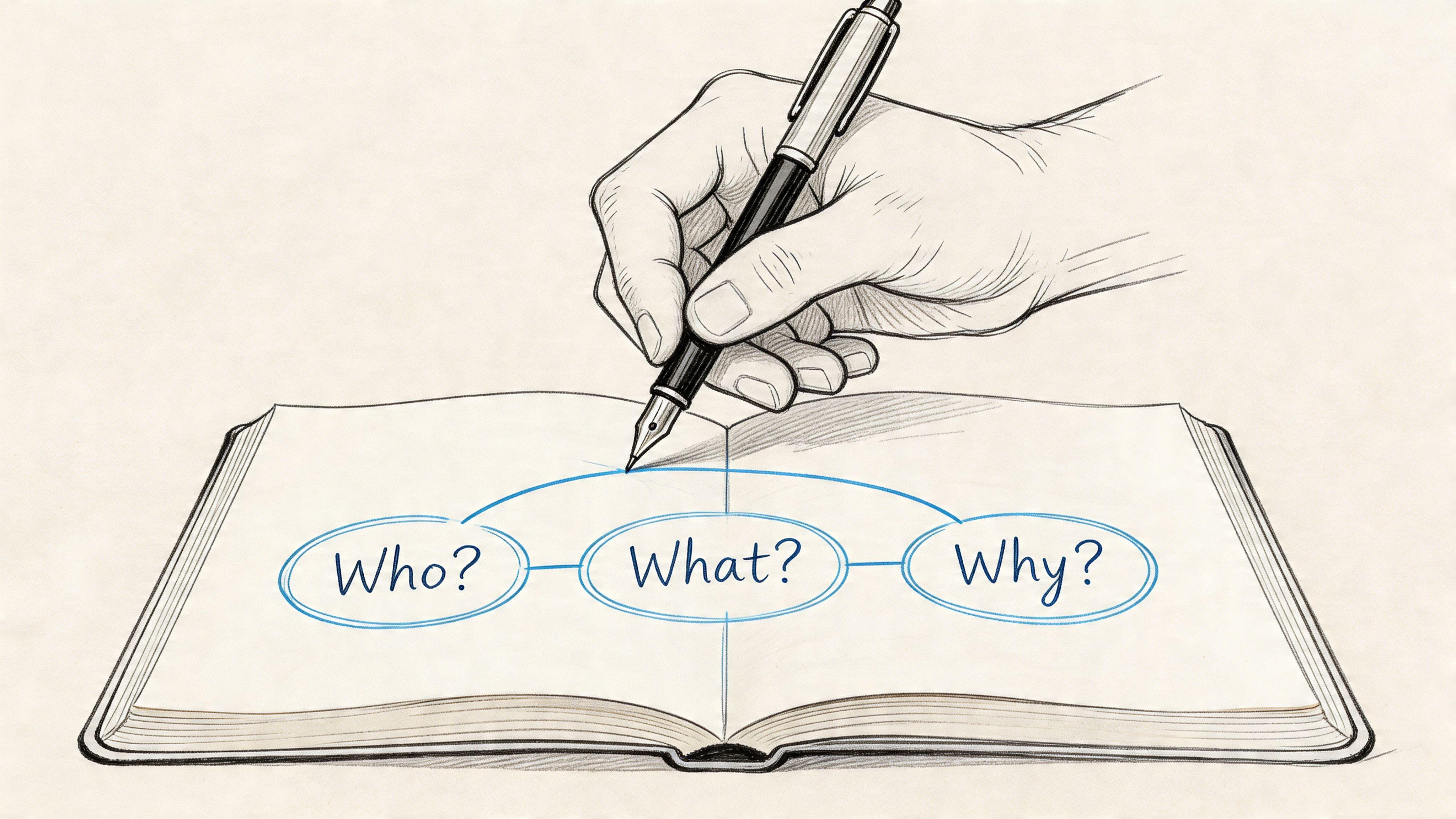
Start with three written decisions:
- Who will read this
- What should they understand or feel by the end
- What form fits the material you have
That third question saves time. A polished professional bio, a family life story, and a book-length biography all describe a person, but they demand different evidence, different structure, and different restraint. I have seen strong raw material fail because the writer chose a larger format than the source base could support. I have also seen rich lives flattened into short bios that left out the very tension that made the subject memorable.
Here is the practical difference.
| Attribute | Professional Bio | Personal/Family Bio | Historical/Long-Form Bio |
| Primary goal | Establish credibility and relevance | Preserve memory and character | Interpret a life in context |
| Typical audience | Clients, employers, partners, press | Relatives, future generations, community | General readers, students, researchers |
| Tone | Clear, polished, selective | Warm, reflective, intimate | Analytical, narrative, evidence-based |
| Scope | Career highlights and defining background | Life story, values, family history, voice | Full arc of a life with historical setting |
| Best source material | Resume, interviews, speeches, public profiles | Interviews, photos, letters, family records | Archives, letters, diaries, interviews, published scholarship |
| Biggest risk | Sounding generic or self-promotional | Becoming sentimental but vague | Becoming exhaustive but dull |
AI can help at this stage if you use it as a planning assistant, not a substitute for judgment. In 1chat, for example, you can paste a few notes and ask for three possible biography angles, a likely audience for each, and the trade-offs in scope. That helps students narrow a paper topic, helps families organize interviews, and helps businesses avoid bios that read like marketing copy.
Choose a subject angle with tension
A biography needs motion. Achievement alone rarely provides it.
Readable lives usually contain one or more of these pressures:
- A turning point: migration, illness, a public failure, a late-career reinvention
- A contradiction: authority in public, uncertainty in private
- A recurring pattern: habits or decisions that shaped relationships, work, or reputation
- A wider frame: the life helps explain a community, company, era, or social change
Many early drafts falter here. The writer admires the subject and starts defending them on the page. Biography works better when it asks a live question and follows the evidence objectively. Why did this person change course? What did they sacrifice to gain status? How did family history shape public choices?
A useful test is simple: can you state the story problem in one sentence?
Set ethical boundaries early
If the subject is living, get clear on permission, access, and review expectations before you start collecting sensitive material. That does not mean handing over editorial control. It means deciding, in advance, what the subject may verify for factual accuracy, what remains off the record, and how you will handle private records, contested memories, or reputational risk.
This matters for family projects as much as formal biographies. One sibling may remember an event one way, another may remember it differently, and both may feel protective of the subject. A business bio has its own version of the same problem. Founders often want a story that sounds confident, while legal or communications teams want every claim supportable. You need a process that respects both truth and audience.
Formal biographical research methods reflect that discipline. The AERA overview of biographical research describes several forms of biographical work grounded in evidence such as interviews, letters, and life histories. If you are unsure whether a source is strong enough to support a claim, use this quick guide to what makes a source scholarly before you build your outline around it.
Build a planning filter you can actually use
Before drafting, run the project through four checks.
- Audience fit: Can you name the reader clearly?
- Scope control: Do you know which years, themes, or milestones belong in the story?
- Source reality: Do you already have enough material, or a realistic way to get it?
- Ethical clarity: Have you set rules for privacy, sensitive facts, and disputed accounts?
If one of those answers is vague, pause there.
That pause is not wasted time. It is where strong biographies separate from rushed ones. Clear foundations give you better interviews, sharper research questions, and a draft that sounds intentional rather than assembled.
The Art of Biographical Research
A biography usually starts to wobble long before the draft does. It happens in the research stage, when dates come from one file, anecdotes from another, and nobody has checked whether the polished family story matches the record.
Good biography research is disciplined collection followed by careful judgment. The goal is not to gather everything. The goal is to gather the right material, track where it came from, and know which details can carry narrative weight.
Gather primary and secondary sources on purpose
Writers new to biography often start with summaries because they are easy to find and easy to quote. That saves time at first, but it usually produces a generic draft. The same facts appear in the same order, with none of the friction, texture, or contradiction that makes a life feel lived.
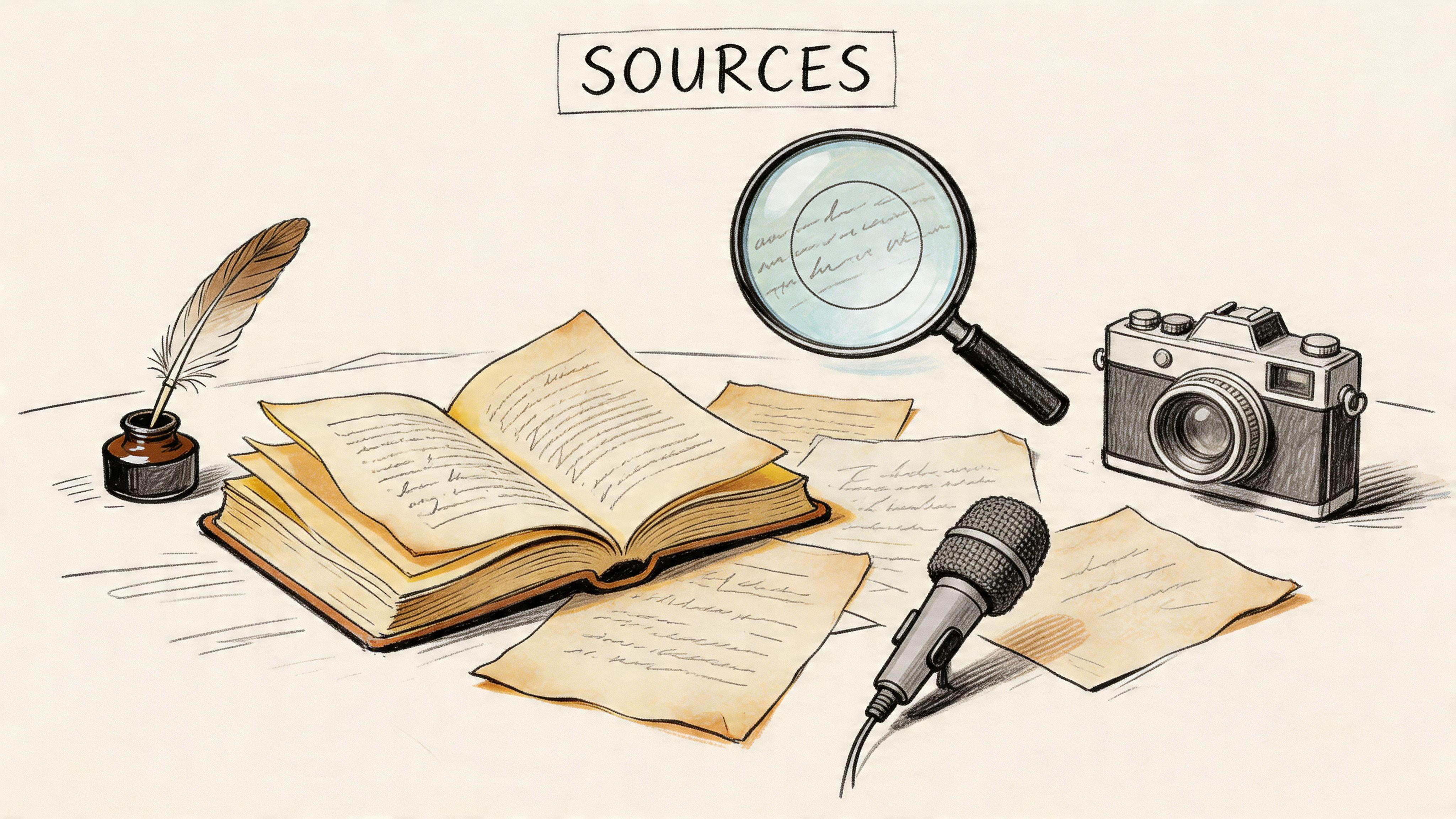
Primary sources are closest to the subject's own time and experience. Secondary sources interpret, frame, and compare.
Use both. Give them different jobs.
- Primary sources include letters, diaries, emails, interviews, school records, speeches, photographs, marginal notes, and firsthand public documents.
- Secondary sources include books, articles, documentaries, obituaries, previous biographies, and commentary by later writers.
Primary material gives you voice, scene, and surprise. Secondary material helps you test significance. A diary entry may show what a person felt on one day. A historian or prior biographer may explain why that day mattered.
If you need a quick standard for judging credibility, especially in student or academic work, review this guide on what makes a source scholarly.
Build a research system before the pile gets messy
Research breaks down when the filing system breaks down.
I have seen strong interviews become unusable because the recording was saved without a date, or a great quotation lost because nobody wrote down which edition it came from. Students run into this problem with class deadlines. Families run into it when several relatives send materials at once. Businesses hit it when old bios, press releases, LinkedIn profiles, and internal timelines all disagree.
Set up a system early and keep it plain enough that you will use it. A solid working setup includes:
- A source log: what the item is, where it came from, when you accessed it, and how reliable it seems
- A chronology file: dates, locations, milestones, and unanswered questions
- A quote bank: exact wording copied carefully with source references
- A contradiction list: places where records, memories, or public claims conflict
- A permissions file: notes on what can be quoted, shared, or published
AI can help here if you use it carefully. Tools like 1chat are useful for organizing interview transcripts, grouping research by theme, and turning messy notes into searchable summaries. They save time on sorting. They do not replace source checking, context, or judgment.
Interview for scenes, not summaries
Broad prompts produce broad answers. If you ask, "What was she like as a child?" you will usually get a polished description shaped by hindsight.
Ask for moments instead.
- "What did the room look like when he made that decision?"
- "What words did she use?"
- "Who disagreed with him at the time?"
- "What changed the next day?"
- "What detail do people always leave out?"
Those questions recover scene, conflict, and point of view. They also expose where memory gets fuzzy, which is useful. A clean anecdote is not always a reliable one.
Interviewing has trade-offs. Family members often provide emotional truth and vivid detail, but they may smooth over harm, failure, or estrangement. Colleagues can clarify public achievements, but they may speak in corporate language that says very little. Return to interviews after you review documents. The second round is usually sharper because you know what needs testing.
Don’t ignore digital traces
Modern biography research includes archives, but it also includes digital residue. Old websites, newsletters, event programs, public social posts, local news clips, podcasts, and video interviews often fill gaps that formal records miss.
That matters for recent subjects in particular. A founder's public identity may be scattered across conference pages, startup profiles, and deleted web pages. A family story may gain detail from old photo captions, community Facebook groups, or school newsletters. Students writing shorter biographies can often get useful chronology from digital records before they ever enter a library.
Treat digital sources with caution. Posts can be staged. Dates can shift. Profiles are often ghostwritten or copied from earlier bios with errors intact. Use digital material as evidence to verify, compare, and question.
Research until the person stops sounding generic
A weak research file produces adjectives. A strong one produces specifics.
"Dedicated." "Respected." "Driven." Those words tell the reader almost nothing unless the evidence underneath them is clear and concrete.
Keep working until the subject becomes harder to summarize. Maybe the person saved every rejection letter. Maybe they told one version of an event in public and another in private correspondence. Maybe a business leader celebrated as decisive took years to act when the stakes were personal. Details like those give you a human subject instead of a flat profile.
That is the standard worth aiming for. Research should leave you with more than information. It should leave you with a life that sounds specific, contested, and real.
Structuring Your Narrative and Creating an Outline
A writer can spend weeks gathering rich material and still end up with a flat biography if the structure is weak. That usually happens at the moment the notes turn into pages. The writer has dates, quotes, records, and anecdotes, but no clear decision about what kind of story the life will become.
Research gives you raw material. Structure decides what the reader understands from it.
Choose chronology or theme with intent
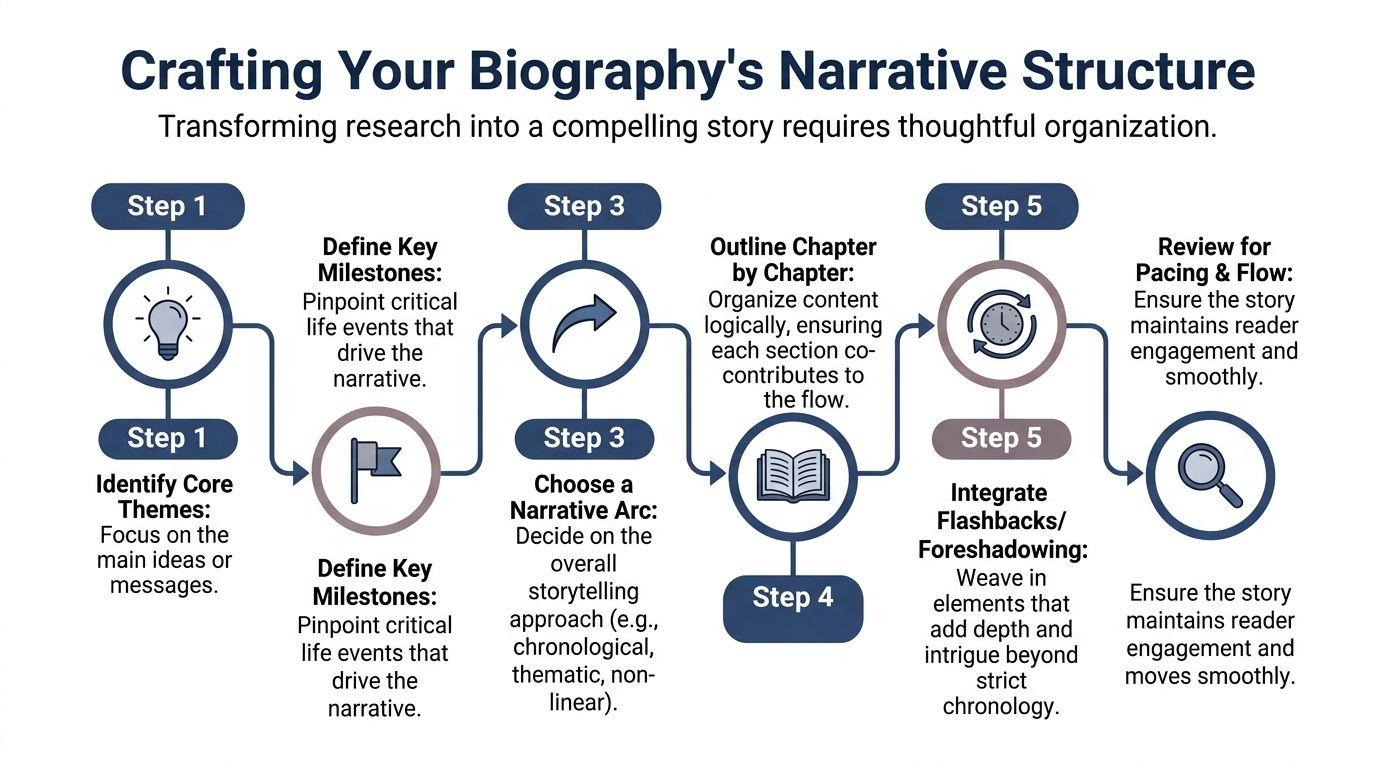
Many biographies start in the wrong place because the writer confuses sequence with shape. A life happened in order. A readable biography does not always need to tell it that way.
A straight chronological structure works well when the reader needs orientation first. Students often need it for assignments. Families often prefer it for memorial books or life histories. It also suits subjects whose development is the story, where each stage clearly changes the next.
A thematic structure works better when the subject’s life keeps circling the same pressures or questions. A founder may keep returning to risk. An artist may spend decades revising the same conflict between recognition and independence. A political figure may be easier to understand through themes like loyalty, exile, ambition, or reinvention than through year-by-year reporting.
Most strong biography projects end up using a hybrid. Time keeps the reader grounded. Themes tell the reader why the events matter.
| Structure | Best for | Common strength | Common weakness |
| Chronological | Students, family histories, clear developmental arcs | Easy to follow | Can become a fact list |
| Thematic | Complex subjects, long-form books, idea-driven lives | Deeper interpretation | Can confuse readers if time markers are weak |
| Hybrid | Most serious biographies | Balance of clarity and depth | Requires disciplined outlining |
Find the controlling idea
Every biography needs a governing question or argument. Without one, the draft starts collecting material instead of interpreting a life.
The controlling idea does not need to sound academic. It needs to be usable. If it helps you decide what belongs, it is doing its job.
Examples:
- A founder kept rebuilding a public identity after each setback.
- A reformer’s caution in private shaped bold decisions in public.
- A family matriarch held everyone together through routine, not speeches.
- A scientist’s breakthrough came from a long habit of resisting consensus.
That choice affects every chapter. It tells you which episodes deserve space, which ones need only a sentence, and which ones should stay in your notes.
AI can help here if you use it carefully. I often recommend asking a tool like 1chat to sort research notes into possible themes, recurring conflicts, or turning points. That saves time. It does not replace judgment. The writer still has to decide whether the pattern is meaningful or just convenient.
Build the outline around pressure points
A good outline tracks change under pressure. Readers stay with a biography because something is at stake. The subject wants something, resists something, loses something, or pays for something.
That means the outline should mark more than milestones. It should identify pressure points. Where did the subject face a test? Where did an old habit stop working? Where did success create new costs?
An effective outline often includes:
- An opening point of pressure: a crisis, breakthrough, public test, or irreversible decision
- Selective backstory: earlier material that explains how the subject reached that moment
- A middle with rising consequences: events that sharpen the stakes rather than extend the timeline
- A later turn: the period when results, regrets, or contradictions become harder to avoid
- An ending with interpretation: legacy, unresolved tension, or a changed understanding of the life
Opening in the middle of a meaningful moment can work well, especially for longer biographies, because it gives the reader immediate tension. A cradle-to-grave opening can also work, particularly for school assignments or family projects where clarity matters more than dramatic entry. The right choice depends on the subject, the audience, and the length of the piece.
If you want a practical model for arranging sections before you draft, this essay outline example for organizing ideas clearly is a useful starting point. Biography usually needs more flexibility than a standard essay, but the discipline of ordering material still applies.
Working test: Remove three sections from your outline. If the meaning of the life barely changes, the structure is probably too loose.
A practical chapter map
For longer work, build a chapter plan that answers two questions at once. What happens here, and why does it matter?
I use a simple planning format:
- Chapter focus
- Time period
- Primary conflict or question
- Key evidence
- What this chapter shows about the subject
That last line matters more than many writers expect. It keeps chapters from becoming storage bins for research. It also helps when you use AI to assist with drafting or organizing notes. If you give the tool a chapter purpose, the output tends to stay focused. If you give it a pile of facts, it usually produces summary.
Don’t confuse completeness with shape
Writers often feel guilty leaving material out, especially after hard research. I understand that instinct. You spent hours finding the interview, verifying the date, or tracing the family connection. The fact feels earned.
It still may not belong.
A biography is not a warehouse for everything you found. It is a structured reading experience. Readers need the details that reveal character, motive, pressure, and consequence, placed in an order that makes the life legible.
Good structure is selective. That is true whether you are writing a school biography, a company founder profile, a family history, or a book-length life. The more material you have, the more disciplined the outline needs to be.
Bringing the Story to Life Through Writing
You can feel when a biography starts working. A reader stops skimming dates and starts seeing a person make choices under pressure.
That change happens at the sentence level. Many drafts fail here. The facts are sound, the outline is solid, but the writing keeps every moment at the same temperature. Promotion, setback, marriage, loss, reinvention. Each event gets the same flat treatment, so the life never develops shape or force.
Write scenes from evidence, not imagination
A useful scene places the reader inside a documented moment. It does not invent private thoughts or polished dialogue you cannot support.
Compare these two versions:
“He faced criticism early in his career and later became more confident.”
Accurate, perhaps. Memorable, no.
Now ground the moment in what can be observed:
The review arrived before the work had fully circulated. He read it, folded the page, and kept it. Years later, he still referred to that criticism when judging new work.
The scene works because it gives the reader action, sequence, and implication. It also stays honest about what the evidence can carry. That trade-off matters. If you push too far for drama, you may get a lively paragraph and lose the reader’s trust.
Build character through patterns
Not every biography offers cinematic material. Family histories, student assignments, and company founder profiles often depend on fragments, memories, documents, and recurring habits rather than fully reconstructable scenes.
That is not a weakness.
Repeated behavior often reveals more than a single dramatic event. A founder who rewrites every public statement by hand tells you something about control. A grandmother who logs birthdays in the same notebook each year tells you something about devotion and memory. A student organizer who keeps worn campaign flyers long after the event tells you what mattered enough to preserve.
When scene material is thin, look for patterns such as:
- what the subject kept
- what the subject ignored
- how the subject responded to pressure
- what different people remembered in similar terms
- what changed late, and what remained fixed
Those details let the writing show a life from the inside without making claims the record cannot support.
Quote selectively and interpret what it means
Quotation can sharpen a biography fast. It can also clutter a page fast.
Use direct quotes when the wording itself reveals character, conflict, humor, fear, or conviction. If the line could be paraphrased without losing much, paraphrase it. Long blocks of quoted material often signal that the writer has stopped shaping the story.
Context matters as much as the quote. Set up who said it, when, and under what conditions. Then explain why it belongs. A line from a diary carries different weight than a remembered remark from an interview given forty years later. A polished public speech tells you less about private feeling than a letter written under strain.
Accuracy creates authority. Performance without evidence weakens trust, even when the prose sounds polished.
AI can help here if you use it carefully. Tools like 1chat are useful for pulling candidate quotes from transcripts, grouping remarks by theme, or comparing how the subject sounded in public versus private records. The judgment still belongs to the writer. The tool can sort language. It cannot decide what a reader should believe or feel.
Control narrative distance
Every biography has to solve the same problem. How close should the writer stand to the subject?
Too much closeness produces praise, apology, or sentimentality. Too much distance produces a case study. Readers want interpretation, but they also want a sense that a real person is present on the page.
The right distance depends on the job the biography needs to do. A family biography usually benefits from warmth and memory, but it still needs precision. A professional biography for a website or speaking profile needs tighter selection and less atmosphere. A historical biography often moves between scene, context, and analysis, yet the voice still has to feel consistent.
A practical test helps. Read three pages aloud and listen for strain. Does the subject sound admired in vague terms, or understood through specific detail? Does the narration explain everything before the reader has a chance to notice it? Does the voice fit both the evidence and the audience?
If the answer is no, adjust distance before you polish sentences.
Draft with momentum, then refine for texture
Early drafting is for movement. Get the chapter or section onto the page while the material is still active in your mind. Mark gaps with notes such as “verify date,” “add source,” or “needs transition,” then continue.
Writers often stall because the prompt is too broad. “Write about her childhood” invites summary. A narrower prompt produces usable copy: “Write the morning she first understood the family was in trouble,” or “Draft the paragraph where his public image stops matching private behavior.” Students and newer writers often do better with focused prompts like the ones in these creative writing prompts for students, especially when they need help turning notes into scenes without drifting into fiction.
I use AI the same way. Give it a vague instruction and it produces generic biography language. Give it a narrow task, such as “turn these interview notes into three possible scene openings based only on documented actions,” and the output becomes much more useful.
Good biographical writing sounds alive because it is selective, concrete, and controlled. The writer chooses what to dramatize, what to summarize, and what to leave unsaid. That discipline gives the story energy without sacrificing honesty.
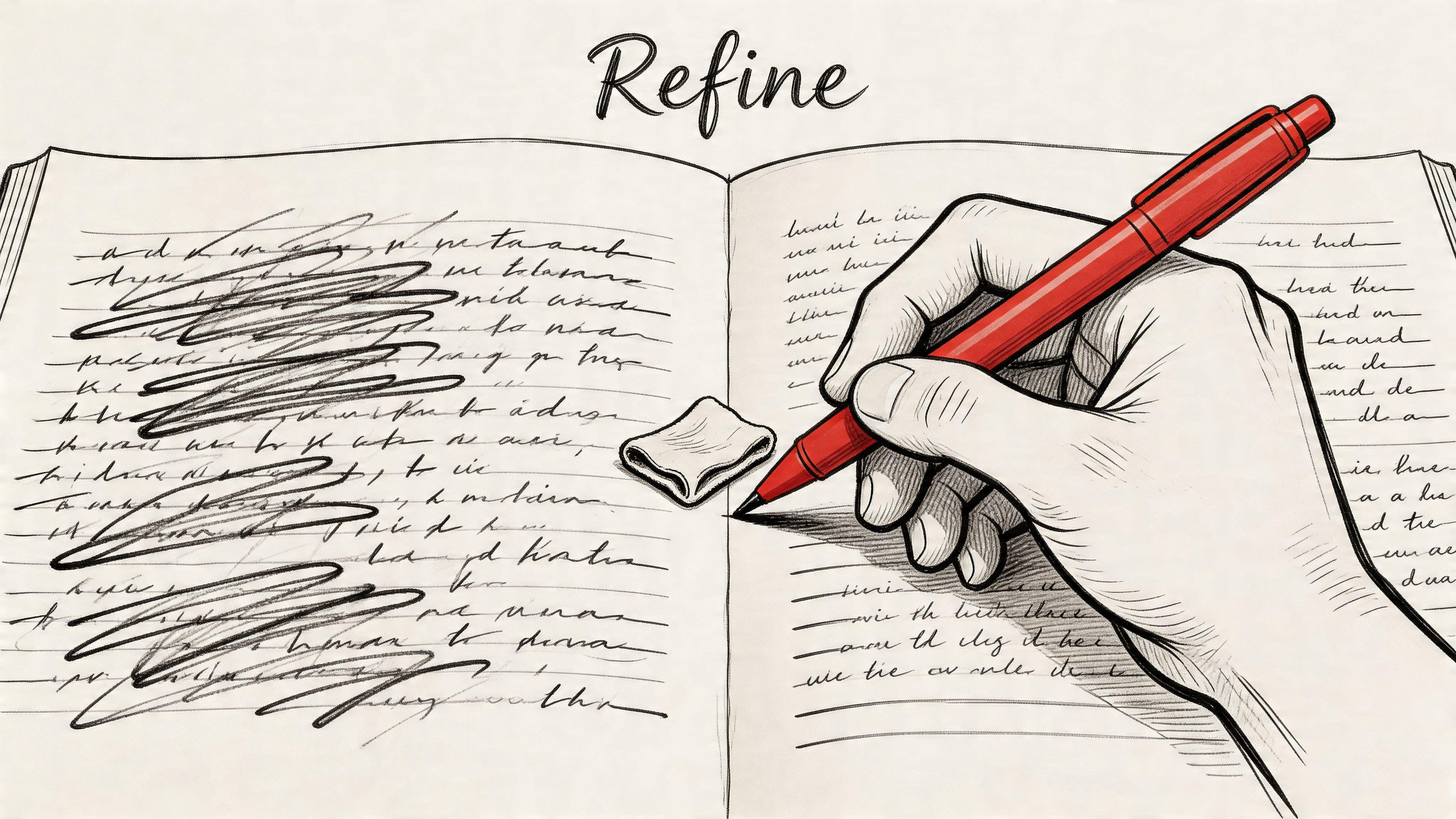
Refining Your Work Through Editing and Polishing
Most biography drafts improve less from better sentences than from harder decisions.
Editing is where you discover whether you’ve written a life story or just accumulated material. It’s also where trust is won. Readers forgive a plain sentence sooner than they forgive a doubtful fact, a misleading omission, or a structure that wastes their attention.
Edit in layers, not all at once
Trying to fix structure, clarity, tone, and punctuation in one pass usually produces shallow edits. Biography needs layered revision because different problems reveal themselves at different scales.
A practical sequence looks like this:
- Structure pass
Cut repetition. Move weak chapters. Check whether the opening earns attention and whether the ending delivers meaning. - Evidence pass
Verify names, dates, titles, relationships, and quoted wording. Mark every place where your interpretation outruns your proof. - Scene and pacing pass
Compress summary where the story drags. Expand moments that carry change, conflict, or revelation. - Line edit
Tighten language. Remove clichés. Replace praise words with observed detail.
If you line-edit too early, you’ll polish paragraphs that may not survive the next structural cut.
Invite feedback that can actually help
Not every reader should review a biography draft. Family members may protect myths. Colleagues may soften criticism. Enthusiastic friends may praise sections that don’t work.
Choose readers who can do one of these jobs well:
- A factual reader catches inaccuracies and timeline confusion.
- A narrative reader notices boredom, drift, and weak transitions.
- A subject-aware reader spots nuance you may have missed.
- A general reader tells you where attention drops.
Give them focused questions. “What did you think?” won’t get you much. “Where did you stop trusting the narrator?” or “Which section felt necessary but not alive?” will.
A biography earns authority twice. First through research, then through revision.
Fact-check like a skeptic
Biographers often make one dangerous assumption. If a detail appears in multiple places, it must be true. Sometimes those multiple places all descend from the same original mistake.
Go back to the strongest available record. Verify spellings, dates, publication titles, school names, job roles, and chronology. Be especially careful with stories that are too neat, too repeated, or too flattering.
Sensitive material needs another layer of review. Ask whether the detail is relevant, supported, and presented with proportion. Relevance matters. A true fact can still be mishandled if it’s included only for shock or gossip.
Citation is part of credibility
Students may need formal citation. Families may prefer endnotes or a source appendix. Commercial biographies often use notes, bibliographies, or acknowledgments depending on audience and publisher expectations.
Whatever format you choose, keep your source trail clean enough that another person could follow it. That protects you if a fact is challenged later, and it signals respect for the subject and the reader.
Editing feels slow because it is slow. That’s not a flaw in the process. It’s the point of the process.
Sharing the Story in Different Contexts
A biography can fail at the last stage even when the research is strong and the writing is careful. The problem is usually fit.
A student may need a cited school submission by Friday. A founder may need a 120-word website bio, a longer speaker introduction, and a polished About page that sounds credible to clients. A family may want a printed life story that people will want to pass around. Those are different deliverables, and each one asks for a different version of the same life.
Adapt the form to the use case
A professional bio has a clear job. It helps readers understand who the person is, what they do, and why they are worth trusting. Lead with the current role, relevant expertise, and a few specifics that make the person distinct. Cut inflated language. It weakens confidence faster than plain facts ever will.
A personal or family biography can carry more warmth and texture. Small artifacts often do heavy lifting here. Photo captions, letters, marginal notes, recipes, military records, and brief sidebars can preserve a person’s presence in ways a polished paragraph cannot.
A long-form manuscript needs stronger architecture. Chapter pacing matters. So does reader expectation. If the book is meant for publication, it also needs a clear position in the market: who will read it, what question it answers, and why this subject deserves sustained attention now.
Write online bios so people can find and use them
A web bio has two audiences. Human readers come first, but search engines still need clear signals.
Use the terms your audience would type. State the field, role, company, and area of expertise in plain language. If someone is a physician, say the specialty. If someone runs a company, name the company and the sector. If someone consults, specify the work instead of hiding behind broad leadership phrasing.
Good SEO for biographies is usually just good labeling. Clear headings, specific role descriptions, and concrete achievements help both readers and search systems understand the page.
Use AI for speed, then apply human judgment
AI can save time here, especially when one biography has to become several versions. I use tools like 1chat to speed up the mechanical parts of the job, then review every line for accuracy, tone, and fit.
That division matters.
AI is useful for tasks like these:
- Summarizing source material: interview transcripts, annual reports, obituaries, archival documents, meeting notes
- Pulling out chronology: dates, moves, promotions, awards, public milestones
- Creating version sets: website bio, speaker intro, staff profile, media kit blurb
- Comparing drafts: spotting missing facts, repeated points, or shifts in tone
- Sorting research notes: grouping material by life stage, theme, or event
Some work should stay with the writer. Interpretation, ethical judgment, emotional balance, and decisions about emphasis belong to a person who understands the subject and the stakes. That is especially true for family histories, memorial writing, and biographies that handle conflict or reputation.
Use AI to reduce clerical effort. Keep meaning, ethics, and voice under human control.
Package the work so it gets used
Delivery matters as much as prose.
A good biography project often ends with one master version and several outputs prepared for different purposes. That might include a printable booklet for relatives, a clean PDF for a school submission, a press-ready founder bio, or a manuscript file with a short synopsis for agents or publishers. Building those versions from one approved source helps keep facts consistent and prevents small errors from spreading across platforms.
If you expect the biography to live in more than one place, plan for that before final delivery. A biography that is easy to reuse has a much better chance of being read, shared, and remembered.
Frequently Asked Questions About Writing Biographies
How do I handle negative or sensitive information
Use three filters. Is it true, is it relevant, and can you support it responsibly.
If the information is dramatic but unrelated to the meaning of the life, leave it out. If it matters, present it with evidence and proportion. Avoid gossip framing, loaded wording, or selective storytelling that turns complexity into a verdict.
For living subjects, privacy and fairness matter even more. If a claim could damage reputation, make sure the documentation is solid and the phrasing is careful.
Do I need permission to write a biography
If the subject is living, asking permission is usually wise even when the project is informal. It improves access, reduces conflict, and clarifies expectations.
If the subject is deceased, legal permission may not be required in many cases, but ethical questions remain. Families, institutions, and archives may still shape what material you can access or quote.
What if my interviews contradict each other
That’s normal. Memory is uneven, and people remember the same event differently.
Don’t force immediate agreement. Log the differences, look for contemporaneous records, and decide whether the contradiction itself reveals something important. Sometimes the disagreement tells you more than a clean consensus would.
How long should a biography be
Length depends on purpose. A website bio may be a few short paragraphs. A family narrative may become a booklet. A historical or commercial biography may require book-length treatment.
Choose length based on audience need, not on the amount of material you collected. More research doesn’t automatically justify more pages.
What if I lose momentum halfway through
Most biographers do at some point. The usual cause isn’t lack of talent. It’s uncertainty about structure.
Go back to the controlling idea and the outline. Then shrink the next task. Don’t tell yourself to “finish the book.” Draft one scene, one chapter question, or one transition. Momentum returns when the assignment becomes specific again.
Should I self-publish or seek traditional publication
That depends on the project.
A family biography, local history, or company founder story may be best self-published or privately printed because control and speed matter more than commercial distribution. A broad-interest historical biography may be worth pitching to agents or publishers if the subject, angle, and research base support a larger market.
Traditional publication brings gatekeeping, editing, and distribution. Self-publishing brings control and speed. Neither path fixes a weak manuscript. The writing still has to carry the weight.
If you want help organizing research, summarizing PDFs, or drafting cleaner biography variations without losing your own judgment, try 1chat’s family-friendly AI workspace. It’s built for students, families, and small teams who want practical writing support in a privacy-first alternative to ChatGPT.