An essay hook is simply the first sentence or two of your paper. But its job is anything but simple. This is your one and only chance to grab your reader’s attention and convince them that your essay is worth their time and focus.
Why Your Essay Hook Matters So Much
Think of your hook as a movie trailer for your essay. It’s a short, compelling preview that sets the tone and promises something valuable is about to unfold. A great opening does more than just keep your reader from dozing off—it strategically frames your entire argument and establishes your credibility from the very first word.
Let's be honest: professors are busy. They have stacks of papers to get through, and those opening lines quickly become a filter. A flat, uninspired start often signals an equally uninspired paper. This isn't just a hunch; one study I came across found that seven out of ten college professors named weak openings as the biggest problem they see when grading essays.
The Core Functions of an Essay Hook
A powerful hook isn't a one-trick pony. It's doing several critical jobs at once, all of which lay the foundation for a strong paper. Here’s a quick breakdown of what a good hook really does.
| Function | What It Achieves for the Reader | Impact on Your Essay |
| Sparks Curiosity | Makes them wonder, "Why does this matter?" or "Where is this going?" | Creates immediate buy-in and a desire to keep reading. |
| Sets the Tone | Establishes if the essay is personal, analytical, formal, or persuasive. | Manages expectations and prepares the reader for your style. |
| Establishes Credibility | A thoughtful opening proves you’ve engaged deeply with the topic. | Builds trust and signals that you have something valuable to say. |
A well-crafted hook shows you respect your reader's time and intelligence. It’s less about a gimmick and more about giving them a clear reason to invest in your ideas.
Your essay's first sentence is your one shot to signal to the reader that your paper is worth their full attention.
Ultimately, your hook builds the momentum your paper needs. It acts as a bridge, smoothly connecting your title to your core argument—your thesis statement. A weak hook can subtly undermine your entire essay, but a strong one creates a positive impression that carries through the whole piece.
For a deeper dive into how that opening connects to your main point, check out our guide on how to write a powerful thesis statement. By mastering the art of the hook, you’re not just learning a writing trick; you’re building a crucial skill for communicating effectively.
A Practical Method for Crafting Your Perfect Hook
The blinking cursor on a blank page can feel like a taunt, especially when you know your entire essay depends on a strong start. But a great hook isn’t born from a sudden flash of genius. It comes from a smart, repeatable process you can use for any paper, every single time.
Let's ditch the "waiting for inspiration" mindset and build a system.
First, Think About Who’s Reading
Before you even think about your first sentence, picture your reader. Is it a professor who has already graded fifty papers this week? An admissions officer looking for a unique voice among thousands of applications? Knowing your audience changes everything. What do they expect? And more importantly, what would completely surprise them?
A hook that works for a casual narrative essay will fall flat in a dense academic paper. You have to write for the person on the other side of the screen.
Match Your Hook to Your Essay’s Goal
Once you know who you're talking to, clarify what you're trying to do. Your essay's primary goal should shape the energy of your opening.
- Persuasive Essay? You need to create a sense of urgency or challenge a belief your reader probably holds.
- Narrative Essay? Your job is to forge an instant emotional connection or drop the reader right into a specific time and place.
- Analytical or Research Paper? A startling fact or a genuinely tough question signals that you're ready to dig deep.
Don't commit to the first idea that pops into your head. Try brainstorming at least three different angles before you write a word. For an essay on Macbeth, for example, you could open with the historical hysteria around witchcraft, a modern psychological take on ambition, or a blunt statement about the corrosive nature of guilt. Options give you freedom.
Draft, Don't Perfect
Now it's time to actually write. But you’re not writing one hook; you’re drafting three to five different versions based on the angles you just came up with. Try one as an anecdote, another as a question, and a third as a shocking statistic. Put them side-by-side and see how they feel.
The goal isn’t to write a perfect hook on the first try. The goal is to draft several good ones and then pick the best one. This simple shift in thinking removes a ton of pressure and almost always leads to a more powerful opening.
Read each option out loud. Which one sounds the most like a real person talking? Which one makes you genuinely curious about what comes next? Trust your gut, pick the winner, and move forward.
Finally, you have to connect the dots. A great hook feels like it was designed specifically to lead into your thesis statement. That seamless transition is what creates a strong, logical flow from the very first word. To see how this fits into the bigger picture, our guide on building an essay outline example can be a huge help.
Following this method turns starting an essay from a moment of panic into a manageable, strategic exercise.
Choosing the Right Type of Hook for Your Essay
Think of your hook as a handshake. Is it firm and confident? Warm and inviting? Unexpected and intriguing? Just like a handshake, your opening sets the tone for everything that follows. Picking the right one isn't about finding a magic formula; it's about making a strategic choice that aligns with your essay's goals.
A hook that works brilliantly for a personal narrative could fall completely flat in a formal research paper. The real skill is learning to match your opening move to the type of essay you're writing and the reader you're trying to reach.
Aligning Your Hook with Your Essay’s Purpose
Your first sentence is a promise. It tells the reader what kind of journey they're about to take. A persuasive essay often needs to establish authority right away, while a college application essay benefits more from creating an immediate, personal connection.
This is where knowing the different tools in your toolkit comes in handy. An anecdotal hook, for example, can put a human face on a dense topic, making it instantly more relatable.
On the other hand, for a persuasive or research-based paper, a startling fact can be incredibly effective. Consider this: the United States goes through over 1 million plastic bottles every single minute. If you were writing about environmental policy, an opening like that creates instant gravity and urgency. It's a powerful way to signal that you're dealing with a serious topic, backed by hard data. If you want to dig deeper into why stats work so well, there are some great expert insights on hook strategies in academic writing.
This whole process—from thinking about your audience to picking a specific type of hook—is a workflow every writer should master.
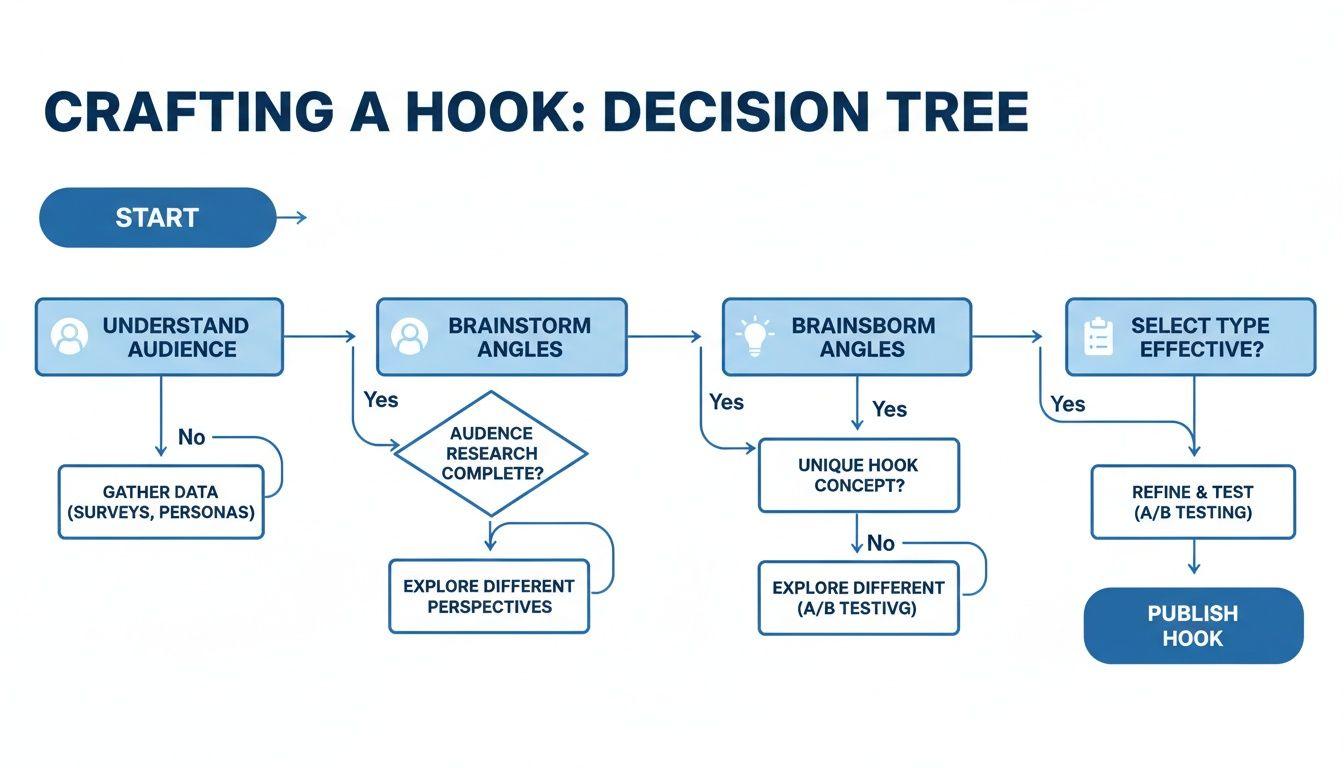
This decision tree gives you a visual map for that workflow. You start with the big picture (your reader), narrow down your angle, and then choose the specific hook that will do the heavy lifting for you. It’s all about being intentional.
Choosing the Right Hook for Your Essay
To make this choice a little less daunting, I've put together a quick comparison of the most common and effective hook types. Use this table as a go-to guide whenever you're staring at a blank page, wondering where to begin.
| Hook Type | Best For (Essay Type) | Primary Effect on Reader | When to Avoid |
| Anecdote | Narrative, Personal Statement | Creates emotional connection | In highly formal or scientific papers where personal stories are inappropriate. |
| Startling Fact/Stat | Persuasive, Research, Expository | Establishes authority and urgency | When the fact is too common or not directly relevant to your thesis. |
| Provocative Question | Argumentative, Persuasive | Sparks curiosity and critical thought | If the question can be answered with a simple "yes" or "no." |
| Vivid Scene-Setter | Descriptive, Narrative, History | Immerses the reader in a setting | When writing a technical or data-heavy paper that demands a direct start. |
| Famous Quote | Literary Analysis, Philosophy | Lends credibility and thematic depth | If the quote is a cliché (e.g., "To be or not to be...") or overused. |
As you can see, each hook has a specific job. Picking the right tool from this list dramatically increases your chances of grabbing—and holding—your reader’s attention from the very first word.
Your hook isn't just about grabbing attention; it’s about making a promise to the reader. An anecdotal hook promises a personal journey, while a statistical hook promises a logical, evidence-based argument. Fulfill that promise.
Ultimately, the best hook doesn't feel forced. It feels like the only possible way your essay could have begun. It doesn’t just pull the reader in; it sets the stage, defines the tone, and builds a solid foundation for the powerful ideas you're about to share.
Powerful Essay Hook Examples You Can Actually Use
All the theory in the world doesn’t help as much as seeing a great hook in action. To really get a feel for what works, you need to see real examples. That’s what this is—a library of hooks you can borrow, adapt, and learn from for your own essays.
We've organized them by the most common types of hooks and included examples for different academic levels, from middle school papers to college applications. These aren't just generic placeholders; they're tailored for the kinds of topics you’ll actually be writing about. Think of them as a starting point to spark your own ideas.
Anecdotal Hook Examples
Starting with a tiny, relevant story is one of the fastest ways to build a connection with your reader. An anecdotal hook is perfect for personal statements or narrative essays because it immediately grounds your topic in a real human experience.
- For a personal narrative about overcoming a fear: "The first time I stood on the high dive, the water below seemed a million miles away. My knees shook, and the laughter of other kids felt like a judgment, but it was the quiet voice of my grandfather beside me that I remember most."
- For a college application essay about choosing a major: "Every Saturday morning for a year, I disassembled and reassembled my dad's old lawnmower. While my friends were sleeping in, I was covered in grease, completely fascinated by how each tiny gear and piston worked together to create power."
A personal story, even a tiny one, makes your essay feel real and human. It’s a powerful way to show, not just tell, what matters to you.
Startling Fact or Statistic Examples
Nothing grabs a reader's attention quite like a shocking number or a surprising fact. This approach lends instant credibility and weight to your argument, making it a go-to for persuasive, expository, or research-heavy essays.
- For a persuasive essay on plastic pollution: "Every sixty seconds, the equivalent of one full garbage truck of plastic is dumped into our oceans, a silent crisis happening right now, far from our daily view."
- For a research paper on sleep deprivation in teens: "While adults need around eight hours of sleep to function, the average high school student in America gets just 6.5 hours per night, creating a public health issue that impacts everything from academic performance to mental well-being."
Provocative Question Examples
The right question forces your reader to pause and think. You’re not looking for a simple "yes" or "no" answer here. The goal is to pose a question that opens up the complexity of your topic, inviting the reader to explore it along with you.
- For an argumentative essay on social media's impact: "If our digital lives are designed to connect us, why do studies show that the heaviest users of social media often feel the most isolated?"
- For a literary analysis of To Kill a Mockingbird: "What does it truly mean to have courage—is it the person who holds a gun, or the one who stands up for their beliefs without one?"
Vivid Scene-Setter Examples
This hook works like a movie's opening shot, dropping your reader directly into a specific time and place. By using rich sensory details—sights, sounds, smells—you create an immersive experience right from the first sentence. It’s an incredibly effective technique for historical, descriptive, or narrative essays. For more tips on crafting compelling introductions, you might be interested in our guide on good intros for essays with examples.
- For a history essay on the Cold War: "The air in Berlin on that August morning in 1961 was thick with tension and dust. Families awoke to find their streets divided by barbed wire, a scar of concrete and politics that would split a city and the world for nearly three decades."
- For a descriptive essay about a favorite place: "The scent of pine and damp earth always hits first. Sunlight filters through the dense canopy in shifting patterns, and the only sound is the rustle of unseen creatures in the undergrowth."
Common Mistakes to Avoid When Writing Your Hook
Knowing what not to do is just as important as knowing what you should do. A weak opening can make your reader—whether it's a professor with a mountain of grading or an admissions officer on their fifth cup of coffee—mentally check out before you even get to your thesis.
After reading thousands of essays, I can tell you that the same mistakes pop up over and over again. Let's walk through the most common traps so you can sidestep them completely.
The Cliché Catastrophe
The first and most obvious trap is the dreaded cliché. Phrases like "Since the dawn of time..." or "In today's society..." are immediate red flags that signal an unoriginal paper. They tell your reader that you grabbed the first, easiest thought that came to mind.
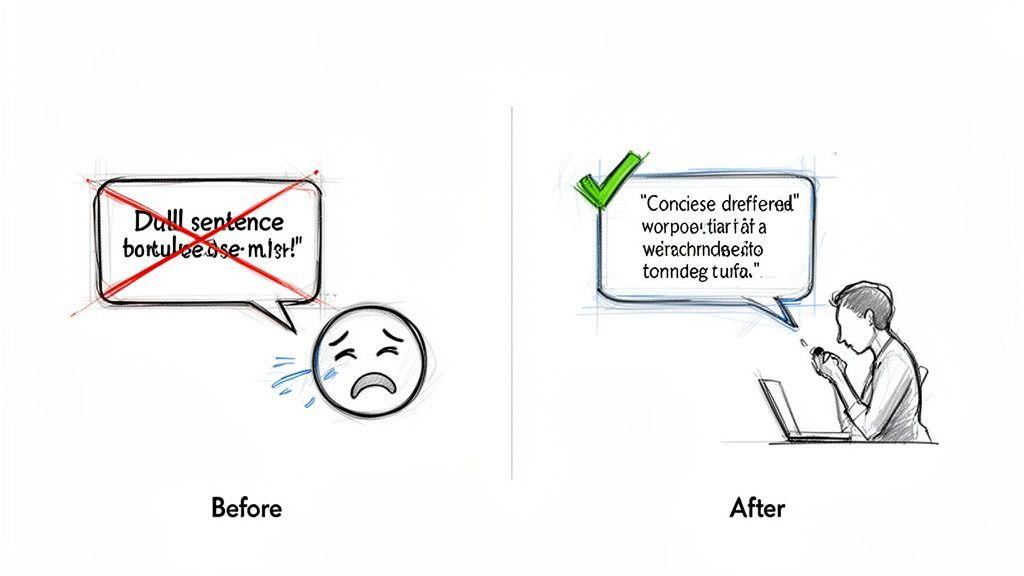
Before: “Since the dawn of time, humans have been fascinated by the stars.” After: “For centuries, the pinpricks of light in the night sky were a source of myth and navigation; today, they represent a cosmic puzzle of dark matter and distant galaxies.”
See the difference? The second version is specific, sets a much more intellectual tone, and immediately shows a deeper engagement with the topic. It swaps a lazy generalization for a thoughtful, historical contrast.
Dodging Definitions and Empty Questions
Another classic misstep is opening with a dictionary definition. Your professor knows what "courage" is. Kicking off your essay this way is a waste of prime real estate and suggests you're just trying to fill space.
- Before: “Merriam-Webster defines a hero as a person who is admired for their courage or outstanding achievements.”
- After: “While we often reserve the word ‘hero’ for soldiers and superheroes, the quiet, daily acts of integrity are where true heroism is forged.”
The same goes for flimsy questions. Avoid any question that can be answered with a simple "yes" or "no" in your reader's head. A good hook question should be genuinely thought-provoking, not rhetorical fluff.
Don't ask a question your reader can answer in two seconds. Instead, pose a question that frames the central conflict or complexity of your essay’s argument. This invites them into the discussion, rather than shutting it down.
Your Quick Revision Checklist
Once you've drafted your hook, put it to the test. Be brutally honest with yourself—your final grade could hang in the balance.
- Is it generic? If you could cut and paste your hook into ten other essays on the same topic, you need to get more specific. Add a detail only your essay will discuss.
- Does it connect to your thesis? Your hook can't just be a flashy, random statement. It absolutely must create a natural pathway leading directly to your main argument.
- Is it too broad? Steer clear of grand, sweeping claims about "society" or "all of humanity." Narrow your focus. Think magnifying glass, not satellite view.
- Does it sound like you? This is especially critical for personal statements and application essays. An authentic voice is far more compelling than trying to sound like a philosophy textbook.
By avoiding these common pitfalls, your hook will do more than just introduce your topic. It will command attention and prove from the very first sentence that your essay is worth the read.
Your Top Essay Hook Questions, Answered
Alright, even after you've seen the templates and examples, some practical questions always pop up right when you’re staring at that blinking cursor. A great hook in an essay can feel like a mystery. Let's tackle some of the most common sticking points I see with students.
How Long Should a Hook Be?
Keep it short. Your hook should be just one or two sentences, three at the absolute most if you're setting a scene.
Its only job is to get the reader’s attention and guide them toward your thesis. If your hook drags on for a whole paragraph, it’s not a hook anymore—it’s a rambling intro that has lost all its punch.
The best hooks are powerful because they are brief. They make an instant impression, then step aside to let your thesis take the spotlight. When it comes to hooks, brevity is your best friend.
Can I Use a Creative Hook for a Formal Paper?
Yes, you can—and you should! But there’s a catch: your creativity has to fit the formal tone of the assignment. A personal story about your childhood probably won't work for a serious research paper on economic policy.
However, a startling statistic, a provocative question, or a sharp, relevant quote can feel both creative and academic. The key is always relevance and tone. A surprising fact about global supply chains is a fantastic hook for an economics paper; a funny story about your online shopping habits is not. Let the subject matter and assignment guidelines be your compass.
What If I Can’t Find a Good Quote?
Then don't use one. Seriously. Forcing a weak or clichéd quote into your intro is far worse than skipping the quote altogether. If you’ve spent a while searching and nothing feels right, that’s your cue to switch tactics.
Instead, try one of these other approaches:
- Dig up a surprising statistic connected to your topic.
- Briefly set a scene that illustrates your core idea.
- Pose a challenging question that your essay will answer.
A powerful hook doesn't need to be a quote. In fact, your own original thought or a well-placed fact can often leave a much stronger, more memorable impression.
Should I Write My Hook First or Last?
This comes down to your personal process, but I almost always recommend writing the hook last. I know it sounds backward, but it’s so much easier to introduce a paper once you know exactly what you've written.
After you've finished your body paragraphs and conclusion, you have a crystal-clear picture of your argument and evidence. Armed with that clarity, you can then go back and write a hook that perfectly captures the essay's spirit and leads into your thesis flawlessly. This strategy takes the pressure off, so you don't get stuck trying to find the perfect opening line before your ideas are even on the page.