Writing a great research paper introduction is about taking your reader on a journey. You start with the big picture, gradually narrow the focus to a specific, unanswered question, and then clearly state how your paper will fill that void. It’s your first and best chance to convince someone that your work is worth their time.
Why Your Introduction Can Make or Break Your Paper
Let’s be real for a moment. Your introduction isn’t just a warm-up; it's the gatekeeper. In the fiercely competitive world of academic publishing, it’s often the only chance your paper gets to make an impression. A weak intro can get you a desk rejection before a peer reviewer ever sees your work. A strong one, on the other hand, is your ticket to getting read.
Think about it from an editor's perspective. They're making quick decisions about a manuscript's potential, and a compelling introduction is non-negotiable.
Standing Out in a Crowded Field
The sheer volume of new research is staggering. Global scientific output jumped from 2.0 million articles in 2010 to a whopping 3.3 million in 2022. This data, highlighted by the National Science Foundation, shows just how loud the academic world has become.
In a sea of millions of competing voices, a sharp, focused introduction is the only way to get noticed. It's not just about getting published, either. It’s about getting read. Your introduction has to answer the "so what?" question right away for busy editors and reviewers who have dozens of other papers waiting.
Your research only matters if people read, understand, and build upon it. This means that writing a good paper is a critical part of the research process. The process of writing forces you to clarify your own thinking in ways that often reveal gaps or new insights.
If you look at elite journals like Nature and Science, where pre-review rejection rates can climb as high as 80-90%, a clear pattern emerges. Papers with compelling introductions that frame a clear research question and powerfully argue for its significance are the ones that make it through. Your intro doesn't just present your topic; it sells it.
The True Purpose of Your Introduction
Many emerging researchers fall into the trap of thinking the introduction is just a literature dump or a simple background summary. That's a huge mistake. Its job is far more strategic. A great introduction is a roadmap, guiding the reader from a broad, familiar landscape to the specific, novel ground your work claims.
A powerful introduction needs to accomplish a few key things:
- Hook the Reader: You need to grab their attention from the first sentence with a surprising fact, a challenging question, or a bold statement about the topic's importance.
- Establish Context: Give just enough background so someone who isn't a world expert in your niche can understand the conversation your research is entering.
- Pinpoint a Clear Problem: This is critical. You must identify a specific gap, an unresolved puzzle, or a flaw in the current literature that your work will tackle head-on.
- Present Your Solution: State your research aim, hypothesis, or thesis with confidence. Frame it as the direct answer to the problem you just laid out.
When you start seeing the introduction as an opportunity instead of a chore, the entire writing process changes. This is your chance to frame the conversation and show why your work matters, right from the very beginning.
Here's a quick summary of the essential components of a research paper introduction and their primary function, giving you a roadmap for the rest of the article.
Anatomy of a Powerful Introduction at a Glance
| Component | Purpose | Key Question It Answers |
| Hook | Grab the reader's attention and establish immediate relevance. | Why should I care about this topic right now? |
| Broad Context | Provide necessary background and situate the topic within a larger field. | What is the established knowledge or conversation? |
| Research Gap | Identify a specific problem, question, or limitation in existing research. | What is missing, unknown, or wrong with what we currently know? |
| Aim/Thesis | State the specific goal or main argument of your paper clearly. | What exactly are you going to do or prove in this paper? |
| Contributions | Briefly explain the significance and novelty of your work. | Why does your research matter? What new value does it add? |
| Outline | Give a brief roadmap of the paper's structure (optional but helpful). | How will you make your case? What should I expect in each section? |
Think of these components as the building blocks. Mastering how to assemble them will put you miles ahead of the competition and give your research the platform it deserves.
Using the Funnel Method to Structure Your Introduction
Staring at a blank page is easily one of the most intimidating parts of academic writing. So, instead of trying to pull the perfect opening sentence out of thin air, give yourself a proven framework. The "funnel method" is a classic for a reason—it’s a highly effective way to structure your introduction, making the process logical, manageable, and much more powerful.
The whole idea is to guide your reader from a broad, easily understood context down to the very specific point of your research. Just picture a physical funnel: wide at the top and narrow at the bottom. Your introduction should mirror that exact shape, starting with general knowledge and zeroing in on your precise contribution.
Starting at the Top of the Funnel
The top of the funnel is all about establishing the broad context. Your goal here is to get everyone on the same page, especially readers who aren't deep experts in your specific niche. You want to start with a statement or a fact that's widely accepted or understood within your general field.
This isn't the spot for your most groundbreaking claim. Not yet. You’re simply setting the stage and inviting the reader into the larger conversation your research is joining.
- Studying social media's impact on teen mental health? You might kick things off by mentioning the near-universal adoption of smartphones among adolescents.
- Working on renewable energy? A good opening could touch on the global push to reduce carbon emissions.
This initial context acts as a gentle on-ramp, making sure you don't lose readers with super-technical jargon right out of the gate. You're essentially saying, "Here's the world we're all familiar with."
This simple visual breaks down the flow from a broad hook to your specific solution.
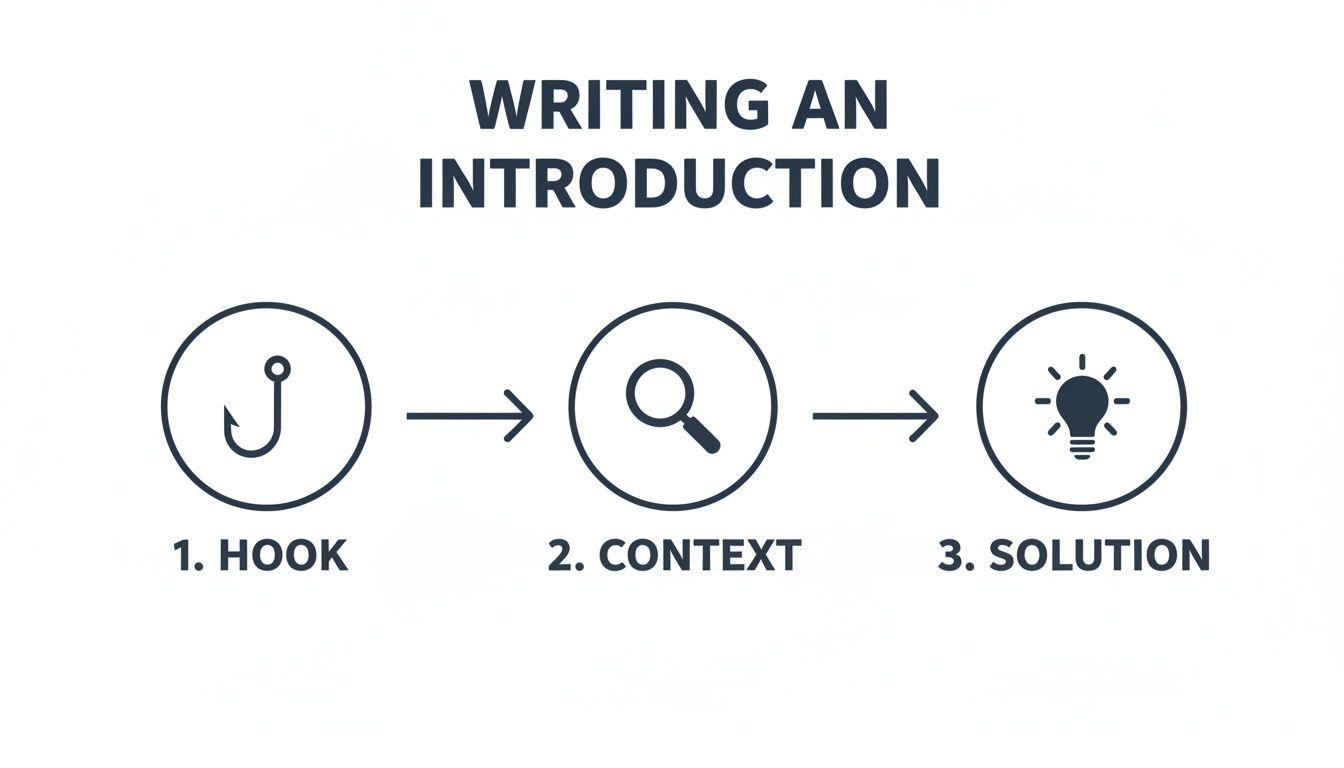
As you can see, a compelling hook draws the reader in, the context gives them the background they need, and the solution presents your research as the clear answer.
Narrowing Down to the Problem
Once you've established the general territory, it's time to start tightening your focus. This is where you steer the reader from that broad context toward a specific problem, an unanswered question, or a contradiction in the existing literature. This is your research gap.
You’re now moving into the middle of the funnel. Transitional phrases are your best friend here, signaling this shift smoothly:
- "However, despite this trend..."
- "While much is known about X, less is understood about Y."
- "This raises an important question..."
Your job here is to demonstrate that within this well-understood area, something is missing or unresolved. The research gap is the entire justification for your paper's existence, so defining it clearly is probably the most critical task of the whole introduction. After all, if there’s no problem, there's no need for your solution.
A well-defined research gap creates a sense of necessity. It transforms your paper from just another report into an essential piece of a larger puzzle that only you can provide.
A strong gap statement makes your work feel urgent and important. It shows reviewers you have a deep understanding of your field and have identified a genuine spot where new knowledge is needed.
Reaching the Point of the Funnel
Finally, you arrive at the narrowest point of the funnel. This is where you present your study as the precise solution to the gap you just identified. This part of the introduction must contain your thesis statement, research question, or hypothesis. It should be a clear, confident declaration of your paper's purpose.
This final section should also briefly lay out your approach and outline the paper's structure—think of it as a mini-roadmap that tells the reader what to expect. This whole process, from broad context to your specific aim, is more than just a writing trick; it's a strategic tool. For instance, some data suggests that papers using the funnel model to frame a problem and offer a solution can see higher acceptance rates. Given that shrinking researcher pools are making academia more competitive, a strong, well-structured introduction can give you a significant advantage.
Of course, this structured approach is just the start. You still need to fill it with compelling content. A great way to plan that is by building a solid framework first. For more guidance on that, check out our guide on how to write a research paper outline. By mapping out your key points beforehand, you can ensure your introduction perfectly aligns with the body of your paper, creating a seamless and convincing argument from start to finish.
Bringing Your Introduction to Life: From Theory to Practice
Frameworks are great, but seeing the pieces come together is where the real learning happens. Let's move past the abstract and actually build an introduction from the ground up. This will show you exactly how to transform those weak, generic sentences you’ve probably seen (or written) into powerful, specific statements that command attention.
For this walkthrough, we’ll use a working topic: "The Impact of AI Chatbots on Student Engagement in High School STEM Subjects."
We're going to build a full introduction, one element at a time. By the end, you'll have a concrete blueprint for your own work.
Step 1: Crafting a Compelling Hook
Your hook has one job: grab the reader and establish immediate relevance. It needs to be sharp, impactful, and make them feel like your research matters.
Here’s a common but weak opening I see all the time:
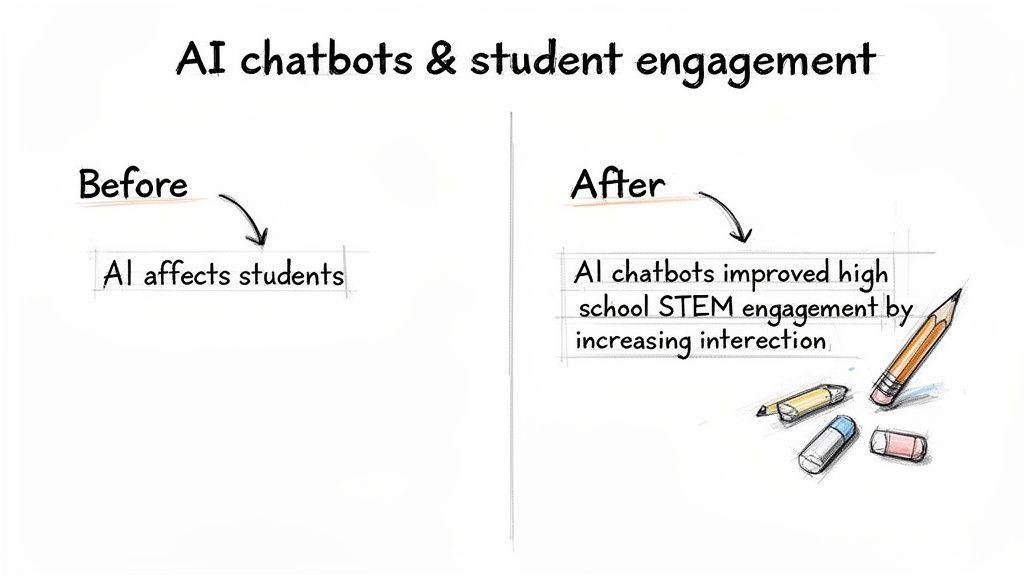
Weak Hook: "Artificial intelligence is becoming more common in education."
It’s true, but it’s boring. There's no urgency, no tension, and it fails to make the reader care. It’s a passive observation, not an engaging entry point.
Let’s try that again, but this time with some energy and specificity:
Strong Hook: "While STEM fields are projected to grow by 11% over the next decade, student engagement in foundational high school courses continues to decline, creating a critical skills gap."
Now that works. It immediately establishes high stakes by using a specific statistic (11%), introduces a conflict (field growth vs. student decline), and frames a real-world problem that demands a solution.
Step 2: Establishing the Broad Context
Once you've hooked your reader, you need to provide just enough background to orient them. This isn't a full literature review; it's about situating your specific topic within the larger academic conversation.
A vague attempt at context often looks like this:
Weak Context: "Many new technologies have been proposed to help students learn better."
This is far too broad. "Many new technologies" and "learn better" are so generic they offer no real value. It feels disconnected from the hook and doesn't guide the reader toward our specific topic.
Let's provide some focused, relevant background instead:
Strong Context: "In response to this engagement crisis, educational institutions are increasingly turning to AI-powered tools, such as intelligent tutoring systems and personalized learning platforms. Early studies suggest these interventions can offer scalable, one-on-one support that was previously unfeasible in crowded classrooms."
See the difference? This version directly addresses the "engagement crisis" from the hook, introduces a specific category of solutions (AI-powered tools), and references existing research ("early studies suggest"). It smoothly narrows the funnel toward our topic of AI chatbots.
Step 3: Pinpointing the Research Gap
This is your pivot point—where you transition from what the field knows to what it doesn't. You have to clearly articulate the specific, unanswered question your paper will tackle. A poorly defined gap undermines the entire rationale for your study.
An ineffective gap statement is a classic rookie mistake:
Weak Gap Statement: "However, more research is needed on AI in schools."
This is the academic equivalent of saying "water is wet." It's so obvious that it's meaningless. Any reviewer would immediately think, "What kind of research? Why is it needed?"
Here’s how you define a sharp, compelling research gap:
Strong Gap Statement: "Despite the growing interest in AI tools, the majority of research has focused on their impact on performance metrics like test scores in higher education. There is a significant gap in understanding how interactive AI chatbots specifically affect the attitudinal and behavioral components of student engagement—such as curiosity, participation, and self-efficacy—within the crucial high school STEM environment."
This statement is incredibly precise. It acknowledges what's already been done (research on test scores), then pivots to what's missing (the effect on engagement components) and for a specific group (high school students). It carves out a clear, defined space that your research will now occupy.
Step 4: Stating a Clear Aim and Thesis
With the gap clearly established, you can now present your research objective as the direct solution. This needs to be a confident, unambiguous statement of purpose. Think of it this way: your entire introduction has been building up to this moment. Your thesis statement is the anchor for the whole paper.
A foggy objective just creates confusion:
Weak Aim: "This paper will look at chatbots and student engagement."
The phrase "look at" is passive and imprecise. It doesn't communicate a clear research action or what you intend to discover.
Let's make it assertive and measurable. If you're struggling to nail this crucial sentence, our detailed guide on how to write a thesis statement offers some really practical steps and examples.
Strong Aim: "This study aims to determine the extent to which daily interaction with a specialized STEM chatbot influences student engagement levels, measured through classroom participation rates, question-asking frequency, and standardized self-efficacy surveys, among 10th-grade physics students."
This aim is specific, measurable, and directly answers the question posed by the research gap. It clearly states what will be measured ("engagement levels"), how it will be measured (participation, questions, surveys), and with who ("10th-grade physics students"). This kind of clarity gives readers—and more importantly, reviewers—confidence in your entire research design.
The language you choose for each of these components can make or break your introduction. Vague, hesitant phrasing signals a lack of confidence, while specific, assertive language shows you're in control.
From Weak to Powerful Phrasing in Your Introduction
This table gives a side-by-side look at how to level up your language, moving from common weak phrases to strong, impactful alternatives.
| Component | Weak Phrasing to Avoid | Strong Phrasing to Use |
| Hook | "In modern times, [topic] is important." | "Despite a 75% increase in funding, [problem] persists, creating an urgent need for new solutions." |
| Context | "Many researchers have studied [topic]." | "Seminal works by Smith (2018) and Jones (2020) established [key finding], but..." |
| Gap | "Not much is known about [specific area]." | "While the literature extensively covers [X], it has largely overlooked the role of [Y] in the context of [Z]." |
| Aim | "This paper is about [topic]." | "This study seeks to quantify the relationship between [variable 1] and [variable 2] by..." |
| Contribution | "This research will be useful." | "This research offers a novel framework for understanding... and provides the first empirical data on..." |
Keep this comparison handy as you draft. Consistently choosing the stronger phrasing will instantly elevate the quality and perceived authority of your work.
Your Introduction Needs to Speak Your Field's Language
A brilliant introduction isn't built from a universal template. The unwritten rules for what makes an intro compelling shift dramatically from one academic discipline to another. What works for a biology journal will fall flat in a history publication, and vice versa.
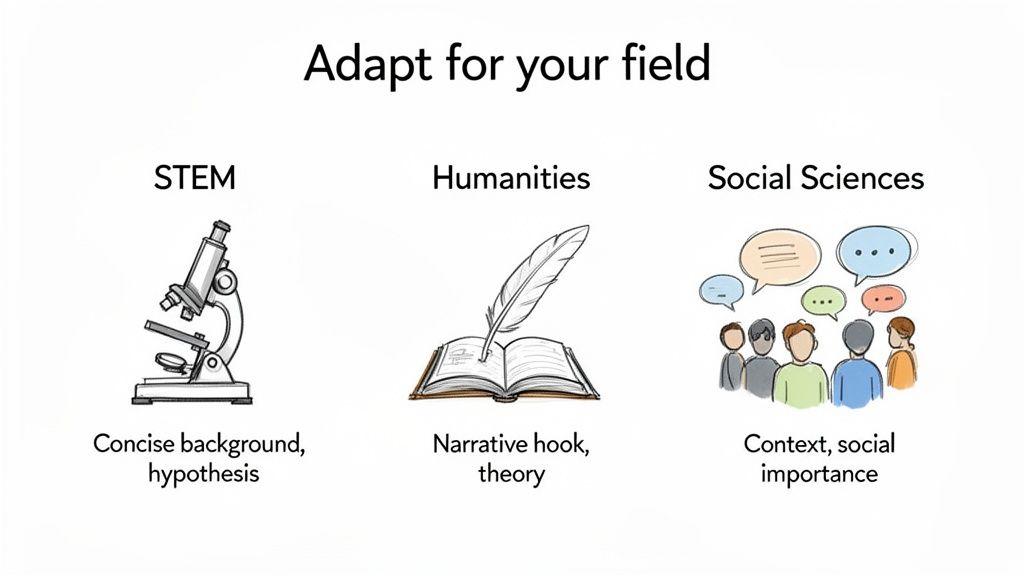
If you write a humanities-style intro for a STEM audience, it might come across as unfocused and overly narrative. Flip it around, and a standard, hyper-efficient STEM intro can seem dry and theoretically shallow to a social scientist. The trick is to tune your structure, tone, and focus to meet the expectations of your specific field.
Writing for STEM: Clarity and Precision Above All
In Science, Technology, Engineering, and Math (STEM), your introduction needs to be a model of efficiency. The name of the game is clarity and a direct, logical path to your research question. Forget the elaborate storytelling; your job is to get straight to the point.
A strong STEM introduction prioritizes a few key things:
- Quick Background: Get right to the established knowledge that's directly relevant to your work. No long-winded historical reviews needed.
- A Pinhole Gap: State the problem or gap in the existing research explicitly. Use direct language like, "However, it remains unknown whether..." or "Current models fail to account for..."
- A Testable Hypothesis: End with a clear, falsifiable hypothesis or a very specific research question. This is what your experiments are built to answer.
Think about a computer science paper. It will likely open by describing the current state of an algorithm, immediately identify a performance bottleneck (the gap), and then propose a new modification to fix it. The language is precise, objective, and gets from known to unknown in just a few paragraphs.
Writing for the Humanities: Joining the Conversation
Humanities introductions are a different beast entirely. You aren't just solving a technical problem; you're entering a long-standing scholarly conversation. The goal is to propose a fresh interpretation or challenge an existing way of thinking, so the approach is often more argumentative and exploratory.
Here's what a good humanities intro does:
- An Engaging Hook: Start with something that grabs the reader—an odd anecdote, a provocative quote, or a surprising historical fact that sets the stage for your argument.
- The Theoretical Stage: You must situate your work within the key theories and critical conversations in your field. This proves you know the scholarly landscape you're about to disrupt.
- Why It Matters: Go beyond the text or artifact and explain the broader cultural, historical, or philosophical importance of your argument.
For a literature paper, you might start with a close reading of a confusing passage in a novel. From there, you'd connect that passage to the cultural anxieties of its time before stating a thesis that offers a completely new way to understand the author's project.
The real difference is the nature of the "gap." In STEM, the gap is often a missing piece of data or an unsolved problem. In the humanities, the gap is a missing perspective, an underexplored theme, or a flawed interpretation that you're here to correct.
Writing for the Social Sciences: The Hybrid Approach
Introductions in the social sciences often walk a fine line, blending the directness of STEM with the theoretical depth of the humanities. You’re dealing with empirical data, but you're also expected to engage with complex social theories and their real-world consequences.
A typical social sciences intro will:
- Start with a Real-World Problem: Ground your research in a tangible social issue. Maybe it's rising inequality or a shift in voting behavior. Make it relevant.
- Set the Scene with a Lit Review: Briefly touch on what previous studies have found, highlighting debates, contradictions, or questions that still need answers. Knowing what is a credible source is crucial for building this foundation.
- State a Clear Question and Argument: Lay out your research question and thesis. Explain how your study will tackle the gap you've identified and hint at its potential social or policy implications.
For instance, a sociology paper might open with a stark statistic about urban gentrification, review the dominant theories explaining it, and then propose a new study to test a hypothesis about its impact on community bonds. It connects hard data with big-picture societal questions, making the work matter to more than just a handful of academics.
Common Introduction Mistakes (And How to Fix Them)
Knowing what not to do is half the battle. Think of your first draft's introduction as a rough cut of a film—the core story is there, but it needs serious editing to make an impact. Spotting these common missteps before you submit can mean the difference between getting a serious review and an immediate desk rejection.
I've seen countless promising papers stumble right out of the gate because of an introduction that makes one of these easily avoidable errors. These mistakes don't just weaken your opening; they signal a lack of clarity to reviewers and can undermine the credibility of your work before they even reach your methods section.
The Overly Long Introduction
This is probably the most frequent mistake I see. An introduction that drags on and on is a major red flag. Remember, this isn't the place for a full-blown literature review. Its job is to get in, orient the reader, point out a clear gap in the research, and state your purpose. A long, meandering intro just buries the lede and frustrates anyone trying to figure out what your paper is actually about.
How to Fix It: As a rule of thumb, aim for your introduction to be about 10% of your paper's total word count. For a 5,000-word paper, that’s around 500 words. Be ruthless. Force yourself to only include the literature that is absolutely essential to frame your specific research question. If a source isn't directly setting the stage for your work, save it for the discussion section.
Revealing Too Much Too Soon
Another common trap is laying all your cards on the table in the first few paragraphs. While you absolutely need to state your aim and hypothesis, you don't want to give away every single result and conclusion right away. Doing so kills the narrative arc of your paper and gives the reader little incentive to keep going.
Think of it like a movie trailer—you want to set up the central conflict and hint at the resolution, not show every key scene from the third act.
How to Fix It: Keep your mention of the results at a high level. Just give enough to support your thesis and pique the reader's interest.
- Instead of: "We found that Group A improved by 34%, Group B by 12%, and that the difference was statistically significant (p < .01)."
- Try this: "Our results reveal a significant positive effect of the intervention, offering strong support for our primary hypothesis."
Drowning in Jargon
Yes, your field has technical language, but bombarding your reader with unexplained jargon and acronyms from sentence one is a surefire way to alienate them. Your goal is to draw people in, not build a wall of terminology around your work. It's always best to assume your reader is a smart, educated person who might not be an expert in your tiny sub-field.
Your research only matters if people can read it, understand it, and build upon it. The writing process itself is a tool for discovery; it forces you to clarify your own thinking, often revealing gaps or new insights along the way.
How to Fix It: It's a simple fix. The first time you use a specialized term or acronym, just provide a quick, simple definition. For instance, "This study employs a Convolutional Neural Network (CNN), a type of deep learning model specifically designed for processing visual data..." That one small gesture makes your work instantly more accessible to a much wider academic audience.
The Vague or Missing Research Question
This one is the cardinal sin of introduction writing. If a reviewer can't easily find a clear, sharp research question or problem statement, the paper is doomed. Your entire study hangs on this. It gives your work purpose and direction. A reviewer shouldn't have to go on a scavenger hunt to figure out what you're trying to do.
How to Fix It: Make it impossible to miss. Dedicate a specific sentence or two to state your purpose explicitly. Use straightforward phrasing like, "The primary aim of this study is to..." or "This paper investigates the question of..." A great place for this is usually toward the end of your intro, right after you've established the context and the research gap. It acts as a perfect, crystal-clear signpost for the reader.
Common Questions About Nailing the Introduction
Even with a solid plan, writing an introduction can feel like walking a tightrope. You'll inevitably run into those tricky questions that can stop you in your tracks. Let's tackle some of the most common issues I see researchers wrestling with. Think of this as a quick-reference guide for getting those nagging details just right.
How Long Should My Introduction Be?
This is the big one, isn't it? Thankfully, there's a pretty reliable rule of thumb to follow. Your introduction should take up about 10% of your paper's total word count.
So, if you're writing a standard 5,000-word research paper, you're aiming for an intro of around 500 words. For a shorter 3,000-word piece, 300 words is a great target.
Of course, this isn't a hard-and-fast rule, but it’s an excellent starting point. If your intro is creeping way past that mark, you've probably drifted into a full-blown literature review. If it's much shorter, you likely haven’t given your reader enough context to understand why your work matters.
How Much Background Is Too Much?
It's so easy to fall down the rabbit hole of providing background information. The line between setting the stage and writing a mini-literature review is a fine one. The trick is to be ruthless in your selection. You only need to include the background research that is absolutely critical for a reader to grasp your specific research question.
Here's a simple way to think about it:
- Essential: Studies that directly set up or define the gap you're about to fill.
- Non-Essential: A sweeping history of the entire field or studies that are only tangentially related.
Your goal is to frame your study, not to summarize everything ever written on the topic. Every sentence you include should be doing the specific job of guiding the reader toward your research gap and thesis.
If a source doesn't help you build the case for why your study is necessary, set it aside. You can always bring it back in the discussion section to compare your findings with the broader field. This keeps your introduction sharp, focused, and powerful.
Should I State My Results in the Introduction?
Yes, but do it carefully. You should absolutely state your main finding or core conclusion, especially as it answers your central research question. This immediately gives your paper a clear argument and tells the reader exactly what you discovered.
What you want to avoid, however, is revealing all the granular details—the specific stats, p-values, and secondary findings. The introduction is for the headline, not the entire story.
- Do this: "Our findings show that the new teaching method significantly improves student retention, which confirms our primary hypothesis."
- Avoid this: "We found that the new method improved retention by 27% (p < 0.01), while the control group only saw an 8% improvement, with the largest gains observed in female students aged 14-16."
Save those juicy numbers and detailed breakdowns for your results section. A clean, high-level summary of your main conclusion is all you need in the intro.
Can I Use "I" or "We" in My Introduction?
The answer here really depends on your field. For a long time, using the first person ("I" or "we") was a big no-no in academic writing, all in the name of objectivity.
Times have changed. In many disciplines—especially in the humanities and social sciences, but increasingly in STEM as well—using "we" is now perfectly fine and often even preferred. It makes your writing more direct and active. For instance, "We conducted an experiment..." is much clearer than the stuffy, passive alternative, "An experiment was conducted..."
A Quick Field Guide:
| Field | First-Person Usage | Example |
| STEM | Increasingly common, especially for clarity. | "We hypothesized that..." |
| Humanities | Widely accepted to frame your argument. | "In this paper, I argue that..." |
| Social Sciences | Generally acceptable, follows STEM trends. | "We surveyed 500 participants..." |
The best advice I can give is to check the author guidelines for your target journal or ask your professor about their preference. When in doubt, look at recently published papers in your specific sub-field. See what other authors are doing—that's always the clearest signal for how to proceed.