
Getting good help in chemistry homework isn't just about finding the right answers. It's about building a solid, repeatable system for tackling any problem that comes your way. The best method starts with pulling the problem apart to see what it's really asking, then breaking down those dense equations into smaller, more manageable pieces. This approach takes you from staring at a confusing page to having a clear path forward.
Decoding Your Chemistry Assignments
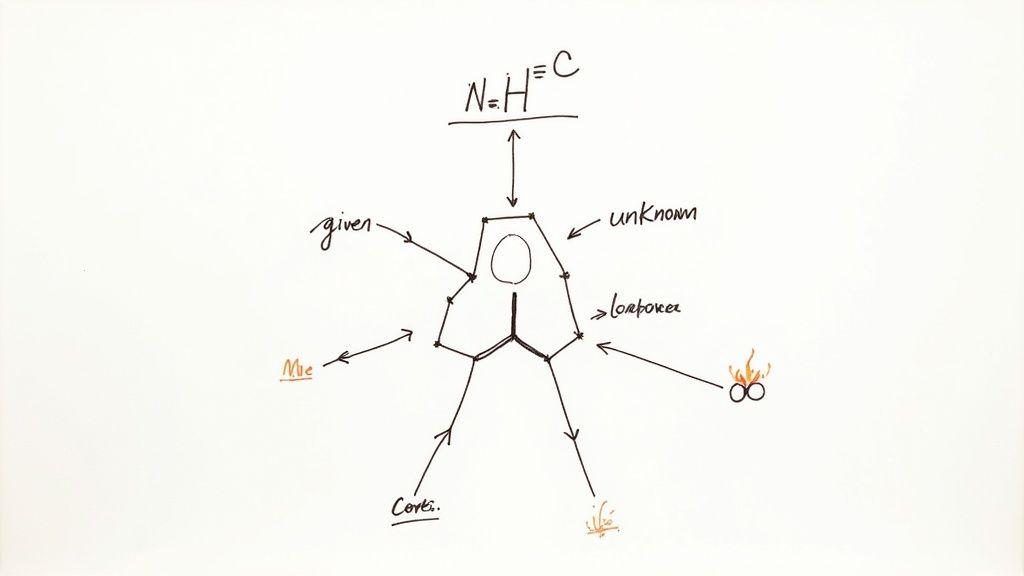
Let's be honest, chemistry homework can feel like you're trying to translate a foreign language. The equations and symbols are hiding the real questions. Your first move isn't to grab a calculator; it's to read the problem carefully. Then read it again. Before you even think about solving anything, you need to pull out three specific pieces of information.
This first pass is everything. A combustion reaction problem, for instance, is more than just balancing CH₄ + O₂. It’s testing your grasp of stoichiometry, the law of conservation of mass, and how to write chemical formulas correctly.
Identify the Core Concept
Before you write a single number, ask yourself a simple question: What did we just learn in class that this relates to? Are we talking about reaction rates, thermodynamics, or mole calculations? Nailing down the core concept immediately brings the right mental tools to the forefront.
For example, spotting words like “enthalpy” or “entropy” is a huge clue. You know you're working in thermodynamics, which means a specific set of formulas and rules apply. This act of categorizing the problem keeps you from getting bogged down in the details and makes it feel a lot less overwhelming.
Don't just solve for 'x'—figure out the why. Understanding the chemical principle behind the problem is the real difference between just passing a quiz and actually mastering chemistry. It's the best long-term strategy because you're learning to think like a chemist.
Break Down the Problem
Once you know the general topic, it’s time to dissect the question. Word problems trip up so many students, but they almost always contain the same basic parts. Try this simple framework to get organized:
- Given Information: Jot down every piece of data the problem gives you. This means all the numbers, units, chemical formulas, and starting conditions. For example, "Initial mass of reactant: 15.0 g" or "Volume of solution: 250 mL." Get it all on paper.
- The Unknown: State exactly what you're being asked to find. Are you solving for the final concentration? The mass of the product? The equilibrium constant? Writing this down makes your goal crystal clear.
- The Bridge: This is the most important step. How do you connect what you're given to what's unknown? You need to find the right formula, equation, or conversion factor that acts as the bridge. It might be the ideal gas law (PV=nRT) or a simple molar mass conversion. This is your roadmap.
Building Your Personal Support System

Let's be honest: nobody masters chemistry alone. It takes a village—or at least a solid support system. Having the right people and tools to turn to can be the difference between a head-scratching homework session and a true "aha!" moment.
Think of it like building a personal team. You have your coach (the teacher), your teammates (classmates), and your on-demand trainers (digital tools). Each one plays a unique role in helping you tackle tough problems and get the help in chemistry homework you need, right when you need it.
Lean on Your Classroom Crew
Your teacher is hands-down your best resource. But how you ask for help matters. Instead of just saying "I'm stuck," try to pinpoint the exact step where things went wrong.
Come to them with specific questions. For example, "I'm good with balancing the equation, but I get lost when I have to calculate the mole-to-mole ratio." This shows you’ve already put in the work and helps them get straight to the heart of the problem.
And don't forget about your peers! A small study group can be a lifesaver. There's something powerful about working through problems together. In fact, a 2018 study showed that students who learn collaboratively tend to achieve more and understand concepts on a much deeper level.
To get the most out of your study sessions:
- Have a Plan: Decide ahead of time which topics or problems you're going to focus on.
- Take Turns: Let one person lead the discussion for each problem to keep everyone engaged and on track.
- Stay Focused: It's tempting to chat, but keep the main goal in mind—cracking those chemistry concepts.
Tap into Digital Tools and AI Assistants
What happens when it’s 10 PM, your teacher is offline, and your study group has gone home? That’s where digital tools come in. Since 2020, the demand for online chemistry tutoring has shot up by about 45%, showing just how many students are looking for support online. If you're curious about this shift, you can explore the full analysis of the best chemistry solvers to see what's out there.
Modern platforms like 1chat can give you instant, step-by-step guidance. You’re not just getting an answer; you’re getting a walkthrough of the entire process. This is perfect for learning the why behind the solution, not just the what.
These tools act like a personal tutor, guiding you through the logic of a problem so you can apply it yourself next time. They're a fantastic supplement to what you learn in the classroom.
Key Takeaway: Don't rely on just one source for help. A great support system combines personalized feedback from your teacher, the brainpower of a study group, and the 24/7 availability of digital tools. This way, you’re never truly stuck on a chemistry problem again.
Learning Through Practical Examples
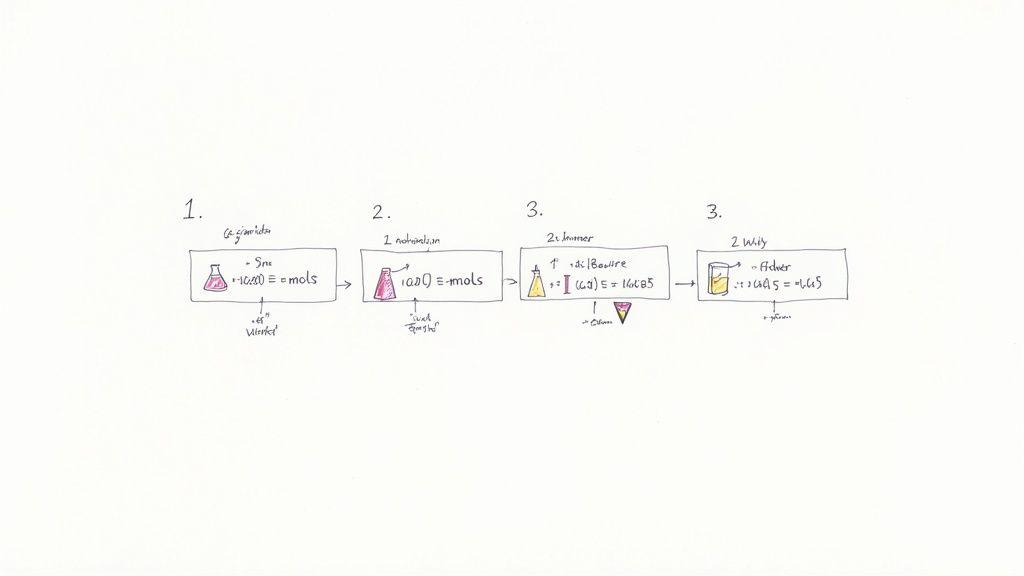
It’s one thing to watch a professor zip through a complex problem on the whiteboard. It’s another thing entirely to get the right answer on your own later that night. The real learning happens when you bridge that gap—moving from just watching to actually doing.
This means getting your hands dirty with worked examples. But don't just read them. Treat them like a blueprint you can use over and over again. We're going to walk through how to break down the logic, not just the math, so you can build a reliable method for tackling tough problems and get genuine help in chemistry homework.
Dissecting a Solved Problem
Let's take a classic stumbling block: a limiting reactant problem. You're given the mass of two different reactants and asked for the maximum amount of product you can make. It’s a multi-step puzzle that catches a lot of students off guard.
Instead of just glancing at the final number, your mission is to deconstruct the thought process. The goal isn't just to follow along, but to annotate the why behind every single calculation. Grab a pen and get ready to mark up the example.
Here’s how you could break down the steps and add notes in the margins:
- Conversion to Moles: Next to the calculation turning grams into moles, jot down: "Why? Because chemical equations are all about mole-to-mole ratios, not grams. This has to be the first move."
- Mole Ratio: At the point where the stoichiometric ratio is used, add this thought: "Why? This ratio, pulled straight from the balanced equation, is the heart of the problem. It tells me exactly how much product I can get from each reactant."
- Identifying the Limiting Reactant: When you see one reactant produces less potential product than the other, circle it and write: "This one is the limiting reactant. It's the bottleneck—it runs out first and controls the maximum yield."
- Calculating the Final Answer: Beside the final conversion back to grams, make a final note: "Why? The question asked for the answer in grams, so I have to convert the mole amount back to a mass using its molar mass."
By doing this, you've just transformed a static page in a textbook into your own personal, interactive study guide.
Applying the Blueprint Yourself
Now for the real test. Find a similar problem in your textbook or from an online worksheet. Make sure it has different numbers and compounds but follows the same core concept.
Lay your freshly annotated example right next to your blank notebook page. This isn't cheating; it's smart studying. You’re using a proven guide.
Follow your own notes as you tackle the new problem. First, convert your new masses to moles, just like your note says. Next, find the mole ratio from the new balanced equation. Your annotated example becomes a checklist, making sure you don't skip a crucial step in the logic.
By deconstructing a solved problem and then immediately using it as a guide for a new one, you burn the problem-solving logic into your brain. You’re not just memorizing steps—you’re understanding the sequence and the reason behind them. This is how you become a more confident, independent problem-solver.
This approach is one of the most powerful ways to get help in chemistry homework. It turns passive review into an active learning exercise, building the skills you need to eventually solve any problem thrown your way, no blueprint needed.
How to Double-Check Your Work and Boost Accuracy
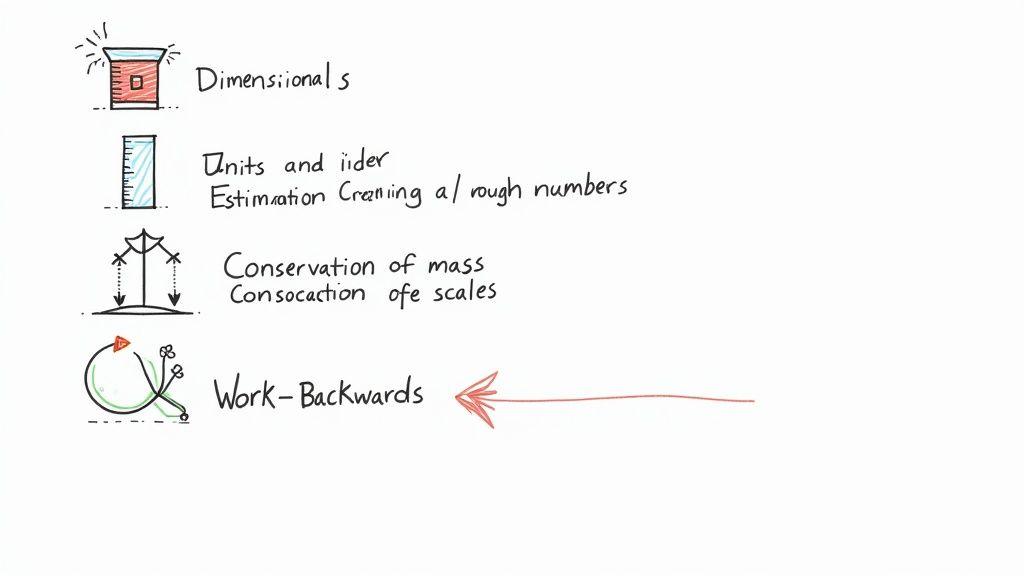
It’s one thing to get an answer on your paper. It’s another thing entirely to know, with confidence, that it’s the right answer. Handing in work you haven't checked is a bit like hitting "send" on a text without reading it over—a tiny mistake can change everything.
Building a solid habit of verifying your work is probably the most effective form of help in chemistry homework you can give yourself. This is how you shift from just doing the steps to truly thinking like a scientist. It’s all about developing those analytical muscles. For a closer look at this mindset, we have another guide that explores how to build critical thinking skills for students.
Use Dimensional Analysis as Your First Check
Forget about the numbers for a second. Look at the units. Dimensional analysis is your best friend for catching common slip-ups. It’s simply the process of checking that your units cancel out properly, leaving you with the unit you actually want for your final answer.
Think about it: if you're asked to calculate molarity (moles/liter) but your final units come out as grams/mole, you know immediately that something in your setup is off. It’s a quick, powerful check that can save you a ton of points.
Here’s how to put it into practice:
- Write everything down. Don't try to cancel units in your head. Put every conversion factor and unit on the page.
- Cancel as you go. As you multiply and divide, actually draw a line through the units that cancel out.
- Inspect the final unit. Is the last unit standing what the problem asked for? If not, it’s time to backtrack.
Run a Quick Sanity Check
Okay, the units look good. Now, take a step back and ask yourself a simple question: "Does this answer even make sense?" This is where a little bit of estimation goes a long way. Before you dive into the complex math, try to guess a reasonable range for the answer.
For example, if you're calculating the pH of a strong acid and your calculator spits out 9.5, a huge red flag should pop up in your mind. You know acids have a pH below 7. This "gut check" is fantastic for catching conceptual errors, not just simple math mistakes.
The goal isn’t just to get an answer—it's to get an answer that makes sense. A quick estimate or a backward calculation can reveal a misplaced decimal or a faulty assumption faster than re-doing the entire problem from scratch.
Another killer strategy is to work the problem in reverse. Take your final answer and plug it back into the original equation. If it gets you back to one of the starting numbers given in the problem, you can be pretty darn sure you nailed it. This doesn't just verify your work; it actually deepens your understanding of how all the variables are connected.
Finding the Right Kind of Chemistry Help
Let's be honest, hunting for the right chemistry help can sometimes feel as complicated as the homework itself. There are so many options out there, and what works for your lab partner might not be the best fit for you. The trick is to match the resource to your specific situation, your learning style, and, of course, your budget.
Think of it this way: a free study session with a friend is great for bouncing ideas around and getting a quick second opinion. But it hinges on your friend actually knowing the answer and both of you having the time to meet up. On the flip side, a professional tutor can provide incredible one-on-one support tailored just for you, but that expertise comes with a price tag.
Matching the Tool to the Task
So, how do you choose? Start by asking yourself what kind of help you actually need right now. Are you completely stuck on one tricky stoichiometry problem, or are you looking for consistent help to get you through the entire semester?
- Quick, Specific Problems: When you're burning the midnight oil and get stuck on a single question, AI homework helpers are a lifesaver. They're available 24/7 to give you an instant, step-by-step breakdown when your teacher is asleep.
- Deep Conceptual Understanding: For those "I just don't get it" moments, nothing beats a human. A great tutor, whether you meet online or in person, can re-explain concepts in a new way, answer all your follow-up questions, and make sure the knowledge really sticks.
- Collaborative Review: Getting ready for a big test? This is the perfect time to form a study group. It’s an awesome way to review notes, quiz each other, and talk through the material until everyone feels confident.
Lately, AI assistants have become a go-to for many students. They offer a fantastic middle ground—you get the instant availability of a digital tool combined with surprisingly detailed explanations. If you're curious about which ones are worth your time, our guide on the best AI for students is a great place to start.
Who’s Actually Using These Tools?
It’s not just one group of students looking for a little extra help. The demand for online chemistry resources is huge and comes from all age levels.
High school students (ages 14-18) are the biggest users, making up about 52% of the audience. College students aren't far behind at 31%. What’s really interesting, though, is the rise of adult learners, who now represent 17% of people seeking help online.
This trend shows a massive shift in how we think about education. In fact, 67% of parents now actively encourage their kids to use online learning tools for homework. That's a huge leap from just 22% back in 2015. You can actually discover more insights about these trends on GlobalAssignmentHelp.com.
To help you visualize your options, here’s a quick breakdown of the most common resources.
Comparing Chemistry Homework Help Options
| Resource Type | Average Cost | Availability | Best For |
| Teacher/Professor | Free | Limited (office hours) | Clarifying class material, asking in-depth questions. |
| Peer Study Group | Free | Depends on schedules | Collaborative review, quizzing, moral support. |
| AI Homework Helper | Free to Low-Cost | 24/7 | Instant step-by-step solutions, late-night help. |
| Online Forums | Free | 24/7 (response time varies) | Niche questions, seeing different approaches. |
| Private Tutor | $25 - $80+ per hour | Scheduled sessions | Personalized, one-on-one instruction for tough topics. |
Choosing the right tool at the right time is what really makes a difference. Don't be afraid to mix and match—use an AI helper for a late-night problem, meet with your study group before a quiz, and schedule time with your teacher to clear up a big concept.
Using Homework Tools Without Cheating
Let’s be honest. With a world of instant answers just a click away, the line between using a tool to learn and just plain cheating can feel a bit blurry. The key to getting real help in chemistry homework is using these resources to actually build your skills—not just to copy-paste an answer and call it a day. Academic integrity isn't just about following rules; it's about getting a genuine understanding that will stick with you long after you've submitted the assignment.
The difference really comes down to your intent.
Are you using an online solver to check an answer you already struggled through? That’s smart studying. Are you asking an AI for a hint to get past one specific step that’s tripping you up? That’s a great way to learn. But if you’re just plugging in the problem and writing down the solution without a second thought, you're only cheating yourself in the long run.
From Copying to Comprehending
The first thing to do is shift your mindset. Stop thinking of these homework tools as answer keys. Instead, start seeing them as on-demand tutors. Their true value isn't in spitting out the final answer, but in illuminating the step-by-step process you might have missed.
Here are a few ways to use these aids ethically and effectively:
- Work First, Check Later: Always try to solve the problem on your own first. Give it your best shot. Only then should you use a tool to verify your answer and, more importantly, compare your method to its own.
- Ask for Clues, Not Conclusions: If you’re truly stuck, frame your question for a hint. Ask something like, "What's the first step for solving a limiting reactant problem?" or "Can you explain the mole-to-mole ratio in this equation?"
- Rewrite the Explanation: After you get a worked-out solution, close the tab. Now, try to write out the entire explanation in your own words, from start to finish. This little trick forces your brain to actually process the logic.
The goal here is to become an independent problem-solver. Using a tool to learn a method is a win. Using it to avoid learning is a failure that will become painfully obvious on your next exam. True understanding is the only thing you can actually bring with you into the test.
The consequences for cheating are real, from a zero on an assignment to much more serious disciplinary action. But the hidden cost is the gaping hole it leaves in your knowledge. Chemistry concepts are like building blocks; if you skip a foundational one, the whole structure will be wobbly when you try to learn the next topic.
This is especially true for complex subjects like organic chemistry, where understanding how a reaction happens is way more important than just knowing the final product. To dig deeper into this, check out our guide on using an organic chemistry solver for strategies to truly master the material. When used responsibly, these tools can help you learn more deeply and efficiently than ever before.
Got Questions About Chemistry Homework? We've Got Answers.
Chemistry can feel like learning a whole new language, and it's completely normal to have questions when you're deep in a problem set. Wondering what tools are out there or how to use them without crossing a line? You're not alone. Let's tackle some of the most common questions students have.
This isn't just about finding quick fixes. It's about building a solid foundation and real confidence in the subject. Getting smart, targeted help is what separates the students who struggle from those who succeed.
What If I'm Stuck on Homework Late at Night?
It’s 11 PM, your assignment is due tomorrow, and your teacher logged off hours ago. So, how can you get immediate help in chemistry homework? Your best bet is to look online.
- AI-Powered Tools: An AI chemistry solver like 1chat can be a lifesaver. These platforms are available 24/7 and are designed to give you step-by-step breakdowns of even the toughest problems.
- Online Tutors: Many services offer live, on-demand tutoring. You can connect with a real chemistry expert in just a few minutes, no matter the time zone.
- Student & Expert Forums: Don't underestimate the power of community. Websites like the Chemistry Stack Exchange or Reddit forums (think r/chemhelp) often have knowledgeable people ready to offer surprisingly fast and helpful advice.
Is Using a Chemistry Solver Cheating?
This is a big one, and the answer really boils down to how you use the tool.
The line between a powerful study aid and academic dishonesty is all about your intent. Are you using it to understand the why behind the answer? Great. Use it to check your work after you’ve already tried, or to get a hint on one specific step that’s holding you up. But if you’re just copying the final answer without trying to learn the process, you’re not only cheating yourself out of an education but also likely breaking your school's academic integrity rules.
Which Chemistry Topics Are the Toughest?
Ever feel like you’ve hit a wall with a particular concept? Chances are, you’re not the only one. Tutoring services and educational data consistently show that a few key areas trip up most high school and first-year college students.
Stoichiometry is often the number one roadblock, especially when you get into mole-to-mole conversions and figuring out limiting reactants. Right behind it are thermodynamics (wrapping your head around enthalpy and entropy), tricky acid-base equilibria, and the often-intimidating rules of organic chemistry nomenclature. Knowing these are common hurdles can help you focus your study time where it'll make the biggest impact.