Summarizing a research paper is all about boiling down a dense, complex study into a short, clear overview of what matters most. The real skill is in pulling out the core research question, methods, key findings, and conclusions and explaining them in your own words. You're creating a quick, accurate snapshot of the original work.
Why Summarizing Research Is a Modern Superpower
We're all drowning in information, so being the person who can quickly grasp and share the gist of a complex research paper isn't just a handy academic skill—it's a serious professional advantage. This ability gives you an edge whether you're a student trying to keep up, a researcher on a deadline, or a business leader making a critical decision.
This isn't just about making a long document shorter. It’s about learning to spot the signal in the noise. You’re training yourself to pull out the most valuable nuggets of information while filtering out all the secondary details that can bog you down.
The Hidden Cost of Manual Summaries
The time it takes to do this manually is shocking when you add it all up. Recent research in educational technology found that about 73% of college students spend somewhere between 3-5 hours summarizing a single paper by hand. For a student with a full course load, that can balloon to over 240 hours in a single academic year. You can dig into more of these trends and what they mean for academic writing over at Grammarly.
And this isn't just a student problem. In the modern workplace, with remote and hybrid teams, synthesizing information is a constant demand. In fact, 62% of professionals say that piecing together insights from multiple documents is a regular part of their job. Getting faster at it is a huge productivity win.
A great summary doesn't just save you time; it forces a deeper level of understanding. By making yourself identify and articulate the core ideas, you internalize the information much more effectively than if you just read it passively.
From Academic Chore to Strategic Advantage
Once you start seeing summarization as a strategic skill, its purpose completely changes. It’s no longer just another assignment to get through; it becomes a powerful tool that pays off everywhere.
- For students, it means better grades and real learning. When you can summarize well, you can write sharper essays and show a much deeper grasp of the material.
- For teams, it means more efficient work. In any business, the person who can share a clear, concise summary of an industry report keeps the whole team in the loop without creating information overload.
- For leaders, it means smarter decisions. Executives need distilled information to make fast, smart choices. A solid summary of market research can uncover an opportunity or a risk that would have otherwise been lost in a 50-page report.
This is what it looks like to turn dense research into a real, actionable advantage.
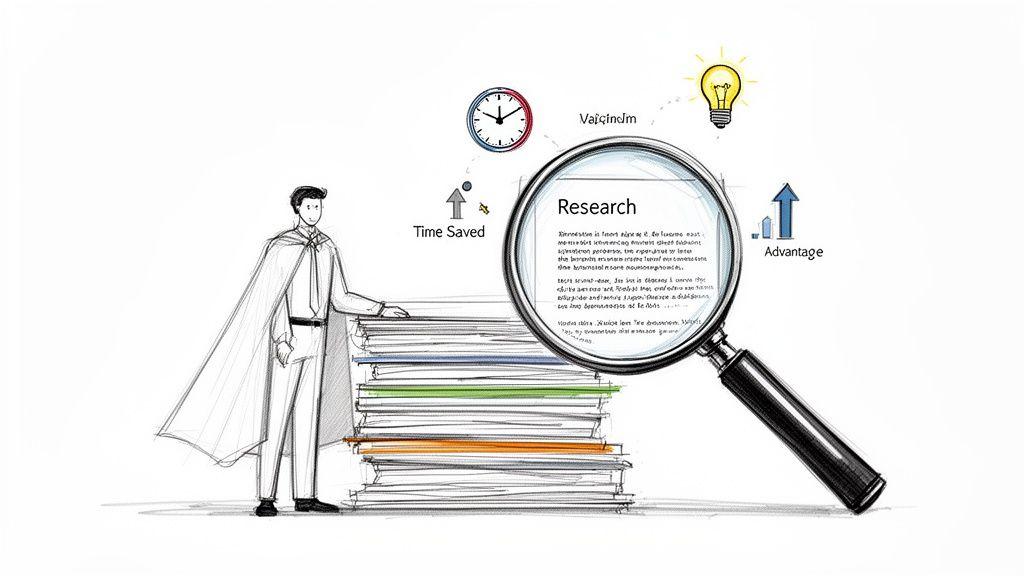
This image perfectly captures the idea of summarization as a power—the ability to turn raw data into a clear edge. The good news is that technology is making this "superpower" much easier to develop. AI-powered tools like 1chat are completely changing the game, helping anyone learn how to summarize a research paper with more speed and accuracy than ever before.
Read Strategically Before You Write A Word
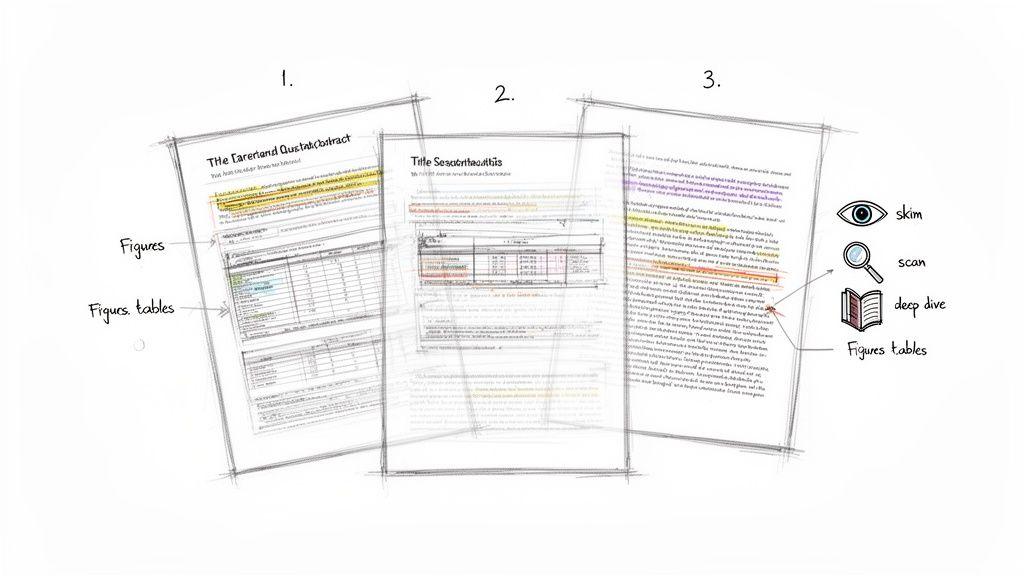
Here's a secret that experienced researchers know: a great summary starts with smart reading, not fast writing. If you try to summarize a paper by reading it cover-to-cover, you're setting yourself up for a long, frustrating process. It’s like trying to build IKEA furniture without glancing at the diagram first—you might get there, but it won’t be pretty.
A much better way is to use a multi-pass reading method. This approach helps you dismantle the paper with purpose, ensuring you grab the most important information without getting bogged down in the dense, technical jargon. Think of it less as a long journey and more as a targeted reconnaissance mission.
The First Pass: Skim for the Core Idea
Your first objective is simple: get the gist of the paper in about five minutes. This isn't about deep understanding; it's about getting a bird's-eye view. A quick skim of the highest-impact sections is all you need.
Here’s what to read, in this order:
- Title and Keywords: These tell you the topic and scope right away.
- Abstract: This is the author's own mini-summary. It's your cheat sheet.
- Introduction: Zero in on the last paragraph. It almost always states the specific research question or hypothesis.
- Conclusion: This section wraps up the main findings and tells you why they matter.
After this quick pass, you should be able to answer one question: "What problem were they trying to solve, and what was the main takeaway?" If you can't, give those same sections another quick scan.
The goal of the first pass isn't comprehension; it's orientation. You are simply creating a mental map of the paper's structure and core argument. This map will guide you through the more detailed passes that follow.
The Second Pass: Scan for Supporting Evidence
Now that you have the main idea, it’s time to hunt for the evidence. This pass is about scanning, not reading. Your eyes should be moving quickly, looking for the signposts and data that form the study's backbone.
Focus your attention on these elements:
- Figures and Tables: I always look at the visuals first. They are often the most information-dense parts of a paper and present the key results in a format that's easy to digest. Make sure you read the captions.
- Topic Sentences: Skim the first sentence of each paragraph, particularly in the Methods and Results sections. These sentences usually summarize the paragraph's main point, giving you a rapid overview of the experiment and its outcomes.
This scan helps you connect the "what" from your first pass with the "how" and "why" of the research. You'll start to see exactly how the authors arrived at their conclusions. This is also a great time to start taking notes. If you're looking for a good system, check out our guide on how to organize research notes.
The Third Pass: Deep Dive for Critical Details
You've mapped the terrain and spotted the landmarks. Now it's time for a targeted deep dive—but only where it counts for your summary. For most people, this means focusing your energy on the Discussion and Limitations sections.
The Discussion is where the authors interpret their findings and explain what it all means in the bigger picture. The Limitations section is just as crucial; it provides essential context about what the study doesn't prove. Acknowledging these limitations is the key to writing an honest and accurate summary.
This three-pass system turns a daunting task into a manageable process. It ensures you read with a clear purpose, arming you with a solid understanding of the paper's essential components before you even think about writing that first sentence.
Building Your Summary With Six Core Components
So, you’ve done the heavy lifting and picked apart the research paper. You have a pile of notes and highlighted sections. Now what? The difference between a jumble of facts and a genuinely useful summary lies in the structure.
Think of it as assembling a skeleton. A powerful summary needs a solid frame to hold everything together. Without it, you just have a heap of bones. To make your summary stand out, you need to consistently include six essential elements. Getting this right is what separates a novice summary from a professional one.
The “Why”: What Was the Core Question?
First things first, you have to nail the "why." What problem were the researchers trying to solve? What question drove their entire investigation? This is the anchor for your whole summary, and it’s usually hiding in plain sight toward the end of the paper's introduction.
Get straight to the point. Start with something clear like, "The study’s main goal was to see if..." or "Researchers investigated the link between..." This immediately tells your reader what the paper is all about.
The “How”: What Was the Methodology?
Next, you need to explain how the researchers actually did the work. You don't need to write a novel here, just a quick snapshot of their approach. Was it a survey? A clinical trial? A series of lab experiments?
Mentioning the specific methods or tools they used adds a ton of credibility. For instance, you could write, "The team used functional MRI (fMRI) to monitor brain activity..." This shows you understand the foundation of their research, not just the results.
The “Who”: Who or What Was Studied?
This part is crucial for context. Who were the subjects of the study? Were they college students, lab mice, or patients with a specific condition? Be specific about the group.
Always include key details like the sample size (e.g., "500 adult participants"), age range, and any other important demographics. This information is critical because it defines the scope of the findings.
A finding from a study on 20-year-old male athletes might not apply to a group of 65-year-old women. Specifying the participants helps the reader understand who the results are most relevant to.
The “What”: What Were the Key Findings?
This is the heart of your summary. What did the researchers discover? Lay out the most important results clearly and concisely. And whatever you do, use the numbers.
Vague statements like, "The new drug worked well," are useless. Instead, quantify it: "The group taking the new drug saw a 35% reduction in symptoms, while the placebo group only saw a 5% reduction." Numbers make the findings real and impactful. Remember to put these results into your own words—if you need a hand with that, check out this excellent guide on how to paraphrase without plagiarizing.
The “So What”: What Were the Author's Conclusions?
After you've presented the raw findings, you have to explain what it all means according to the authors. How did they interpret their own data? This is where they connect the dots and explain the significance of their work.
This is different from the findings. For example:
- Finding: "Group A scored 20 points higher than Group B."
- Conclusion: "These results suggest that the new teaching method significantly improves student performance."
Your job is to report their interpretation, not your own. Stick to what the paper says.
The Caveats: What Were the Limitations?
Finally, a truly great summary acknowledges the study's limitations. No research is perfect, and good researchers are upfront about that. They’ll almost always discuss the weaknesses of their study in the discussion or conclusion section.
Mentioning limitations shows that you’re thinking critically, not just taking the results at face value. It could be a simple sentence: "The authors noted that the small sample size makes it difficult to generalize the findings." This adds a layer of academic honesty and keeps everyone’s expectations realistic.
To give you a quick reference, here’s a checklist you can use to make sure you’ve covered all your bases every single time you write a summary.
Essential Components of a Research Summary
| Component | Purpose | What to Include |
| Objective | Sets the context and explains the "why" | The central research question, problem, or hypothesis. |
| Methodology | Establishes credibility and explains the "how" | The study type (e.g., survey, trial), key techniques, and tools used. |
| Participants | Defines the scope and relevance of the findings | The sample size, demographics (age, gender), and key characteristics. |
| Key Findings | Presents the core results of the study | The most significant outcomes, including specific numbers and statistics. |
| Conclusions | Explains the meaning and importance of the results | The authors' own interpretation of their findings; the "so what." |
| Limitations | Provides critical context and ensures honesty | Any weaknesses or boundaries mentioned by the authors (e.g., small sample). |
Mastering these six components is the most important step in learning how to summarize research effectively. In fact, summaries that hit all these points are rated as 87% more useful by readers. For a deeper dive, this guide from Scholarcy offers a great breakdown of why each element is so vital.
How To Tailor Summaries For Different Audiences
A great summary is never one-size-fits-all. The summary that earns you an A in a graduate seminar will fall completely flat with your boss, and what works for your boss would be baffling to the general public. Learning how to translate a research paper for a specific audience is the final, and most critical, piece of the puzzle.
The key is to change your mindset. Don't just report what the paper says. Instead, get inside your audience's head and figure out what they need to do with the information. Are they looking for academic gaps, business opportunities, or just a simple answer to "what does this mean for me?" You have to speak their language.
Summarizing for an Academic Audience
When you're writing for a professor, a thesis committee, or other researchers in your field, your goal is to prove you've done the work. You need to demonstrate a deep, critical understanding of not just the paper itself, but its place in the wider academic conversation.
In this context, your summary has to hit these specific notes:
- Methodological Rigor: Don't just say they "did a study." You need to be precise. Mentioning it was a "longitudinal cohort study using regression analysis" is exactly the kind of detail this audience expects.
- The Hard Numbers: Stick to the data. Use the actual statistics reported in the findings, like "a statistically significant correlation of r = .45." This shows you're not just paraphrasing but actually interpreting the results.
- Scholarly Context: Where does this study fit? Briefly explain how it confirms, challenges, or refines what's already known in the field. This shows you've read beyond this single paper.
- Critical Limitations: Acknowledging the study's weaknesses is a sign of strength, not a criticism. It proves you’ve read the paper with a critical eye and understand the boundaries of the conclusions.
Your tone should be formal, objective, and surgically precise. This isn't the place for sweeping generalizations; stick to the evidence the authors provide.
For an academic summary, the real goal is to prove comprehension. Your professor wants to see that you can take the research apart, understand how it works, and accurately place it within the larger body of scientific work.
Summarizing for a Business Team
When your audience is your boss, your product team, or other company stakeholders, the rules change completely. They don't have time for methodological debates or p-values. They have one question: "How does this help us win?" Your job is to be a translator, turning academic jargon into actionable intelligence.
For a business audience, always lead with the bottom line up front (BLUF). Start with the single most important takeaway. For instance: "A new study in JMR shows customers are 40% more likely to buy when they see social proof on a product page."
From there, you build your case:
- Actionable Insights: What should the team do now? Translate the findings into a clear recommendation. "Based on this, we should immediately test adding customer testimonials to our top 5 product pages."
- The Competitive Angle: How does this information give you an edge? Frame it in terms of a new opportunity, a potential risk to mitigate, or a market shift you can get ahead of.
- ROI Potential: If the research involves a new process or tool, touch on the potential return on investment. Is this a cheap experiment with a big potential upside? Say so.
Keep your language simple and direct. Use bullet points and bold text to make the key points impossible to miss. You’re not writing a report; you’re delivering a strategic brief.
Summarizing for the General Public or Non-Experts
This can be the toughest audience of all. When you're writing for a blog, a company newsletter, or just explaining a study to a friend, you have to strip away all the jargon and make it personal.
Here’s a good framework:
- Tell a Relatable Story: Hook them with a problem they recognize. "Ever hit that 2 PM wall and feel like you can't focus?" Then, present the research as the hero of the story—the explanation or the solution.
- Lean on Analogies: Complex ideas land better when you compare them to something familiar. If you're explaining brain activity, you might say it's like "a city's electrical grid during rush hour." It's not perfectly accurate, but it gets the main idea across instantly.
- Answer the "So What?": This is the only question that matters to a general audience. Why should they care? Make the answer explicit. "What this research really means is that a simple 10-minute walk after lunch could be all you need to beat that afternoon slump."
Your tone should be conversational, warm, and engaging. Imagine you're explaining a cool new fact you just learned to a friend at a coffee shop. The goal isn't to be exhaustive—it's to spark a little curiosity and leave them with one memorable, useful idea.
Once you’ve got the hang of how to read and structure a summary, it’s time to bring in some serious firepower: artificial intelligence. Using AI as a research partner can slash the time you spend summarizing, often while making your final draft even sharper. This isn't about handing over the reins; it's about smart collaboration.
You’re still the expert calling the shots. Think of it as a partnership where AI handles the initial grunt work, and you provide the critical thinking and direction. The trick is to learn how to guide the AI with specific instructions, turning what was once a long slog into a quick, dynamic process.
Shifting to an AI-Assisted Workflow
An AI tool like 1chat can act as your first-draft generator. Instead of spending an hour or more just reading and taking notes, you can upload the research paper's PDF and have a solid summary draft in front of you within seconds. This isn't the finished product, but it's a fantastic head start.
From that point on, your role changes. You're no longer the one digging through the text; you're the editor and strategist. You'll use your understanding of a good summary's core components to refine what the AI gives you. This is where targeted prompts come into play.
Here’s how that might look:
- For specifics: "Pull the key statistical findings from the Results section."
- To find weaknesses: "List the study's limitations as mentioned by the authors."
- For clarity: "Explain the methodology in simple terms, focusing on the experimental setup."
This back-and-forth lets you quickly gather all the pieces you need for your summary. The hours once lost to manual searching and note-taking can now be compressed into just a few minutes.
How AI is Changing the Game
This isn't just a theory; the numbers show a real change in how people work. Since around 2020, AI summarization has completely reshaped research workflows. Recent data shows that 67% of college students now use some form of digital assistance for summarizing, a huge leap from only 12% back in 2018.
The savings are just as impressive for small businesses. Teams of 20-50 people report saving between $15,000 and $25,000 a year by using AI for tasks like market research analysis.
To see just how much time this can save, let's compare the workflows side-by-side.
Manual vs AI-Assisted Summarization Workflow
| Task | Manual Method (Time) | AI-Assisted with 1chat (Time) |
| Initial Read-Through | 30–60 minutes | N/A (AI does this) |
| Generating 1st Draft | 45–75 minutes | 1–2 minutes |
| Extracting Key Data | 20–30 minutes | 3–5 minutes |
| Refining & Editing | 15–25 minutes | 15–25 minutes |
| Total Time | ~2.5–3.5 hours | ~20–30 minutes |
As you can see, the AI-assisted approach doesn't eliminate your role—it just removes the most time-consuming parts. You still spend time refining and ensuring quality, but you get to the finish line in a fraction of the time.
The best way to use AI isn't to replace your thinking, but to accelerate it. The AI gathers the raw materials—the facts and figures—while you provide the structure, context, and critical eye.
This is especially helpful when you need to tailor your summary for different people. An AI can quickly rephrase content for various levels of expertise, a task that would be tedious to do manually.
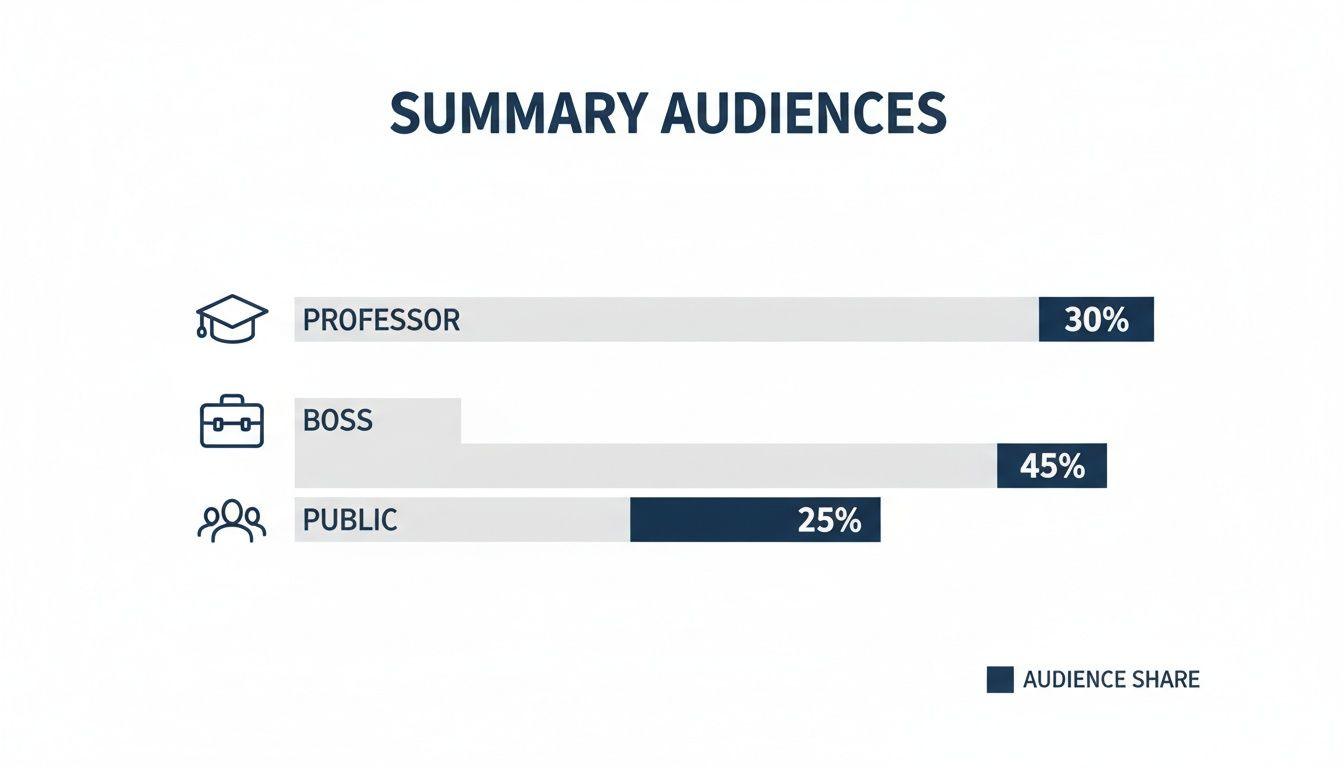
As the chart suggests, a summary for your professor needs granular detail, one for your boss demands actionable takeaways, and one for the public has to be straightforward.
Prompting Like a Pro for Better Summaries
Vague prompts give you vague, unhelpful summaries. If you want a top-notch result, you have to get good at giving specific directions. Don't just ask, "Can you summarize this paper?" Instead, steer the AI with a series of focused commands.
Let's say you're tackling a dense medical study. You could run a sequence of prompts like this:
- "Summarize the main objective and hypothesis of this paper in a single sentence."
- "Now, describe the study's methodology. Tell me the sample size, participant demographics, and how long the trial ran."
- "List the three most important quantitative findings from the results. Include p-values if they are mentioned."
- "Based on those findings, what conclusions did the authors reach?"
- "Finally, rephrase that conclusion for someone without a medical background, focusing on the real-world health impact."
Each prompt builds on the one before it, letting you construct your summary piece by piece. This method also keeps you in control, as you’re constantly checking each part against the original paper. It ensures accuracy and lets you shape the final story, something a single, broad prompt could never do.
By mastering these prompting techniques, you can find more strategies and tools by exploring our guide on the best AI tools for academic research. You’ll turn a simple chatbot into an indispensable research assistant, making the job of summarizing papers faster and more effective than ever.
Common Questions About Summarizing Research Papers
Even when you have a great system in place, a few nagging questions always seem to surface when you’re wrestling with a dense research paper. It’s totally normal. I’ve seen students and professionals alike get tripped up on the same details, from word counts to the gray areas of using AI.
Let's clear up some of that confusion. Answering these common questions now will make your entire process feel much smoother and more professional.
How Long Should a Research Paper Summary Be?
There’s no universal rule, but a solid starting point is to aim for about 10% of the original paper’s length. For a typical 10-page academic paper, which is often around 3,000 to 4,000 words, that puts your target at a concise 300 to 400 words. That’s usually the sweet spot for covering the key components without getting bogged down.
Of course, the real answer always depends on who you're writing for. Context is everything.
- For an executive brief: You might need to be ruthless. The goal is a single, hard-hitting paragraph, maybe 150 words tops.
- For your personal study notes: Feel free to make it longer. This is your space to capture specific quotes or data points you need to nail that exam.
- For a literature review: The summary needs to be tight but also substantive enough to build a larger argument, focusing on how this one paper fits into the broader scholarly conversation.
Before you even start writing, just ask yourself: "Who is reading this, and what do they really need to know?" Your answer is your guide.
Can I Copy Sentences Directly From the Paper?
Let's be blunt: absolutely not. Lifting sentences or even unique phrases from the source without quotation marks isn’t summarizing—it’s plagiarism. Plain and simple. The entire point of a summary is to prove you understand the material well enough to distill it into your own words.
A fantastic little trick to avoid accidentally plagiarizing is what I call the "read, hide, write" method. Read a key section, then physically look away or cover the text. Now, try to write out the main idea from memory. This forces your brain to actually process the information instead of just shuffling words around.
Following this simple habit ensures you’re truly paraphrasing—using your own vocabulary and sentence structures to convey the author's ideas. It's the foundation of all ethical, effective summarizing.
What Is the Most Common Mistake When Summarizing?
The single most common mistake I see is injecting personal opinions or critiques into the summary. A summary is not a review. Its job is to be an objective, neutral report of what the authors did, what they found, and what they concluded.
Save your thoughts on the research—whether you think it's brilliant or deeply flawed—for a separate critique.
Another classic blunder is getting lost in the weeds of the paper's introduction. Many writers burn too many words on the background details. Instead, zero in on the new contribution of the study. What new knowledge did this specific paper bring to the world? That’s the real story you're there to tell.
Is It Okay to Use AI for My School Assignments?
Using an AI tool like 1chat can be a great way to jumpstart your research, but you have to walk a fine line of transparency and ethics. Your first move, always, is to check your school's academic integrity policy. Every institution has its own rules, and it’s on you to know and follow them.
Think of AI as a research assistant, not a ghostwriter. Here’s how to use it responsibly:
- Generate a first draft: Let the AI create an initial summary to help you spot the key points quickly.
- Verify everything: This is non-negotiable. Go back to the original paper and fact-check every single claim, number, and finding the AI gave you. AI hallucinates.
- Rewrite from scratch: Using the verified points as your outline, write the entire summary in your own voice.
- Internalize the content: Make sure you truly understand the material. If you can't explain it without your notes, you're not done yet.
Under no circumstances should you ever submit a purely AI-generated summary as your own work. It's academically dishonest, and it completely bypasses the real goal of the assignment: for you to actually learn something.