Staring at a blank page labeled "Marketing Plan" can be completely paralyzing. Let's be honest, most of us have been there. To build a plan that actually gets results, you need to define clear goals, get to know your audience inside and out, figure out what makes you different, and then pick the right places to tell your story.
This guide is your blueprint for creating a living, breathing strategy that drives real growth.
Your Modern Marketing Plan Blueprint
Forget those dusty, 50-page binders that get created once and then sit on a shelf. A truly effective marketing plan in 2026 is a dynamic roadmap, not a static document. It’s the critical link between your big-picture business goals and the day-to-day work your team does. Without it, your marketing efforts can feel scattered, leading to wasted money and missed chances to connect with customers.
This introduction will walk you through the essential pieces of a modern strategy, from setting your first goal all the way to measuring what worked.
The Foundation of Modern Planning
Building a solid marketing plan boils down to a few core, connected stages. I’ve seen it time and again: you can't just jump straight to posting on social media.
It all starts with your business goals. From there, you dig deep to understand the people you’re trying to reach. Only then can you make smart decisions about where and how to communicate with them. This simple flow—goals, audience, channels—is the bedrock of any successful plan.
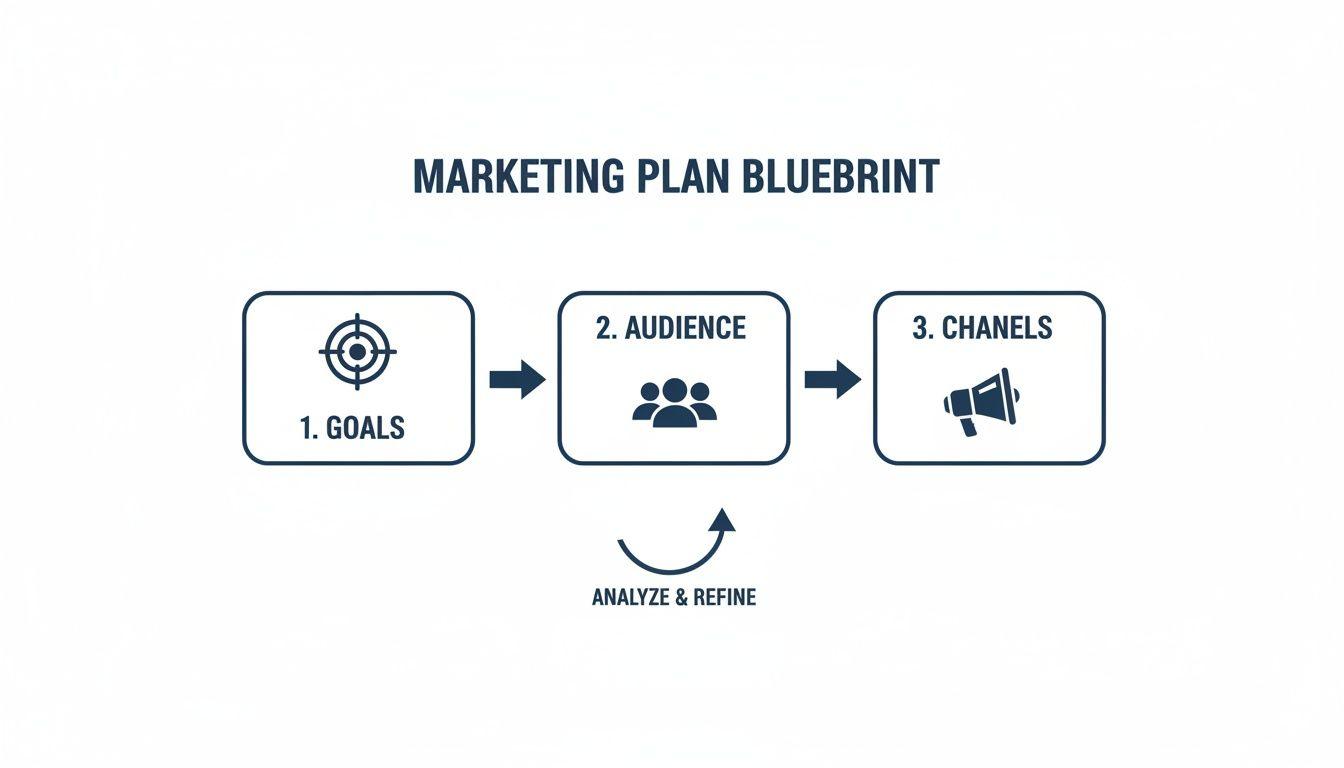
The key takeaway here is that you can’t pick the right channels without first knowing your objectives and understanding your audience's habits. It’s a constant cycle of doing, learning, and refining.
To put it simply, every effective plan today needs a few key ingredients. Here’s a quick rundown of the core components we’ll be covering.
Core Components of a Modern Marketing Plan
| Component | What It Is | Why It Matters in 2026 |
| Goals & Objectives | Clear, measurable targets for your business (e.g., increase leads by 20%). | It aligns marketing with business success and prevents "busy work." |
| Audience Research | Deeply understanding your customer's needs, pain points, and behaviors. | Personalization is no longer a bonus; it's an expectation. |
| Value Proposition | The unique benefit or solution you offer that no one else does. | In a crowded market, being different is your biggest advantage. |
| Channel Strategy | Choosing the right platforms (social, email, SEO) to reach your audience. | Your customers aren't everywhere, so you shouldn't be either. Focus your efforts. |
| Budget & Timeline | Allocating resources and setting realistic schedules for your activities. | It turns your plan from a wish list into an actionable project. |
| KPIs & Measurement | The specific metrics you will use to track progress toward your goals. | This is how you prove ROI and make data-driven decisions to improve. |
Think of these as the building blocks. Get them right, and you'll have a sturdy foundation for everything that follows.
The Role of AI in Your Marketing Plan
Knowing how to write a marketing plan today also means knowing how to work with new technology. By 2026, artificial intelligence isn't just a shiny new toy; it's a fundamental part of the toolkit. In fact, 61% of marketers now believe AI is causing the biggest disruption to the industry in 20 years.
This shift means we have to think of AI as a core part of our planning process, not just an add-on.
AI is like having a super-smart assistant on your team. It can help you brainstorm campaign ideas, analyze thousands of customer reviews in minutes, or even draft initial content. It makes sophisticated marketing accessible to everyone.
This technology helps you move faster and make smarter, data-backed decisions. For example, you can use AI to quickly scan your competitors' websites and pinpoint gaps in their strategy that you can exploit. If you're curious about how to put this into practice, check out our guide on using AI tools for competitive analysis. We'll show you how to turn these powerful tools into a real-world advantage.
Defining Your Mission and Setting Measurable Goals
Let's be honest: a marketing plan without clear goals isn't a plan at all. It's a wish list. This is the first, and most critical, step. It’s what separates purposeful action from just being busy. Before you can figure out how to market your business, you need to lock down why you're doing it and what success actually looks like.
Your marketing goals have to flow directly from your core business mission. If you run a company that provides affordable accounting software for freelancers, your marketing shouldn't be chasing enterprise clients. It should be laser-focused on generating leads from the freelance community. This alignment is what ensures every dollar and hour you spend is pushing the business forward.
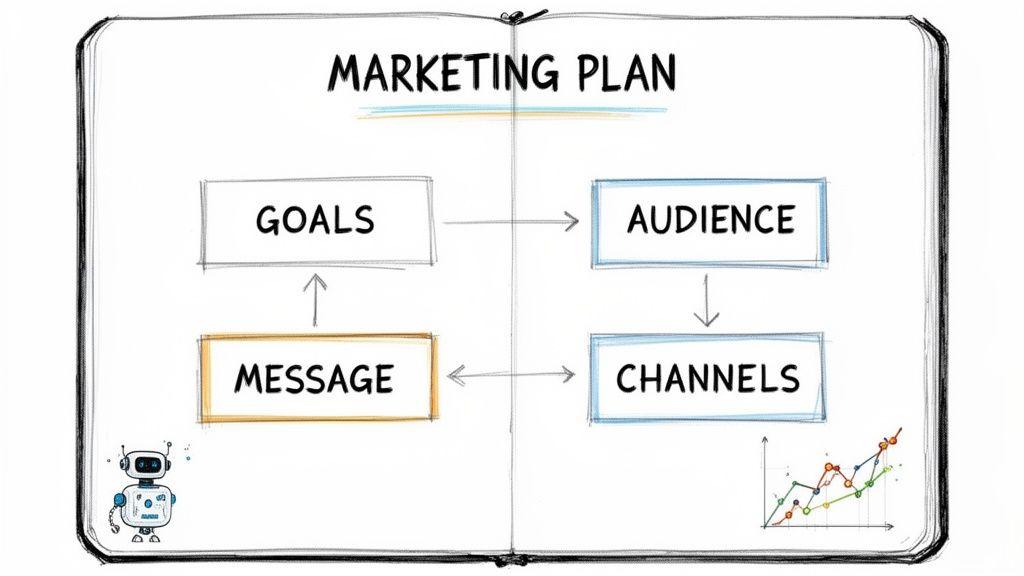
The trap many people fall into is setting fuzzy targets. "Increase brand awareness" or "get more website traffic" sound great, but they're impossible to pin down. How do you know when you've actually succeeded? More importantly, how do you prove to yourself or your boss that your marketing is actually working?
Moving from Vague Ideas to SMART Goals
The fix for this is the SMART framework. It's a classic for a reason—it’s a simple but incredibly effective tool for turning those vague ideas into solid, actionable objectives. Every goal you set needs to pass this test:
- Specific: Nail down exactly what you want to achieve. Instead of "more leads," get specific: "increase qualified leads from organic search."
- Measurable: You have to be able to track it. Use a number, a percentage, or a dollar amount.
- Achievable: Be ambitious, but don't set yourself up for failure. Your goal should be realistic given your team, budget, and timeline.
- Relevant: Does this goal actually help the business? Make sure it directly supports a bigger objective, like increasing revenue or grabbing more market share.
- Time-bound: A deadline creates urgency and a clear finish line. Without it, goals tend to drift.
Setting SMART goals transforms your marketing from an expense into an investment. When you can confidently say, "We invested $5,000 in this campaign and generated 500 new leads," you're speaking the language of business growth and proving your value.
A perfect example comes from a family travel blog I followed. Their goal was: "Grow our email subscriber list from 500 to 2,000 subscribers in the next 6 months to increase affiliate revenue." It's specific, you can measure it, it's a realistic stretch, it’s relevant to their income, and it has a deadline. That’s a target you can build a real plan around.
Tying Marketing Goals Directly to Revenue
Ultimately, marketing has to contribute to the bottom line. The best goals have a clear and direct path to revenue. While metrics like social media likes or shares are useful health indicators, they aren't the end goal. You have to connect those early-stage activities to actual business results.
Today’s most effective marketing plans focus on hard numbers. You'll see goals like increasing qualified leads by 40% within 12 months or pushing web conversion rates from 1.2% to 2.0% in 6 months. This sharp focus on measurable outcomes shows how marketing has become a core revenue driver, a trend highlighted in recent industry analysis of marketing's evolving business impact.
Let's ground this with a few real-world scenarios.
Example Scenarios for Different Businesses
- For a Small E-commerce Store: A vague goal is "sell more products." A much stronger SMART goal is: "Increase the average order value (AOV) by 15% from $50 to $57.50 by the end of Q3 by implementing a product recommendation engine and a 'customers also bought' feature."
- For a Local Service Business (e.g., a plumber): Forget "get more calls." A better goal is: "Generate 25 new qualified quote requests per month through our optimized Google Business Profile and local SEO efforts within the next 4 months."
- For a B2B SaaS Company: "Improve brand reputation" is too soft. A powerful, measurable goal would be: "Reduce customer churn from 4% to 2.5% over the next 12 months by launching a new customer onboarding email sequence and hosting quarterly user training webinars."
Each of these examples gives you a clear target, a deadline, and a direct link to a business result. This kind of clarity is the engine of a successful marketing plan. It empowers your team to make smart decisions and focus their creativity where it will have the biggest impact.
Get to Know Your Audience and Nail Your Message
You've got your goals locked in. Great. But who are you actually talking to? Even the most brilliant marketing plan will fall completely flat if it’s aimed at the wrong crowd. To really hit the mark, you need to get inside your audience's head—not just with surface-level details, but with a real understanding of what makes them tick.
Let's be honest, the old-school buyer persona—"Sarah, a 35-year-old mom who likes yoga"—is basically useless. That tells you next to nothing about her actual problems or motivations. What’s keeping her up at night? What does she wish she had more time for? What truly makes her feel seen by a brand?
Look Past the Obvious Demographics
To forge a genuine connection, you have to paint a picture of your audience based on their behaviors, their biggest frustrations, and what they secretly hope for. This is where you put on your detective hat and dig into the data you already have.
- Scour your customer feedback. Dive into support tickets, product reviews, and sales call notes. Are the same questions popping up over and over? What complaints do you see? This is a goldmine of raw, unfiltered customer insight.
- Watch their online behavior. Use your website analytics to see which pages get the most love, how long people stick around, and what content they're actually consuming. This tells you what they really care about, not just what they say they care about.
- Just talk to them. If you can, sit down with a few of your best customers. Ask open-ended questions like, "Walk me through the last time you struggled with [the problem your product solves]." The exact words they use will become your most powerful marketing copy.
This isn't just a "nice-to-have" anymore. The game has changed. Marketing in 2026 is all about emotional and behavioral precision. This means building your plan on a solid foundation of detailed customer journey maps and real data. If you want a peek into where things are headed, check out the latest 2026 marketing predictions from dotdigital.com.
Just starting out with a blank slate? No problem. Our guide on how to conduct market research for a small business will give you a great framework to get started.
Chart Their Path to Purchase
Once you have a clearer picture of who your audience is, you need to map out the journey they take before they even think about buying from you. This is called customer journey mapping, and it's how you find every single opportunity to connect with them.
A typical journey breaks down into a few key moments:
- Awareness: This is the "aha!" (or "uh-oh") moment when they realize they have a problem. Think of a student staring at a blank document, completely overwhelmed by a research paper.
- Consideration: Now, they start hunting for solutions. That student might be searching for "how to write a research paper faster" or "essay writing tips."
- Decision: Finally, they weigh their options. The student could be comparing tutoring services, different writing software, or even AI tools like 1chat that can help organize their thoughts.
For each of these stages, you need to ask: What are they thinking? What are they feeling? And what are they doing? Answering these questions helps you show up with the perfect message at the perfect time.
Create a Message That Clicks
Now that you're armed with a deep understanding of your audience’s world, you can finally craft your value proposition. This isn't just a catchy slogan; it's a clear, confident statement explaining exactly how you solve their problem better than anyone else.
From your customer’s point of view, a powerful value proposition instantly answers three things:
- What is this?
- Is it for me?
- Why should I care?
Your message must be a mirror, reflecting your audience's exact pain point back to them, and then a window, showing them the solution.
For example, a weak message for a family-focused AI tool might be, "Our AI is safe and easy to use." It’s generic. It’s boring. It gets ignored.
A much stronger message, one that comes from truly understanding the customer, sounds like this: "Give your kids a creative AI partner for their homework without worrying about inappropriate content. 1chat provides human-like text assistance in a safe, private environment designed for families." See the difference? It speaks directly to a parent's fear (unsafe content) and offers a specific, reassuring solution. It proves you get it. Your entire marketing plan will be built on delivering this core promise.
Choosing Your High-Impact Marketing Channels
You’ve set your goals and figured out who you’re talking to. Now comes the big question: where do you actually show up to reach them?
With a seemingly endless list of marketing channels out there, it’s easy to fall into the trap of trying a little bit of everything. But that "spray and pray" method is the fastest way to drain your budget and burn out your team with very little to show for it.
The smarter approach is to be deliberate. Your job is to find the handful of high-impact channels where your audience is already hanging out and actively searching for solutions. Think of it like fishing—you don't just cast a line into any random body of water. You go to the specific spot where you know your target fish are biting.
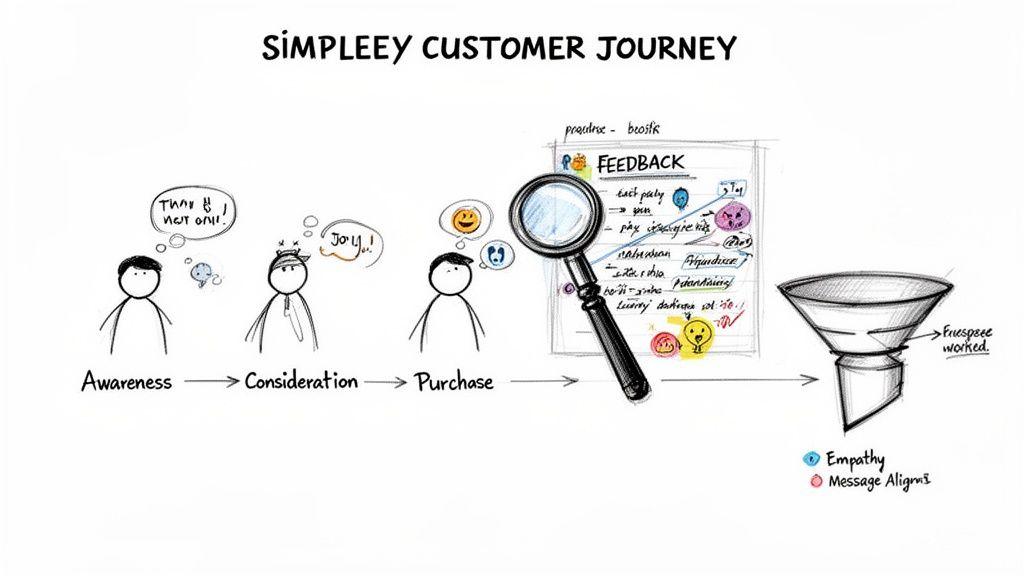
This is where that customer journey map we talked about becomes your secret weapon. By knowing what your audience is thinking, feeling, and doing at each stage, you can pick the perfect channels to meet them there.
Match Your Channels to the Customer Journey
Your marketing channels shouldn't exist in a vacuum. They need to work together, seamlessly guiding someone from "Who are you?" to "Take my money!" This means you'll need different tools for different parts of their journey.
- For the Awareness Stage: This is all about getting discovered. Channels like SEO, content on YouTube, and visual platforms like Pinterest are fantastic for this. A student struggling with a big paper might search "how to write a thesis statement" and stumble upon your super helpful blog post.
- For the Consideration Stage: Now they know you exist and are weighing their options. This is where in-depth content (think detailed guides or case studies), email marketing, and retargeting ads shine. That same student might sign up for your "Ultimate Research Paper Checklist" and join your email list.
- For the Decision Stage: It's time to close the deal. Here, customer reviews, free trials, and crystal-clear sales pages do the heavy lifting. Now that the student trusts your expertise, they might finally decide to try 1chat to organize their research.
When you align your tactics with each stage, you create a natural, cohesive experience that doesn't feel pushy. To get a handle on planning all this out, check out our guide on how to create a content calendar—it's a great framework for organizing your efforts.
The Power of Owned, Earned, and Paid Media
A great way to balance your channel strategy is by thinking in terms of Owned, Earned, and Paid media. This simple framework helps ensure you aren't putting all your eggs in one basket.
- Owned Media: This is everything you control completely. Think of your website, your blog, and your email list. These are your digital headquarters and, frankly, the most valuable assets you can build.
- Earned Media: This is the digital word-of-mouth you get when other people talk about you. It includes customer reviews, press mentions, and anyone who shares your content on social media. It’s incredibly powerful because it comes with built-in trust.
- Paid Media: This is when you pay to get in front of an audience. We're talking about social media ads on platforms like Facebook or LinkedIn, search engine ads via Google Ads, and paying for influencer collaborations. It's the quickest way to get guaranteed visibility.
Your owned media is your most important asset. Social media platforms can change their algorithms overnight, but nobody can take your email list or website away from you. Focus on building channels you truly control.
A solid marketing plan uses all three. You might use paid media to drive targeted traffic to your owned media (like a blog post), where you then build a relationship that generates earned media (like social shares and great reviews). It’s a powerful, self-sustaining cycle.
To help you visualize where you might want to focus, here’s a quick comparison of some popular channels.
Marketing Channel Comparison for Small Businesses
A comparative look at popular marketing channels to help you decide where to invest your time and budget.
| Channel | Best For | Average Cost | Key Metric |
| SEO & Blogging | Building long-term authority, capturing search intent | Low (Time-intensive) | Organic Traffic, Keyword Rankings |
| Email Marketing | Nurturing leads, driving repeat business | Low to Medium | Open Rate, Click-Through Rate, Conversions |
| Social Media Ads | Hyper-targeting specific demographics & interests | Medium to High | Cost Per Click (CPC), Conversion Rate |
| Content Marketing | Educating audience, building trust | Medium (Time & asset creation) | Engagement, Leads Generated, Time on Page |
| Google Ads (PPC) | Capturing high-intent buyers, immediate traffic | High | Cost Per Acquisition (CPA), Return on Ad Spend (ROAS) |
| Influencer Marketing | Reaching niche audiences, building credibility | Varies widely | Reach, Engagement Rate, Referral Traffic |
This table is just a starting point. The "best" channel is always the one that connects you with your specific customer.
Putting It All Together: Real-World Examples
Let's look at how this plays out for a few different businesses.
- A small e-commerce shop selling handmade leather goods would likely thrive on visual platforms like Instagram and Pinterest for discovery (a mix of paid and earned). At the same time, they'd invest heavily in SEO for long-term traffic and use email marketing to encourage repeat purchases (their owned channels).
- A B2B software company, on the other hand, would probably skip Pinterest. They'd focus on LinkedIn for targeted outreach (paid), publish deep-dive articles on their blog to capture organic search traffic (owned), and work on getting featured in industry trade publications (earned).
- A family travel blogger could build a strong presence by creating video guides for their YouTube channel and fostering a community in a private Facebook group (owned). They'd use both to drive traffic back to their main blog, which is monetized with affiliate links and sponsored posts.
The lesson here isn't to be everywhere. It's to be in the right places with a message that resonates, at the exact moment your audience needs you. Your marketing plan should name the 2-3 primary channels you’ll focus on and clearly explain why they’re the perfect fit for your goals and audience.
Budgeting Your Plan and Measuring What Matters
I've seen countless amazing marketing strategies gather dust on a shelf. Why? Because a plan without money or a deadline isn't a plan at all—it's just a wish list. This is the moment your big ideas get real. You have to figure out how much you can actually spend, where to put those dollars, and how on earth you'll know if any of it is working.
Let’s get one thing straight: a small budget doesn't mean you can't make a huge impact. It just means you have to be smarter. Instead of throwing a little money at ten different things, a tight budget forces you to get laser-focused on the channels that will truly move your business forward.
How to Build Your Marketing Budget
There’s no magic formula for setting a budget, and anyone who tells you there is hasn't been in the trenches. The best approach really depends on where your business is today and where you want it to go. For most small businesses, a couple of models work particularly well.
- Percentage of Revenue: This is the most common starting point. You simply earmark a set percentage of your revenue for marketing. For a more established business, this usually lands somewhere between 7-12% of gross revenue. If you're a startup scrambling for market share, you'll likely need to push that number higher.
- Objective-Based Costing: This is my personal favorite because it's built on strategy. You start with your goals—say, "get 200 qualified leads this quarter"—and work backward. What will it cost to run the ads, create the content, and use the tools to hit that number? This method directly links every dollar you spend to a concrete result.
A great way to do this is to use both methods. Start with the percentage-of-revenue model to get a realistic ballpark figure. Then, use objective-based costing to slice up that pie, making sure every piece is dedicated to achieving a specific goal.
Prioritizing Your Spend for Maximum Impact
Once you have your number, the real fun begins: deciding where the money goes. This is where your channel strategy and your bank account have a serious conversation.
If you’re working with a lean budget, your first priority should always be the assets you own and the channels that give you the most bang for your buck.
Start by shoring up your foundation. Your website and your email list are the most valuable marketing assets you have, period. Make sure you’ve budgeted for solid web hosting, any essential plugins, and a dependable email service like Mailchimp or AWeber. These are non-negotiable.
Next, look at your data and double down on what’s already working. If your blog and SEO efforts are bringing in a steady stream of leads, invest in more content or better SEO tools. If a particular social media channel is driving actual sales, that's where you should test a small, highly-targeted ad budget.
Finally, always protect a small "test" fund. I recommend setting aside 10-15% of your budget for pure experimentation. This is your sandbox. It gives you the freedom to try a new ad platform or a different content style without putting your core marketing engine at risk.
Remember, a marketing budget isn't just about ads. It has to cover your tools (analytics, design software), content creation (hiring a writer, stock photos), and any freelancers or agencies you might work with.
Turning Your Plan into a Timeline
A budget without a schedule is a recipe for what I call "random acts of marketing." To avoid this, you need a marketing calendar. It turns your strategy into a day-by-day, week-by-week roadmap. This doesn't need to be fancy—a simple spreadsheet or a Trello board works wonders.
Your calendar should map out all your major campaigns, content launches, and promotions for the year, broken down quarterly or monthly. For example, if a Q1 goal is to grow your email list, your calendar might look like this: January: Publish new eBook lead magnet. February: Run social media ads promoting the eBook. March: Analyze campaign results and plan Q2 list-building activities.
This simple document brings incredible clarity to your team and shifts your marketing from being reactive to proactive.
Measuring What Truly Matters with KPIs
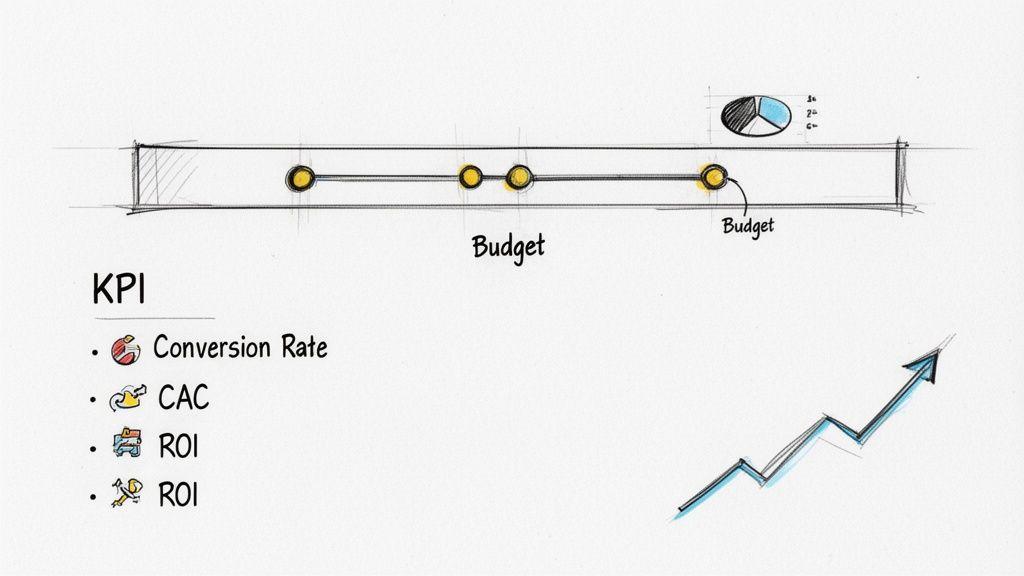
You can't manage what you don't measure. The last, critical step is to define your Key Performance Indicators (KPIs). These are the handful of metrics you'll watch to see if you're actually hitting your goals. The trick is to make sure your KPIs are directly tied to the SMART goals you set earlier.
For instance, if your goal is to "Increase qualified leads from our website by 40%," you shouldn't be obsessing over total website visitors. Your real KPIs would be:
- Conversion Rate: What percentage of people visiting your landing page actually fill out the form?
- Cost Per Lead (CPL): How much did you have to spend in marketing to get that one lead?
- Lead-to-Customer Rate: Of the leads you generated, what percentage turned into paying customers?
Other vital KPIs for any small business are Customer Acquisition Cost (CAC)—the total cost to get a new customer—and Return on Investment (ROI), the ultimate measure of whether your marketing is a cost or an investment.
The best way to track all this is to set up a simple dashboard. A free tool like Google Analytics is perfect for this. By checking it regularly, you transform your marketing plan from a static document into a dynamic guide that helps you make smart, data-backed decisions to grow your business.
Frequently Asked Questions About Marketing Plans
As you start pulling all these pieces together, it's completely normal for questions to bubble up. In fact, it’s a great sign—it shows you’re digging in and thinking strategically. Let's tackle some of the most common questions I hear from teams just like yours so you can move forward with confidence.
How Often Should I Update My Marketing Plan?
One of the worst things you can do is treat your marketing plan like a historical document—something you write, file away, and never look at again. Think of it as a living, breathing guide for your business. I always advise a major, deep-dive review at least annually. This is your chance to zoom out, assess the big picture, and set your strategic direction and budget for the year ahead.
But that doesn't mean you can ignore it for the other 11 months.
You need to be checking in on it much more often. Put a recurring reminder on your calendar to review your progress against your KPIs either monthly or, at a minimum, quarterly. This regular check-in is what gives you the agility to react to what's happening in the real world.
For example, what if a new feature on Instagram suddenly becomes the hot spot for your audience? A quarterly review gives you the room to test it out without having to blow up your entire annual strategy. The yearly plan is your roadmap, but the monthly reviews are where you find the smart detours and adjust for traffic.
What Is the Biggest Mistake in Marketing Plans?
I've seen it a thousand times: the single biggest mistake is a lack of focus. So many businesses, especially when they're smaller, feel this immense pressure to be everywhere at once. They create a marketing plan that’s really just a long wish list of every channel imaginable, from TikTok dances to local radio ads, without considering their limited time and money.
This "spray and pray" method almost guarantees you'll get mediocre results everywhere instead of great results somewhere.
A strong marketing plan is just as much about what you decide not to do. It’s about making smart sacrifices.
Your plan should literally have a section for what you are NOT going to do this quarter. Being brutally honest about your limitations isn’t a weakness; it’s a sign of strategic maturity. It is far better to dominate one or two channels where your customers actually are than to have a faint, forgettable presence across ten.
Instead of spreading your team and your budget thin, commit to winning on the handful of channels that truly matter. That’s how you build momentum and see a real return on your investment.
Can I Write a Marketing Plan with No Budget?
Absolutely. But let's be clear: you'll be trading money for time, creativity, and good old-fashioned hustle. A "no-budget" marketing plan just means you're going to rely entirely on your owned and earned media channels. Your strategy will be built on sweat equity, not ad spend.
Here’s where to pour your energy:
- Make Content Your Foundation: Your blog is your most valuable asset here. By creating genuinely useful guides and articles, you build long-term SEO value that pulls in free, organic traffic for years. Make sure you understand the basics of search engine optimisation (SEO) so people can actually find your work.
- Obsess Over Your Email List: Unlike your social media followers, your email list is an asset you completely own. Create a valuable freebie—like a checklist, a mini-eBook, or a handy template—to give people a reason to subscribe.
- Become a Fixture in Online Communities: Where do your ideal customers hang out online? Find those forums, subreddits, or Facebook groups. The key is to show up to help, not to sell. Answer questions, offer real advice, and become a trusted voice in that community.
The goal is to prioritize activities that build a sustainable foundation. It’s a slower burn, but the results are often far more resilient than a paid campaign that disappears the moment you turn off the spend.
How Can AI Help Me Write My Marketing Plan?
Artificial intelligence tools have become incredible partners for busy marketers. Instead of battling a blank page, you can use an AI tool like 1chat as a research assistant and brainstorming buddy. It helps automate the tedious parts of planning, which frees you up to focus on the high-level strategy that really matters.
Think about it: instead of manually sifting through a 50-page PDF of customer survey responses, you can upload it to 1chat and ask, "What are the top 3 pain points mentioned in this document?" You get instant, actionable insights for your audience research.
Here are a few practical ways AI can help right now:
- Audience Research: Feed it customer reviews or social media comments to instantly spot common themes, desires, and complaints.
- Competitor Analysis: Ask it to scan a competitor’s website and summarize their value proposition, tone of voice, and main marketing messages.
- Content Brainstorming: Generate a dozen blog post titles, social media hooks, or email subject lines based on your target audience's known interests.
- Creating First Drafts: Use it to produce a rough draft of a blog post or a series of social media updates. From there, you just need to edit and inject your unique brand personality.
It's essentially a junior marketer on demand, ready to help you gather information and get your initial thoughts organized faster than ever before.