So, should you opt out of AI resume screening? Let’s get straight to it: the answer for most people is a hard no. Especially if you're targeting a corporate role, opting out often means your application simply vanishes into a black hole. It's usually much smarter to learn how the system works and play the game than to try and sidestep it altogether.
The New Gatekeepers Your Resume Must Face
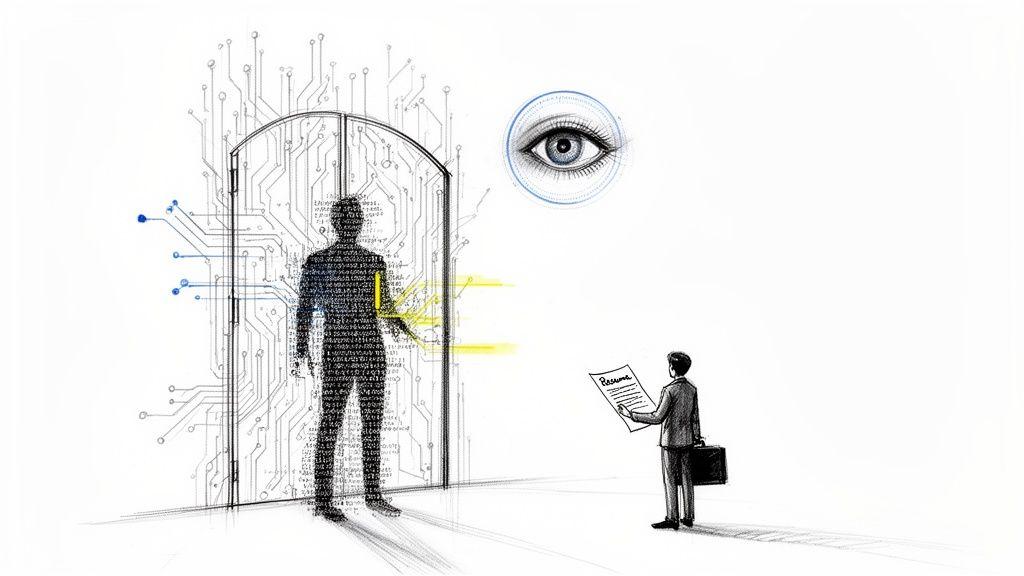
It’s a frustrating scenario. You’ve spent hours polishing every word of your resume, only for a machine to glance at it and make a decision in seconds. But that’s the reality of the job hunt in 2026. These automated systems are the first hurdle you have to clear, acting like digital bouncers at an increasingly crowded club.
How AI Screening Changes the Game
These AI-powered tools are typically part of a larger platform called an Applicant Tracking System (ATS). Their main job is to help companies sort through the flood of applications they receive every day. They work by scanning your resume for specific keywords, skills, and past experiences that line up with what’s in the job description.
Think of it as a search engine, but for people. A recruiter might type in “project manager with PMP certification,” and the AI instantly sifts through thousands of resumes to serve up the few that match. This creates a whole new challenge for anyone looking for a job.
The core trade-off is clear: employers gain speed and efficiency, while candidates risk being overlooked by an algorithm that misses the nuance of their experience. Your resume is no longer written just for human eyes.
The Scale of AI in Hiring
This isn't just some fringe tech anymore; it's the standard operating procedure for many companies. It’s more common than you’d think to get that instant rejection email simply because your resume didn't hit the right keyword combination. In fact, recent 2026 statistics show that a whopping 51% of companies now rely on AI for initial screening.
While this technology can slash a recruiter’s initial review time by up to 71%, it also means that human eyes see only a tiny fraction of the applications that come in.
This shift means your success often hinges on how well your resume can "talk" to a machine first. These systems lean on a technology you can explore in our guide to Natural Language Processing, which is what allows them to understand and categorize the text on your resume.
Weighing the Pros and Cons of Automated Screening
AI resume screeners are a classic case of what’s good for the company isn’t always great for the person applying. For employers, they promise incredible speed and efficiency. But for candidates, the experience can feel like shouting into the void, with your qualifications lost to parsing errors, hidden biases, or a simple lack of human understanding.
Think of an AI screener like a club bouncer with a very specific, rigid list. They might turn away a brilliant, talented person just because they're not wearing the "right" shoes, completely ignoring the substance of who they are.
The Employer Advantage: Speed and Scale
From a company's perspective, it's easy to see the appeal. The main draw is pure efficiency. AI can slash the time spent on interview-related tasks by as much as 90%. It also cuts the cost-per-hire by around 30%, which can ultimately boost a company's revenue per employee by 4%.
Those numbers are hard to ignore, and they’re driving a huge push toward automation. A 2026 survey found that 74% of firms are planning to use even more AI in their hiring. But, as this HR Dive report on AI hiring trends points out, many of those same companies have serious concerns, highlighting a growing tension between the need for speed and the demand for fairness.
The Candidate Disadvantage: Bias and Misinterpretation
So, what's a win for the company can feel like a huge loss for you, the job seeker. The downsides are very real and can stop your career in its tracks before it even gets started.
- Hidden Bias: An algorithm is only as good as the data it's trained on. If a system learns from a company’s past hiring decisions—which may have favored a certain demographic—it can unintentionally learn to penalize candidates from different backgrounds.
- Context Blindness: This is where AI really falls short. It can't understand the story behind a resume gap you took to care for family. It won't recognize incredible transferable skills from an unrelated industry or appreciate a non-traditional career path that made you a creative problem-solver.
- Formatting Penalties: That beautifully designed resume with columns, graphics, or custom fonts? It can completely confuse an Applicant Tracking System (ATS). The AI might misread your information, jumble your experience, or fail to process it entirely, landing you in the "no" pile without a human ever seeing your name.
The biggest fear for most job seekers is getting filtered out for all the wrong reasons. The worrying part? Over 50% of HR professionals admit they’re concerned that AI screening tools eliminate qualified candidates or even make existing biases worse.
This brings us back to the central question: should you opt out of AI resume screening? While the technology makes life easier for employers, it puts up serious roadblocks for anyone whose value isn't easily summed up by keywords. For those with unique backgrounds, bypassing the bot isn't just a preference—it’s a strategic move to make sure your story gets a fair hearing.
When You Should Seriously Consider Opting Out
Playing the AI screening game is the default move for most job seekers, but sometimes, it’s a game you’re set up to lose. For some professionals, deciding to bypass the algorithm isn’t just a preference—it’s a strategic necessity. The question of whether you should opt out of AI resume screening becomes crucial when your career path doesn't follow the straight, predictable line that algorithms expect.
This choice—letting a bot scan your resume versus getting it into human hands—is one of the first and most important decisions you'll make in your application process.
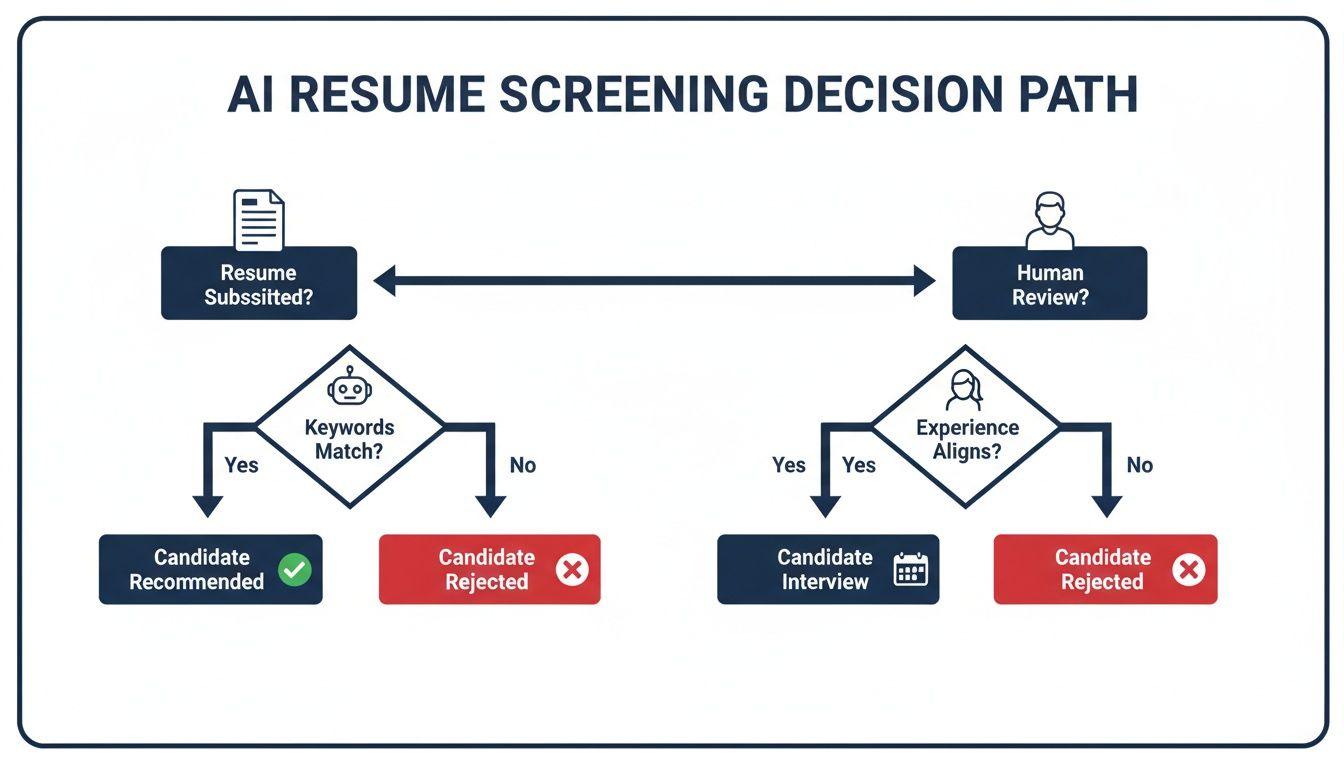
As you can see, your resume has two potential fates after you hit "submit." It either goes through an AI filter or directly to a person. For anyone with a non-traditional background, making sure your resume lands in that "Human Review" pile is often the only way you'll get a fair look.
Profiles That Get Lost in the Algorithm
I’ve seen it time and again: talented, qualified people getting rejected before a human ever sees their name. Certain profiles are almost guaranteed to be misunderstood or unfairly flagged by automated systems. If any of these sound like you, your best bet is to find a way around that digital gatekeeper.
- Career Changers: You’re pivoting industries and your resume is packed with incredible, transferable skills. But the AI is just looking for an exact job title match, like "Product Manager." It completely overlooks the decade of project management experience that makes you a perfect fit because the title is different. The algorithm sees a mismatch, not untapped potential.
- Creatives and Portfolio-Driven Professionals: For a designer, writer, developer, or artist, a resume is just the appetizer. Your portfolio is the main course—it tells the real story. An AI can’t "see" your work, judge your aesthetic, or appreciate the genius in your code. It can only scan for keywords, rendering your most important qualifications invisible.
- Candidates with Resume Gaps: Life happens. Maybe you took time off to raise a family, deal with a health issue, or travel the world. A human recruiter can understand that context. An algorithm, however, often sees an employment gap as a massive red flag and automatically penalizes your score, no questions asked.
When Nuanced Expertise Defies Keywords
It’s not just non-traditional candidates who struggle. Senior leaders and niche experts often find their experience is too complex for a simple keyword scan. An algorithm might be programmed to look for "cybersecurity analyst," but it has no way of understanding that you led a groundbreaking project that redefined security protocols for an entire Fortune 500 company.
When your greatest accomplishments are found in the context and complexity of your work, a keyword-matching bot becomes your biggest obstacle. Bypassing it is about making sure your true value gets seen.
Beyond just getting a fair evaluation, there's also the growing concern over data privacy. Every time you upload your resume, you're feeding your personal and professional history into a database. If you're worried about where that data goes, you can learn more about how to protect your privacy online. For anyone whose story is too rich for an algorithm to understand, the job search needs to be about human connection, not keyword optimization.
Your Practical Guide to Bypassing the Bots
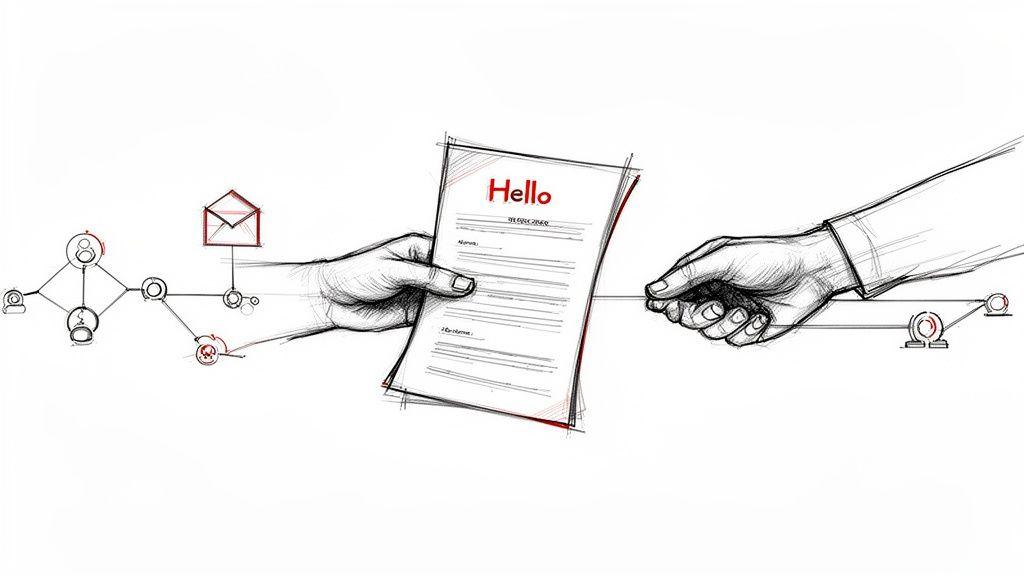
So, you've decided the algorithm isn't for you. Answering "yes" to the question of should you opt out of AI resume screening means you're ready to trade the passive application process for a more proactive, human-centered approach. It's less about finding a hidden "opt-out" button and more about finding a completely different door to knock on.
Your entire goal shifts. Instead of just feeding your resume into a machine, you’re on a mission to get it directly into the hands of a person who can appreciate your unique experience and story.
Target Companies That Value Human Review
Let's be realistic—this strategy won't work everywhere. Your best bet is to focus your energy on companies where a human connection is more likely to pay off.
- Go Smaller: Think small-to-medium-sized businesses (SMBs) and startups. Many don't have the budget or need for a massive Applicant Tracking System, which means a real person is probably reviewing the applications.
- Look for Human-First Language: Scour the "Careers" or "About Us" pages of company websites. Phrases like "we value our people" or "we have a personalized hiring process" are huge clues that they prioritize individual assessment over automated filtering.
Forget the main application portal. Your new objective is to sidestep it entirely. Think of yourself as a detective trying to find the keyholder, not just another person waiting outside the locked gate.
Connect with the Right People
Once you have a company in your sights, the real work begins: finding the right person to contact. This is where a platform like LinkedIn becomes your secret weapon.
Search for titles like "Hiring Manager," "Recruiter," or the head of the department that interests you, such as the "Director of Marketing." You're looking for the person who would either be your direct boss or the one in charge of filling the role.
A warm introduction or a well-crafted message is exponentially more effective than a cold application. A referral from a mutual connection can put your resume at the top of the pile, completely bypassing any automated screening.
Craft Your Outreach Message
When you reach out, your message has to be sharp, professional, and focused on the value you bring. This isn't about begging for a job; it's about starting a meaningful conversation.
Here’s a simple template you can adapt to open those doors.
Outreach Message Template for Bypassing AI
| Element | Example Content |
| Subject Line | Interested in the [Job Title] Role - [Your Name] |
| Opening | Hi [Hiring Manager's Name], I'm reaching out because I was incredibly impressed by [Company's recent project or achievement]. |
| Your Value | With my background in [Your Key Skill/Experience], I believe I could contribute significantly to your team's goals, particularly in [Specific Area]. I've attached my resume for your consideration. |
| Call to Action | Would you be open to a brief conversation next week to discuss how my skills align with the [Job Title] position? |
Remember to customize every message. A generic copy-paste email is just as bad as a generic application—it shows you haven't done your homework. A little personalization goes a long way in proving you’re the right person for the job.
How to Beat the Bots When You Cannot Opt Out
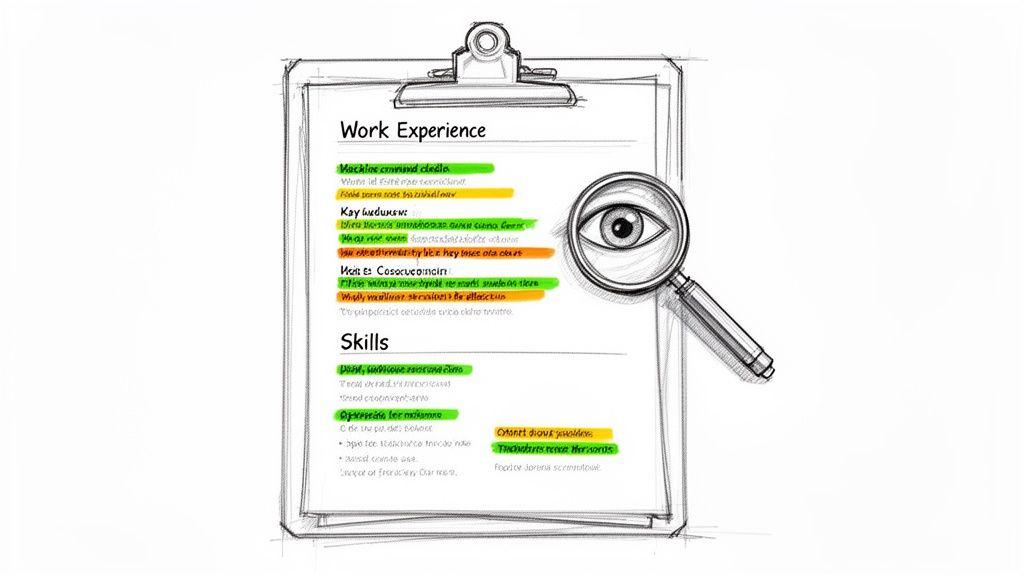
In the world of corporate hiring, trying to sidestep the automated gatekeepers often isn't a choice. For most large companies, opting out is the same as opting out of the job entirely—your application will simply never be seen. When you're up against this digital wall, the only way forward is through it. The real question becomes: how do you beat the bots at their own game?
The trick is to create a resume that speaks the algorithm's language. Your goal is to build a document so clean, structured, and keyword-rich that it sails through the initial filter and lands in front of a human who can appreciate your actual experience.
This is a huge deal, especially if you're changing careers. Imagine you have a decade of valuable, transferable skills, but an AI tosses your resume because you lack one specific job title. While some vendor reports claim AI screening can hit 95% accuracy—a big leap from the 70% of manual reviews—these systems have serious blind spots. With 35% of companies that use AI admitting they reject candidates based on the bot's word alone, and only 26% requiring a human to sign off on every rejection, it's dangerously easy for a great candidate to get lost. You can read more about this in recent reports on the effectiveness of AI resume screeners.
Create a Machine-Readable Masterpiece
To get past the bots, you have to prioritize clarity over creativity. Applicant Tracking Systems (ATS) are powerful parsers, not sophisticated readers, and they get tripped up by anything out of the ordinary.
- Ditch the fancy formatting. Columns, text boxes, images, and graphics are the enemy. Stick to a simple, single-column layout using a standard font like Arial, Calibri, or Times New Roman.
- Use standard section titles. This isn't the time for creative headings like "My Professional Journey." Use the terms every system recognizes: "Work Experience," "Education," and "Skills."
- Mirror the job description. Carefully scan the job posting for key skills and qualifications. Weave those exact keywords and phrases naturally into your resume. If it asks for "data analysis," don't write "interpreting metrics"—use their exact term.
Fight Fire with Fire: Use AI to Your Advantage
One of the smartest moves you can make is to use AI yourself. Several tools are available that can analyze a job description, compare it to your resume, and flag missing keywords or suggest improvements.
Think of it as using a friendly AI to prep for your battle with the gatekeeper AI. These tools can help you craft keyword-optimized summaries and bullet points that perfectly reflect what the employer is searching for.
This tactic helps you build a powerful, machine-friendly resume without sacrificing your professional story. And while this approach is all about machine readability, you might also find our guide on how to humanize AI text useful for striking the right tone in your cover letter. By optimizing for the algorithm first, you give your carefully crafted story the best chance of actually being told.
Frequently Asked Questions About AI Resume Screening
It's natural to have questions when a machine might be the first—and only—gatekeeper to see your resume. Let's cut through the confusion and tackle some of the biggest concerns job seekers have about automated hiring.
Can I Legally Demand a Human Review My Resume?
I get this question all the time, and the straightforward answer is, generally, no. In most places, there's no law that forces a company to let a person review your application if they've chosen an automated system. Deciding if you should opt out of AI resume screening is a strategic move, not a legal right you can demand.
That said, the ground is starting to shift. Some regions are putting new rules in place, like New York City, which now requires companies to tell candidates when they use AI and offer an alternative path. It's always a good idea to look into your local laws, as this is an area that's changing quickly.
Will a Creative Resume Format Always Get Rejected by AI?
Unfortunately, the answer is almost always yes. Most Applicant Tracking Systems (ATS) are built for one thing: efficiently parsing simple text. They just aren't programmed to appreciate your eye for design.
Think of an ATS like a speed-reader who only understands plain, straightforward text. It’s not looking for beauty; it’s looking for keywords in a predictable order.
Things like columns, tables, images, or even funky fonts can completely trip up the software. The AI might scramble your information or, worse, see a blank page. When applying online, your best bet is a clean, single-column resume. Save that beautiful, custom-designed version for when you're emailing a hiring manager or networking contact directly.
How Can I Tell if a Company Uses AI Screening?
Here's the safest rule of thumb: assume they do. If you're applying through an online portal on a company’s website or a major job board like LinkedIn or Indeed, your resume is almost certainly being filtered by software first.
While smaller businesses and startups are more likely to have a human review applications from the start, it's never a guarantee. With some studies showing that as many as 88% of companies use AI in their hiring process, it's just smart strategy to always have an ATS-friendly resume ready to go.