You've got the assignment open. The tab says “informative essay.” The cursor keeps blinking. You know your topic, sort of. You may even have a few notes. But the ideas feel loose, messy, and out of order.
That feeling doesn't mean you're a weak writer. It usually means you need a better frame.
The structure of informative essay writing matters because structure does more than organize words on a page. It helps you sort what belongs, what doesn't, and what your reader needs first. Good structure turns stress into sequence. Instead of asking, “How do I write this whole thing?” you start asking smaller, solvable questions like, “What should my first paragraph do?” and “What evidence belongs in body paragraph two?”
Students aren't the only ones who benefit from clear systems. The same reason schools teach writing frameworks is the reason education teams build repeatable workflows. If you work in a tutoring program, it helps to see how how tutoring centers streamline operations with systems that reduce confusion and keep everyone moving in the same direction. Essays work the same way. A clear structure reduces friction.
Why Your Essay Needs a Strong Structure
One student I've taught had plenty of ideas about renewable energy. She knew facts, examples, and definitions. But her first draft felt like a pile of note cards dropped on the floor. Nothing was exactly wrong. It just wasn't arranged in a way a reader could follow.
That's what structure fixes.
A strong essay structure gives each idea a job. The introduction opens the door. The body paragraphs carry the explanation. The conclusion helps the reader leave with the main point still clear in mind. When those parts work together, your writing feels calmer and more confident, even if you were anxious while drafting it.
Structure helps you think before you decorate
Many students treat structure like a school rule they have to survive. A better way to see it is as a thinking tool. If your ideas are the building materials, structure is the frame that keeps everything from collapsing.
Without that frame, common problems show up fast:
- You repeat yourself because you haven't decided which paragraph owns which idea.
- You drift off topic because every fact you found feels equally important.
- Your reader gets lost because you know what you mean, but the path isn't visible on the page.
Practical rule: If you can't summarize the job of each paragraph in one short sentence, the essay probably isn't organized yet.
Clear structure also lowers pressure. You don't need to produce a perfect essay in one burst. You only need to build one part at a time. That's a much more manageable task on a busy school night.
Strong structure makes writing easier to revise
Revision is hard when the problem is invisible. Structure makes problems visible.
If your essay has a clear plan, you can ask useful questions:
- Does my introduction prepare the topic?
- Does each body paragraph focus on one main idea?
- Does the conclusion pull ideas together instead of repeating them?
Those questions are easier to answer than “Is this good?”
The Blueprint of an Informative Essay
Think of an informative essay like building a small house. You need a foundation, rooms with clear purposes, and a roof that brings the whole design together. If one part is weak, the whole thing feels unstable.
The most common model taught in school is the five-paragraph format: one introduction, three body paragraphs, and one conclusion. It's widely taught because it helps beginning writers organize information logically, as explained in this guide to the five-paragraph informative essay format.
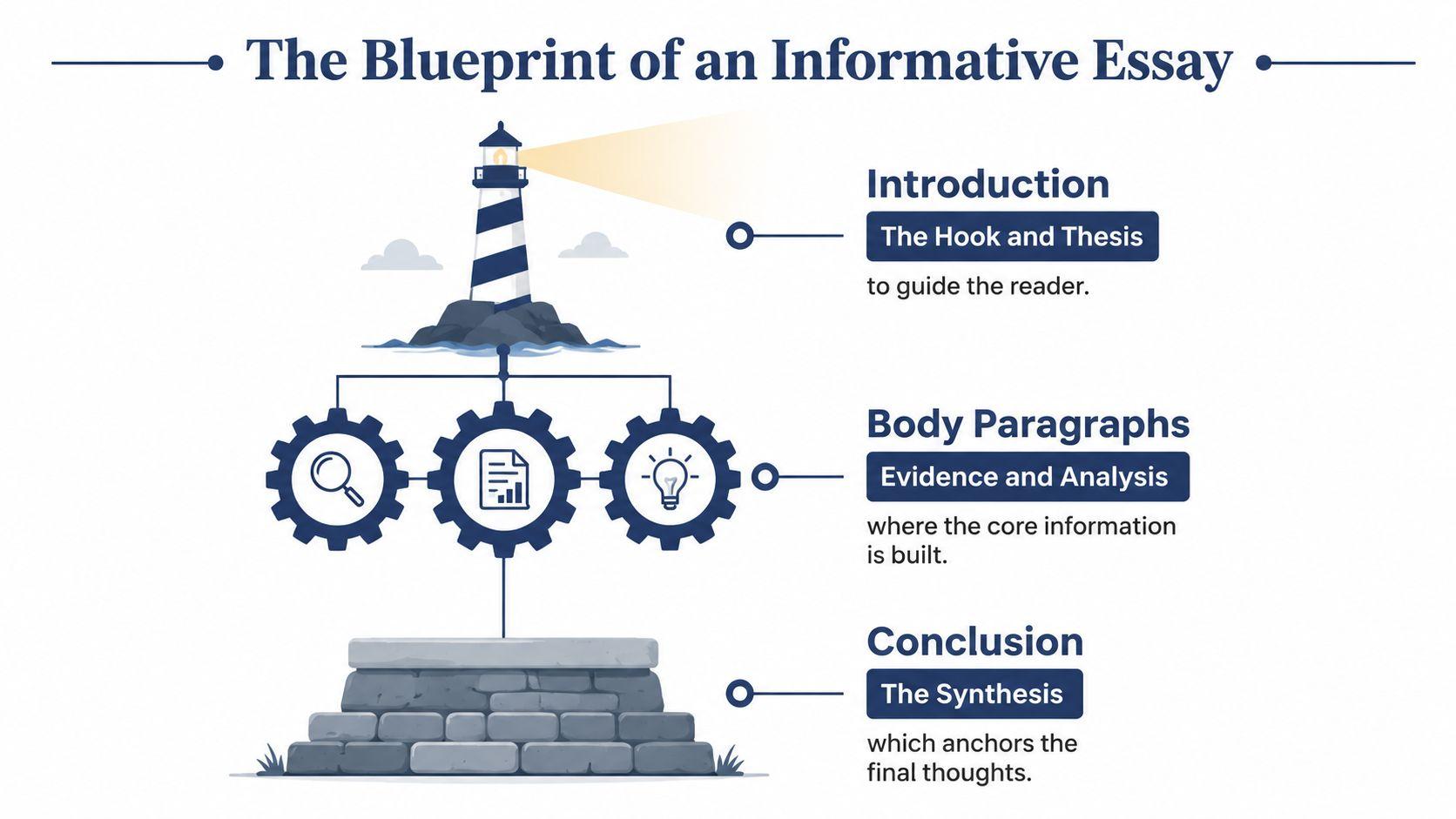
The introduction is the front door
Your introduction welcomes the reader and tells them what kind of essay they're entering. It doesn't need to tell everything right away. It needs to orient the reader.
A good introduction usually does three things:
- Gets attention with a hook
- Provides context so the topic makes sense
- States the thesis so the reader knows the essay's direction
If your essay were a house, the introduction would be the front entryway. It gives a first impression and tells visitors where they are.
The body paragraphs are the rooms
Each body paragraph should do one main job. That job might be explaining a cause, defining a key idea, describing a process, or presenting a category of information. What matters is focus.
Here's a simple way to think about the three body paragraphs in a basic essay:
| Paragraph | Main job | Reader benefit |
| Body 1 | Introduce the first major point | The reader gets the first piece of the explanation |
| Body 2 | Add the next major point | The essay develops depth |
| Body 3 | Complete the explanation | The reader sees the full picture |
When students struggle, they often try to make one paragraph do too much. A paragraph is a room, not the whole house.
A body paragraph should feel complete on its own, but still connected to the larger essay.
The conclusion is the roof
The conclusion closes the structure. It doesn't add a surprise new section. It gathers what the essay has shown and leaves the reader with a clear final understanding.
A weak conclusion repeats earlier lines. A strong one reminds the reader why the topic matters and how the parts fit together.
That's why structure isn't a cage. It's support. Once you understand the blueprint, you can write with more freedom because the main shape already holds.
Crafting an Introduction and Thesis Statement
The introduction often feels hardest because it comes first on the page. But its job is narrow. It needs to guide the reader into the topic with control.
A useful way to build it is to think in three parts: hook, background, thesis.
Start with a hook that fits the topic
A hook is your opening move. It should make the reader willing to continue. That doesn't mean it has to sound dramatic. It just has to feel relevant.
Here are three workable hook styles:
- A question: “Why do some cities recycle far more effectively than others?”
- A brief fact from your research: only if you can verify and cite it properly
- A short scenario: “Every day, students use search engines to answer questions in seconds, but not every answer is reliable.”
The safest hook is one that naturally leads into your subject. Avoid hooks that feel unrelated or overly theatrical. If your essay is about soil erosion, don't open with a broad statement about “humanity throughout time” unless you truly connect it.
Add background without writing the whole essay
After the hook, provide the reader with sufficient context to understand the topic. In this section, you define key terms, narrow the focus, or explain why the topic matters.
For example, if the essay topic is school lunch programs, your background might clarify what those programs are and what part of the topic you'll discuss. You do not need to include every detail you found in your notes.
A good test is simple: after reading your background sentences, could a classmate understand what the essay is about?
End with a thesis that works like a roadmap
Your thesis statement is the controlling idea of the essay. In an informative essay, it doesn't argue in the same way a persuasive essay does. It tells the reader what the essay will explain.
For a topic like urban gardening, a weak thesis might be:
Urban gardening is important.
That's too broad. Important how? For whom? In what way?
A stronger thesis would be:
Urban gardening improves access to fresh food, builds community involvement, and makes use of limited city space.
That version gives the reader a route. It also gives the writer a structure for the body paragraphs.
If thesis statements still feel slippery, this guide on how to write a thesis statement breaks the process into manageable steps.
A quick before and after
| Version | Example | Problem or strength |
| Before | “Pollution affects many places around the world.” | Too general |
| After | “Water pollution affects ecosystems, human health, and local economies in distinct ways.” | Clear focus for three body paragraphs |
Your introduction doesn't need to impress your teacher with fancy language. It needs to create direction. That's what makes the rest of the essay easier to write.
Building Strong Body Paragraphs
Body paragraphs are where your essay does its real teaching. If the thesis is your blueprint, each paragraph is one finished room in the house. A reader should be able to step into that paragraph, understand its purpose, and see how it supports the whole structure.
One practical way to build a paragraph is TEET: Topic sentence, Evidence, Explanation, Transition. The pattern matters because it keeps you from dumping facts onto the page without showing what they mean. It also gives you a repeatable system when you are tired, short on time, or staring at a blank document the night before a deadline.
T means topic sentence
Your topic sentence states the paragraph's main idea. It should connect to the thesis clearly, but it should not copy the thesis line word for word. Each body paragraph needs its own job.
Say your thesis is that urban gardening improves access to fresh food, builds community involvement, and makes good use of limited city space. One body paragraph might begin like this:
Urban gardening can improve access to fresh produce in neighborhoods with limited grocery options.
That sentence gives the paragraph direction. The reader now knows what to expect, and you know what belongs in that paragraph and what does not.
If topic sentences are hard to write, this guide on how to write a strong topic sentence can help you practice making them clear and specific.
E means evidence
Evidence gives the paragraph weight. In an informative essay, that might be a fact from a textbook, a detail from class notes, an example from a credible source, or a brief summary of research.
Students often stop here because evidence feels like proof that the paragraph is finished. It usually is not.
A body paragraph without explanation is like stacking bricks without mortar. The materials are there, but they are not holding together yet.
The second E means explanation
Explanation is the part many students rush, and it is often the part teachers are looking for most closely. In this section, you show your reasoning. You explain how the evidence supports the paragraph's point and why the reader should care about it.
Look at the difference:
- Evidence only: “Community gardens can be placed on unused lots.”
- Evidence plus explanation: “Community gardens can be placed on unused lots. That matters because it turns neglected space into a source of food and neighborhood activity, which supports the essay's point about practical land use.”
That second version sounds stronger because the writer is doing the thinking on the page instead of asking the reader to do it alone.
AI tools can help here, but they should stay in a supporting role. A tool like 1chat can suggest places where your explanation feels thin, help you brainstorm follow-up questions, or offer a sample outline for a paragraph. You still need to decide what your evidence means and whether the explanation is accurate. That thinking belongs to you.
T means transition
A transition helps the paragraph connect to the next point. It does not need to sound formal or dramatic. It just needs to guide the reader forward.
Here is a simple TEET paragraph plan on the topic of recycling:
- Topic sentence: School recycling programs can reduce everyday waste.
- Evidence: Students use large amounts of paper, plastic bottles, and food packaging during the school day.
- Explanation: Because these materials appear constantly, a recycling system gives schools a practical way to manage common waste instead of sending everything to the trash.
- Transition: Those daily routines can also teach habits students carry outside school.
Notice what makes that example work. Every sentence has a job. Nothing wanders.
A quick paragraph check
Before you move on, pause and test the paragraph with these questions:
- Can I identify one clear main idea?
- Did I include support instead of unsupported opinion?
- Did I explain the support in my own words?
- Does the ending help the reader move to the next idea?
If one answer is no, the paragraph probably needs another pass. That is normal. Strong structure is not about following rigid rules for their own sake. It is a tool that helps you organize your thinking so your reader can follow it with less effort.
Creating Your Informative Essay Outline
You sit down to write, open three tabs of research, glance at the clock, and suddenly every point feels equally important. That is the moment an outline earns its place. It gives your ideas an order before full sentences start competing for attention.
An informative essay outline works like a house blueprint. You would not start hanging doors before deciding where the walls go. In the same way, outlining helps you choose the main parts first, then place your supporting details where they fit.
A Roman-numeral outline is useful because it makes the levels of your thinking visible. Your biggest ideas stay at the top level. The details that support them sit underneath. That simple hierarchy keeps the essay from drifting off topic and makes drafting easier because each paragraph already has a job.
A simple Roman-numeral template
You can copy this structure and adapt it to your topic:
I. Introduction
A. Hook
B. Background on the topic
C. Thesis statement
II. Body Paragraph 1
A. Main point
B. Supporting detail or evidence
C. Explanation of why it matters
D. Link to thesis
III. Body Paragraph 2
A. Main point
B. Supporting detail or evidence
C. Explanation
D. Connection to next point
IV. Body Paragraph 3
A. Main point
B. Supporting detail or evidence
C. Explanation
D. Final connection to thesis
V. Conclusion
A. Thesis restated in fresh words
B. Summary of main points
C. Closing insight
If Roman numerals feel too formal, do not let the format distract you. The fundamental goal is clarity. You are building a map of your thinking, not trying to impress anyone with labels.
What an outline helps you decide
A useful outline answers a few questions before drafting begins:
- What does the reader need to understand first?
- Which points belong in the body, and which notes are just extra?
- What order will make the explanation easiest to follow?
- Where does each piece of evidence fit?
That is why outlines save time for many students. You make the hard choices early, while it is still easy to move parts around.
A quick example
Suppose your topic is school recycling programs. A rough outline might look like this:
I. Introduction
A. Brief context about school waste
B. Why the topic matters
C. Thesis: School recycling programs reduce waste, build student responsibility, and support long-term environmental habits
II. Body Paragraph 1
A. Recycling reduces common school waste
B. Paper, bottles, and packaging appear every day
C. Explanation of how collection systems reduce trash volume
III. Body Paragraph 2
A. Recycling programs teach responsibility
B. Students learn routines through daily participation
C. Explanation of how habits form through repetition
IV. Body Paragraph 3
A. School programs can influence behavior outside school
B. Students may carry recycling habits home
C. Explanation of broader community impact
V. Conclusion
A. Restate thesis
B. Summarize the three points
C. End with a final thought about practical environmental action
Notice what the outline does. It does not write the essay for you. It gives each paragraph a purpose so your draft has direction from the first sentence.
Using AI without handing over your thinking
AI tools such as 1chat can help at the outline stage if you use them like a study partner, not a substitute for judgment. You can paste in your notes and ask for possible paragraph groupings, missing subpoints, or a cleaner order of ideas. Then you check whether the outline matches your assignment, your sources, and your thesis.
That last step matters most. AI can sort information quickly, but it cannot decide what your teacher expects or whether a point reflects your understanding. You still choose what stays, what gets cut, and what needs stronger support.
If you want a model to compare against your own plan, this essay outline example collection can help you see how a finished outline looks before you start drafting.
Common Structure Mistakes to Avoid
Most weak informative essays don't fail because the student has nothing to say. They weaken because the structure slips. The good news is that structural mistakes are fixable once you learn to spot them.
Mistake one is a vague thesis
A vague thesis creates confusion everywhere else. If the thesis is broad, the body paragraphs become broad too.
Before:
“Technology affects education.”
After:
“Technology changes education by expanding access to resources, changing classroom communication, and supporting flexible learning.”
The second version gives the essay shape. The first one leaves the reader guessing.
Mistake two is listing facts without explaining them
Students often believe research alone makes a paragraph strong. It doesn't. A paragraph full of facts can still feel empty if the writer never interprets those facts.
Here's the difference:
| Weak version | Better version |
| Gives several facts in a row | Uses one or two facts, then explains their meaning |
| Feels like copied notes | Feels like guided thinking |
| Leaves the reader to connect ideas | Shows the connection clearly |
If your paragraph sounds like a report of disconnected details, add explanation after each key piece of evidence.
Mistake three is choppy movement between paragraphs
When transitions are weak, essays feel assembled instead of written.
A sudden jump looks like this:
- Paragraph one discusses causes
- Paragraph two suddenly shifts to solutions
- No sentence helps the reader make that turn
A smoother move includes a bridge line at the end of the first paragraph or opening of the next. That bridge doesn't need to be fancy. It just needs to show the relationship between ideas.
Readers rarely complain that a paragraph had too much clarity. They struggle when the connection stays in the writer's head.
Mistake four is writing a conclusion that only repeats
A conclusion should sound familiar, but not copied. If you restate your introduction sentence by sentence, the essay ends flat.
Try this shift:
- Repeat: “In conclusion, pollution is a serious issue. Pollution affects water, air, and land.”
- Synthesize: “Looking at water, air, and land together shows that pollution isn't one isolated problem. It affects connected parts of daily life and environmental health.”
The second ending gathers ideas. That's the job.
A quick self-check before submitting
Read your draft and ask:
- Can I underline one clear thesis?
- Does each body paragraph focus on one main point?
- Have I explained my evidence in my own words?
- Does the conclusion add perspective rather than simple repetition?
If you can answer yes to those four questions, the structure is likely doing its job.
Conclusion and Essay Structure FAQs
Essay structure isn't just about following school rules. It's a way to think clearly under pressure. When students use a stable framework, they don't have to invent the whole path every time they write. They can focus on understanding the topic, choosing the best evidence, and explaining ideas in a way a reader can easily follow.
A practical writing process helps too. One proven approach is a six-step sequence: pick a topic, research, outline, write the body first, then write the introduction and conclusion, and finally proofread. This method is described in Study.com's guide to the informative essay writing process, which also explains why writing the body first often leads to more cohesive openings and closings.
If you're reviewing a draft and want help spotting structural issues in a paper or assignment file, tools built for intelligent education document processing can help you examine the organization of a document before final submission.
Questions students often ask
How long should my paragraphs be
Length depends on the assignment and topic, but clarity matters more than size. A paragraph should be long enough to develop one complete idea with support and explanation. If it feels thin, add explanation. If it covers multiple ideas, split it.
Can I use “I” in an informative essay
Often, teachers prefer an objective tone in informative writing. Many assignments work better without “I” because the focus stays on the topic rather than the writer. Still, follow your teacher's instructions first.
What is the difference between an informative essay and a persuasive essay
An informative essay explains. A persuasive essay argues. Informative writing helps the reader understand a topic. Persuasive writing tries to convince the reader to agree with a claim.
Should I always use five paragraphs
The five-paragraph form is a strong starting point, especially for school assignments and newer writers. But not every informative essay has to stay locked to that exact length. If the assignment asks for a longer paper, the same structural logic still applies. You'll just expand the body with more focused sections.
What if I get stuck after researching
That usually means the problem is organization, not effort. Go back to the outline. Group related notes. Name the three main points. Once the plan is visible, drafting gets easier.
Good structure doesn't replace thinking. It gives your thinking a place to stand.
If you want an ethical way to use AI help after outlining, use it to brainstorm examples, suggest clearer wording, or help you notice weak transitions. Then make the final decisions yourself. That's the balance worth aiming for.
If you want a privacy-first way to brainstorm, outline, and refine essays without handing over the thinking, try 1chat. It can help students and teams organize ideas, work with PDFs, compare models, and improve drafts while keeping the writer in control.