The life of a student often feels like a relentless juggling act. Between classes, homework, looming exam dates, extracurricular activities, and maintaining a social life, the pressure can be immense. It’s easy to feel like you're constantly behind, buried under a mountain of tasks with no clear path forward. Feeling overwhelmed is common, but it doesn't have to be your default state. Many traditional time management tips for students offer generic advice that fails to address the specific, high-stakes pressures of modern academic life.
This guide is designed to be different. We're moving beyond vague suggestions and diving deep into concrete, actionable systems that create real change. You won't find platitudes here. Instead, you'll discover a comprehensive toolkit of proven strategies, from powerful prioritization frameworks like the Eisenhower Matrix to focused study methods like the Pomodoro Technique. We’ll explore how to break down intimidating projects into manageable steps, build an environment that minimizes distractions, and strategically use technology to your advantage instead of letting it control you.
Each strategy is presented not just as a tip, but as a complete system with clear implementation steps, practical examples, and adjustments for middle school, high school, and college students. These are the time management tips for students that build sustainable habits, reduce stress, and prevent burnout. Forget the chaos of last-minute cramming and the anxiety of an ever-growing to-do list. It's time to build a structured, intentional approach that allows you to stop juggling and start thriving. Let’s get started.
1. The Pomodoro Technique
The Pomodoro Technique is a cyclical time management method that breaks down work into focused, manageable intervals. Developed by Francesco Cirillo in the late 1980s, this approach uses a timer to structure work sessions into 25-minute blocks, known as "pomodoros," separated by short breaks. The core idea is that these frequent breaks can improve mental agility and sustain concentration over long study periods.
This method is exceptionally effective for tasks that require deep focus, such as writing essays, coding, or conducting research. One of the best time management tips for students is to use this technique to combat procrastination and reduce burnout. A typical cycle involves 25 minutes of uninterrupted work followed by a 5-minute break. After completing four pomodoros, you take a longer break of 15-30 minutes.
How to Implement the Pomodoro Technique
Getting started is simple. All you need is a timer and a clear task list.
- Step 1: Choose Your Task. Select a single assignment or study topic to focus on. For example, drafting the introduction for your history paper.
- Step 2: Set Your Timer. Set a timer for 25 minutes. You can use your phone, a kitchen timer, or a dedicated app like Forest or Be Focused.
- Step 3: Work Intensely. Work on the chosen task without any interruptions until the timer rings. This means no social media, no texts, and no multitasking. If you are using a tool like 1chat for research, dedicate the entire interval to that specific activity.
- Step 4: Take a Short Break. When the timer goes off, mark one pomodoro as complete and take a 5-minute break. It's crucial to step away from your desk, stretch, or grab a glass of water.
- Step 5: Repeat and Rest. Repeat this cycle three more times. After the fourth pomodoro, take a longer, restorative break of 15 to 30 minutes.
This structured approach not only makes large tasks less daunting but also helps you accurately track the time spent on your studies, providing a clear picture of your productivity. By breaking down your study sessions, you can maintain high levels of focus and make steady progress on your academic workload.
2. Priority Matrix (Eisenhower Box)
The Priority Matrix, often called the Eisenhower Box, is a decision-making framework that helps you categorize tasks based on urgency and importance. Popularized by Stephen Covey and based on a method attributed to Dwight D. Eisenhower, it organizes your to-do list into a four-quadrant grid. This visual tool forces you to differentiate between what is truly important for your long-term goals and what is merely urgent, demanding your immediate attention.
This matrix is one of the most powerful time management tips for students because it provides clarity amid a chaotic schedule of assignments, extracurriculars, and social commitments. It helps you strategically allocate your energy to what matters most. By sorting tasks, you can avoid the trap of being busy with low-impact activities and instead focus on tasks that contribute to your academic success.
How to Implement the Priority Matrix
Using the Eisenhower Box is about thoughtful categorization before you start working. You draw a simple 2x2 grid and label the quadrants.
- Step 1: List Your Tasks. Write down everything you need to do, from studying for an upcoming exam to responding to group project emails.
- Step 2: Categorize Each Task. Place each item from your list into one of the four quadrants:
- Quadrant 1 (Urgent & Important): Do it now. These are tasks with immediate deadlines and significant consequences, like studying for a test tomorrow or finishing an essay due at midnight.
- Quadrant 2 (Not Urgent & Important): Schedule it. These are activities that support your long-term goals, such as starting research for a term paper due in three weeks or reviewing class notes. Aim to spend most of your time here.
- Quadrant 3 (Urgent & Not Important): Delegate it. These are interruptions that require immediate attention but don't help you reach your goals, like some emails or requests from others. If you can't delegate, handle them quickly.
- Quadrant 4 (Not Urgent & Not Important): Eliminate it. These are time-wasters, like mindless social media scrolling or watching TV.
- Step 3: Act on Your Matrix. Focus on completing Quadrant 1 tasks first, then dedicate quality time to your scheduled Quadrant 2 activities. Minimize time spent on Quadrant 3 and actively avoid Quadrant 4.
This framework shifts your focus from firefighting urgent but unimportant tasks to proactively managing your important long-term responsibilities, leading to less stress and better academic performance.
3. Time Blocking
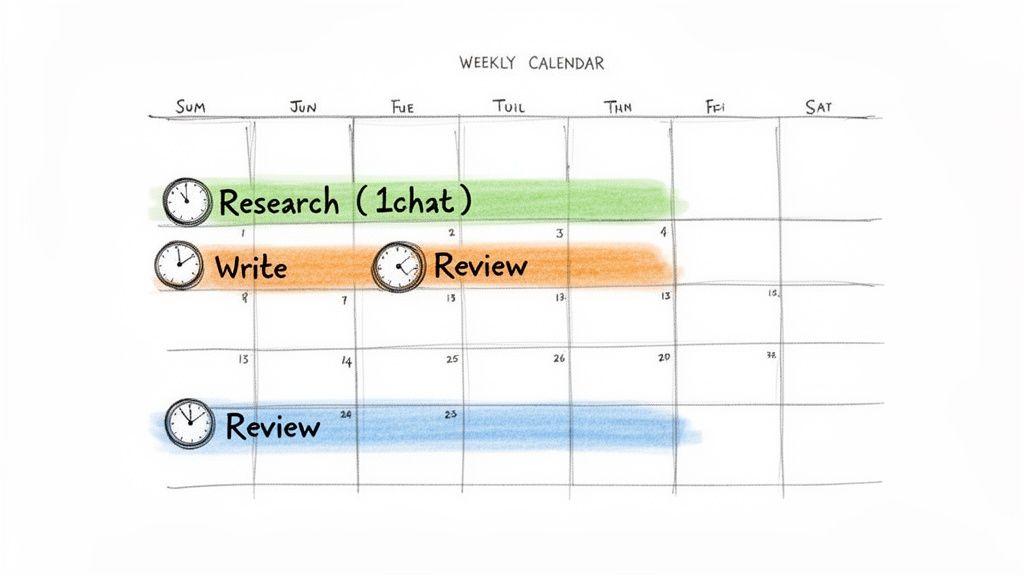
Time blocking is a scheduling method that involves dedicating specific blocks of time in your calendar to particular tasks or activities. Popularized by productivity expert Cal Newport, this approach transforms your to-do list into a concrete schedule, assigning every minute of your day a specific job. This structure minimizes context switching and helps you commit fully to the task at hand, whether it's studying, research, or personal time.
This technique is one of the most effective time management tips for students because it provides a clear roadmap for the day and week. By scheduling dedicated blocks for each course, you ensure that every subject receives adequate attention. For a college student, this could mean blocking out Monday and Wednesday mornings for chemistry research using 1chat, and afternoons for drafting an English essay. This proactive planning prevents you from deciding what to do in the moment, which often leads to procrastination.
How to Implement Time Blocking
To get started with time blocking, all you need is a digital calendar or a physical planner. The goal is to create a visual template for your week.
- Step 1: List Your Fixed Commitments. Begin by scheduling non-negotiable events like classes, work shifts, appointments, and meals. This creates the basic framework of your week.
- Step 2: Create Blocks for Academic Work. Identify your peak mental energy hours and schedule your most challenging subjects or tasks during that time. For instance, a high school student might block 4-5 PM for math homework, then 5-6 PM for biology study, using 1chat's PDF analysis to review notes.
- Step 3: Schedule Buffers and Breaks. It’s unrealistic to switch instantly from one complex task to another. Schedule 10-15 minute buffer blocks between your main tasks for transitions, grabbing a snack, or a quick mental reset.
- Step 4: Incorporate Flexibility. Your schedule is a guide, not a rigid rulebook. Leave some unscheduled "flex time" to handle unexpected tasks or to allow a block to run over if you're in a state of deep focus.
- Step 5: Review and Adjust Weekly. At the end of each week, take 15 minutes to review your schedule. Identify what worked and what didn't, then adjust your blocks for the upcoming week accordingly.
Using tools like Google Calendar or Notion with color-coding can make your schedule visually intuitive. By assigning a specific purpose to every hour, time blocking helps you take control of your workload and make intentional progress toward your academic goals.
4. The Two-Minute Rule
The Two-Minute Rule is a powerful productivity principle popularized by David Allen in his book "Getting Things Done." The core concept is simple: if a task takes less than two minutes to complete, you should do it immediately rather than postponing it. This approach prevents small, quick tasks from piling up and creating unnecessary mental clutter, allowing you to focus your energy on more substantial assignments.
This method is one of the most practical time management tips for students because it combats procrastination at its source. It helps build momentum by quickly clearing minor items off your to-do list. For students, this could mean responding to a professor's email, organizing lecture notes from the day, or adding a new source to a bibliography. By handling these small tasks instantly, you maintain a clearer mind and a more manageable workload.
How to Implement the Two-Minute Rule
Adopting this rule is straightforward and requires only a conscious shift in how you approach small tasks.
- Step 1: Identify the Task. As tasks arise throughout your day, ask yourself: "Will this take less than two minutes?" For example, a professor emails you back with a quick question.
- Step 2: Act Immediately. If the answer is yes, do it right away. Instead of marking the email as unread to handle later, draft and send your reply on the spot.
- Step 3: Leverage Quick Tools. Use tools that accelerate small tasks. For instance, if you need to double-check a citation format or clarify a concept for an essay, asking an AI tool like 1chat can provide an answer in seconds, keeping your workflow uninterrupted. A college student could use it to generate a quick essay outline before starting a larger writing session.
- Step 4: Combine with Other Methods. Integrate the Two-Minute Rule into your existing routines. Use the 5-minute breaks in your Pomodoro cycles to knock out a couple of these quick tasks.
- Step 5: Review Your Progress. At the end of the week, look back at all the small tasks you completed. Recognizing this cumulative progress can be a significant motivator and reinforces the habit.
By consistently applying this rule, you prevent small administrative duties from snowballing into a source of stress, freeing up valuable time and mental bandwidth for your most important academic work.
5. The ABC Method
The ABC Method is a straightforward prioritization technique that organizes tasks based on their level of importance. Popularized by time management consultant Alan Lakein, this approach categorizes your to-do list into three distinct tiers: A (must-do), B (should-do), and C (nice-to-do). The fundamental rule is to focus on completing all 'A' tasks before moving to 'B' tasks, and all 'B's before starting on 'C's.
This hierarchical system is one of the most effective time management tips for students because it forces you to confront your most critical responsibilities first. It prevents you from spending valuable time on low-impact activities while high-stakes deadlines loom. For example, a college student might categorize dissertation research as an 'A' task, weekly course readings as a 'B,' and exploring optional topics for an extracurricular club as a 'C.' This ensures their primary academic goals always receive the most attention.
How to Implement the ABC Method
To start using this method, all you need is your task list for the day or week. The goal is to assign a priority level to every single item.
- Step 1: List All Your Tasks. Write down everything you need to accomplish. Don't worry about order yet; just get it all on paper.
- Step 2: Assign a Letter. Go through your list and assign an A, B, or C to each task.
- A Tasks: These are your most important, high-priority items. They have significant consequences if not completed, such as studying for a major exam tomorrow or finishing a term paper.
- B Tasks: These are important but less urgent. They have moderate consequences, like completing weekly homework or reviewing lecture notes.
- C Tasks: These are low-priority tasks with minimal consequences if postponed, such as organizing your digital files or reading optional articles.
- Step 3: Prioritize Within Categories (Optional). For even greater clarity, you can number your tasks within each category (A-1, A-2, B-1, etc.) to decide the exact sequence.
- Step 4: Focus on 'A' First. Begin working exclusively on your A-1 task. Do not move to any 'B' or 'C' tasks until all your 'A' tasks are complete.
- Step 5: Move Through the List. Once all 'A' tasks are done, move to your 'B' tasks. Only address 'C' tasks if you have time left over.
This method instills a discipline of focusing on what truly matters, ensuring your most impactful academic work is never neglected. It transforms a chaotic to-do list into a clear, actionable plan for success.
6. Goal Setting and Breaking Down Projects
Goal setting and breaking down large projects is a foundational time management strategy that transforms overwhelming assignments into a clear, actionable roadmap. This approach involves defining specific academic objectives and deconstructing intimidating tasks, like a research paper or a group presentation, into smaller, more manageable sub-tasks. By doing so, you reduce procrastination and gain a tangible sense of progress with each completed step.
This method is particularly powerful for long-term assignments that can seem impossible to start. One of the most effective time management tips for students is to shift focus from the final, distant deadline to immediate, achievable milestones. For instance, a 20-page research paper is daunting, but a goal to find five primary sources in one afternoon is not. This process builds momentum and ensures you are consistently moving forward.
How to Implement Goal Setting and Project Breakdown
To get started, you need to think both macro and micro: establish the big-picture goal, then break it into its smallest components.
- Step 1: Define Your Goal with SMART Criteria. Make your objective Specific, Measurable, Achievable, Relevant, and Time-bound. Instead of "do my term paper," a SMART goal would be: "Complete the 2,500-word history research paper by next Friday with a target grade of an A-."
- Step 2: Deconstruct the Project. List every single step required to reach your goal. For an essay, this might include: research, outlining, drafting the introduction, writing body paragraphs, conclusion, and revising. Aim to create sub-tasks that take no more than 1-3 hours each.
- Step 3: Assign Deadlines to Milestones. Don't just focus on the final due date. Set deadlines for each major phase. For a month-long project, you might set a deadline for completing all research in the first week, finishing the first draft by week three, and dedicating the final week to revisions.
- Step 4: Use Tools to Your Advantage. Leverage tools to streamline specific stages. For example, during the initial research phase, you can use 1chat to gather information and find sources efficiently. For more tips on this initial stage, check out our guide on planning an assignment.
- Step 5: Review and Adjust Weekly. Check in on your progress regularly. This allows you to identify roadblocks and adjust your timeline accordingly, preventing a last-minute panic.
By systematically breaking down projects, you create a clear path to completion. This method not only makes your workload more approachable but also enhances the quality of your work by ensuring each component receives adequate attention.
7. Minimize Distractions and Create a Focused Environment
Minimizing distractions involves intentionally designing both your physical and digital spaces to support deep focus. This time management strategy, championed by experts like Cal Newport, is based on the idea that concentration is a finite resource. By proactively removing interruptions before they happen, you can accomplish more high-quality work in less time, reducing the need for late-night cramming.
This approach is crucial for any task that demands sustained mental effort, from writing research papers to solving complex problem sets. One of the most impactful time management tips for students is to create a sanctuary for studying, as even small interruptions can break your concentration and cost you valuable minutes to refocus. A dedicated, distraction-free environment signals to your brain that it's time to work, making it easier to get into a state of flow.
How to Implement a Distraction-Free Environment
Creating a focused study space is a two-part process: managing your physical surroundings and taming your digital world.
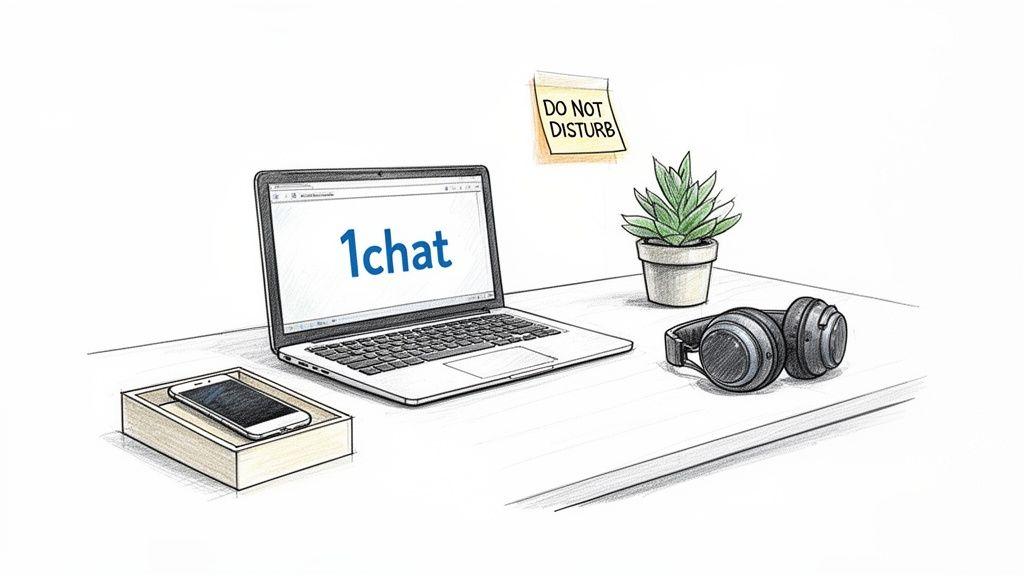
- Step 1: Designate Your Study Zone. Choose a specific, quiet location for studying, like a library carrel or a clean desk in your room. Keep it organized and free of visual clutter. For example, a high school student might clear their desk of everything except their laptop, a notebook, and a textbook.
- Step 2: Eliminate Physical Interruptions. Set clear expectations with family or roommates about your study hours to prevent them from interrupting you. Use noise-canceling headphones or play white noise to block out ambient sounds that can break your focus.
- Step 3: Lock Down Your Digital Space. Your digital environment is often the biggest source of distraction. Use website and app blockers like Freedom or Cold Turkey to prevent access to social media during study sessions. Put your phone in another room or turn on "Do Not Disturb" mode.
- Step 4: Streamline Your Workflow. When working, open only the essential tabs and applications. For instance, if you are conducting research, keep your browser open only to your research sources and an AI tool like 1chat to help synthesize information. This prevents multitasking and keeps you on task.
- Step 5: Practice Consistently. Make this setup a consistent habit. The more you use your designated focused environment, the stronger the psychological association between that space and productive work becomes.
By systematically removing distractions, you create the optimal conditions for effective learning. This structured setup complements other techniques, such as active learning strategies for students, by ensuring you have the undivided attention needed to engage deeply with your material.
8. Batch Similar Tasks Together
Task batching is a time management strategy that involves grouping similar activities together and completing them in a single, dedicated session. This method is designed to combat "context switching," the mental drain that occurs when your brain has to shift between different types of thinking. For students, this means moving from research mode to creative writing mode or from analytical problem-solving to memorization takes a toll on focus and efficiency.
Grouping tasks that require a similar cognitive state, such as research, writing, or administrative work, allows you to maintain momentum and enter a state of deep focus, often called "flow." One of the most effective time management tips for students is to use batching to streamline their workflow. For instance, a college student could dedicate one block of time to researching for multiple papers and another block entirely to writing, rather than alternating between the two. This specialization of effort makes each work session more productive.
How to Implement Task Batching
Getting started with task batching requires a bit of planning to identify and group your tasks effectively.
- Step 1: Identify and Categorize Your Tasks. Review your to-do list for the week and group tasks into logical categories. Examples include "Research," "Writing," "Math Problems," "Lab Reports," "Emails," and "Formatting Citations."
- Step 2: Schedule Dedicated Blocks. Assign specific, uninterrupted blocks of time in your schedule for each batch. A 90-minute block for all your weekly research or a two-hour session for drafting history essay outlines can be highly effective.
- Step 3: Prepare Your Resources. Before you begin a batch, gather everything you will need. If you're doing a research batch using a tool like 1chat, have your list of questions, topics, and relevant PDFs ready to go to minimize distractions once you start.
- Step 4: Execute with Single-Minded Focus. During your scheduled block, work only on tasks within that batch. Avoid the temptation to check your email during a writing session or to start formatting while you are still researching.
- Step 5: Take a Transition Break. After completing a batch, take a meaningful break of 15-20 minutes before moving to a different type of task. This helps your brain reset and prepare for the next cognitive demand.
This approach transforms a chaotic to-do list into an organized, efficient workflow. By minimizing the mental startup energy required for each new task, you can accomplish more in less time and produce higher-quality work.
9. Regular Review and Adjustment of Schedule
Effective time management is not a static, "set it and forget it" process. It's a dynamic skill that requires continuous refinement. Regularly reviewing and adjusting your schedule is a crucial practice that ensures your time management system remains effective and aligned with your current academic demands, workload, and personal energy levels. This approach, inspired by continuous improvement philosophies like Agile methodology, helps you learn from your experiences and optimize your productivity over time.
This method is one of the most powerful time management tips for students because it turns your schedule into a learning tool. By dedicating a short amount of time each week to reflect on what worked and what didn't, you can identify bottlenecks, recognize patterns, and make data-driven decisions. For example, you might discover that using an AI tool like 1chat for research consistently cuts your essay preparation time by 40%, allowing you to reallocate that time to a more challenging subject.
How to Implement Regular Schedule Reviews
Making this a consistent habit is simple. All you need is a calendar, your past week's schedule, and about 30 minutes of focused time.
- Step 1: Schedule a Review Session. Block out a 30-minute slot in your calendar each week. A common choice is Friday afternoon to reflect on the past week or Sunday evening to plan for the upcoming one.
- Step 2: Compare Estimates to Reality. Look at the tasks you planned for the week and compare the time you estimated with the time you actually spent. A simple spreadsheet can help track this. Note any significant differences.
- Step 3: Ask Critical Questions. During your review, ask yourself: What went well this week? What challenges did I face? What will I do differently next week? Be specific. For instance, "My study sessions for biology were 50% faster when I used 1chat to analyze PDF articles."
- Step 4: Identify Patterns and Bottlenecks. Note recurring issues. Are you always underestimating the time needed for math homework? Are you most productive in the morning? Recognizing these patterns is the first step toward fixing them.
- Step 5: Adjust Your Future Schedule. Use your insights to create a more realistic and effective plan for the next week. Allocate more time for subjects that consistently overrun, schedule demanding tasks during your peak energy hours, and build in successful strategies you've identified.
This iterative process transforms your schedule from a rigid set of rules into a flexible, responsive guide. By consistently reviewing and adjusting, you ensure your time management strategies evolve with you, helping you stay organized, reduce stress, and achieve your academic goals more efficiently.
10. Use Technology Strategically & Build in Buffer Time
Effective time management for students in the digital age involves a two-part strategy: leveraging technology to streamline your workflow and building in buffer time to handle unexpected issues. This approach combines the efficiency of digital tools with the realism of practical planning. By selecting a few core applications and scheduling more time than you think you need, you create a resilient system that reduces stress and prevents last-minute crises.
This dual method is crucial for managing a complex academic workload, from daily assignments to long-term research projects. Strategic use of technology automates organization and accelerates tasks, while buffer time acts as a safety net, ensuring that unforeseen delays don't derail your entire schedule. For instance, using an AI assistant like 1chat can significantly speed up research, but allocating buffer time ensures you have space for critical thinking and synthesizing that information.
How to Implement This Strategy
A balanced approach starts with choosing your tools wisely and planning realistically.
- Step 1: Select Core Tools. Avoid overwhelming yourself with too many apps. Start with a maximum of three: a calendar (like Google Calendar) for scheduling, a task manager (like Todoist) for daily to-dos, and a central hub for research and writing. Using one of the best AI tools for students can centralize much of this work.
- Step 2: Automate and Integrate. Connect your tools where possible. For example, sync your task manager with your calendar to see deadlines in one place. Use distraction blockers like Forest or Cold Turkey during focused work sessions to maintain discipline.
- Step 3: Estimate and Add a Buffer. When planning a task, estimate the time required and then add a 25-30% buffer. If you believe an essay will take 10 hours, schedule 12-13 hours for it. This extra time can be used for deeper revisions or to absorb unexpected research challenges.
- Step 4: Set Internal Deadlines. Create personal deadlines that are 1-2 days earlier than the actual due date. This practice builds in a natural buffer and eliminates the pressure of submitting work at the very last minute.
- Step 5: Review and Refine. Periodically assess your system. If an app isn't saving you time, replace it. If you consistently underestimate time for a certain type of task, adjust your buffer percentage accordingly.
This strategic combination of technology and buffer time creates a robust framework for academic success. It allows you to work efficiently without becoming fragile, ensuring you can handle the unpredictable nature of student life while consistently producing high-quality work.
10 Student Time-Management Strategies Comparison
| Method | 🔄 Implementation Complexity | ⚡ Resource Requirements | 📊 Expected Outcomes | 💡 Ideal Use Cases | ⭐ Key Advantages |
| The Pomodoro Technique | 🔄 Low — simple rules and repeatable cycles | ⚡ Low — timer or app, short breaks | 📊 High — sustained focus, reduced fatigue | 💡 Intensive study sessions, timed research/writing bursts | ⭐ Builds momentum, prevents burnout |
| Priority Matrix (Eisenhower Box) | 🔄 Low–Moderate — requires judgment to categorize | ⚡ Low — paper or simple app | 📊 High — clearer priorities, less wasted time | 💡 Multiple deadlines; deciding what to do now vs later | ⭐ Visual clarity on urgency vs importance |
| Time Blocking | 🔄 Moderate — needs planning and discipline | ⚡ Moderate — calendar app and planning time | 📊 High — reduced context-switching, balanced coverage | 💡 Managing diverse coursework and routine weeks | ⭐ Creates accountability and predictable focus periods |
| The Two-Minute Rule | 🔄 Very Low — instant decision rule | ⚡ Very Low — no tools required | 📊 Moderate — fewer small tasks accumulate, quick wins | 💡 Small admin tasks, quick clarifications with 1chat | ⭐ Prevents buildup of trivial tasks; momentum booster |
| The ABC Method | 🔄 Low — simple A/B/C triage | ⚡ Low — minimal setup (list or app) | 📊 Moderate–High — attention to highest-impact tasks | 💡 Day-to-day prioritization when many tasks compete | ⭐ Simple, fast prioritization that reduces overwhelm |
| Goal Setting & Breaking Down Projects | 🔄 Moderate–High — requires upfront planning | ⚡ Moderate — planning tools, milestones, time | 📊 High — projects become manageable, measurable progress | 💡 Large essays, dissertations, multi-phase projects | ⭐ Clear roadmap and milestone-based progress tracking |
| Minimize Distractions & Focused Environment | 🔄 Moderate — physical + digital setup effort | ⚡ Moderate — blockers, ergonomic gear, routines | 📊 High — deeper focus, faster completion of tasks | 💡 Deep research, long writing or analysis sessions | ⭐ Dramatically improves concentration and work quality |
| Batch Similar Tasks Together | 🔄 Moderate — planning to group related work | ⚡ Moderate — longer uninterrupted blocks | 📊 High — reduced switching costs, improved flow | 💡 Bulk research, citation formatting, proofreading | ⭐ Efficiency gains through sustained cognitive mode |
| Regular Review & Adjustment of Schedule | 🔄 Moderate — requires consistent tracking & reflection | ⚡ Low–Moderate — simple logs or spreadsheets | 📊 High (over time) — better estimates, fewer bottlenecks | 💡 Semester-long planning, refining study routines | ⭐ Data-driven improvements and adaptive planning |
| Use Technology Strategically & Build Buffers | 🔄 Moderate–High — tool selection & integration | ⚡ High — apps, integrations, setup time + buffers | 📊 High — automation, reduced search time, less stress | 💡 Complex projects, team coordination, multi-tool workflows | ⭐ Centralizes work, automates reminders, protects against overruns |
From Theory to Action: Building Your Personal Time Management System
You have now explored a comprehensive toolkit of ten powerful time management tips for students, each designed to address a different facet of the academic grind. We moved from the focused, 25-minute sprints of the Pomodoro Technique to the high-level strategic planning of the Priority Matrix. We discussed the structural power of Time Blocking, the momentum-building magic of the Two-Minute Rule, and the simple-yet-effective categorization of the ABC Method. These strategies are not just abstract ideas; they are practical, field-tested methods for reclaiming control over your schedule and directing your energy where it matters most.
The journey from feeling overwhelmed to feeling in command of your time doesn't happen overnight. It also doesn't come from adopting a single, "perfect" technique. The true path to sustainable academic success lies in building a personalized time management system. Think of the strategies we've covered as individual components. Your task is not to use all of them at once, but to select, combine, and adapt the ones that best fit your unique personality, learning style, and academic demands.
Your Immediate Action Plan
To transition from reading this article to actively improving your daily routine, here are your next steps. Don't try to do everything at once. Choose one area to focus on this week and build from there.
- Identify Your Biggest Challenge: What is your primary time management struggle right now? Is it procrastination? Feeling overwhelmed by large projects? Constant distractions? Pinpoint the main problem first.
- Select Your "Starter" Technique: Based on your challenge, pick one or two methods from this guide to implement immediately.
- Struggling with focus? Start with the Pomodoro Technique.
- Feeling overwhelmed and unsure where to begin? Use the Priority Matrix to clarify what truly needs your attention.
- Lacking structure in your day? Implement Time Blocking for your next study session.
- Commit to a One-Week Trial: Dedicate yourself to consistently using your chosen technique(s) for the next seven days. Don't worry about perfection; focus on the effort. Use a simple notebook or a digital app to track when you use the method and how it feels. Did it help? What were the obstacles?
- Review and Refine: At the end of the week, take 15 minutes to reflect. Was the technique effective? Does it need a slight adjustment to better fit your workflow? Perhaps you need to combine it with another strategy, like Batching Tasks, to see a greater impact. This review-and-adjust cycle is the core of building a system that lasts.
The Bigger Picture: Investing in Your Future
Mastering these time management tips for students is about more than just getting better grades or finishing assignments on time. It's an investment in your well-being and your future. Effective time management reduces stress, prevents burnout, and creates the space in your schedule for rest, hobbies, and social connections, all of which are critical for a healthy and fulfilling student experience. The skills you cultivate now, such as prioritizing tasks, breaking down complex projects, and minimizing distractions, are the very skills that will define your success in your future career and personal life.
As you integrate these habits, remember that the goal is not to become a robot, rigidly adhering to a flawless schedule. The goal is to become an architect of your own time. It's about making conscious, intentional choices about how you spend your most valuable, non-renewable resource. By combining smart strategies with a commitment to consistent practice, you can transform your relationship with time from one of conflict to one of partnership. You will move beyond simply surviving your academic journey to truly thriving within it, unlocking your full potential for deep learning, outstanding achievement, and a balanced, rewarding life. The clock is always ticking; now you have the tools to make every second count.