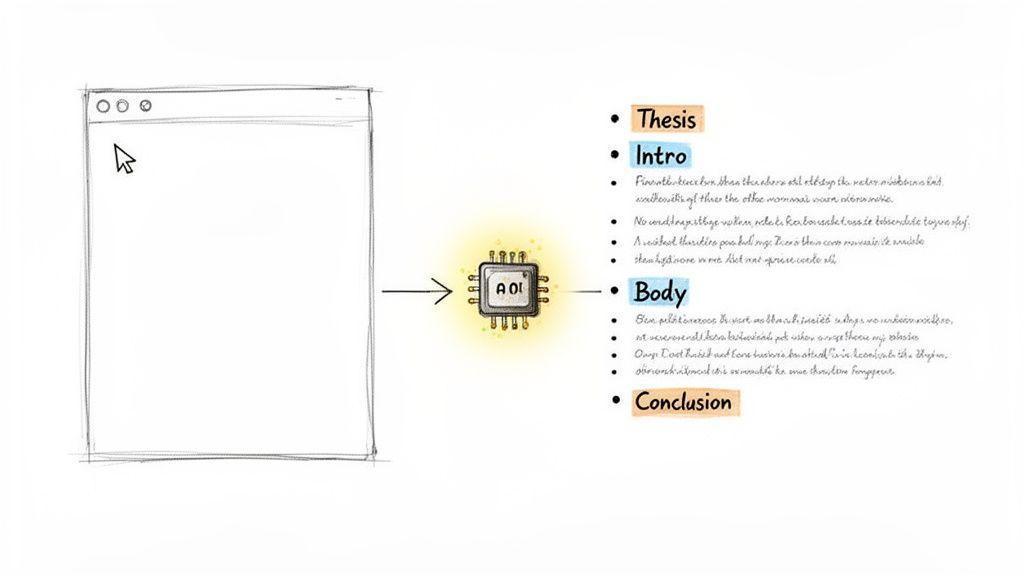
We've all been there—staring at a blank document, the cursor blinking mockingly. That initial hurdle of just starting an essay can be the most intimidating part of the entire writing process. An AI essay outline generator is the perfect tool to break through that wall. You simply give it your topic or thesis, and it builds a logical roadmap for you in seconds.
Think of it as a smart assistant that handles the structural heavy lifting—organizing your introduction, main body paragraphs, and conclusion—so you can focus on the actual writing.
Beat the Blank Page With an AI Outline
That initial paralysis when facing a new assignment is real. The pressure to create a perfect argument from nothing is immense. This is where an AI essay outline generator comes in handy, turning a single idea into a structured, workable plan almost instantly.
It's more than just a passing gadget; it’s a smart way for students and writers to bring clarity and efficiency to their work from the very beginning. Instead of juggling a dozen scattered thoughts, you start with a solid foundation, whether it's for a high school argumentative essay or a dense university research paper.
Why Outlining Is the New Killer App for AI
It turns out that building a strong structure is a universal pain point. The professional world figured this out quickly. A recent study found that a massive 71.7% of content marketers now use AI specifically for outlining. That's more than those using it for brainstorming ideas (68%) or even drafting content (57.4%).
What does that mean for you? It means you can generate a complete framework for a 1,200-word essay in less than a minute. This doesn't just save time; it dramatically lowers the stress of getting started.
The real power of an AI outliner is its ability to create order from chaos instantly. It gives you a clear, actionable roadmap, freeing you to focus your energy on developing arguments and finding evidence instead of just figuring out where to begin.
To show how this works in practice, here’s a quick look at the immediate value an AI outliner provides for different users.
Immediate Benefits of an AI Outline Generator
See how an AI essay outline generator delivers value for different users right away.
| Feature | Benefit for Students | Benefit for Small Businesses |
| Instant Structure | Overcomes writer's block by providing a clear starting point for any essay. | Quickly creates content briefs and article structures for blogs or marketing materials. |
| Logical Flow | Ensures arguments are presented coherently with a natural progression of ideas. | Organizes key selling points and information for proposals and reports. |
| Time Savings | Reduces hours spent on planning, allowing more time for research and writing. | Speeds up content production, allowing teams to publish more frequently. |
| Idea Expansion | Suggests sub-points and supporting details you may not have considered. | Helps flesh out simple ideas into comprehensive content plans. |
The takeaway is clear: getting a solid structure is the first and most important step toward creating high-quality written work efficiently.
How a Privacy-First Tool Can Help
When you're ready to try this, using a tool like 1chat gives you a big advantage. It lets you access several different AI models from one spot, so you can test which one generates the best outline for your specific topic.
More importantly, its privacy-first approach means your research, ideas, and drafts stay completely confidential—a crucial detail for academic work. You can experiment freely without worrying about your data. This lets you finally move past writer's block and start with a plan you can trust.
For more inspiration, check out our guide with a comprehensive essay outline example to see what a polished structure looks like in action.
How to Craft Prompts for Better Outlines
The quality of the outline you get from an AI is a direct reflection of the quality of your prompt. It’s that simple. A vague request like "outline an essay on The Great Gatsby" is only going to give you a generic, surface-level plan that won't impress anyone.
To really get the most out of an AI essay outline generator, you have to be the one in the driver's seat. Think of it like giving directions—a great prompt is a detailed map, guiding the AI to the exact destination you have in mind. A lazy prompt is just telling the driver to "head west" and hoping for the best.
The Core Ingredients of a Powerful Prompt
So, what does a good prompt actually look like? It's all about providing context. You need to give the AI enough information to build a structure that lines up with your specific assignment and your unique angle.
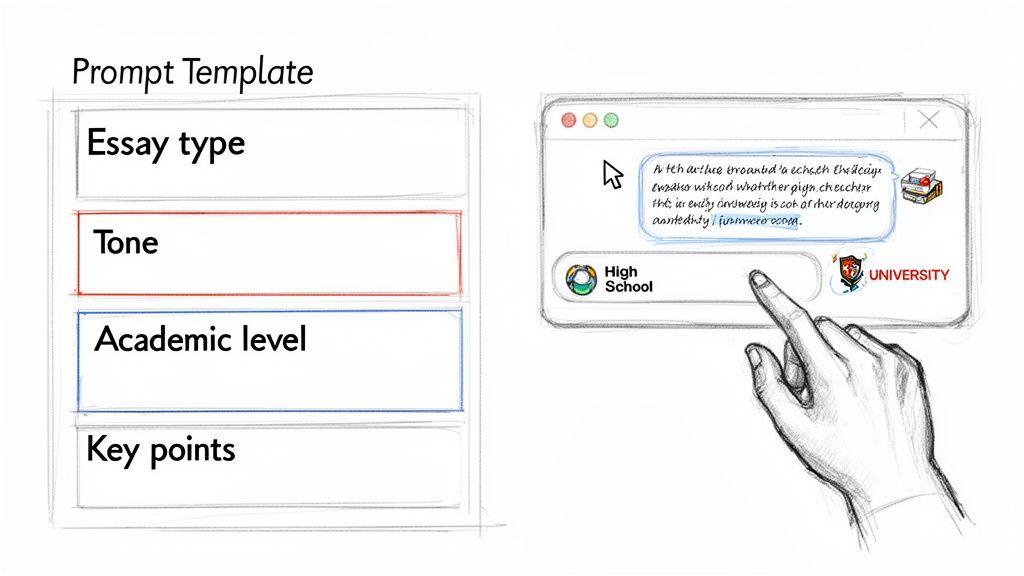
Any solid prompt should include these details:
- Essay Type: Be upfront. Is this an argumentative, expository, persuasive, or comparative essay? The structure changes for each.
- Topic and Thesis: State your central topic. If you already have a thesis statement, include it. This is the North Star for your entire essay.
- Academic Level: Tell the AI if you're writing for a 10th-grade class or a university seminar. This adjusts the complexity of the language and ideas.
- Key Arguments: List the main points you want to cover. This is your chance to steer the AI and make sure your key ideas are front and center.
- Required Sources: If your professor wants you to use specific articles, books, or data, mention them. The AI can then suggest where to weave them in.
When you include these elements, the AI becomes less of a magic eight ball and more of a focused collaborator, building the exact framework you actually need.
From Vague Ideas to Specific Instructions
Let’s look at a real-world example to see just how big the difference is. Imagine you're writing a high school paper on The Great Gatsby.
A beginner's prompt often looks something like this:
"Give me an essay outline for The Great Gatsby."
This is way too broad. You’ll get a cookie-cutter book report outline that probably won't get you a great grade. Now, let’s build a much stronger prompt using those core ingredients we just talked about.
Strong Prompt Example: "Generate a detailed outline for an argumentative essay for a 10th-grade English class. The topic is 'The American Dream in The Great Gatsby.' My thesis is: 'F. Scott Fitzgerald critiques the American Dream, portraying it as an illusion corrupted by wealth and social class.' The outline should include an introduction with the thesis, three body paragraphs focusing on the themes of old money vs. new money, the illusion of self-reinvention, and the ultimate unattainability of dreams for characters like Gatsby. Include a counter-argument and a conclusion."
See the difference? This detailed prompt gives the AI essay outline generator everything it needs to create a genuinely useful and sophisticated structure. You've specified the essay type, academic level, thesis, and the exact arguments for each body paragraph. The outline it produces will be a far better starting point for your draft.
If you really want to get good at this, it’s worth learning a bit about what prompt engineering is. Mastering this skill will give you a major leg up when using any AI tool.
Alright, enough with the theory. Let's get our hands dirty and see what this looks like in practice. This is where you’ll watch an AI essay outline generator like 1chat turn a simple prompt into a solid, workable structure for your paper.
We'll use a common scenario: a history essay on the causes of World War I. You've done some preliminary reading, you have a general idea of what you want to argue, and you’ve put together a solid prompt.
Generating Your First Outline
The first thing you'll do in 1chat is pick an AI model that suits your task. Some are brilliant at dissecting historical events, while others might be geared more toward scientific analysis or creative writing.
Once you’ve picked your model, it’s time to feed it your prompt. This is the moment where detail pays off. Instead of just typing "Causes of WWI," you'll use the specific, detailed prompt we worked on earlier—the one that includes your thesis and specifies the core arguments you want to explore (militarism, alliances, imperialism, and nationalism).
You click generate, and in a matter of seconds, the AI delivers your first draft outline. This isn't just a random list; it's a structured argument, complete with a thesis, topic sentences for your paragraphs, and even suggestions for where evidence would fit best.
This is what the interface looks like when you're ready to go.
As the screenshot shows, the clean interface makes it easy to drop in your prompt and choose the right AI model. This flexibility is a huge help, as you can experiment to see which model gives you the best starting point for your specific assignment.
Understanding the AI's Output
So, what do you do with what the AI gives you? Think of the generated outline as your road map. It’s not set in stone, but it gives you a clear direction.
For our WWI essay, a good AI-generated outline might look something like this:
- Introduction: Starts with a compelling hook, provides brief historical context, and presents your specific thesis statement.
- Body Paragraph 1 (Militarism): A topic sentence focused on the European arms race, with notes to insert evidence like stats on Germany's and Britain's naval expansion.
- Body Paragraph 2 (Alliances): The topic sentence here would explore the chain reaction created by the Triple Entente and Triple Alliance.
- Body Paragraph 3 (Imperialism): This section would focus on how the fierce competition for overseas colonies created friction between major powers.
- Body Paragraph 4 (Nationalism): A paragraph dedicated to the powder keg of the Balkans, culminating in the assassination of Archduke Franz Ferdinand.
- Conclusion: Brings it all home by restating the thesis in a new way and summarizing your main arguments.
This initial structure is gold. It takes all those jumbled ideas and facts floating around in your head and organizes them into a logical, persuasive argument. Instantly, writer's block feels a lot less intimidating because you have a clear path forward.
From here, you can start fleshing out each section. And because 1chat is a privacy-first platform, you can brainstorm, outline, and draft with the confidence that your academic work stays completely private. This quick walkthrough shows just how fast you can get a high-quality, actionable outline to kickstart your writing process.
So, you've just used an AI essay outline generator and have a neat, structured plan in front of you. That's a great head start, but let's be clear: this is where the real work—and the real writing—begins.
Think of the AI's output as raw material. It's a solid foundation, but it's not your essay yet. It lacks your unique perspective, your voice, and the specific arguments you want to make. The next step is all about rolling up your sleeves and refining that structure.
This is the part of the process where you shift from simply using a tool to actually crafting a compelling argument. You're not just accepting a pre-made template; you're using it as a scaffold to build something much stronger and more personal.
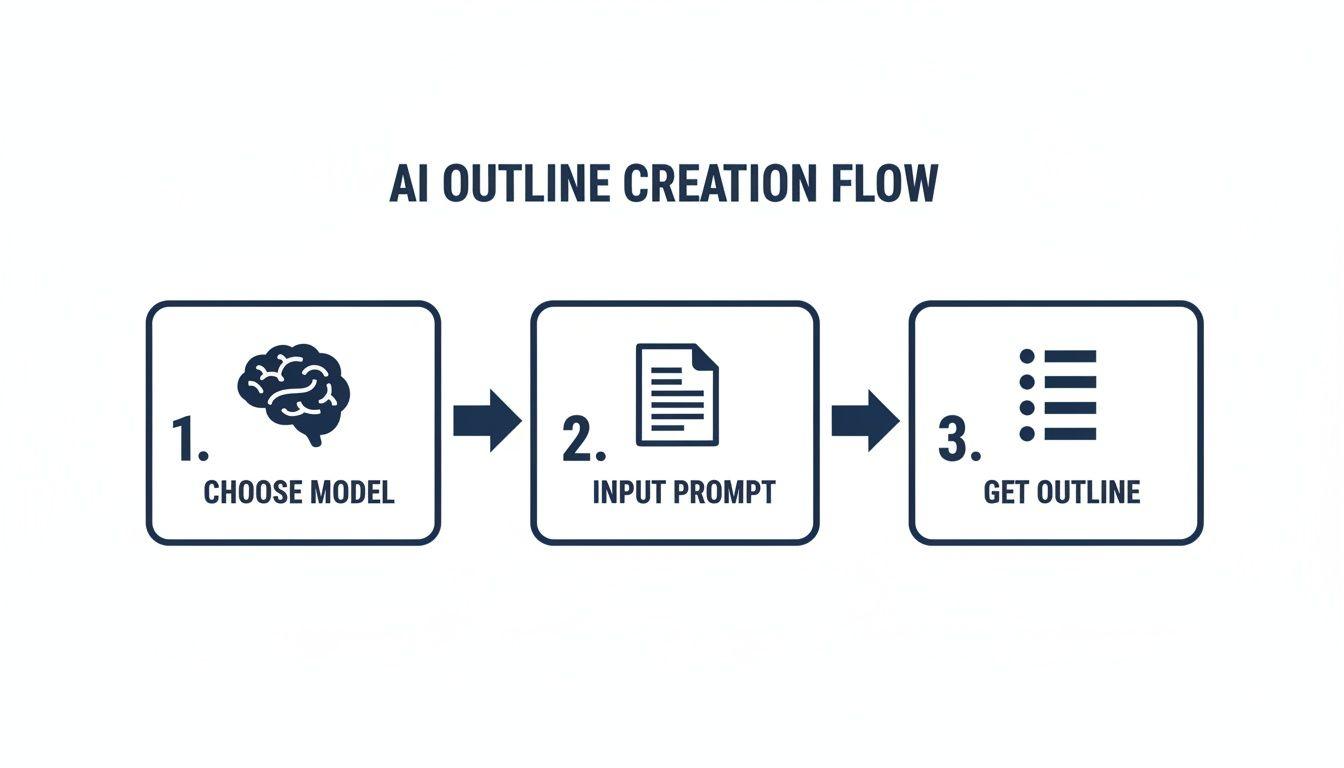
As the diagram shows, getting the initial outline is quick. Now, let’s invest that time saved into making it truly excellent.
Make the Argument Your Own
Start by reading the AI’s outline with a critical eye. Does the argument flow logically to you? The AI might default to a standard, predictable order, but your unique take might be more powerful if you rearrange things.
Don't be afraid to completely reorder the main points. For instance, maybe the AI put a key counter-argument at the end, but you know it would be more effective to tackle it head-on right at the beginning. Drag, drop, and shuffle sections until the narrative feels right for the story you’re trying to tell.
This is also the perfect time to ditch the AI’s generic topic sentences and rewrite them in your own voice.
Find and Fill the Gaps
No matter how good the AI is, it can't read your mind or know the specific nuances your professor is looking for. It will almost certainly leave gaps or create points that feel a bit thin. Your job is to play detective and hunt down these weak spots.
As you review the outline, ask yourself a few key questions:
- Where does an argument feel unsupported or underdeveloped?
- What sub-points did the AI miss that could really strengthen a main idea?
- Did the outline leave clear spots for the specific data, quotes, or evidence from your research?
This is where the magic happens. A key reason the generative AI market is set to explode to $356.10 billion by 2030 is its ability to reduce prep time—some studies show by over 70%. You can learn more about how generative AI growth is impacting productivity. Use that saved time for this critical review.
Why Manual Refinement Matters
To really see the difference, let's compare a raw AI-generated outline with one that's been thoughtfully refined by a human. The gap in quality is significant.
| Attribute | Raw AI Outline | Refined Human-Edited Outline |
| Argument Flow | Often logical but can be generic and predictable. | Strategically ordered for maximum impact and narrative drive. |
| Voice & Tone | Neutral, robotic, and lacks a distinct personality. | Reflects the writer's unique voice and perspective. |
| Supporting Points | May be superficial or miss key details. | Includes specific, nuanced sub-points and evidence placeholders. |
| Originality | Follows common patterns and may lack a fresh take. | Infused with unique insights and a creative angle. |
| Completeness | Can have gaps or fail to address all assignment requirements. | Thoroughly checked against requirements, with gaps filled. |
The table makes it clear: the initial AI output is a starting point, not a destination. Your careful refinement is what transforms a generic structure into an essay that is well-argued, authentic, and genuinely stands out.
Using AI Outliners Ethically in School
So, you're using an AI essay outline generator. Smart move for getting past that initial blank-page panic. But let's talk about the big question: where's the line between using a tool and cheating? It might seem a little fuzzy, but the distinction is actually pretty clear. It all boils down to who is doing the thinking.
Think of an AI outliner as a super-powered brainstorming partner, not a ghostwriter. It can help you map out your ideas and see different ways to structure an argument, much like a calculator crunches numbers for you in a complex math problem. But the calculator isn't solving the problem; you are. The AI isn't writing your essay; it's just helping you organize your own thoughts.
Keeping Your Work Yours
The one rule you can't bend is this: the work you submit must be your own. Your ideas, your analysis, your voice. That’s it.
With the market for AI text generators projected to hit $1.75 billion by 2030, these tools are becoming a normal part of the academic landscape. That makes it even more critical to understand where the ethical lines are drawn. You can read more about the growth of the AI text generator market yourself. Using AI to structure your own arguments is just being efficient. Using it to write those arguments for you is academic misconduct.
A great way to check yourself is with this question from admissions experts: "If a college admissions officer asked you how you used AI in your application, what would you feel proud to say?"
If you'd have no problem explaining how you used the tool to spark ideas or organize your points, you're almost certainly in the clear.
The Dos and Don'ts of AI in Your Essays
So what does this look like in practice? Before you do anything, check your school’s specific AI policy—they can vary a lot.
But generally, here are some clear guidelines to keep you on the right side of academic integrity.
What You Should Do
- Do use an AI to brainstorm initial ideas and explore different angles on your topic.
- Do generate a basic outline to see a potential structure for your arguments.
- Do ask it to point out potential gaps in your logic that you need to fill.
- Do use it to suggest different ways to organize the points you’ve already come up with.
What You Should Not Do
- Don't copy and paste any text from the AI directly into your essay. Ever.
- Don't ask the AI to write entire paragraphs or your thesis statement for you.
- Don't submit an AI-generated outline as your own work if the assignment was to create the outline yourself.
- Don't use AI to find sources and then just list them without actually reading and citing them properly.
When you stick to these rules, a tool like 1chat becomes a powerful and legitimate study aid. You get all the benefits of breaking through writer's block while ensuring the final piece is 100% your own intellectual work.
Common Questions About AI Essay Outline Generators
Whenever a new tool like an ai essay outline generator shows up, a lot of the same questions pop up. It's only natural to wonder where the boundaries are and how to use it right. Let's get those common questions answered so you can use these tools confidently and, more importantly, ethically.
Is Using an AI Outliner Considered Cheating?
This is the big one, and the short answer is no. Thinking of an AI outliner as a high-tech brainstorming partner is the right way to frame it. It’s no different from using a thesaurus to find a better word or a grammar checker to polish your sentences. You're using a tool to organize your thoughts, not to create them.
The line gets crossed when you ask the AI to do the actual writing. Submitting text generated by an AI as your own work is, without a doubt, plagiarism. The whole point is to use the tool for planning, structuring, and getting past that initial blank-page paralysis. But always, and I mean always, check your school’s academic integrity policy. Most see AI-assisted outlining as a smart study habit.
Can AI Handle Complex Topics?
What happens when you’re not just writing a five-paragraph essay but tackling a senior thesis or a dense research paper? Can an ai essay outline generator keep up?
You'd be surprised. This is actually where these tools can really shine. For a massive project, the AI can be an incredible organizational assistant. You can feed it your core research question, a list of your sources, and the key arguments you've already found. In return, it can map out a logical structure that makes space for everything—your literature review, methodology, data analysis, discussion, and conclusion.
It helps you see how all the puzzle pieces of your research might fit together. Tools like 1chat, which let you access several different AI models, are particularly good for this. You can experiment to find an AI engine that "gets" your specific subject, whether you're analyzing historical documents or interpreting scientific data.
An AI outliner for a complex paper isn't about replacing your research; it’s about organizing it. It helps you build a coherent framework for a large amount of information, ensuring you don’t miss critical components of a well-structured academic argument.
It forces you to think about the high-level flow of your argument before you get lost in the weeds of writing a single paragraph.
How Do I Make an AI Outline Sound Like Me?
Okay, so you get an outline, but it feels... generic. Robotic, even. That’s a common and valid concern. The first draft from the AI is just a skeleton; it’s your job to give it a personality—yours.
Think of the AI's output as a suggestion, not a command. Here’s how you can start making it your own:
- Rewrite the main points: Take the topic sentences for each section and rephrase them completely. How would you introduce that idea?
- Shuffle the deck: Don't feel locked into the AI’s order. If your argument flows better by moving section three to become section two, do it. You’re the expert on your own argument.
- Inject your own insights: This is the most important step. Where are your unique examples? What specific data points will you use? Add sub-bullets with your own evidence and analysis that an AI could never have come up with.
You are the crucial "human in the loop." You're just using the ai essay outline generator to get the ball rolling faster. By the time you’re done refining it, the outline shouldn't feel like an AI's work at all. It should be a clear, personalized roadmap of your own ideas.