You used ChatGPT to draft an essay, a client email, or a blog post. It helped. It saved time. Then the worry kicks in.
Will Turnitin flag it? Will an SEO checker mark it as AI? Should you paste it into one of those “undetectable AI” tools and hope for the best?
That’s the question behind a lot of late-night searches for does undetectable ai work. The honest answer is yes, sometimes. But that’s only the beginning. The more important answer is that this whole game is unstable, risky, and hard to win for long.
Students and small business owners usually aren’t looking for a grand ethical debate. They’re looking for a practical answer. Can I use AI without getting burned? Can I improve my writing without triggering detectors? Can I trust the tools making big promises?
You can use AI well. You just shouldn’t build your workflow around trying to fool a system that keeps changing.
The Undetectable AI Dilemma
A student drafts an outline with ChatGPT, expands it into a paper, and reads it back. The grammar is clean. The structure is solid. But the voice feels a little flat. Then they remember their school uses AI detection.
A small business owner faces a similar problem. They use AI to speed up product descriptions and email campaigns. The copy sounds polished, but they worry it sounds polished in the wrong way. Too even. Too neat. Too much like every other AI-assisted page online.
That’s where “undetectable AI” tools enter the story. They promise to rewrite AI text so it looks human. The pitch is simple. Paste in AI-generated writing, click a button, and get something safer to submit or publish.
The appeal makes sense. So does the anxiety.
The problem is that this isn’t a yes-or-no situation. It’s a cat-and-mouse game. Detectors look for patterns. Humanizer tools rewrite those patterns. Then detectors adapt. Then humanizers adapt again.
Bottom line: If you’re hoping for a permanent invisibility cloak, that’s not what these tools offer.
Some people do see lower detection scores after using them. Others still get flagged. The result depends on the detector, the kind of text, and how aggressively the content was rewritten.
That uncertainty is why this topic matters. The question isn’t only whether these tools can work. It’s whether building your process around evasion is smart in the first place.
How AI Detectors Hunt for Digital Fingerprints
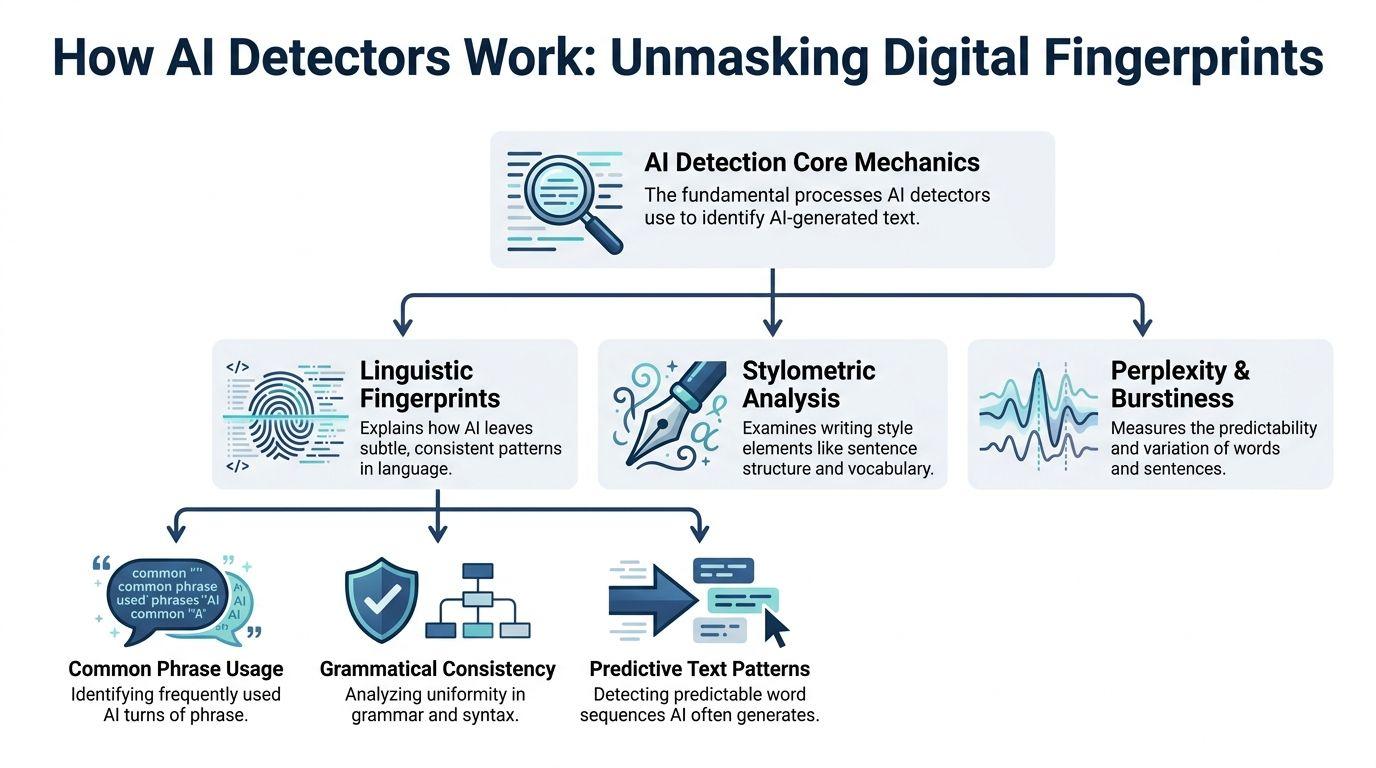
AI detectors aren’t mind readers. They’re pattern matchers.
Think of them like a linguistic detective. They don’t “know” who wrote a paragraph. They look for clues that often appear in machine-generated writing.
Perplexity and burstiness in plain English
Two terms confuse readers more than anything else. Perplexity and burstiness.
- Perplexity is about predictability. If the next word in a sentence is easy for a model to guess, the text has lower perplexity.
- Burstiness is about variation. Human writing tends to mix short sentences with long ones, simple phrases with more unusual ones.
AI often writes in a smooth, balanced rhythm. That can sound good to a person. But statistically, it can look too regular.
A human paragraph might zigzag a bit. It may include an odd phrase, a sudden short sentence, or a sentence that bends around an idea before landing. AI often irons those wrinkles out.
That’s why detector tools often examine:
| Clue | What it means |
| Predictable wording | The phrasing follows common next-word patterns |
| Uniform sentence shape | Sentences feel structurally similar |
| Stable tone | The voice stays oddly even throughout |
| Limited surprises | The text lacks natural irregularity |
If you want a beginner-friendly overview of the language science behind these systems, this guide to natural language processing helps connect the dots.
Why the detectors themselves are shaky
People often get confused. If detectors can scan for these patterns, why aren’t they reliable?
Because pattern recognition isn’t the same as proof.
Evidence summarized by Litero notes that AI detection tools show false-positive rates of 10% to 28% on human writing, while about 20% of AI text can evade detection, and OpenAI shut down its own detector after it correctly identified only 26% of AI-written text while misclassifying 9% of human writing (Litero’s review of how AI detectors work).
That means detectors can do two bad things at once:
- Flag work written by real people.
- Miss work produced by AI.
A detector score is a guess based on patterns, not a courtroom verdict.
That weakness is exactly why humanizer tools have room to operate.
The Emergence of AI Humanizer Tools
Once detectors started looking for AI fingerprints, a new class of tools appeared to smudge those fingerprints.
These tools usually call themselves AI humanizers, undetectable AI, or rewriters. Their promise is straightforward. They take text that sounds too statistically clean and reshape it into something messier, less predictable, and more human-like.
In practical terms, they often do things like:
- change sentence length and rhythm
- swap common phrasing for less expected wording
- break up repetitive structure
- introduce more variation in tone or syntax
That sounds technical, but the basic idea is simple. If a detector looks for regularity, a humanizer tries to add irregularity.
What these tools are really selling
The product isn’t just better writing. It’s reduced anxiety.
For a student, the appeal is “maybe this won’t trigger Turnitin.”
For a freelancer, it’s “maybe this won’t alarm a client.”
For a marketer, it’s “maybe this will pass an SEO content check.”
That emotional promise has created aggressive marketing. Some vendors sound less like software companies and more like miracle cure salespeople.
One example stands out. Multiple sources note a gap between Undetectable AI’s marketing and independent verification. A review points out that the company claims a Forbes-related “#1 best AI detector” style accolade, yet says that based on Forbes’ November 2024 ranking, Undetectable AI was not mentioned (GPTZero’s review discussing the claim).
That doesn’t prove the tool never works. It does show why skepticism matters.
A better question than which tool is best
A lot of buyers ask, “Which humanizer should I trust?” The better question is, “What evidence supports the claim?”
If you’re curious about the mechanics of rewriting AI output into something more natural, this article on how to humanize AI text is useful. But natural-sounding writing and detector-proof writing aren’t the same thing.
That difference matters. A tool can improve readability and still fail when the detector changes.
Putting Undetectable AI to the Test Real World Evidence
The strongest argument in favor of these tools is simple. Some of them do lower detection scores, and sometimes by a lot.
That’s why the answer to does undetectable ai work can’t be a flat no.
What the before-and-after tests show
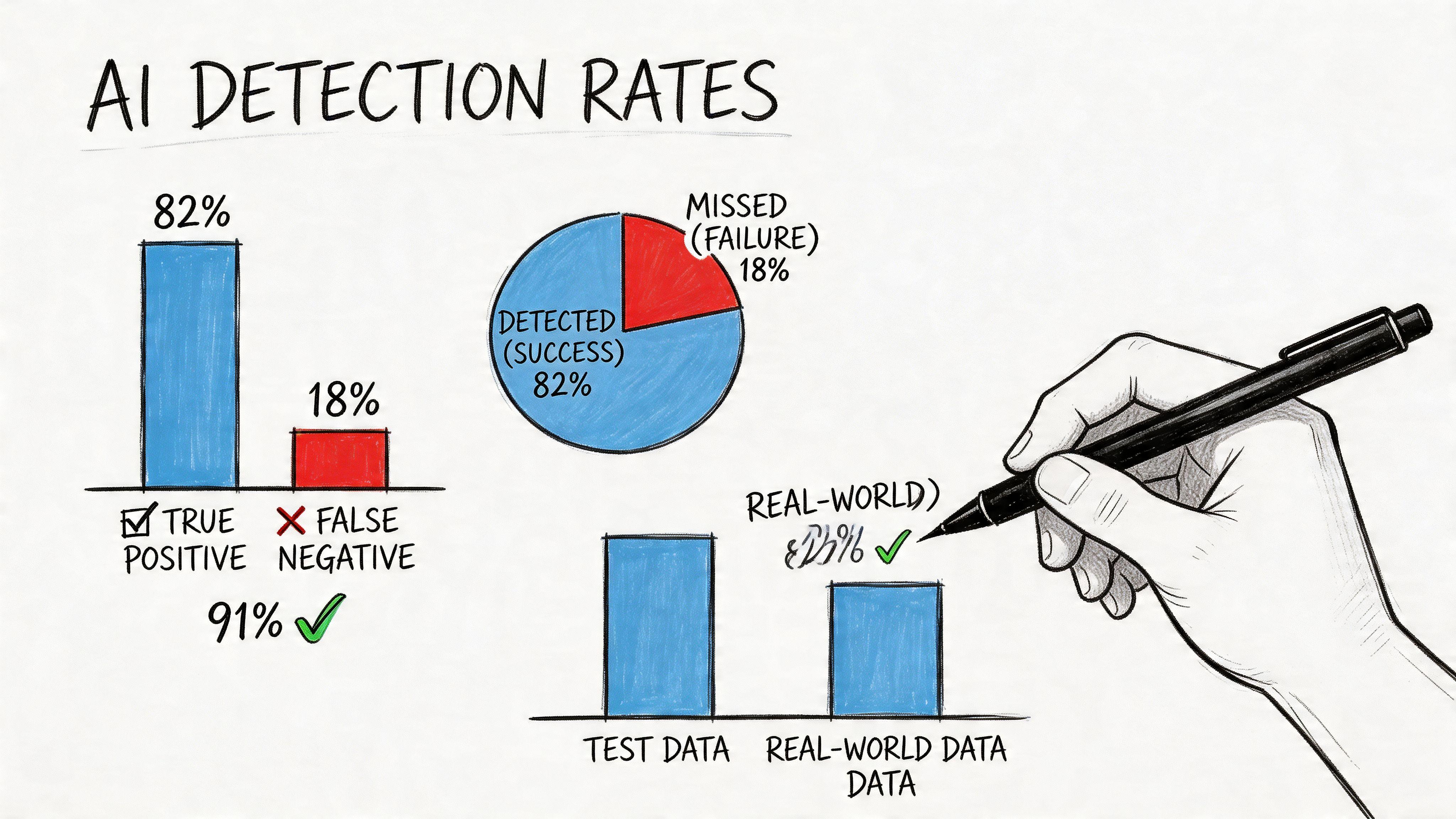
One evidence summary reports that real-world tests pushed detection scores from over 92% to 99% AI down to 7% to 24% depending on the text type. In the same analysis, a blog post introduction dropped from 98% AI to 11%, and marketing email copy dropped from 99% to 7% (AI Image Detector’s analysis of whether undetectable AI works).
Those are not tiny changes. They show that rewriting can alter the statistical signals detectors rely on.
Here’s the practical takeaway:
| Content example | Original score | After humanizing |
| Blog post introduction | 98% AI | 11% |
| Technical paragraph | 92% AI | 24% |
| Marketing email copy | 99% AI | 7% |
If you’re a marketer producing lightweight copy, those results explain why people keep using these tools. The rewrite may be enough to move content out of the obvious danger zone.
Why the results look impressive
Detectors don’t inspect secret watermarks embedded in every sentence. They infer authorship from writing patterns.
So when a humanizer changes rhythm, wording, and structure, the detector’s confidence can collapse. The text may still come from AI, but the original fingerprints become harder to spot.
That’s similar to changing your handwriting enough that a rushed reviewer hesitates. The message hasn’t changed much. The visible pattern has.
What the data supports: Humanizers can reduce detector confidence in meaningful ways, especially on simpler forms of content.
Why this still doesn’t equal safety
Lowering a score isn’t the same as guaranteeing a pass everywhere.
A detector might call a paragraph human-like today and flag a similar paragraph tomorrow after an update. A marketing snippet might slide through, while a class essay using the same tool doesn’t.
So yes, these tools can work. The evidence says they sometimes work very well. But “works in a test” is not the same as “reliably protects you in actual usage.”
The Unwinnable Arms Race and Technical Limits
The core problem with AI evasion is that success expires.
A humanizer only works because it exploits the current blind spots of a detector. Once the detector learns those new patterns, the advantage shrinks. Then the rewriting tools change again. Then the detectors update again.
That’s why this isn’t a stable strategy. It’s a moving target.
Performance changes by content type
Not all writing gives a humanizer the same room to maneuver.
Evidence summarized by HumanText says that simple blog posts can reach 60% to 80% bypass rates against basic detectors, while academic essays often reach only 20% to 40% against advanced systems like Turnitin. The same source says enterprise-grade systems such as Copyleaks can maintain up to 99.8% accuracy, and notes Turnitin’s high-accuracy approach still involves a 2% false positive rate on human content (HumanText’s review of undetectable AI performance).
That split makes sense.
A simple blog intro gives a tool freedom to rephrase. An academic essay has tighter constraints. You can’t casually replace technical terms, distort citations, or rewrite discipline-specific phrasing without damaging meaning.
Why harder content stays harder to hide
A student paper, legal summary, or technical memo carries built-in structure. It needs precision.
A humanizer can vary sentence shape, but it can’t freely scramble domain language without consequences. If it rewrites too lightly, detectors may still spot the AI pattern. If it rewrites too aggressively, the content gets sloppy.
That creates a trap:
- Too little change and the text still looks machine-generated.
- Too much change and the writing becomes inaccurate, awkward, or off-topic.
The practical paradox
The people most tempted to use these tools often face the strictest detection systems.
Students deal with academic integrity software. Businesses may face client scrutiny, editorial review, or compliance checks. Those environments don’t rely on the weakest detector available. They tend to use stronger ones.
So even if a humanizer beats a free online checker, that tells you very little about what happens when the content reaches a school platform, a publisher, or an enterprise workflow.
Free detectors are often the easiest opponents in this game. They’re not the ones that matter most.
This is why the evasion game is unwinnable in the long run. It’s not because humanizers never work. It’s because they don’t work consistently enough to build trust, policy, or reputation on top of them.
The Hidden Costs and Risks of Getting Caught
The danger isn’t only that a tool fails. The bigger danger is what failure means once another person is involved.
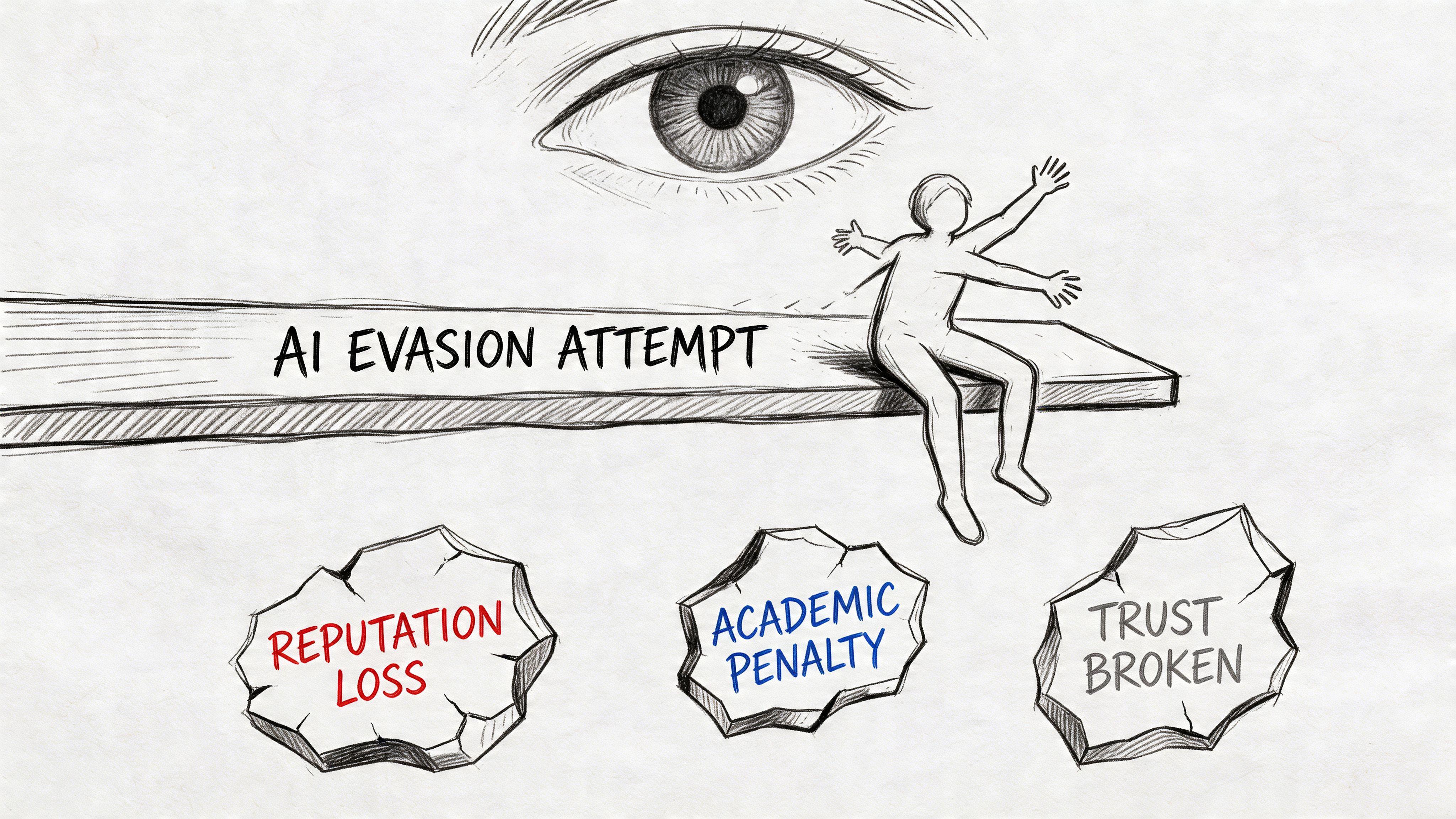
For students, that can turn into an academic integrity case. Even if the writing started as legitimate assistance, trying to hide that assistance can make the situation look worse. Schools usually react more strongly to concealment than to honest disclosure.
What students and professionals risk
- Academic penalties: A flagged paper can trigger review, disciplinary action, or a long conversation you don’t want to have with an instructor.
- Client trust problems: If a client believes you passed off machine output as original human work, the relationship can sour fast.
- Brand damage: Businesses that publish thin, generic, over-automated content can look careless even when no detector is involved.
- Editing overhead: Rewritten text often needs cleanup because the “humanized” version may sound strange in ways a detector doesn’t care about but a reader does.
There’s also a quieter cost. You can spend more time gaming detection than improving the actual piece.
The quality trade-off
People often assume the goal is to make writing more human. In practice, some humanizers make writing less clear.
They may add odd synonyms, awkward transitions, or sentence variation for its own sake. That can lower a detector score while also lowering the quality of the final work.
The moment you optimize for “less detectable” instead of “more useful,” the writing process starts drifting away from the reader.
For small businesses, that means weaker pages and shakier messaging. For students, it means turning in work you may not be able to defend in discussion.
The risk isn’t abstract. It’s practical. If you can’t explain your own paper, or if your brand voice suddenly sounds off, the detector is no longer the only problem.
A Smarter Path Responsible AI for Writing and Research
There’s a better way to use AI than trying to disguise it.
Use it as a collaborator, not a ghostwriter you need to hide.
That means asking AI to help brainstorm angles, summarize source material, build outlines, suggest counterarguments, tighten grammar, or give feedback on clarity. Then you make the decisions. You add your examples. You shape the argument. You keep responsibility for the final draft.
What responsible use looks like
A student can use AI to:
- generate a study guide from class notes
- compare possible thesis statements
- improve paragraph flow after writing the first draft
- identify weak logic before submission
A small business owner can use AI to:
- draft rough product descriptions for later editing
- organize customer FAQs
- summarize research from PDFs
- produce first-pass ideas for campaigns that still need human review
That approach builds skill instead of dependency.
Why the economics matter too
There’s also a business argument against the evasion route. A review of this market says the cost-effectiveness of AI humanizers is questionable, with some tools described as having “unreasonable pricing given performance.” The same source notes there’s no analysis showing they outperform alternatives like human editing, transparent AI disclosure, or privacy-first writing assistance (TWAINGPT’s review of undetectable AI pricing and value).
So even if you ignore the ethical issue, the workflow can still be weak:
- Generate AI text.
- Pay to humanize it.
- Test it in detectors.
- Manually fix the weird parts.
- Worry anyway.
That’s not lean. It’s not reliable. And it doesn’t teach better writing habits.
If you want a more grounded approach to policy and originality, this piece on is using ChatGPT plagiarism is worth reading.
For readers who want AI help without building their process around evasion, 1chat is a privacy-first option designed for practical writing, research, PDF analysis, and family-friendly use. That’s a more sustainable path than chasing whatever loophole a detector hasn’t closed yet.
If you’re deciding whether to trust an “undetectable” tool, use this rule. If the workflow depends on hiding your process, it’s fragile. If it helps you think, draft, revise, and learn more effectively, it’s probably worth keeping.
Frequently Asked Questions
Can’t I just manually edit AI text to make it undetectable
You can make AI text sound more like you. That’s different from making it safely undetectable. Manual editing helps when you add real judgment, examples, and structure. It doesn’t create a guarantee.
Is using any AI for schoolwork cheating
Not always. It depends on your school, teacher, and assignment rules. Using AI for brainstorming or proofreading may be allowed. Submitting AI-generated work as your own may not be. Check the policy before you submit.
Are there free ways to check for AI content
Yes, but treat free detectors cautiously. They can be inconsistent, and a low-risk score doesn’t mean institutional tools will agree.
What’s the safest way to use AI for writing
Use AI for support, not concealment. Draft your own argument, verify facts yourself, and be ready to explain every sentence you turn in or publish.