You’re staring at a blank document, a deadline is getting close, and ChatGPT can produce a clean paragraph in seconds. That’s where the panic starts.
Students worry they’ll accidentally cheat. Parents worry their child will get in trouble for using a tool that feels normal now. Small business owners worry that a quick AI-written blog post or sales email could create legal, reputational, or policy problems later. The question sounds simple, but it rarely has a simple answer.
Is using ChatGPT plagiarism? Sometimes yes. Often no. The difference usually comes down to your process, your intent, and whether you present AI-assisted work as fully your own when your school, employer, or client expects something else.
That’s why so many people feel confused. The technology moved faster than the rules. Some teachers allow AI for brainstorming. Others treat it like unauthorized help. Some workplaces welcome it for drafting. Others require disclosure or review. Many people are trying to act ethically while working with policies that are vague, inconsistent, or missing altogether.
The good news is that you don’t need a perfect universal rule to make good decisions. You need a practical way to use AI that protects your integrity, your grades, and your reputation.
The AI Dilemma Facing Us All
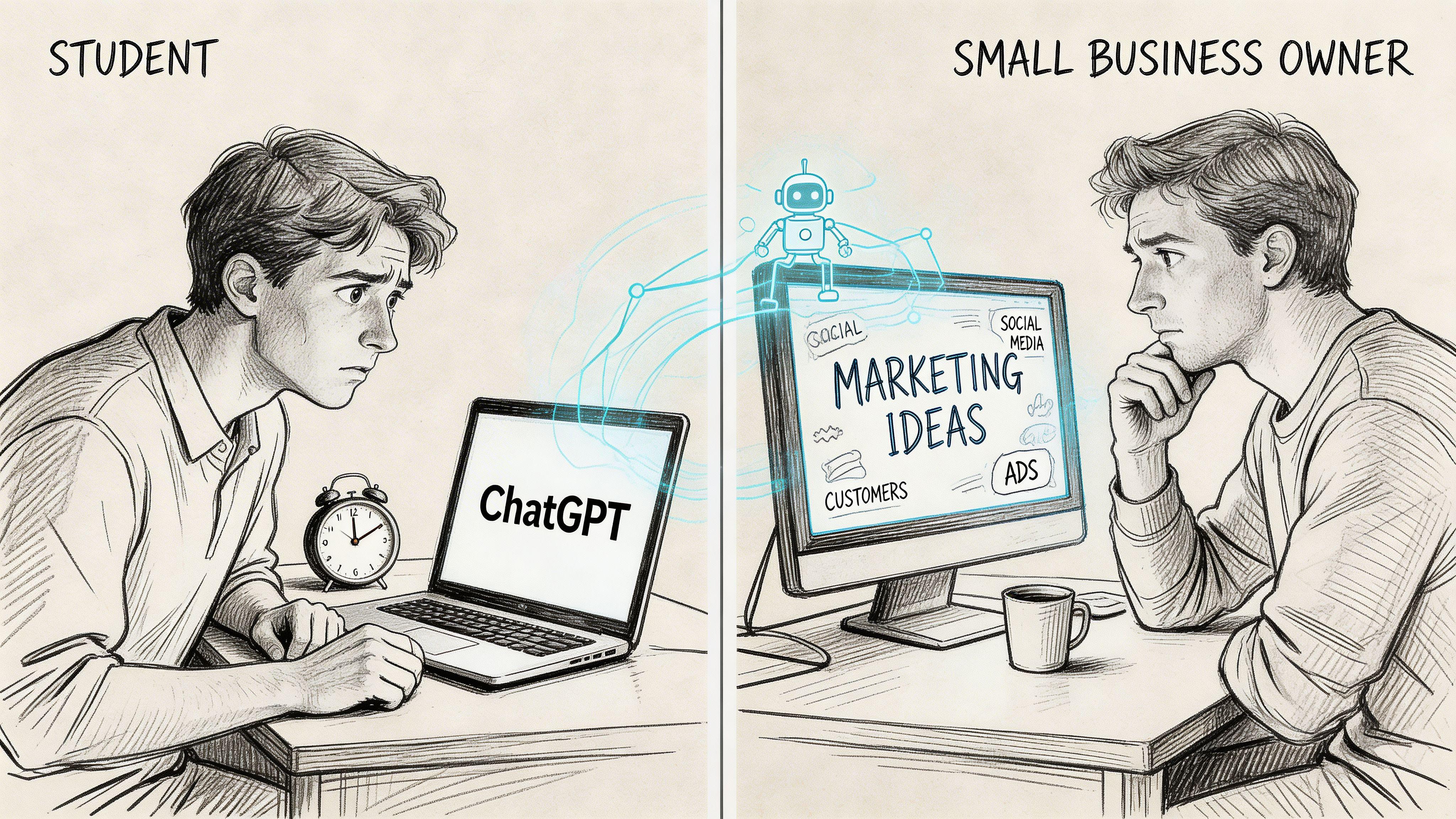
A college student opens ChatGPT at 11:40 p.m. The essay is due at midnight. They don’t want to cheat. They also don’t want to fail. So they type, “Write me a conclusion for my paper.”
Across town, a small business owner is doing something that feels very different, but isn’t. They need website copy, a newsletter, and social posts before morning. They type, “Create marketing copy for my spring promotion.”
Both people are asking the same question in different clothes: If I use AI to help me finish this, am I crossing a line?
The stakes are real. In the UK, a significant number of university students were formally caught cheating with AI tools like ChatGPT in the 2023–24 academic year, marking a substantial increase over the previous year's figures. In the US, 43% of college students have employed AI for schoolwork, with 53% using it for essays, according to these AI plagiarism statistics compiled by Artsmart.
That combination matters. A lot of people are using AI, and a lot of institutions are policing it more aggressively.
Why readers feel stuck
Many readers aren’t trying to game the system. They’re trying to save time, reduce stress, or get help starting.
The confusion usually comes from three places:
- The tool feels conversational. ChatGPT feels like help from a tutor or assistant, not like copying from a website.
- The output often looks original. Because the words are newly generated, users assume it can’t count as plagiarism.
- The rules differ by setting. A teacher, professor, manager, or client may all define acceptable use differently.
You can use the same tool in two almost identical ways, and one may be acceptable while the other violates policy.
The better question
Instead of asking only, “Is using ChatGPT plagiarism,” ask these:
- What am I using it for?
- Am I hiding its role?
- Am I still doing the thinking?
- Would my teacher, employer, or client consider this undisclosed assistance?
That shift changes everything. It moves you away from fear and toward a process you can control.
Redefining Plagiarism in the Age of AI
Traditional plagiarism is straightforward. You take someone else’s words, ideas, or work and present them as your own without proper credit.
AI complicates that because ChatGPT doesn’t act like a normal source. It generates new text. That makes people think the old plagiarism rules no longer apply. They still do, but they apply differently.
AI isn’t the moral actor. You are
ChatGPT itself doesn’t make an ethical choice. The user does.
A helpful analogy is a calculator. Using a calculator to check arithmetic on a difficult math problem is normal. Sneaking a full answer key into an exam is not. The tool isn’t the issue. How you use it is the issue.
The same logic applies here:
| Situation | Likely ethical status |
| Asking ChatGPT for topic ideas | Usually acceptable if allowed |
| Asking it to explain a concept in simpler language | Often acceptable |
| Copying its full answer into an assignment and submitting it as your own | Often a problem |
| Using AI text without disclosure when disclosure is required | Often a problem |
What research suggests
A 2025 study found that frequent ChatGPT use was linked with higher plagiarism, but it was a very poor predictor, explaining only 3.9% of plagiarism behavior. A much stronger factor was a pre-existing cheating culture, which, combined with other factors, explained 28% of plagiarism. The study is available in Interactive Learning Environments.
That matters because it challenges a common shortcut in public discussion. People often say, “AI causes plagiarism.” The study suggests the picture is more complicated. A student or employee already willing to cut corners may use AI as one more shortcut. The tool alone doesn’t explain much.
Intent matters, but process matters more
A lot of people say, “I didn’t mean to plagiarize.” Sometimes that’s true. But institutions often judge what you submitted, not what you meant.
That’s why your process has to do some of the ethical work for you.
A risky process
- You ask ChatGPT to write your essay or report
- You paste the output into your document
- You make a few word changes
- You submit it without saying AI helped
That can be treated as plagiarism, unauthorized assistance, or another academic integrity violation depending on the rulebook.
A safer process
- You use AI to brainstorm angles
- You research with real sources
- You write your own draft
- You use AI to clarify awkward sentences or suggest structure
- You disclose AI use if required
That looks much closer to using software as support, not replacement.
Practical rule: If AI is doing the core thinking, drafting, or argument-building that you were supposed to do yourself, you’re entering dangerous territory.
Original words are not the same as original work
Many readers get tripped up on this point. ChatGPT may produce sentences that are technically new. But plagiarism and dishonesty rules often care about more than word matching.
If you submit AI-generated analysis, reflection, interpretation, or argument as if it came from your own mind, many schools and workplaces will still see a problem. In plain language, new wording doesn’t automatically make the work yours.
How Schools and Workplaces Are Responding
The biggest mistake people make is assuming there’s one standard rule. There isn’t.
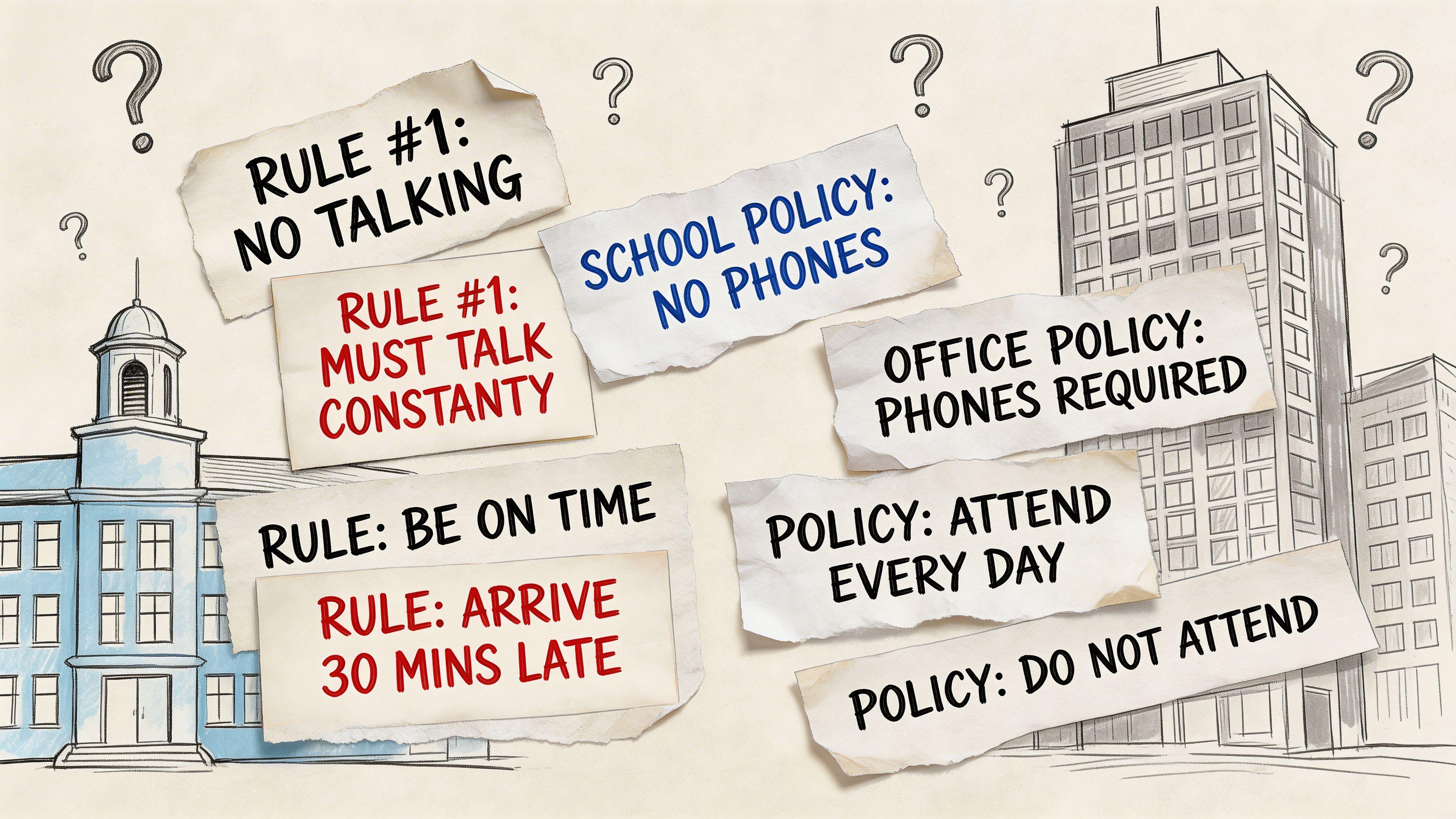
A middle school may ban AI completely. A university department may allow it with disclosure. A marketing agency may encourage it for drafts but require human review before publication. A regulated business may restrict it because staff could paste sensitive information into a public tool.
That inconsistency is why careful people still get in trouble.
The policy map is messy
A 2025 survey found that 62% of U.S. universities require AI disclosure, but only 28% provide specific citation formats. At the same time, 40% of teachers admit they lack clear AI plagiarism guidelines from their own institutions, as summarized by QuillBot’s discussion of ChatGPT and plagiarism.
That explains why students hear mixed messages like these:
- “AI is allowed for brainstorming.”
- “You must cite any AI help.”
- “Don’t use it for graded writing.”
- “I haven’t decided my class policy yet.”
A parent trying to help a teenager can’t rely on common sense alone when the adults in the system may not agree with one another.
What this looks like in real life
In K-12 settings
Schools often focus on learning habits. Teachers may object if AI replaces the student’s own struggle, practice, or explanation.
That means using ChatGPT to understand a history topic may be fine in one class, while asking it to write the homework response may be treated as misconduct in another.
In colleges and universities
Higher education usually puts more weight on disclosure, citation, authorship, and independent analysis.
If you’re in that world, don’t assume “everyone uses it” will protect you. It won’t.
In workplaces
Employers often care less about the word “plagiarism” and more about risk:
- accuracy
- confidentiality
- copyright concerns
- brand voice
- client trust
- compliance with internal policy
An employee who uses AI to draft internal notes may be praised for efficiency. The same employee might face serious consequences for publishing unchecked AI-written claims under the company name.
For students trying to sort out what responsible use looks like in practice, this overview of AI chat for students is useful because it frames AI as a study tool rather than a replacement author.
The safest assumption
If a policy is unclear, treat AI use as something that may need to be limited, disclosed, or both.
Use this quick decision guide:
| If your rule says | Your safest move |
| AI is banned | Don’t use it for the assignment |
| AI is allowed with disclosure | Disclose it clearly |
| AI policy is unclear | Ask before submitting |
| Workplace policy is silent | Use it only for low-risk drafting and verify everything |
Ambiguous rules don’t protect you. They usually put more responsibility on you to ask, document, and verify.
The Right Way to Use AI With Citing and Disclosure
Many individuals don’t need a philosophical debate. They need a clean workflow.
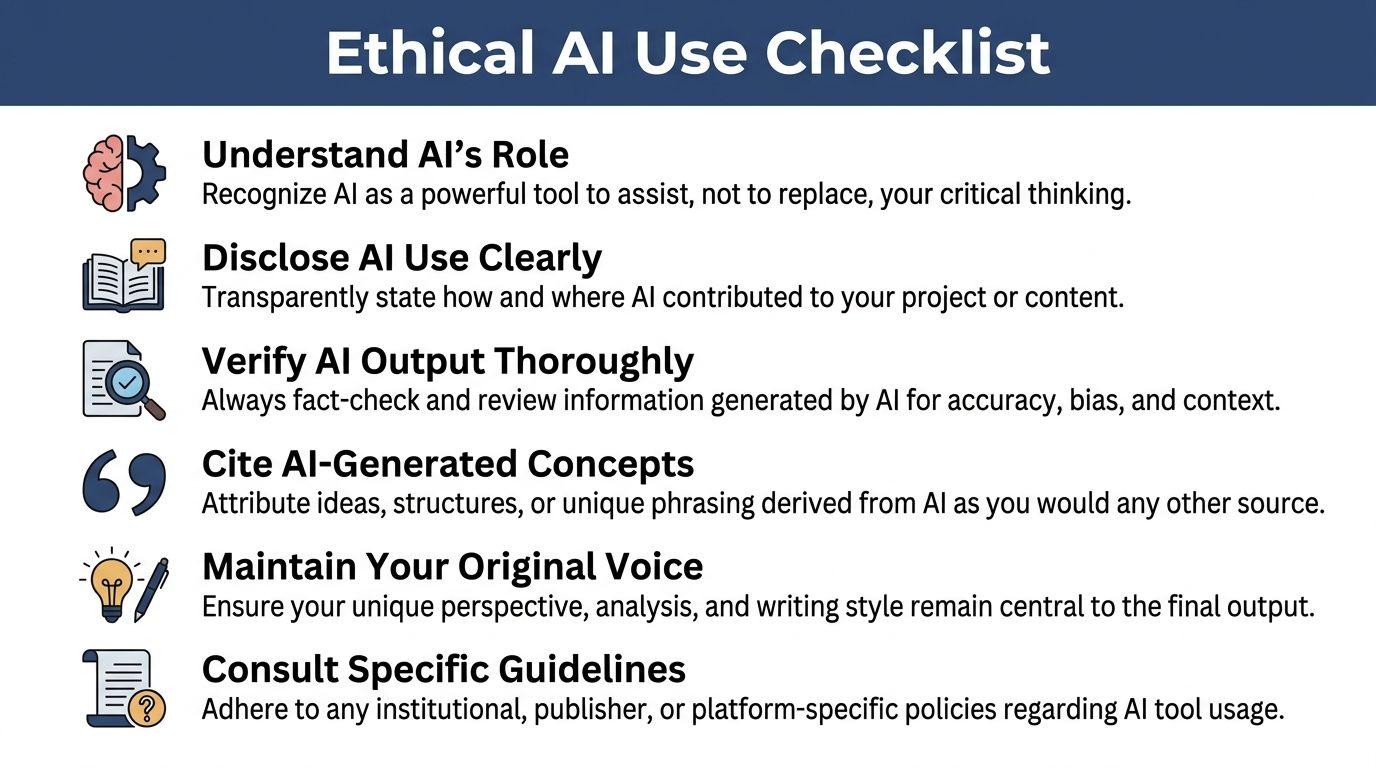
The strongest general rule is this: if AI meaningfully shaped the work, don’t hide that fact.
The emerging consensus across institutions is that undisclosed AI generation violates academic integrity policies, and the responsibility sits with the user to follow the relevant rules and verify factual claims, as explained in Grammarly’s review of whether ChatGPT plagiarism is an issue.
When you should cite AI
In schools and some professional settings, citation is appropriate when AI contributed more than a tiny mechanical edit.
Common examples include:
- Direct wording from AI. If you copy a phrase, paragraph, or substantial wording.
- Distinct ideas or structure. If the AI gave you a framework, thesis angle, outline, or comparison you relied on.
- Research leads that shaped your draft. If it suggested concepts you then built into the final piece.
If your teacher or manager says “disclose but don’t formally cite,” follow that rule. If they require citation, do that instead.
When disclosure matters even more than citation
Citation answers, “What source influenced this work?” Disclosure answers, “How did I use the tool?”
That second question often matters more with AI.
A simple disclosure can remove a lot of suspicion. It also shows that you understand the boundary between assistance and authorship.
Sample disclosure statements
You can adapt these to your setting.
For a school assignment
I used ChatGPT to brainstorm topic ideas and generate an initial outline. I wrote the final draft myself, revised the wording, and verified factual claims against course materials and approved sources.
For a college paper
AI assistance was used during early planning to refine the research question and suggest organizational structure. All analysis, source selection, and final writing were completed by the author.
For workplace writing
AI tools were used to generate draft headline options and organize notes. Final content was reviewed, edited, and approved by the authoring team, and factual claims were independently checked.
A simple ethical workflow
1. Start with your own thinking
Write rough notes first. Even a few bullets help.
That gives you a baseline so the AI supports your thinking instead of replacing it.
2. Use AI for bounded tasks
Good prompts ask for support, not substitution.
Examples:
- “Give me three possible thesis directions on this topic.”
- “Explain this paragraph in simpler language.”
- “Suggest a clearer structure for these notes.”
3. Verify every factual claim
AI can sound confident when it’s wrong. If it gives you a date, claim, quote, or data point, check it in a reliable source before using it.
4. Rewrite in your own voice
Don’t treat the first output as finished work. Rework it until it sounds like you.
That includes your reasoning, examples, tone, and judgment.
5. Add disclosure or citation based on the rule
This step is where many problems happen. People think, “I only used it a little.” But if the policy requires disclosure, the amount matters less than the rule.
If paraphrasing is part of your revision process, this guide on how to paraphrase without plagiarizing can help you keep your own voice instead of just swapping words.
A useful test before submitting
Ask yourself:
- Could I explain exactly how I used AI?
- Did I verify facts independently?
- Does the final piece reflect my judgment?
- Would the person evaluating this work expect disclosure?
- Can I defend every sentence as something I understand and endorse?
If the answer is no, stop and revise.
AI Use Scenarios Navigating the Gray Areas
The gray areas are where anxiety lives. Most misuse doesn’t start with a dramatic act of cheating. It starts with a small shortcut that feels harmless.
Here’s how that looks for different people.
Scenario one, the student with an essay due
Maya is assigned a paper on climate policy. She’s stuck at the beginning.
She tries two different approaches.
The safer version
She asks ChatGPT:
- “Give me five possible arguments people make about climate policy.”
- “Help me understand the difference between mitigation and adaptation.”
- “Turn these messy notes into a possible outline.”
Then she reads her assigned sources, chooses her position, and writes the paper herself.
That’s close to using a tutor, brainstorming partner, or study guide. In many settings, especially if disclosed when required, that’s likely to be acceptable.
The risky version
She types:
- “Write a 1,200-word essay arguing that climate policy should focus on adaptation rather than mitigation. Use an academic tone.”
She pastes the response into her document, changes a few words, and turns it in.
The problem isn’t only that AI helped. The problem is that the core intellectual work was outsourced.
If the assignment is meant to measure your reasoning, and AI supplied the reasoning, the issue is bigger than wording.
Scenario two, the parent helping with homework
A parent wants to support a middle school child who’s frustrated by a science assignment.
There are two very different kinds of help a parent can provide with AI.
Helpful support
The parent asks the AI to explain photosynthesis in simpler language, then asks the child to summarize it in their own words.
The child still does the learning.
Unhelpful support
The parent asks the AI to answer every worksheet question, then tells the child to copy the responses into the homework packet.
Now the child may finish faster, but the assignment no longer shows what the child understands.
That’s why intent matters, but learning purpose matters too. If the point of the homework is practice, replacing practice with AI answers creates a problem even if nobody meant to deceive.
Scenario three, the small business owner writing content
A bakery owner needs an email newsletter, product descriptions, and social posts before a weekend sale.
Ethical use
They ask AI for:
- headline options
- rough product description ideas
- alternate calls to action
- draft subject lines
Then they edit for brand voice, remove weak claims, confirm all details, and publish only what they can stand behind.
That’s efficient and responsible.
Risky use
They ask AI to write a full blog post about food safety rules, publish it as-is, and never verify anything.
Even if that doesn’t trigger a plagiarism complaint, it can still create a serious trust problem if the content includes errors or borrowed ideas without proper handling.
Scenario four, the employee drafting a report
An employee uses AI to organize meeting notes into sections and suggest clearer wording.
That’s usually lower risk.
The same employee asks AI to generate market claims, legal language, and customer-facing promises, then submits the document without review. That’s a very different situation. The concern may be policy violation, false statements, or confidentiality exposure rather than classic plagiarism.
A quick gray-area checklist
If you’re unsure, ask these before using the output:
- Did AI help me think, or did it think for me?
- Am I using it to learn, or to replace learning?
- Did I verify anything factual?
- Would the person evaluating this work expect disclosure?
- Can I defend every sentence as something I understand and endorse?
When people ask “is using ChatGPT plagiarism,” they often want a yes-or-no answer. Real life works more like a spectrum. The further you move from support toward substitution, the more risk you create.
AI Detection Limits and Smart Originality Workflows
A lot of users focus on the wrong goal. They ask, “Can the school tell?” or “Will a detector flag this?”
That mindset leads people into bad decisions. Detection tools matter, but they shouldn’t be your ethical compass.
Plagiarism detection and AI detection are different
A plagiarism checker compares your text against existing material to find overlap. An AI detector looks for patterns associated with machine-generated writing.
According to Honorlock’s explanation of ChatGPT plagiarism detection, advanced AI detection tools can achieve high accuracy in identifying AI-generated text by analyzing writing patterns. But that is different from plagiarism detection, which checks copied content. That creates a dual-verification challenge.
In plain language, your work might:
- pass a plagiarism checker because the words are new
- still raise questions in an AI detector because the writing patterns look machine-generated
Why this confuses people
Many users assume, “If it’s not copied, it’s safe.” That’s no longer enough in many schools and workplaces.
A generated paragraph can be original in wording and still violate a policy if you weren’t allowed to use AI that way or failed to disclose it.
A smarter workflow than trying to beat detectors
Don’t build your process around evasion. Build it around authorship.
Draft with boundaries
Use AI for notes, outlines, or alternative phrasing. Don’t ask it to produce the final answer you’re supposed to author.
Interrupt the machine voice
After any AI help, step away and revise manually. Add:
- your examples
- your reasoning
- your course-specific or business-specific context
- your own sentence rhythm
Check for overlap and weak paraphrase
A plagiarism check can still help catch accidental similarity or over-reliance on borrowed phrasing. This practical guide to checking for plagiarism using Google shows one simple way to spot wording that may need revision.
Keep a basic record
If your institution or manager later asks how you worked, a few saved prompts or notes can help show that you used AI as support rather than a ghostwriter.
The best way to avoid detection anxiety is to create work that belongs to you.
What authentic work tends to look like
Authentic AI-assisted work usually has signs of real human ownership:
| Human-owned sign | Why it matters |
| Specific examples from your class, job, or experience | AI often stays generic |
| Clear judgment and prioritization | Human writers choose what matters most |
| Verified facts and source-based claims | AI can invent or blur details |
| Natural variation in style | Machine output often sounds overly even |
If your final piece sounds like a polished but generic summary of the internet, revise more. If it sounds like you, reflects your understanding, and follows the rules, you’re in much better shape.
1chat A Responsible AI Partner for Your Family and Team
Once you understand that process matters more than panic, the next question is practical. Which tool supports responsible use instead of pushing you toward shortcuts?
For families, students, and small teams, that usually means looking for something that feels useful without turning every task into an all-or-nothing automation gamble.
Why the tool choice matters
A responsible AI workflow works better when the platform supports privacy, organization, and review.
That matters if you’re:
- a parent helping a child study without handing over the answer
- a student organizing research and notes before writing
- a small business owner drafting ideas without exposing sensitive internal material
- a team member collaborating on content that still needs human approval
Where 1chat fits
1chat is designed as a privacy-first alternative for families, students, and small businesses that want access to leading AI models in one place.
That matters because responsible use isn’t only about the text you generate. It’s also about the environment you use for research, drafting, and review.
With 1chat, users can:
- work with multiple leading LLMs in one platform
- analyze PDF documents for research and study support
- generate AI images for projects and creative work
- build more controlled workflows for family or team use
A practical way to use it responsibly
A student could upload a reading, ask for a plain-language summary, then create their own outline from that summary before drafting. A parent could use it to turn a difficult chapter into simpler explanations and quiz questions. A small business team could use it to brainstorm campaign angles, compare message options, and then have a human editor finalize everything.
That’s the pattern worth aiming for. Use AI to support understanding, drafting, and organization. Keep human judgment in charge.
If that’s the kind of setup you want, 1chat offers a more family-friendly and team-oriented environment for putting these habits into practice.
Frequently Asked Questions About AI and Plagiarism
Is using ChatGPT plagiarism if I only use it for ideas?
Usually not, but it depends on your rules. If you use it like a brainstorming partner and still do the research, writing, and analysis yourself, that’s often treated differently from submitting AI-generated text.
If ChatGPT writes something original, how can it still be a problem?
Because plagiarism and academic dishonesty rules often look at authorship and disclosure, not just copied wording. Original phrasing doesn’t automatically mean the work reflects your own effort.
Do I always have to cite ChatGPT?
Not always. Some instructors or workplaces want formal citation. Others want a disclosure statement. Some ban certain uses entirely. Follow the local rule, not internet folklore.
Is paraphrasing AI output enough to make it mine?
No. If the ideas, structure, or reasoning still came from AI, simple rewording may not solve the problem.
Can teachers and schools reliably detect AI?
They can use detectors and compare your work against your normal writing, but those tools are not the same as plagiarism checkers. The safer move is to use AI in a way you could openly explain.
Is Grammarly the same as ChatGPT for plagiarism concerns?
Not exactly. A writing assistant that suggests grammar fixes is usually different from a generative system that drafts whole passages or arguments. The more the tool contributes to actual authorship, the more careful you need to be.
What’s the simplest rule to remember?
Use AI as support, not substitute. Verify facts. Keep your own voice. Disclose help when required. If you can defend your process openly, you’re usually on the right track.