You probably are not really asking, “How many paragraphs is 500 words?”
Many readers seek a deeper answer: How should I divide 500 words so the writing feels clear, complete, and easy to read? That is the question that helps you write a stronger essay, post, or email.
A paragraph count is not a magic rule. It is a design choice. Once you understand why paragraphs exist, the numbers stop feeling random.
The Short Answer and The Real Question
For academic writing, a 500-word piece usually lands around 3 to 5 paragraphs according to this academic writing guideline. That range works because a short paper still needs a beginning, a middle, and an ending.
For online writing, the count often goes higher because screen reading changes what feels comfortable. On phones and laptops, shorter paragraphs are easier to scan, so a 500-word blog post may use more paragraph breaks than a school essay.
If you also want a page-length estimate, this quick guide on how long is 500 words helps connect word count to what you see on the page.
The key question is this: Who is reading, and what do they need from the writing?
A teacher often wants organized thinking and developed points. A blog reader wants speed and clarity. A coworker reading an email wants the point fast.
Think of paragraph count like serving size in a recipe. The ingredients may be the same, but the plating changes depending on whether you are preparing a school lunch, a dinner party, or a quick snack.
Key takeaway: The best answer to “how many paragraphs is 500 words” depends on format, audience, and purpose. The number follows the job the writing needs to do.
Understanding the Building Blocks of Writing
A paragraph is not just a chunk of text. It is one unit of thought.
When students get confused about paragraph count, they often treat paragraphs like containers to fill evenly. That leads to weak writing. A better way to think about it is to imagine paragraphs as building blocks. Each block holds one clear idea, and the full piece becomes a structure made of those blocks.
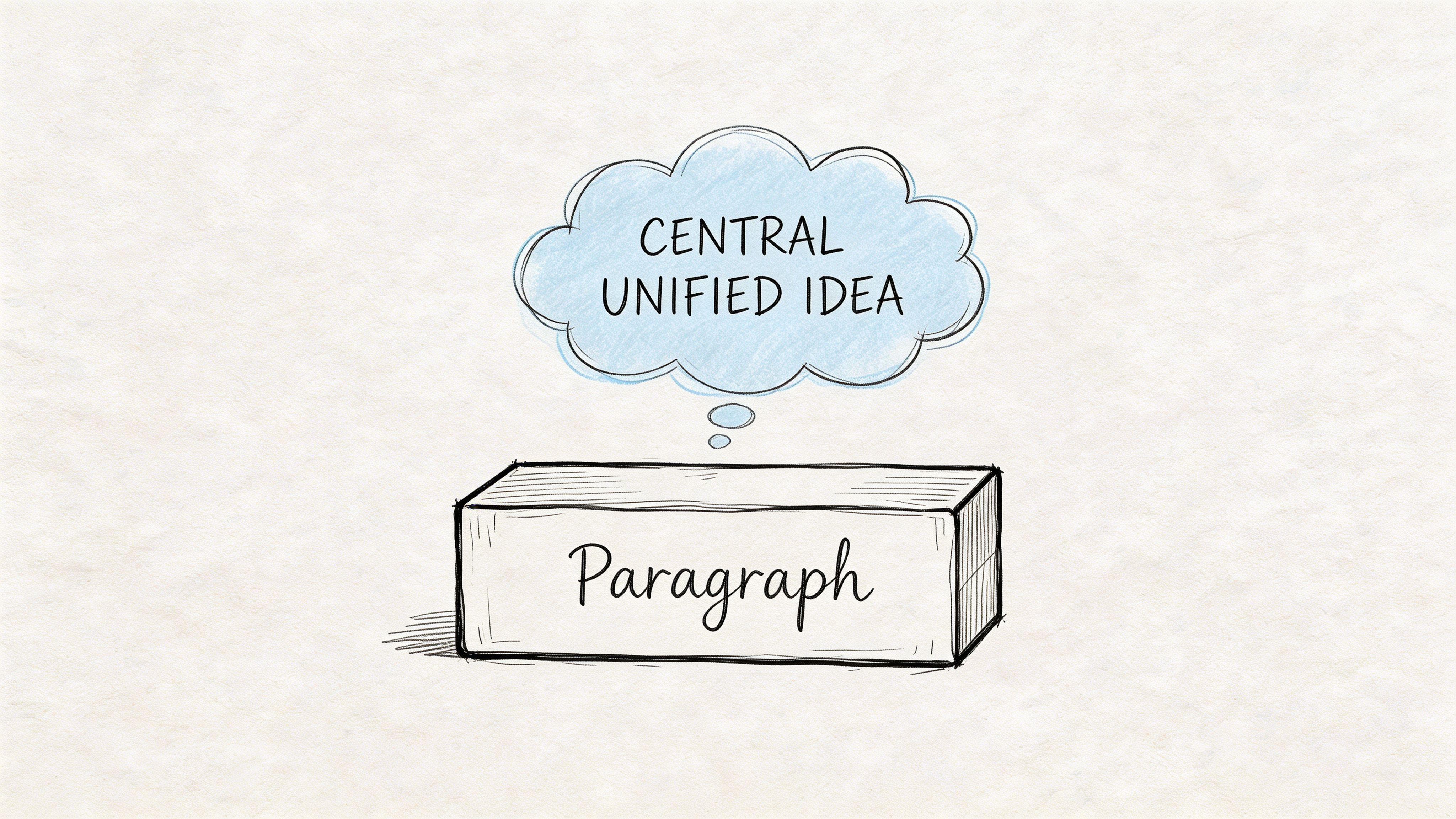
One idea per block
A strong paragraph usually does three jobs:
- It introduces a point.
- It develops that point.
- It signals why the point matters.
If you switch ideas halfway through, the block cracks. The reader has to stop and figure out where one thought ends and another begins.
That is why paragraphing matters so much. It is not cosmetic. It guides attention.
The math behind the paragraph count
There is a simple reason 500 words can produce different paragraph totals. Paragraph length and paragraph count move in opposite directions. According to this breakdown of paragraph density in 500-word essays, essays using 75 to 150 words per paragraph typically end up with 4 to 6 paragraphs. The same source notes that paragraphs around 75 words can lead to about 6 to 7 paragraphs, while paragraphs around 150 words can lead to about 3 to 4 paragraphs.
That means you are not guessing. You are choosing.
Here is a simple way to picture it:
| Paragraph style | What it feels like | Likely total in 500 words |
| Short paragraphs | Quick, airy, easy to scan | About 6 to 7 |
| Medium paragraphs | Balanced and steady | About 4 to 6 |
| Long paragraphs | Dense, formal, slower to read | About 3 to 4 |
Control the structure before you draft
If you know your format, you can decide your paragraph style early.
- For essays: choose fuller paragraphs with one developed point each.
- For blogs: break ideas more often.
- For emails: keep most paragraphs brief and direct.
That shift helps many writers relax. You do not “end up” with a paragraph count by accident. You build it on purpose.
How Writing Format Changes the Paragraph Count
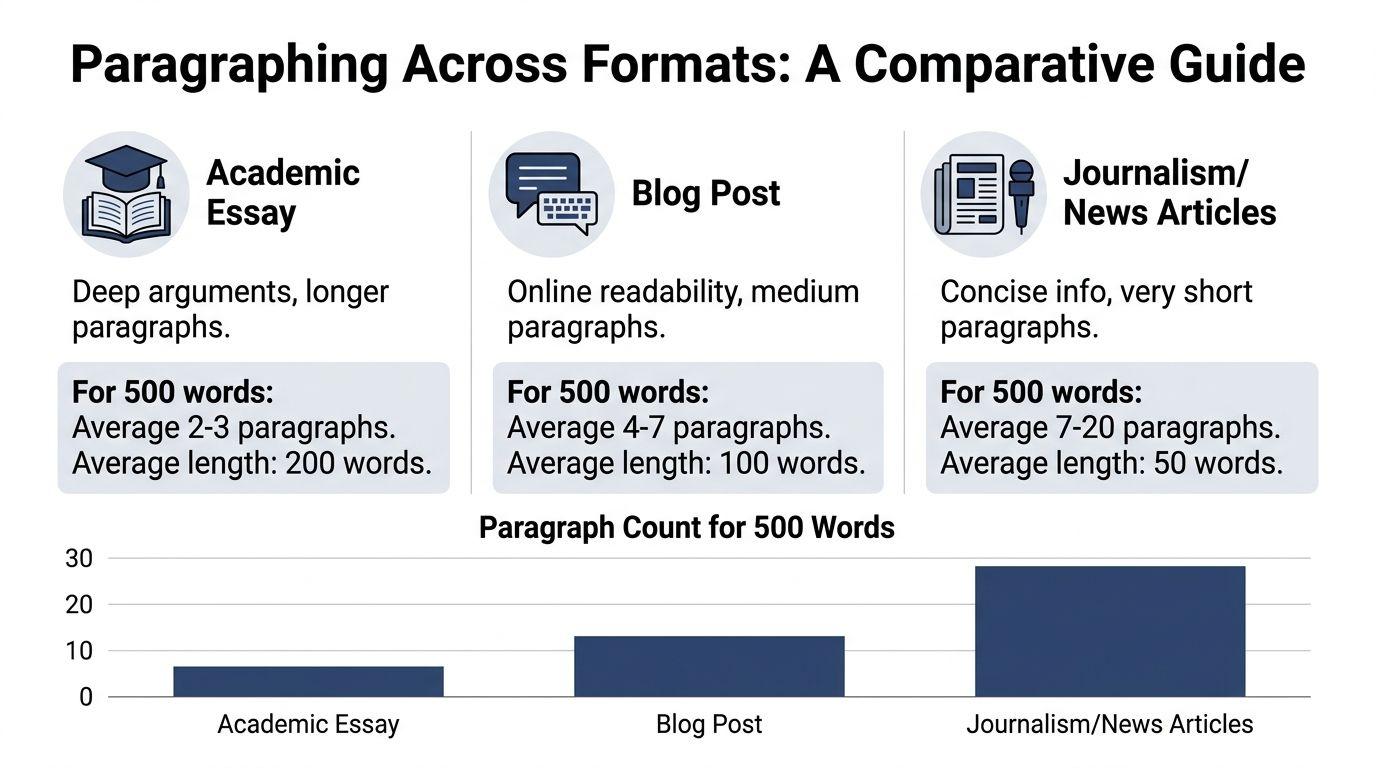
A 500-word essay, a 500-word blog post, and a 500-word email can all contain the same number of words while looking completely different. That is normal. Different formats ask readers to process information in different ways.
The school essay
In a school essay, readers expect development. Your teacher usually wants to see a claim, explanation, support, and a conclusion that ties the thinking together.
That is why essay paragraphs are often longer. You are not just stating a point. You are proving it. A paragraph has room to breathe.
A typical 500-word essay often works best when each body paragraph handles one supporting idea. The result is usually a tighter, more formal structure.
The blog post
A blog reader behaves differently. They scroll. They pause. They scan headings first.
That is one reason online paragraphs tend to be shorter. According to this discussion of mobile-friendly paragraphing, digital adaptation shortened paragraphs by 10 to 15%, and for a 500-word piece this often shifts a structure from 4 to 5 paragraphs to 6 to 8 paragraphs to maintain readability.
That does not mean online writing is shallow. It means the packaging changes. The same idea that needs one academic paragraph may become two shorter blog paragraphs because screens reward white space.
The professional email
A 500-word email is unusual, but it happens in project updates, client explanations, and team summaries. In email, readers want direction more than development.
That usually means:
- a short opening that states the purpose
- a few brief body paragraphs grouped by topic
- perhaps a list for dates, requests, or next steps
- a closing that tells the reader what to do next
An email paragraph often feels more like a spoken sentence in a meeting. It is there to move the conversation forward.
A quick comparison
| Format | Best paragraph style | Why it works |
| Academic essay | Longer, more developed | Readers expect reasoning and support |
| Blog post | Shorter, more frequent | Readers scan and read on screens |
| Brief and direct | Readers want fast clarity and action |
Practical rule: Ask not “How many paragraphs is 500 words?” Ask “How much space does each idea need in this format?”
When you match the structure to the setting, your writing stops feeling forced.
500-Word Paragraph Breakdowns and Templates
Writers improve faster when they can see a model. So instead of staying abstract, let’s turn 500 words into practical templates you can use.
Template for a 500-word academic essay
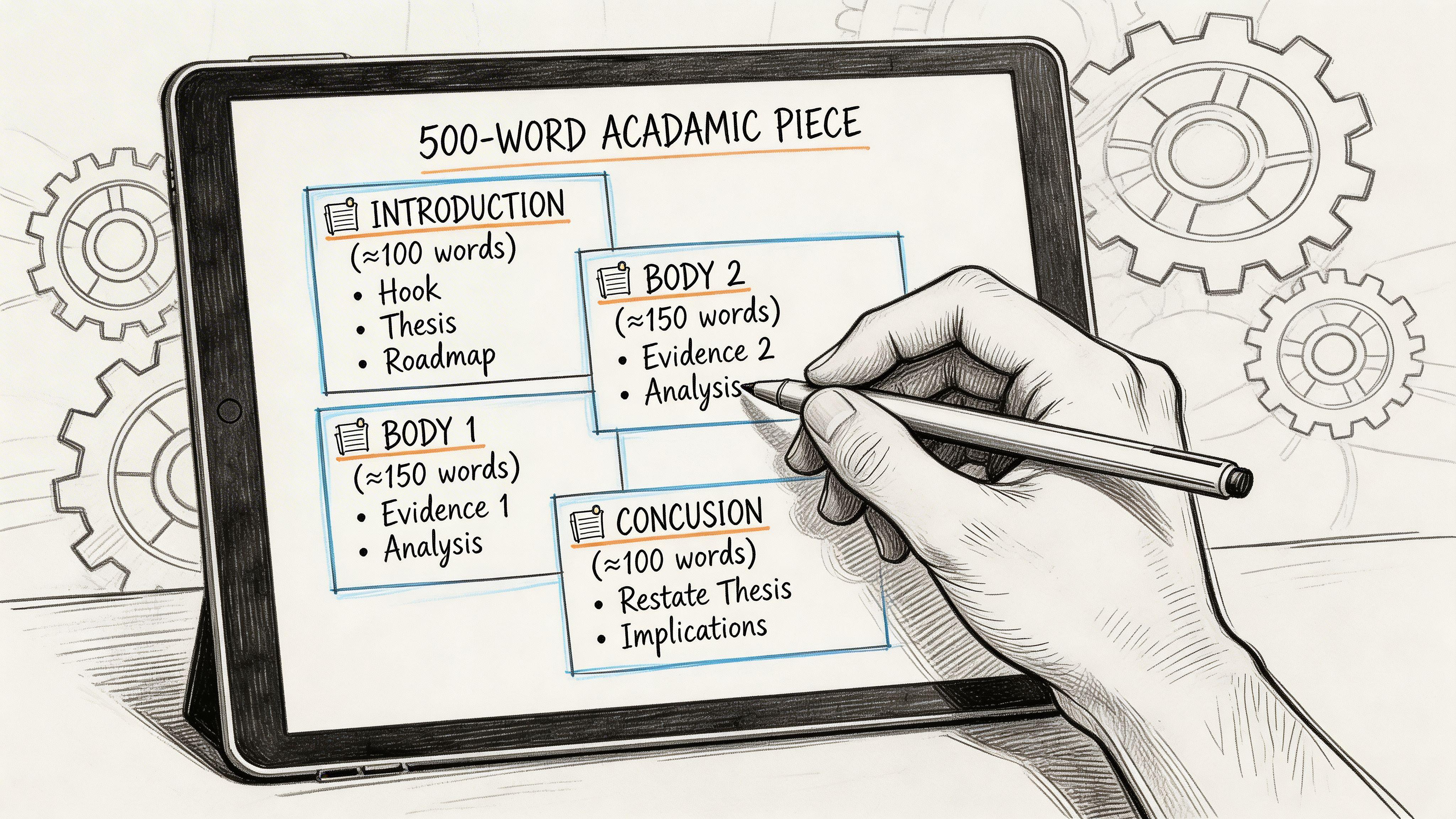
The most reliable starting point is the classic 5-paragraph model. According to this structural analysis of 500-word essays, the model of 1 introduction, 3 body paragraphs, and 1 conclusion gives an effective cognitive load distribution, with body paragraphs typically holding 100 to 200 words each.
That sounds formal, but the idea is simple. Give each major point its own space.
A usable breakdown looks like this:
| Part | Job | Approximate length |
| Introduction | Present topic and thesis | Short |
| Body paragraph 1 | First main point | Medium |
| Body paragraph 2 | Second main point | Medium |
| Body paragraph 3 | Third main point or counterpoint | Medium |
| Conclusion | Reinforce the main takeaway | Short |
Try this fill-in-the-blank version:
- Introduction: Introduce the topic. End with your main claim.
- Body 1: Explain your first reason or example.
- Body 2: Add your second supporting point.
- Body 3: Add a final point, contrast, or implication.
- Conclusion: Restate the thesis in fresh words and leave the reader with a clear final thought.
If you want a visual sense of length before drafting, this guide to 500-word essay length can help.
Template for a 500-word blog post
A blog post uses the same total word count but usually breaks ideas into smaller visual chunks.
A practical blog template might look like this:
- Opening hook Raise the question or problem fast.
- Short explanation Define the core idea in plain language.
- Example paragraph Show what the problem looks like in life.
- Main point one Keep it focused and easy to scan.
- Main point two Add a contrast, tip, or mistake to avoid.
- Action step Tell the reader what to do next.
- Closing paragraph End cleanly, without repeating everything.
Notice the difference. The essay groups ideas into larger blocks. The blog slices them into smaller servings.
Template for a 500-word email
Email needs even more compression.
Use this structure:
- Opening sentence: Why you are writing
- Context paragraph: What the reader needs to know
- Decision or update paragraph: The key information
- Action paragraph: What you need from the reader
- Closing line: Deadline, thanks, or next step
Tip: If a paragraph in an email covers two different tasks, split it. Most email confusion comes from combining updates, decisions, and requests in the same block.
Templates are not cages. They are scaffolding. Once the structure holds, you can focus on wording.
Beyond the Count Improving Readability and Flow
A 500-word piece can hit the expected paragraph count and still feel hard to read. The reason is simple. Paragraphs do more than divide words. They control pace, signal shifts in thought, and give the reader places to pause.
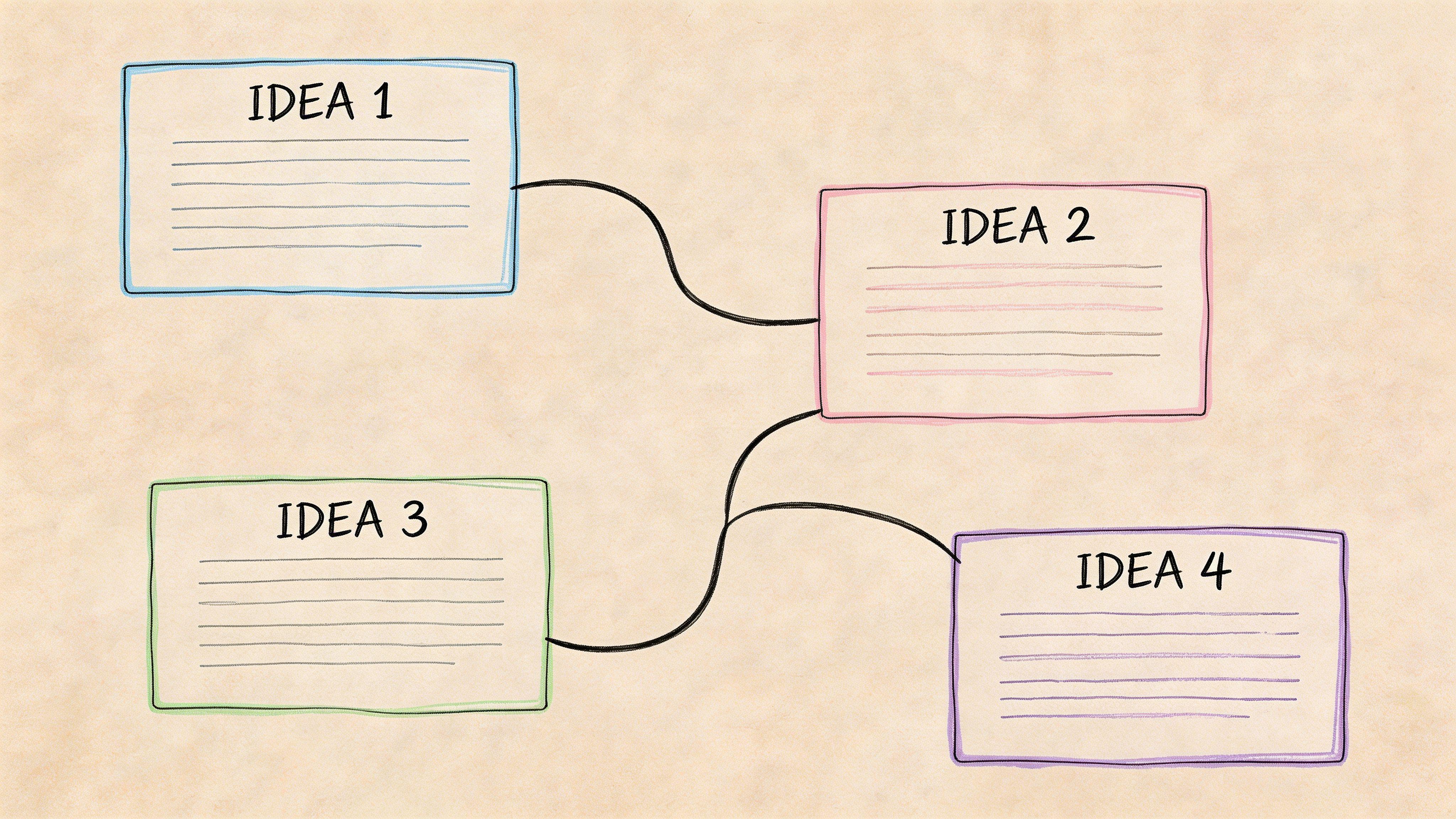
Paragraphs work like rooms in a house. If one room tries to serve as the kitchen, office, bedroom, and garage, people feel lost inside it. Writing works the same way. Each paragraph should give the reader one clear job: explain, support, compare, question, or conclude.
Break when the idea changes
A paragraph break usually belongs at one of four moments:
- a new point begins
- an example starts
- the focus shifts from problem to solution
- the reader needs a visual pause after a dense explanation
This is the "why" behind paragraphing. You are not breaking for appearance alone. You are helping the reader sort information into manageable pieces, the way a recipe separates ingredients, prep, and cooking steps.
Flow comes from what follows the break
Many writers split a long block and assume the job is done. The true test is the first sentence of the next paragraph. It should tell the reader how this new block connects to the last one.
Useful transition moves include:
- Adding: also, another point, one more factor
- Contrasting: however, by contrast, on the other hand
- Clarifying: in other words, more specifically
- Concluding: therefore, as a result, overall
These words are small, but their job is big. They act like labels on moving boxes. Without them, the reader has to guess how each idea fits with the next.
Match paragraph size to the format
The same 500 words can feel smooth in one format and heavy in another.
In an essay, a longer paragraph often works because the reader expects a fuller chain of reasoning. In a blog post, shorter paragraphs usually read better because screens make dense blocks look harder than they are. In an email, the paragraph should stay tight because the reader is often scanning for context, decision, and action.
If you want a practical benchmark, this guide on how many words should be in a paragraph can help you judge whether a paragraph feels balanced for its purpose.
A good question to ask is not, "How long should this paragraph be?" Ask, "Can the reader absorb this idea in one pass?"
Use rhythm to keep attention
Paragraphs do not all need the same size.
A one-sentence paragraph can create emphasis. A medium paragraph can explain a key point clearly. A longer paragraph can work when the idea has several parts that belong together. Variety keeps the writing from sounding mechanical.
Editing trick: Read only the first sentence of each paragraph. If those sentences form a clear path, your structure is probably working. If they feel scattered, the paragraph breaks may be hiding a logic problem.
Strong flow comes from clarity, sequence, and reader awareness. The count matters less once each paragraph has a clear purpose and a clear place.
Mastering Your Message One Paragraph at a Time
So, how many paragraphs is 500 words?
The honest answer is still: it depends.
For a formal essay, 3 to 5 paragraphs is a common academic guideline. For many 500-word essays, the 5-paragraph model remains a practical choice. For blogs, shorter screen-friendly paragraphs often push the count higher. For emails, the best structure is the one that delivers context, message, and action without wasting the reader’s time.
That is the deeper lesson. Paragraphs are not rules to obey blindly. They are tools for shaping meaning.
If you are a student, think in ideas, not just word count. If you are a professional, think in reader needs, not just formatting. If you are writing online, think in visual pace as much as sentence quality.
Strong writing happens one paragraph at a time. Build one clear block, then the next, then the next. The final count will usually take care of itself.
If you want help turning rough notes into a clean 500-word draft, 1chat can help students, families, and small teams brainstorm, outline, and revise writing with multiple AI models in one place.