Staring at a blank page can feel like the toughest part of any big assignment. But getting your term paper off the ground really boils down to one critical skill: turning a huge, vague subject into a sharp, manageable topic. Honestly, this one decision sets the stage for everything that follows, from your research to the final draft.
From Blank Page to a Focused Topic
The feeling of being swamped by a broad assignment is something we've all been through. Your professor says, "Write a term paper on 20th-century American history," and your mind either draws a complete blank or races with a million different ideas, from the Jazz Age to the Civil Rights Movement. This is precisely where a little focused brainstorming can save the day.
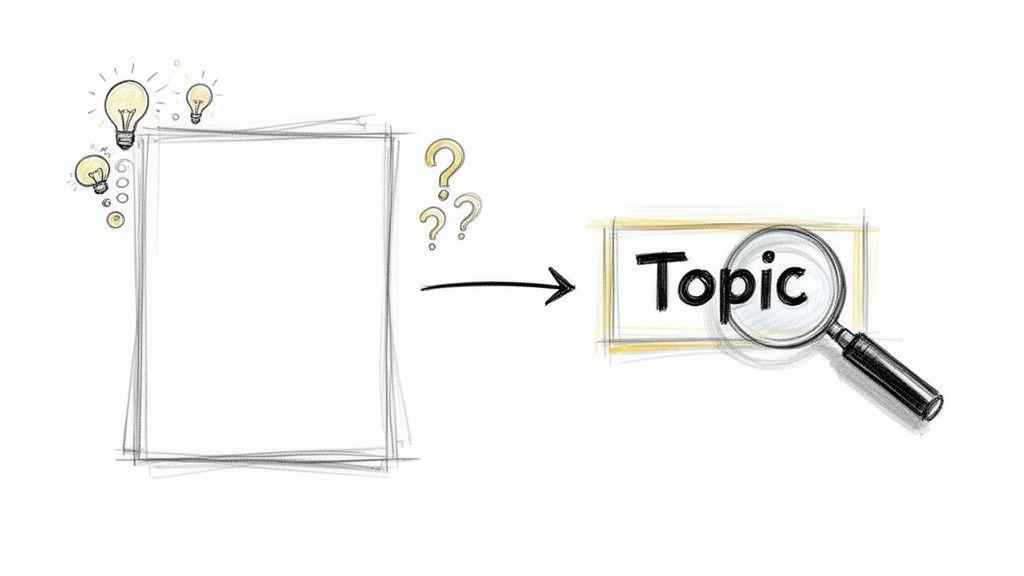
Forget trying to find the "perfect" topic right out of the gate. Just give yourself some space to explore what genuinely interests you within the subject. Jot down anything that catches your eye. Don't edit, don't judge—just write. Maybe you’re into technology, or social movements, or economic history.
Your first-pass list might look a little like this:
- The golden age of Hollywood
- How the Great Depression hit rural families
- The creation of the interstate highway system
- Protest songs from the 1960s
This simple act immediately changes your perspective from "I have to do this" to "What do I actually want to learn about?"
Narrow Your Focus to Strengthen Your Paper
Once you have a handful of ideas, the real work begins: picking one and narrowing it down. A broad topic almost always leads to a shallow, unconvincing paper. But a focused topic? That’s where you can really dig in, build a strong argument, and show you know your stuff.
To get specific, start asking targeted questions. Let's run with the "protest songs from the 1960s" idea. It's a great start, but it's still way too big for a term paper. Start probing:
- Who? Are you more interested in a specific artist like Bob Dylan or Nina Simone?
- What? What message do you want to focus on? The anti-war movement? Racial inequality? The generation gap?
- Where? Was there a geographic hub for this music, like New York's Greenwich Village?
- Why? What made this music so powerful in swaying public opinion?
Suddenly, "protest songs" morphs into a focused, researchable topic like, "How Bob Dylan’s songwriting from 1963 to 1965 mirrored the changing focus of the American youth protest movement." Now that gives you a clear path forward.
A great term paper doesn't just skim the surface of a huge subject. It dives deep into a narrow one, proving you've truly engaged with the material.
Give Your Topic a Quick Test Run
Before you fully commit, do a quick "viability check." You need to know if there are enough credible sources out there to actually write the paper.
Spend 15 minutes on your university’s library database, Google Scholar, or a resource like JSTOR. If you immediately see a bunch of relevant scholarly articles and books, you're good to go. If you find next to nothing, you might need to broaden your scope a bit or try a different angle.
This single step can save you from a world of pain later, making sure your chosen topic isn't just interesting to you, but also well-supported by solid academic work.
Building Your Argument with Solid Research
Once you've nailed down a focused topic, it's time to roll up your sleeves and find the evidence that will give your paper its strength. This is the crucial stage where a simple idea starts to transform into a compelling academic argument. A great term paper doesn't just present your opinion; it builds a strong, persuasive case using credible, authoritative sources.
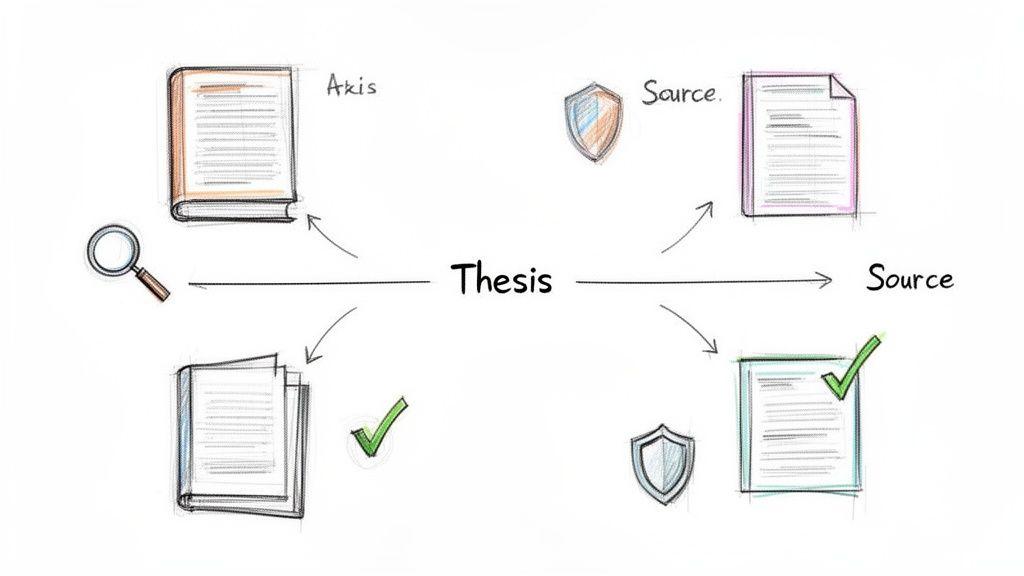
Your university's digital library is the best place to begin. Think of it as a treasure trove filled with scholarly articles, peer-reviewed journals, and academic books—the absolute gold standard for this kind of research. Unlike a simple Google search, these databases give you access to material that's already been vetted by experts in the field.
Finding and Evaluating Your Sources
As you dive into databases like JSTOR or Google Scholar, put on your detective hat. You're hunting for clues—evidence that supports, challenges, or adds a new layer to your topic. The goal isn't just to hoard information; you want to find sources that are essentially in a conversation with one another about your subject.
When you find a promising source, take a moment to evaluate it. I always ask myself these questions:
- Authority: Who wrote this? Is the author a known expert with the right credentials?
- Objectivity: Does the source offer a balanced perspective, or is there a noticeable bias? A little bias is often unavoidable, but you need to be aware of how it shapes the argument.
- Currency: When was it published? For a paper on AI, you'll need the latest research. For a history paper, a classic text from 50 years ago might be essential.
- Relevance: How well does this actually fit my research question? It's tempting to try and force a source to work, but if it's only slightly related, it's better to move on.
Vetting your materials this way ensures your entire paper is built on solid ground. For a deeper dive, our guide on how to determine if a source is credible has some great, practical tips.
From Research to a Strong Thesis Statement
After you've spent some time with your sources, you'll start noticing patterns, connections, and maybe even some contradictions. This is the lightbulb moment. Now you can synthesize all that information into a thesis statement—a single, punchy sentence that announces your paper's main argument.
A good thesis is never just a fact; it has to be something someone could reasonably disagree with. For example, "Protest songs were popular in the 1960s" is a fact, not a thesis. A much stronger thesis would be, "Bob Dylan’s early music was instrumental in shifting the focus of the youth protest movement from civil rights to anti-war sentiment." See the difference? The second one makes a specific, arguable claim that the rest of your paper will prove with evidence.
Your thesis is the engine of your term paper. It's not just a topic, but a specific, debatable position that you will spend the rest of your paper proving to the reader.
Mastering these core skills is more important than ever. The academic writing services market was valued at an incredible $1.8 billion in 2024, which shows just how many students are looking for help with these exact tasks. You can learn more about the growth of academic support services and why developing your own research and thesis skills is such a valuable investment.
Creating Your Blueprint: How to Outline Your Term Paper
So, you've waded through piles of articles and your brain is buzzing with ideas. Fantastic. But now you're faced with a chaotic jumble of notes, quotes, and half-formed arguments. This is the exact moment where many students get overwhelmed. The solution? An outline.
Think of it as the architectural plan for your paper. You wouldn't build a house without a blueprint, and you definitely shouldn't try to write a 15-page paper without a solid framework. An outline transforms that chaos into a clear, logical structure, ensuring every paragraph serves a purpose and connects smoothly to the next.
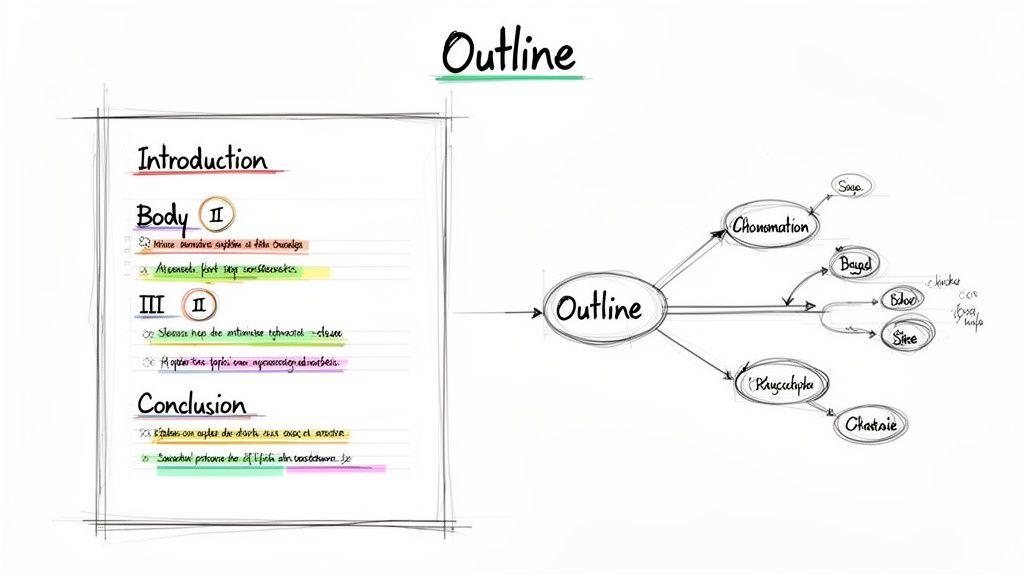
The best part is, there’s no one-size-fits-all approach. Your outline should work for you. Here are a couple of popular methods:
- The Classic Roman Numeral Outline: This is the traditional, hierarchical structure (I, A, 1, a) that helps you organize main points and drill down into supporting details. It's a lifesaver for linear thinkers who thrive on clear, step-by-step progression.
- The Mind Map: Are you more of a visual person? Try mind mapping. Put your thesis in a circle at the center of the page and draw branches for your main arguments, evidence, and potential counterarguments. It’s a brilliant way to see the connections between different ideas.
Building a Strong Foundation
No matter which format you prefer, a good outline contains the same essential DNA. It maps out the entire journey for your reader, from the hook in the introduction to the final, resonant conclusion. Having this solid structure is a huge confidence booster, especially if you're looking for help writing a term paper, because it clarifies exactly what you need to build.
Every good term paper follows a standard, time-tested format. Here's a quick breakdown of what goes where.
Essential Term Paper Structure
| Section | Purpose | Key Elements |
| Introduction | Grab the reader's attention and present your argument. | Hook, background context, thesis statement. |
| Body Paragraphs | Present evidence and analysis to support your thesis. | Topic sentence, evidence (quotes, data), analysis, transition. |
| Conclusion | Summarize your findings and leave a lasting impression. | Restate thesis, synthesize main points, offer final thoughts. |
Understanding these core components is the first step to building a coherent and persuasive paper.
Start your outline by placing your thesis statement right at the top—it’s the North Star guiding every decision you make. From there, you can begin sketching out your main sections and the arguments that will live inside them.
An effective outline is more than a simple to-do list. It’s a critical thinking tool that forces you to organize your argument, arrange your evidence logically, and ensure every point directly supports your central claim.
For example, a detailed plan for a single body paragraph might include the topic sentence, the specific quote or statistic you plan to use, and a quick note to yourself about how you'll analyze it to tie back to your thesis. This level of detail makes the actual writing process infinitely smoother.
If you want to dive deeper into different outlining techniques, check out our guide on how to write a research paper outline for some practical templates and examples. Spending just 30-60 minutes on this step is easily the best investment you'll make in the entire process.
Drafting and Polishing Your Final Paper
You’ve done the heavy lifting and have a solid outline. Believe it or not, the hardest part is behind you. Now it's time to shift from planning to writing, and the name of the game is momentum, not perfection.
Your first draft is all about getting those ideas from your research and outline onto the page. Don't worry about finding the perfect word or crafting the most elegant sentence just yet. Let the words flow. This is your "brain dump" phase—a chance to translate your structured thoughts into prose without the pressure of getting it right on the first try. You can always clean up clunky sentences later. For now, just write.
From Raw Ideas to a Coherent Draft
Once you've got a complete first draft, the best thing you can do is walk away. Seriously. Give it a day or two if your deadline allows. This mental break is crucial; it helps you switch from being the writer to being the editor, giving you the fresh eyes needed to see what’s really there.
When you come back to it, you're not just looking for typos. This is the revision stage, which is all about the big picture. Read the whole thing from start to finish and ask yourself some tough questions:
- Does my introduction grab the reader and clearly state my thesis?
- Does each paragraph have a single, focused point that links back to my main argument?
- Are my ideas connected logically? Do I use transitions to guide the reader smoothly from one point to the next?
- Is the evidence I've used actually convincing? Or does a point feel a little weak?
- Does the conclusion wrap everything up nicely and leave a lasting impression?
This is when you’ll find yourself moving entire paragraphs around, beefing up a weak argument with more evidence, or rewriting topic sentences to make them punchier.
Revising isn't just about fixing mistakes. It's the critical process of reshaping your initial thoughts into a clear, logical, and persuasive argument that truly engages your reader.
The Final Polish: Editing and Proofreading
After you’ve wrestled with the big structural pieces, it’s time to zoom in on the details. This is where editing and proofreading come in. Editing is about sentence-level flow, clarity, and tone. Proofreading is the final, meticulous hunt for any errors you might have missed.
Here’s a pro tip that works wonders: read your paper aloud. It might feel a bit strange, but it forces you to slow down. Your ear will catch awkward phrasing, run-on sentences, and repetitive words that your eyes just skim over.
Before you even think about submitting, run through a final checklist. This is your last line of defense against small mistakes that can cost you valuable points and damage your credibility.
Your Essential Proofreading Checklist:
- Grammar and Spelling: Use a spell checker, of course, but also keep an eye out for sneaky homophones your software will miss (like their vs. there).
- Punctuation: Are your commas, semicolons, and apostrophes all in the right places?
- Formatting: Double-check the assignment requirements. Are the margins, font, and spacing correct?
- Citations: Make sure every in-text citation matches your reference list and that both are formatted perfectly in the required style (like APA or MLA).
This last, careful pass is what turns a good draft into a polished paper you can be proud of.
Using AI Tools Ethically and Effectively
Let's be honest, artificial intelligence isn't some far-off concept anymore—it's a powerful tool available right on your desktop. For students who need help writing a term paper, AI assistants can feel like a game-changer. But it's critical to understand their proper role to protect your academic integrity.
The best way to think of an AI is like a brilliant research assistant or a super-powered calculator. It’s there to support your thinking, not to do the thinking for you.
The core principle is simple: use these tools to enhance your own work, not to create it from scratch. The line between ethical assistance and academic dishonesty is crossed the moment you ask an AI to write entire paragraphs or your conclusion for you. You must remain the author of your own ideas and arguments. Using AI to sharpen and refine your work, however, is just smart strategy.
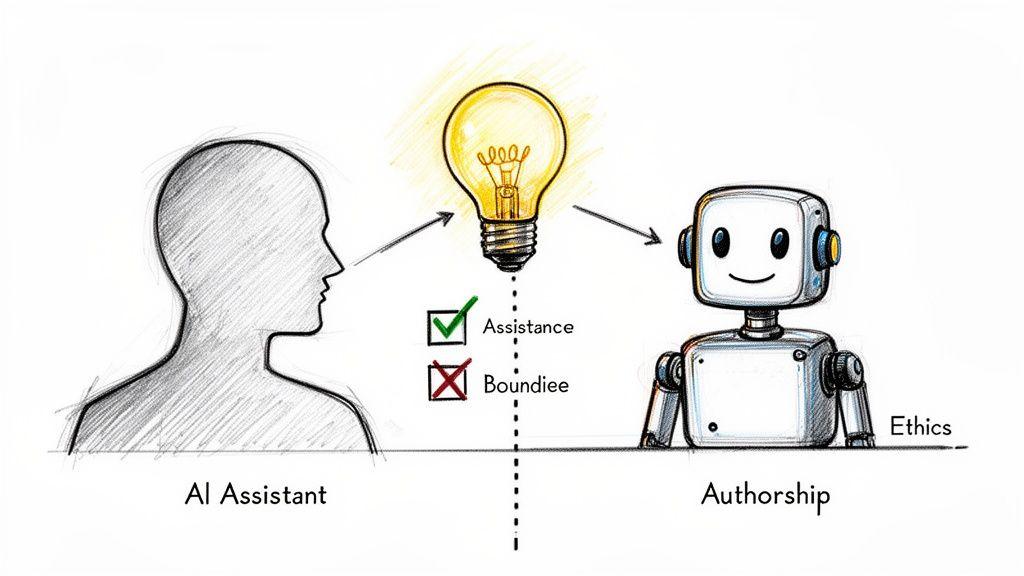
This kind of partnership is what you should aim for. The AI becomes a collaborator that helps you organize thoughts and polish your language, but you always have the final say and creative control.
Smart Ways to Use AI in Your Writing Process
Instead of asking an AI to write for you, reframe the question: how can it help you write better? The goal is to offload the more tedious parts of the process. This frees you up to concentrate on the high-level critical thinking that actually earns you a good grade.
Here are a few powerful and ethical ways to bring AI into your workflow:
- Brainstorming and Idea Generation: Feeling stuck? Treat an AI like a brainstorming partner. For example, you could prompt it, "Generate five potential research questions about the economic impact of the interstate highway system on small towns in the 1950s."
- Summarizing Dense Sources: When you’re staring down a dense, jargon-filled academic article, an AI can give you a quick, concise summary. This is a huge time-saver, letting you grasp the main points before you commit to a deep read.
- Refining Your Outline: Once you have a rough outline, feed it to an AI and ask for structural feedback. A prompt like, "Does this outline for a paper on Bob Dylan's protest music flow logically? Can you suggest a better order for my main points?" can be incredibly helpful.
- Grammar and Style Checks: After you’ve finished a draft, use an AI as an advanced proofreader. It can catch subtle grammatical mistakes, suggest more powerful vocabulary, and help you rephrase clunky sentences to make your writing clearer and more impactful.
The demand for these tools is exploding. Global search data shows that searches for 'AI essay writer' shot up by a staggering 537% between January 2023 and January 2025. During that same period, traditional 'essay writing service' searches fell by 41%. This shift shows a massive appetite for instant help but also shines a spotlight on the new challenges of academic honesty.
Maintaining Academic Honesty with AI
The golden rule is this: the intellectual work must be yours. This means the core arguments, the analysis, and the final conclusions have to come from your own mind. To stay on the right side of your school's policies, you have to avoid submitting any text generated by an AI as your own work.
Always check your institution's specific academic integrity policy regarding AI tools. Many universities now have clear guidelines on what is and isn't permissible, and it's your responsibility to know the rules.
Ultimately, getting help writing a term paper is about finding support, not shortcuts. To find tools designed for ethical support, you can check out our guide on the best AI for writing papers. When you use AI as a collaborator instead of a ghostwriter, you can produce a more polished, well-researched paper that is still a true reflection of your own learning and hard work.
Got Questions About Term Papers? Let's Clear Things Up.
Even after you’ve written a few, the term paper process can still throw some curveballs. It’s natural to have questions pop up along the way. Getting those sorted out early can save you a ton of stress and help you focus on what really matters: crafting a great paper.
Here are a few of the most common questions I hear from students, along with some straight-shooting answers.
How Long Does This Thing Actually Need to Be?
This is, without a doubt, the question I get asked most often. The answer is always simple: check your syllabus or assignment guidelines first. Seriously. That document is your bible for the project, and your professor’s instructions are the final word.
As a general rule of thumb, most undergraduate papers land somewhere in the 10-15 page neighborhood, which works out to about 2500-3750 words. But that’s just an average. I’ve seen assignments that are much shorter and some that are way longer, depending on the course. Remember, the goal isn't just to hit a number. A powerful, well-supported 10-page paper will always beat a rambling 15-pager that's full of fluff.
What’s the Best Way to Make Sure I Don’t Plagiarize?
The absolute best defense against plagiarism is to get into the habit of citing every single source you use, without fail. This means every direct quote, every statistic, and even every idea you paraphrase. Be consistent with whatever style guide your professor requires—APA, MLA, Chicago, etc.
My golden rule has always been: when in doubt, cite it. It’s far better to have a few extra citations than to have even one instance of accidental plagiarism. A great pro-tip is to take meticulous notes during your research, immediately linking every fact or idea to its source. It makes the final citation process a breeze.
Can I Use AI Tools Without Getting into Trouble?
Absolutely, but you have to be smart about it. The key is to think of AI as a helpful assistant, not as a ghostwriter. You're still the author; the AI is just there to help you brainstorm, organize your thoughts, and polish your own work.
Here are a few ways to use AI tools ethically and effectively:
- Kickstart Your Brainstorming: Feeling stuck? Ask an AI for potential research questions or to suggest different angles on your topic.
- Sketch Out an Outline: Use it to generate a basic structure for your paper. Then, you go in and fill it with your own research, analysis, and voice.
- Untangle Dense Articles: AI can be fantastic for summarizing complex academic articles so you can quickly get the main arguments.
- Polish Your Final Draft: Once you've written everything, let it check your grammar, spelling, and style. It’s like having a proofreader on call 24/7.
The ethical line gets crossed the moment you ask an AI to write entire paragraphs or the whole paper for you. That's not your work anymore. It's interesting to see how student habits are changing with this tech. A 2025 study noted a huge jump in students using a mix of AI and human academic help—from 24% in 2023 to 44% in 2025. This points to a new trend of using AI to get a first draft going and then relying on human expertise to add real depth and originality. You can read more about these student writing trends to see how the academic world is adapting.
Most importantly, always check your university's specific academic integrity policy. They'll have clear rules on what is and isn't acceptable when it comes to AI.