If you want to get better answers, you have to start by asking better questions. It all begins with having a clear objective before you even form the words. The most reliable way to do this involves a simple, four-part method: define your goal, provide context, specify the format, and refine your approach.
Mastering this turns vague curiosity into a precision tool for getting exactly what you need, whether you're talking to a colleague, a family member, or an AI.
Why Better Questions Are Your New Secret Weapon
We're all drowning in information, so the quality of the answers you get is now directly tied to the quality of your questions. This isn't a skill just for researchers or detectives anymore; it’s a massive advantage for anyone. Learning to ask sharp, focused questions can slash rework, spark genuine innovation, and build deeper connections in every part of your life.
The whole idea is to shift from lazy, open-ended queries to structured, intentional ones. It’s the difference between asking a chef, "What should I make for dinner?" and "Can you suggest a healthy, gluten-free dinner I can make in 30 minutes using chicken, broccoli, and quinoa?" The second question does all the upfront work, which practically guarantees a useful response.
This becomes even more critical when you're working with AI like 1chat, which depends entirely on your input to create something valuable.
A Framework for Clarity
To keep this process straightforward, I use a simple acronym: GCFR. It stands for Goal, Context, Format, and Refine. Each piece builds on the last, giving you a solid foundation for any question you ask.
Think of this framework as a mental checklist. It helps structure your thoughts and ensures you’ve provided all the necessary ingredients for a high-quality answer. It's also a fantastic way to sharpen your critical thinking skills and get more out of every conversation.
The most important thing to remember is this: make it easy for the other person (or AI) to help you. The harder they have to work to understand your question, the less likely you are to get a great answer.
The table below breaks down the GCFR framework, which we’ll explore in detail throughout this guide.
The GCFR Framework for Asking Better Questions
This table summarizes the four essential components for crafting effective questions for AI, teams, or even just for personal reflection.
| Component | What It Means | Example Application |
| Goal | Clearly state what you want to achieve. What is your ultimate objective? | "I need to create a weekly social media schedule to boost our engagement." |
| Context | Provide relevant background. Who is the audience? What are the constraints? | "...for a small business selling handmade candles, with a budget of $50/week." |
| Format | Specify how you want the answer presented. A list, table, or paragraph? | "...in a table format with columns for Day, Platform, and Content Idea." |
| Refine | Review the answer and ask follow-ups to improve its accuracy or depth. | "That's a good start. Can you refine the content ideas to focus on behind-the-scenes video concepts?" |
By consciously thinking through these four elements, you’ll start seeing a dramatic improvement in the answers you receive. It's a small shift in approach that yields huge results.
From Vague Thoughts to Laser-Focused Questions
Every truly great answer starts with a well-defined question. We've all been there—you have a fuzzy idea, you ask a half-baked question, and you get a useless answer that leaves you more frustrated than when you started. It’s a common trap.
The problem is skipping the most critical part of the process: figuring out what you actually want to achieve. Before you can get a useful answer, you need to know your destination. Without a clear goal, you’re just wandering, and any answer you get is a shot in the dark.
Turning a general thought into a specific objective is the real secret here. It’s the foundational skill for getting better answers from people, search engines, and even AI.
Context is Your Guide
Once you’ve nailed down your goal, it's time to paint a picture with context. Think of context as the guardrails that keep the answer on track. It filters out all the irrelevant noise and zeroes in on the perfect response for your specific situation. This includes details like who you're talking to, any constraints you're working with, and essential background info.
Here’s a classic example I see all the time with small business owners.
- The Vague Question: "How can I grow my business?"
- The Specific Question: "Given our target audience of eco-conscious millennials and a $500 monthly marketing budget, what are three digital strategies we can use to boost our Q3 online sales by 15%?"
See the difference? The first question is a bottomless pit. The second is a guided missile. By adding the audience, budget, and a measurable goal, the owner is practically guaranteed to get actionable advice instead of generic fluff.
Providing context isn't about adding more words; it's about adding more value. Each piece of background information you share acts as a signpost, pointing directly to the insightful answer you're looking for.
This simple, four-step process is something I use constantly to turn a vague idea into a powerful question.
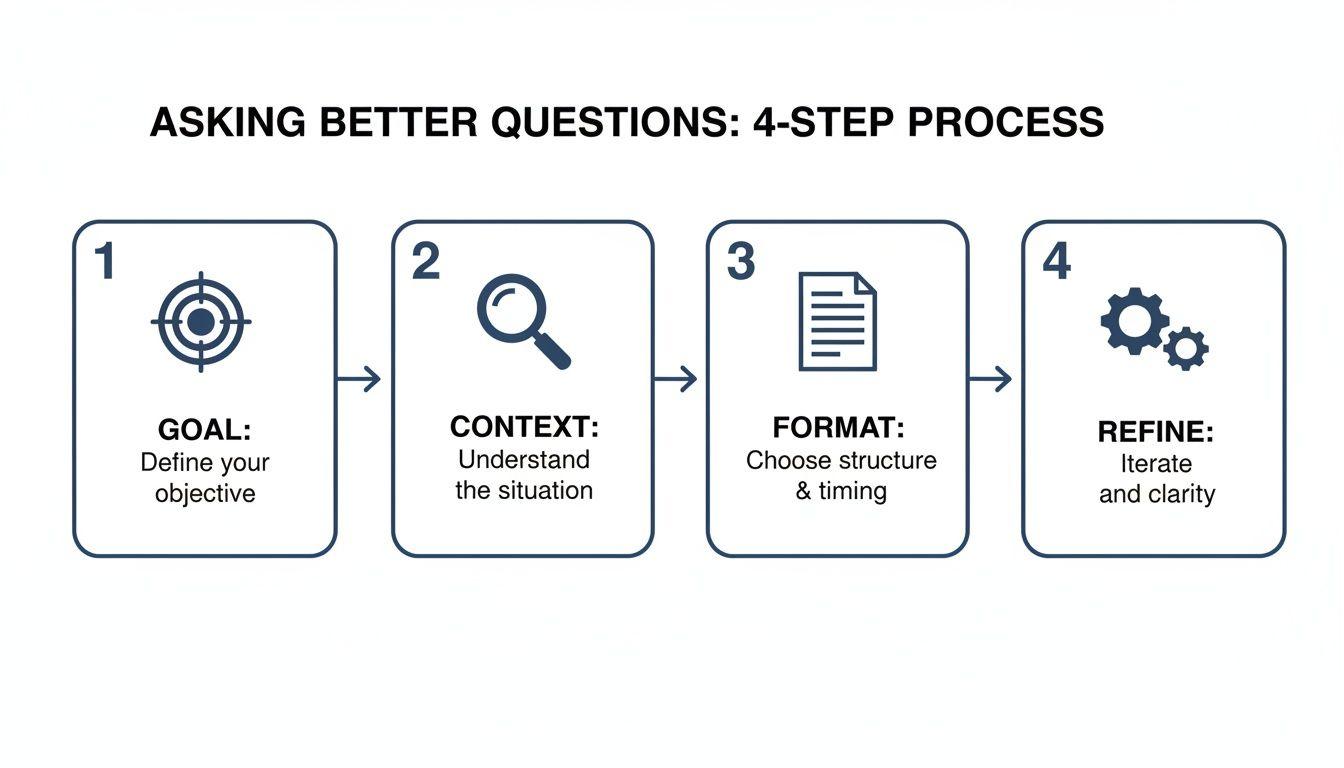
As you can see, locking in your Goal and providing rich Context are the two pillars that support a fantastic question.
Be Explicit About What You Want Back
This principle works everywhere, not just in business. A student asking a vague question runs into the same roadblocks as a CEO. The fix is always the same: add layers of specificity to clarify the endgame.
Let's switch gears to a student’s request:
- Vague: "Explain photosynthesis."
- Specific: "Can you explain photosynthesis to me like I'm a 5th grader? Please use a simple analogy and focus on what chlorophyll does."
The first request could easily pull up a college-level dissertation—totally unhelpful. The second one, though, is built for success. It clearly defines the audience (a 5th grader), the format (an analogy), and the specific focus (chlorophyll's role).
This kind of detail makes it incredibly easy for anyone—a teacher, a parent, or an AI tool like 1chat—to deliver a pitch-perfect explanation. When you do the work upfront to load your question with goals and context, you remove the guesswork and get exactly what you need.
Structuring Your Questions for Usable Answers

Even when you've nailed your goal and provided all the right context, a great question can still yield a useless answer. The culprit? An unusable format. This is where you can take control by telling your AI—or even your team—exactly how you want the information delivered.
Think about asking a coworker, "Can you give me the latest sales numbers?" You might get a rambling email, a dense spreadsheet you have to decipher, or just a single number shouted across the office. While technically correct, none of those might be helpful. This is a classic stumbling block.
The fix is surprisingly simple: be specific about the format. This little tweak transforms a vague request into a clear, actionable instruction. More than that, it forces you to clarify what you actually need before you even ask.
Match the Format to the Function
The format you choose should be a direct reflection of your goal. Don't just pick one at random. Ask yourself: what am I going to do with this information once I have it? This kind of strategic thinking is a core skill in what's known as prompt engineering, which is all about getting the most from AI tools like 1chat.
Are you trying to make a quick decision, compare your options, or follow a complex process? Each goal has an ideal format.
- For quick takeaways: Ask for a bulleted list. It’s perfect for getting key points or a list of ideas without the fluff.
- For easy comparison: Request a table. Nothing beats a table for evaluating options side-by-side, whether you're comparing product features or project timelines.
- For complex tasks: Ask for a step-by-step guide. This is the best way to break a complicated process down into small, manageable chunks.
- For immediate communication: Specify an email draft or a social media post. This gives you ready-to-use content that you can copy, paste, and send in seconds.
By defining the output format, you're essentially building the perfect container for the answer. A well-designed container makes the information organized, easy to digest, and ready for action.
See It in Action
Let’s look at a real-world scenario. A small business owner is eager to use AI to get ahead. They're not alone—small business AI adoption has seen a 39.7% jump in just 18 months, making strategic questioning a critical skill for staying competitive. You can dig into more of these trends with these small business AI adoption statistics.
Here's how that business owner could use formatting to get what they need:
- Vague Question: "Give me some marketing ideas."
- Actionable Question: "Generate a content calendar for next month's blog in a table with columns for 'Topic,' 'Target Keyword,' and 'Headline Idea.'"
See the difference? The second question doesn't just ask for ideas; it demands an organized, ready-to-use plan. This precision saves time, prevents endless back-and-forth, and delivers exactly what's needed to move forward.
Refining Your Way to the Perfect Answer
Getting the right answer almost never happens on the first try. A truly great answer isn’t born from a single, perfect question—it’s uncovered through a conversation. This back-and-forth process is called iteration, and it’s the final piece of the puzzle for mastering how you ask questions.
Don't settle for the first response you get, especially if it feels a little off or misses a crucial detail. Whether you're talking to a colleague or a conversational AI like 1chat, you should treat the exchange as a collaboration. A simple follow-up is often all it takes to guide the conversation toward a much more valuable outcome.
Iteration in Action
Think of your first question as just getting the ball rolling. The initial answer gives you something concrete to react to, allowing you to start steering the conversation with more precision.
Here are a few ways I often refine my own requests:
- To get more specific: "That's a good start. Can you shorten that and focus specifically on the $500 budget I mentioned?"
- To explore other angles: "Thanks. Now, could you argue the three strongest opposing viewpoints to this?"
- To change the tone: "I like the ideas here, but can you rewrite it? I need a more formal tone for a business proposal."
This iterative approach is incredibly effective when using AI for business. We're seeing a huge commitment here, with 71% of small and medium-sized businesses planning to increase their AI spending. They're not just experimenting, either; 85% of SMBs using AI expect a solid return on their investment. In fact, Salesforce research on AI's impact on small business growth found that growing businesses are nearly twice as likely to be investing in AI compared to those that are stagnant.
Common Mistakes That Stall Progress
As you get the hang of refining your questions, watch out for a few common pitfalls that can easily lead to confusing or useless answers. Catching these in your own follow-ups will make a massive difference in the quality of information you get back.
One of the biggest culprits I see is asking bundled questions. This is when you cram several unrelated requests into one sentence. Think: "Can you summarize last quarter's sales data, suggest three new marketing campaigns, and also draft an email about the holiday party?" It’s just too much at once.
Asking bundled questions forces the other person (or AI) to juggle competing tasks. The result is almost always a shallow answer that doesn't fully satisfy any of your needs. Unpack your requests and ask them one by one. You'll get much better, more focused results.
Another frequent mistake is using ambiguous terms. Words like "soon," "better," or "more" mean different things to different people. Instead of asking for a report "soon," be direct and say, "by end of day Friday." This simple clarity eliminates all the guesswork.
Sharpening these habits will also dramatically improve your research abilities in general. When you treat every question as an opportunity to clarify and refine, you gain the power to guide any conversation toward a truly insightful conclusion.
Advanced Questioning for Deeper Insights
Once you’ve nailed the basics of setting a goal and providing context, it’s time to move into more sophisticated strategies. This is where you go from simply getting answers to uncovering insights you didn't even know you were looking for.
Think of it as transforming your questions from a simple request for information into a prompt for genuine critical thinking. This is particularly effective when you're working with an AI like 1chat, which you can instruct to act as a dynamic thinking partner, take on different roles, or even analyze its own reasoning.
Adopt a Persona for New Perspectives
One of my favorite advanced techniques is to ask your counterpart—whether it's a colleague or an AI—to adopt a specific persona. This simple trick forces a completely fresh viewpoint and can instantly highlight blind spots in your own thinking.
For example, instead of a vague question like, "Is this a good business plan?" you can get far more valuable feedback by framing it this way:
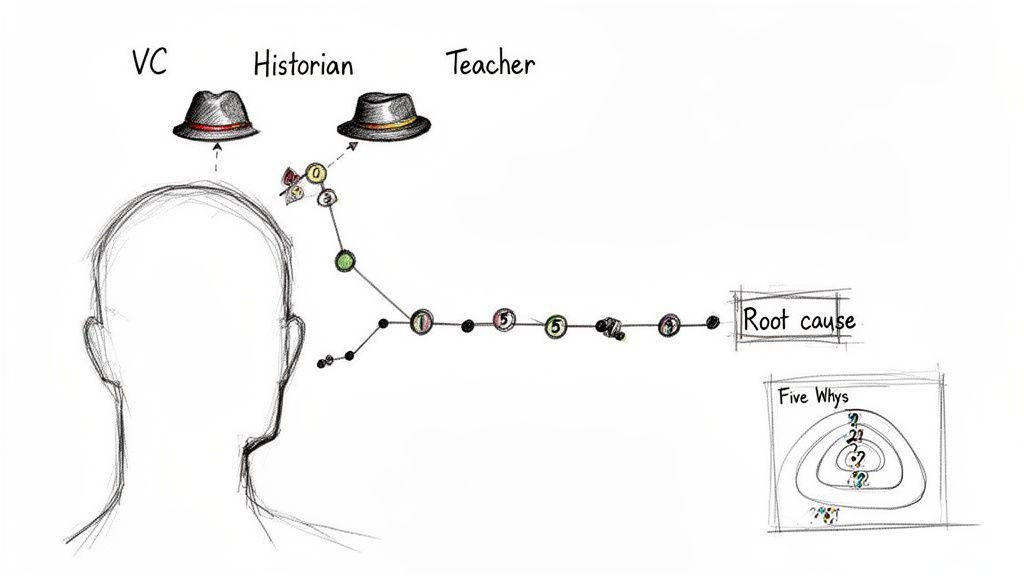
"Act as a skeptical venture capitalist who has seen thousands of pitches. Read my business plan and provide a brutally honest critique, focusing on potential financial risks and market scalability."
Suddenly, the quality of the feedback is on another level. A student could ask an AI to critique their essay from the perspective of a specific historical figure. A marketing team could get feedback on new ad copy from the viewpoint of their ideal customer persona. It’s a powerful way to pressure-test your ideas from all angles.
Get to the Root Cause with the Five Whys
Another game-changer is the Five Whys technique. It’s a simple but brilliant method for digging past the surface-level symptoms of a problem to find the actual root cause. The idea is to ask "Why?" five times in a row to drill down to the core issue.
Let's say a project is falling behind schedule. Instead of just accepting the first answer, you keep digging:
- Why is the project behind? Because the design team delivered their mockups two days late.
- Why were they late? They were held up waiting for the final requirements.
- Why weren’t the requirements finalized? The client gave new feedback at the last minute.
- Why did they give feedback so late? They weren't totally clear on the initial project scope.
- Why wasn't the scope clear? Our kickoff meeting didn't do a good enough job of aligning expectations.
Aha. The real problem wasn't a slow design team—it was a flawed kickoff process. This is what separates effective problem-solvers from people who just put out fires. You stop slapping bandages on symptoms and start fixing the foundation.
Mastering this deeper level of inquiry is becoming non-negotiable. The market for AI tools has already grown into a $12 billion industry, with platforms like ChatGPT and Gemini becoming commonplace. As new insights on the rapid state of AI adoption show, your ability to ask better, more incisive questions is what will determine whether you get real value from these tools.
Frequently Asked Questions About Asking Better Questions
Learning new frameworks is one thing, but actually changing your habits? That’s where the real questions start to surface. It's completely normal to hit a few snags along the way.
Let’s walk through some of the most common questions I hear from people as they begin to master the art of asking better questions. Getting these sorted out will help you move forward with confidence.
How Can I Encourage My Team or Family to Ask Better Questions?
This is a big one, and the best way to start is by modeling the behavior yourself. When someone on your team or even your kid asks a vague question, resist the urge to just give a quick answer. Instead, see it as a coaching opportunity.
You can gently guide them by asking a few clarifying questions of your own. Try something like:
- "That's a great place to start. What’s the ultimate goal we're trying to achieve here?"
- "To give you the best answer, could you tell me a bit more about the context? Who is this for?"
- "Help me understand what a perfect answer looks like for you. Are you picturing a list, a detailed paragraph, or maybe a table?"
This approach turns a simple query into a collaborative effort. It teaches the principles of clear communication without being critical and shows everyone that the goal is to find the best possible answer, together.
What Is the Biggest Mistake People Make When Asking an AI a Question?
By far, the most common mistake is treating the AI like a glorified search engine instead of a creative partner. People will often type in a short, generic phrase and just accept the first thing that comes back. That’s like using a race car to drive to your mailbox.
The biggest trap is forgetting that an AI thrives on rich context and a clear objective. When you don't provide it, the AI is left to guess—and its guesses are often generic, bland, or just plain wrong.
For instance, instead of asking, "Write a blog post about time management," you'll get a dramatically better result with a prompt like: "Act as a productivity expert. Write a 500-word blog post for busy entrepreneurs on conquering their email inbox. Use a friendly, encouraging tone and include three actionable tips in a bulleted list."
That level of detail is what kicks off a real, productive conversation with the AI.
How Long Does It Take to Get Good at This?
Like any worthwhile skill, asking great questions takes practice. You can't just flip a switch and be an expert overnight. The good news? You’ll likely see a massive improvement in the quality of your results within just a few weeks of consciously applying these methods.
True mastery, where this becomes second nature, might take a few months. The key is to focus on steady progress, not instant perfection.
My advice is to start small. Pick one thing to focus on—maybe it's adding more context to your work emails or specifying the format you want from your AI assistant. Once that feels natural, add another layer. Over time, these small, deliberate actions build on each other until you're asking powerful questions without even thinking about it.