You found an article that seems perfect for your paper, report, or presentation. The title matches your topic. The abstract sounds useful. It even appears in a database your school or workplace trusts.
Then a key question arises. Is this peer reviewed?
That question matters more than most students realize. A peer-reviewed source has usually gone through editorial screening and expert evaluation before publication. That does not make it flawless, but it does make it very different from a magazine article, a trade piece, a commentary, or a polished-looking journal page that never received real scholarly review.
Confusion is common because academic publishing is full of lookalikes. Some journals are legitimate but include non-reviewed items such as editorials and letters. Some websites mimic scholarly journals so well that a quick glance is not enough. If you want to know how to know an article is peer reviewed, you need a method, not a guess.
An Introduction to Verifying Academic Sources
You open a database, find an article with a polished abstract, and feel relieved for about five seconds. Then a key question arises. Did this specific article go through peer review, or does it only look like it belongs in a peer-reviewed journal?
That distinction trips up a lot of students because journals are like newspapers with different sections. A respected journal may publish carefully reviewed research studies, but it may also publish editorials, book reviews, letters, and commentaries that do not go through the same review process. If your assignment asks for a peer-reviewed source, the journal title alone is not enough. You have to verify both the journal and the article type.
A helpful way to approach this is to build trust in layers. Start with the article page you can see. Then verify the journal behind it. Then confirm that the publication is indexed and described as peer reviewed in trusted tools. One polished webpage should never do all the convincing for you, especially now that some predatory publishers copy the appearance of legitimate academic journals well.
Here is the quick checklist I share at the reference desk:
- Identify the article type: Terms like “editorial,” “commentary,” “letter,” or “book review” often signal content that is not peer reviewed in the way original research articles are.
- Scan for research features: A study article usually shows a clear structure, such as an abstract, methods, results, and references.
- Note the journal title carefully: You will need the exact name to verify it in databases, directories, and on the publisher's site.
- Watch for surface-level credibility: Professional design, formal language, and a long title can create the impression of quality without proving real review.
- Plan to verify outside the page: A trustworthy decision comes from cross-checking, not from appearance alone.
If you want a broader foundation on what separates academic writing from general web content, this guide on what makes a source scholarly is a useful companion.
One more caution helps at the start. Some predatory journals now imitate the signals students were once taught to trust. They may list an editorial board, promise fast publication, and use names that sound academic. That is why a good verification method works like a toolkit, not a hunch.
Tip: A source can appear in a scholarly journal and still fail the peer-review requirement if the item is an editorial, opinion piece, or other non-research content.
Decoding the Anatomy of a Scholarly Article
The article itself gives you your first clues. You can rule out weak sources within a minute just by reading the page carefully.
Look for the standard research format
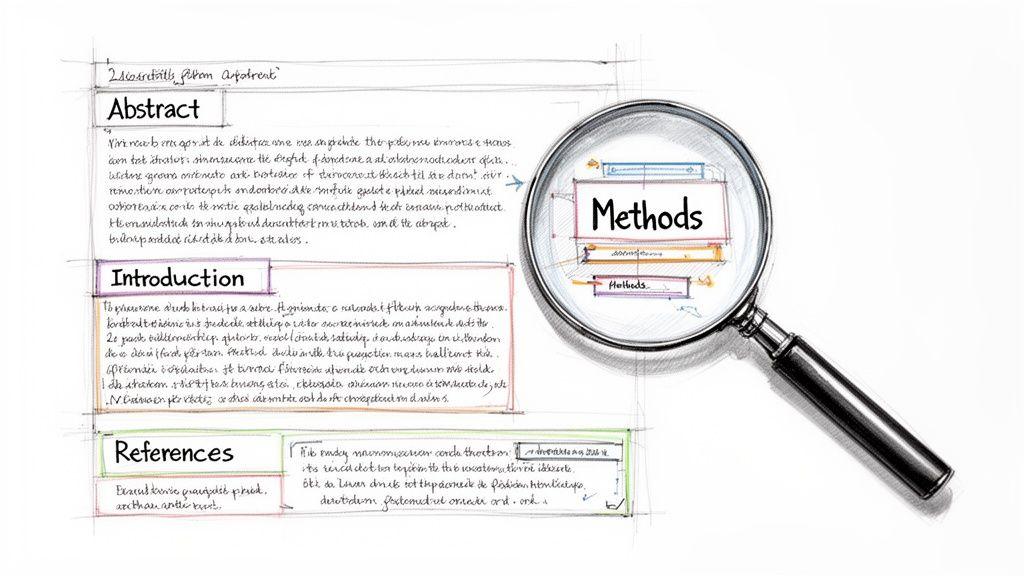
Peer-reviewed articles follow a recognizable structure. According to St. Olaf College Library guidance, they include an abstract, introduction, methodology, results, discussion, and conclusion, and they always include a bibliography or references list while using formal, discipline-specific language for expert readers (St. Olaf Library guide on identifying scholarly articles).
That structure matters because research writing is built to show its process. Readers should be able to see what question the author asked, how the work was carried out, what evidence was collected, and how the conclusions were reached.
A popular article works differently. It may summarize an issue, quote a few people, and move quickly to takeaways. That style can be useful, but it is not the same as peer-reviewed research.
Read the page like a librarian
When I scan an article, I look for signs in this order:
- Abstract at the top This is the fastest clue that you are looking at academic work rather than a blog post or magazine piece.
- Method or methodology section If the article reports original research, the authors should explain how they gathered and analyzed information.
- Results and discussion These sections show that the article is presenting findings, not just opinions.
- References at the end A long reference list signals that the article is grounded in prior scholarship.
Notice the tone and visual style
Scholarly articles are not designed for casual reading. They feel dense. That is not a flaw. It is a clue.
You may notice:
- Formal vocabulary: Terms specific to psychology, nursing, business, biology, or another field.
- Limited decoration: Fewer glossy images and less visual marketing.
- Charts and tables: Data displays are common, in a plain style.
- Longer length: Research articles are more substantial than news or trade pieces.
That said, structure alone does not prove peer review. Some questionable journals copy the appearance of legitimate scholarship. Treat this step as an informed screening tool, not your final answer.
A quick side-by-side check
| Feature | Likely peer-reviewed research article | Likely popular or trade article |
| Abstract | Usually present | Often absent |
| Methods section | Usually present in empirical studies | Rare |
| References list | Expected | Often missing or minimal |
| Tone | Technical and formal | General audience |
| Purpose | Report or analyze research | Inform, persuade, or summarize |
Key takeaway: If the article lacks an abstract, methods, and references, you should be skeptical right away.
Investigating the Journal's Official Website
If the article looks scholarly, move to the journal itself. A legitimate journal explains how it reviews submissions and who is responsible for editorial oversight.
Start with the pages journals use to explain themselves
Open the journal’s main site and look for pages such as:
- About
- Aims and Scope
- Instructions for Authors
- Editorial Policies
- Submission Guidelines
A trustworthy journal does not hide this material. It should explain how manuscripts are handled before publication and what kind of review process authors should expect.
One strong clue is time. A reliable indicator of a peer-reviewed journal is the extended publication timeline, which often takes months because editorial boards and outside scholars evaluate submissions in multiple stages. Legitimate journals also publish formal submission guidelines describing that review process (Sourcely guide to finding peer-reviewed articles).
If a journal sounds like it can publish complex research almost immediately, pause. Serious review takes time.
Examine the editorial board
A strong journal names its editors and editorial board members. You should be able to see academic or professional affiliations attached to those names.
Look for signs such as:
- University or hospital affiliations
- Clear editorial roles
- Consistent field expertise
- Professional presentation across the masthead
Be cautious if the board is missing, oddly vague, or hard to verify. A legitimate scholarly publication wants readers and authors to know who is guiding the review process.
Read for transparency, not buzzwords
Some sites scatter phrases like “international,” “high impact,” or “leading global journal” all over the page. Those claims are less useful than concrete policy details.
A journal earns trust when it can show things like:
| What to look for | Why it matters |
| Submission guidelines | Shows the journal has a formal process |
| Review policy language | Indicates manuscripts are evaluated before publication |
| Named editors | Reveals accountability |
| Editorial affiliations | Helps you judge expertise |
| Clear scope | Shows the journal knows its field |
One more practical clue. Many legitimate journals distinguish between article categories on their site. That matters later, because a strong journal can still publish non-reviewed content alongside reviewed research.
Tip: If the journal website tells you exactly how authors submit work and how editors evaluate it, that is a better sign than a homepage full of promotional language.
Using Search Databases to Confirm Peer Review Status
When students want the closest thing to a firm answer, I point them to library databases and serials directories. This transition moves your search from impression to verification.
Use the peer-reviewed filter, but do not stop there
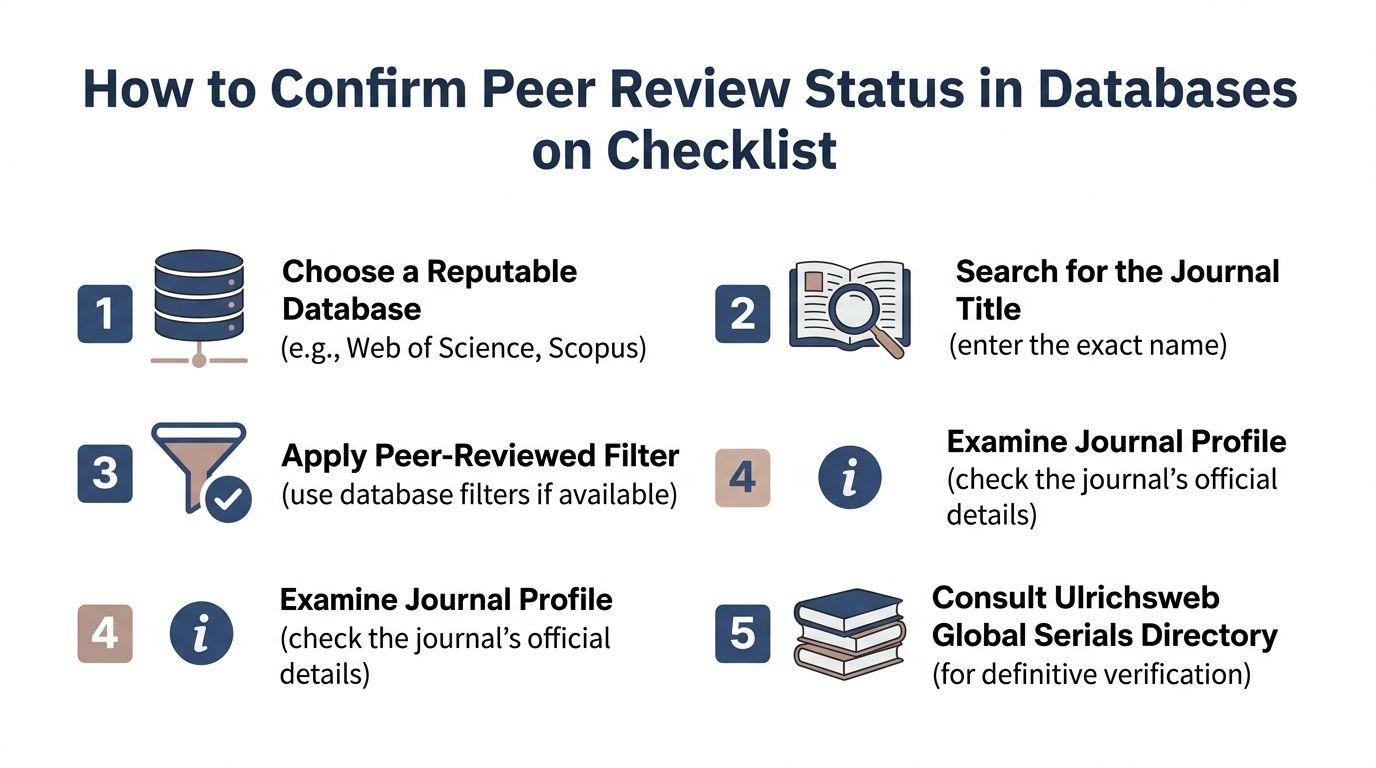
Databases such as Academic Search Complete, Academic Search Premier, CINAHL, and PsycINFO let you limit results to peer-reviewed journals. That feature exists because peer review is a standard classification in academic search systems.
This is an excellent first filter. It saves time and removes a lot of obvious noise.
Still, filters are not magic. They classify the journal, not every item inside the journal. That means the result may come from a peer-reviewed publication while the individual item is a commentary or editorial.
Use Ulrichsweb for stronger confirmation
For journal-level verification, Ulrichsweb is one of the most useful tools available through many academic libraries. The method is straightforward: search the journal title and look for the refereed symbol next to the listing.
According to Angelo State University’s library guidance, this method has a success rate exceeding 95% for major journals because Ulrichsweb cross-verifies editorial claims against publisher data (Angelo State University guide to peer-reviewed sources).
The main thing to remember is precision. Search the exact journal title, not a shortened version you are guessing from memory.
A practical workflow you can repeat
When you want a dependable routine, use this order:
- Find the article in a library database Check whether the database marks the journal as scholarly or peer reviewed.
- Open the full record Read the source information carefully. Databases often list publication type and journal name.
- Search the journal title in Ulrichsweb Look for the refereed marker.
- Visit the journal website if needed Confirm that the editorial policy and submission information match what the database suggests.
What each tool is best for
| Tool | Best use | Limitation |
| Academic Search Complete | Quick filtering by peer-reviewed journals | May not clarify individual article type |
| CINAHL or PsycINFO | Strong subject-specific searching | Still requires article-level judgment |
| Ulrichsweb | Journal-level confirmation | Does not tell you whether every piece in that journal was reviewed |
| Journal website | Policy and editorial transparency | You still need to assess the specific article |
A careful researcher uses all four when accuracy is critical.
One reason this matters is that journal labels are not always enough in the current publishing environment. A database check gives you third-party support. That is much stronger than accepting a publisher’s self-description at face value.
Key takeaway: Use the database filter to narrow results. Use Ulrichsweb to verify the journal. Then verify the article type separately.
Spotting the Red Flags of Predatory Publishers
A polished website is no longer proof of credibility. Some journals imitate scholarly publishing closely enough to fool busy students, early-career researchers, and professionals working outside academia.
As of 2025, over 15,000 questionable journals mimicking peer-reviewed ones have been identified, an increase of 28% since 2024, and these predatory journals often lack transparent review policies, which is why manual verification through publisher sites and tools such as Think.Check.Submit matters (2025 discussion of predatory-journal verification challenges).
What predatory journals tend to do
Predatory publishers want to look just legitimate enough to collect submissions and fees. Their sites may borrow academic vocabulary, display fake seriousness, and imitate the layout of real journals.
Watch for combinations like these:
- Unclear review policy: The site says “peer reviewed” but gives no meaningful detail about the process.
- Unusually fast promises: Serious review is slow. “Publish in days” should make you stop.
- Poor website quality: Broken pages, awkward grammar, and inconsistent formatting suggest weak oversight.
- Aggressive solicitation emails: Repeated invitations to submit work outside your field are a common warning sign.
- Questionable editorial information: Editors are unnamed, hard to verify, or unrelated to the discipline.
A single sign does not prove fraud. Several together should make you walk away.
Do not outsource judgment to AI labels
Students ask whether Google Scholar, AI tools, or search snippets can confirm peer review instantly. That is risky.
Search labels and AI-generated summaries can miss context. They may treat a journal claim as fact without checking whether the policy is real, current, or applied consistently. The same caution applies to plagiarism-related shortcuts. Tools can help you investigate, but they do not replace verification habits. If you are already thinking carefully about source integrity, you may also find this guide to checking for plagiarism using Google helpful for a related research skill.
A red-flag comparison
| Sign | More reassuring | More suspicious |
| Review policy | Detailed and specific | Vague or missing |
| Publication speed | Review described as a multi-stage process | Instant or near-instant publication claims |
| Editorial board | Named experts with affiliations | Missing or unverifiable people |
| Website quality | Consistent and professional | Errors, broken links, confusing pages |
| Scope | Clear disciplinary focus | Covers every field under the sun |
Tip: When a journal claims prestige but cannot clearly explain its review process, treat that as a problem, not a minor detail.
Confirming the Specific Article Type is Reviewed
This is the step many students skip. It is also where many otherwise careful searches go wrong.
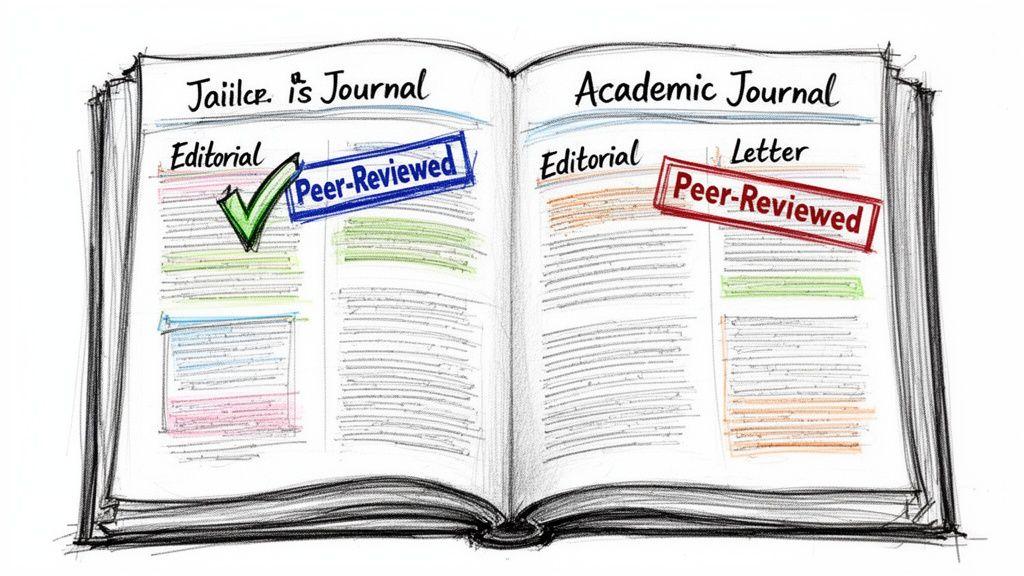
A 2023 study on student research skills found that 42% of undergraduates incorrectly assumed all content within a peer-reviewed journal was also peer-reviewed, even though items like editorials, commentaries, and letters to the editor may not be externally reviewed (Syracuse University library FAQ citing the study and explaining the distinction).
Journal status is not article status
A journal can be peer reviewed as a publication and still include pieces that are not peer reviewed as articles.
Common examples include:
- Editorials
- Opinion pieces
- Letters to the editor
- News sections
- Book reviews
- Commentaries
These items can be worth reading. They may be insightful, influential, or useful for background. But if your assignment asks for peer-reviewed research, they may not qualify.
How to identify the article type
Look in a few places first:
- Under the title Some platforms label the piece directly as “Editorial,” “Commentary,” or “Review Article.”
- In the table of contents Journals often group content by type.
- In the PDF header or first page Article categories are often listed there.
- In the structure of the text A research article has the familiar academic structure and a substantial references section.
If you need help understanding the differences among article categories, this overview of types of a research paper can help you sort them more quickly.
A simple decision guide
| If you see | Likely conclusion |
| Abstract, methods, results, discussion, references | Likely a peer-reviewed research article |
| Editorial or letter label | Not peer reviewed in the same way |
| Personal viewpoint and little or no methodology | Commentary or opinion |
| Book review format | Not a peer-reviewed research article |
The safest habit is to verify both pieces of the puzzle: the journal and the article type. When both checks align, your source is much more likely to meet academic standards.
Building Your Research on a Foundation of Trust
Good research is not built on appearances. It is built on verification.
When you slow down and check the article’s structure, the journal’s website, database records, directory listings, predatory warning signs, and the article type itself, you stop guessing. You start making informed decisions. That shift changes the quality of everything you write afterward.
This habit helps in more places than the classroom. It matters in business reports, nonprofit grant writing, healthcare reading, policy analysis, and any situation where a weak source can weaken your conclusion.
Keep the process simple:
- Inspect the article
- Inspect the journal
- Confirm in databases
- Watch for predatory signs
- Verify the article type
If you do those five things, you will know far more than the average reader about how to know an article is peer reviewed.
Use this method every time a source matters. Confidence in research does not come from luck. It comes from careful, repeatable checks.
Need help reading PDFs, comparing articles, or organizing your research notes across AI tools? 1chat gives students, families, and small teams one place to work with leading language models while keeping a privacy-first experience.