A good book report is more than just a summary. It's your chance to show you didn't just passively read the words, but actually wrestled with the story, its characters, and its deeper meaning. Thinking about how to write a book report really comes down to balancing four distinct parts: the plot, the people, the big ideas, and your own take on it all.
Building Your Foundation for a Great Book Report
Let's be honest, staring at a blank page is the hardest part. The secret to getting past it is realizing that a great book report isn’t some mysterious art form. It's a structured argument that proves you connected with the book.
Interestingly, the book report format we know today came out of the U.S. progressive education reforms back in the 1920s. And it’s stuck around for a reason. With the global books market projected to hit $142.95 billion by 2025, being able to intelligently analyze a text is a more valuable skill than ever. You can read more about the growing books market to see just how big this world is.
The Four Key Ingredients of an Effective Report
I like to think of a report as having four essential ingredients. Each one adds a different flavor, and you need all of them for a balanced result.
- Plot Overview: Start by setting the stage. You're not retelling the entire story, but giving just enough of the main events so your analysis makes sense. Think of it as the "previously on" segment of a TV show.
- Character Analysis: This is where you dig into the people. Who are they, really? Go beyond a simple description and explore their motivations, how they change over the course of the story, and what they represent.
- Theme Exploration: Now, we get to the "so what?" of the book. What is the author trying to say about bigger concepts like justice, love, loss, or courage? This is where you uncover the book's core message.
- Critical Reflection: This is your time to step into the spotlight. What did you think? Was the book successful in its goals? Back up your opinions with specific examples from the text to show your critique is thoughtful, not just a gut reaction.
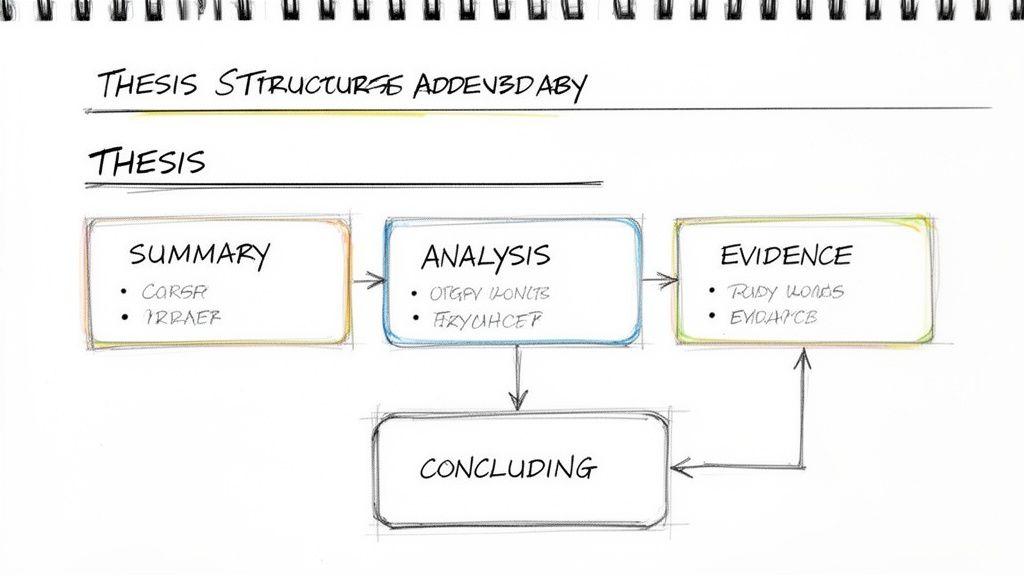
This simple flowchart maps out the journey, moving from the basic "what happened" to the much more interesting "what it all means."
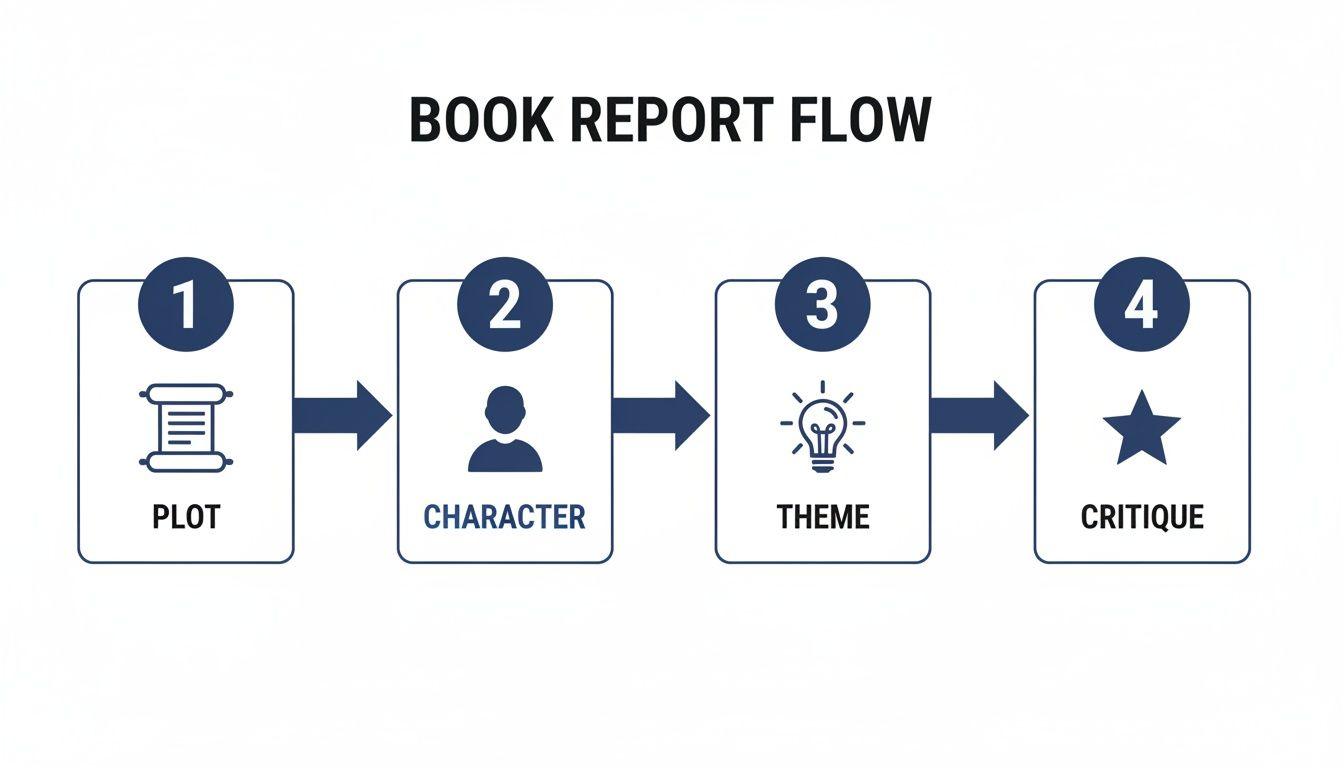
Following this progression ensures your report builds a logical case, grounding your deeper analysis in the fundamentals of the story first.
A truly great book report answers two fundamental questions: "What was this book about?" and "Why does it matter?" Your structure is the roadmap that guides your reader from one to the other.
To really nail the structure, it helps to think about how much space to give each section. A common trap is getting bogged down in the plot summary and leaving little room for your own insights. The table below offers a simple framework for a balanced paper.
Essential Book Report Structure
| Section | Purpose | Recommended Length |
| Introduction & Plot Summary | Hook the reader and provide essential context about the story's main events. | ~20% |
| Character Analysis | Analyze the development, motivations, and roles of the key characters. | ~30% |
| Theme & Symbolism Analysis | Discuss the central ideas, messages, and recurring symbols in the book. | ~25% |
| Critique & Conclusion | Offer your personal evaluation and summarize your key analytical points. | ~25% |
By intentionally splitting your focus this way, you ensure your report moves beyond simple summary and into the realm of true critical analysis. This approach turns a big project into a series of smaller, more manageable tasks.
Reading with Purpose and Taking Smart Notes
The secret to a great book report isn’t some last-minute writing hack. It’s a habit you build while you're still reading the book. The best reports come from a technique called active reading, which is the difference between just letting a story wash over you and actually digging into it.
Think of it this way: you’re not just a reader, you're a detective. Instead of waiting until the final page to piece everything together, you should be gathering clues from the very start. Keep a notebook or a digital document handy as you go. This simple act saves you from the inevitable headache of trying to remember that one perfect quote you read 150 pages ago.
Developing Your Annotation System
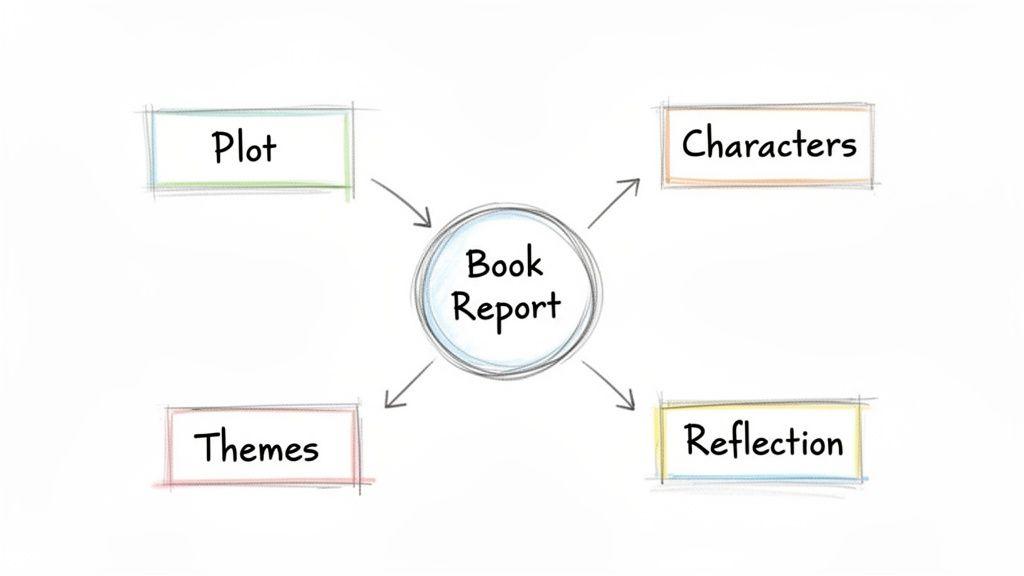
A good annotation system is your best friend—it helps you find exactly what you need in seconds. The only rule is to be consistent. It doesn't need to be fancy.
- For physical books: I’m a big fan of using colored sticky tabs. You could use yellow for major plot points, blue for character insights, and pink for themes or symbols that keep popping up.
- For digital books: E-readers make this a breeze with built-in highlighting tools. Just assign a specific color to each category, the same way you would with physical tabs.
This has become even easier as digital reading has taken off. With ebook sales projected to hit $14.92 billion in 2025 and online book sales expected to reach $26.04 billion globally, you'll likely have digital access to your assigned reading (newprint.com). Take advantage of those note-taking features!
Active reading transforms you from a passive consumer of a story into an active participant in its analysis. It's the single best way to ensure you have rich, detailed evidence to support your report's arguments.
What to Look For While Reading
As you get into the habit of active reading, you'll start noticing things you might have missed before. This isn't just about reading; it's about investigating the author's craft.
Your notes will become a goldmine if you focus on capturing these elements:
- Character Arcs: Pinpoint the moments a character has a change of heart, faces a tough choice, or shows a surprising new side to their personality.
- Recurring Symbols: Does a specific object, color, or even a type of weather appear over and over? Make a note of where it shows up and what it might mean.
- Powerful Quotes: Grab any sentence that perfectly captures a theme, reveals a character’s motive, or just shows off the author's incredible writing style.
- Your Questions: Seriously, write down what confuses you. "Why did the protagonist lie in that scene?" or "What's the significance of this setting?" These questions are the seeds of deep analysis.
Getting all these thoughts down is one thing, but keeping them organized is what really makes a difference. For some great, structured methods, check out our guide on how to organize research notes. When you gather this raw material as you go, you’re basically writing the first draft of your report one note at a time.
Structuring Your Outline and Drafting with Clarity
Alright, so you’ve finished the book and your notes are ready. Now it's time to build the skeleton of your report. An outline is your best friend when it comes to avoiding writer's block—it gives your thoughts a clear path from the first sentence to the last.
Don't get stuck on the old, rigid five-paragraph essay model you might remember from middle school. A great outline is flexible and serves the story you want to tell about the book.
Your outline doesn't need to be fancy. Think of it as a simple blueprint. Just use bullet points to map out the main idea for each paragraph, and jot down which quotes or plot points you'll use as proof. This simple step turns that scary blank page into a much easier "fill-in-the-blanks" task. If you want to see how this works for other types of writing, this handy essay outline example breaks down the same core principles.
Forging a Powerful Introduction and Thesis
Your introduction only has to do two things: grab your reader's attention and state your thesis. You can hook them with a surprising fact about the author, a thought-provoking question about the book's themes, or a quick story that ties into the main conflict. Anything to make your teacher lean in and want to know more.
After your hook, introduce the book's title and author, and then deliver your thesis statement. This is, without a doubt, the most important sentence in your entire paper. It’s not just an observation—it’s a specific, arguable claim you’re going to prove.
A strong thesis is the engine of your book report. It’s a bold declaration of what you will prove, turning a simple summary into a compelling argument. It answers the question, "What is the main point you are making about this book?"
The key to a great thesis is moving beyond the obvious. Take a basic observation and ask "why?" or "how?" This pushes you to form a real argument that someone could actually debate.
Crafting an Effective Book Report Thesis
This table shows how to turn a flat observation into a thesis with some real argumentative power.
| Book Genre | Weak Thesis | Strong Thesis |
| Science Fiction | The Martian is a book about an astronaut trying to survive on Mars. | The Martian uses its hyper-realistic depiction of scientific problem-solving to argue that human ingenuity and collaboration are the ultimate tools for survival. |
| Classic Literature | To Kill a Mockingbird deals with themes of racism and injustice. | Through the innocent eyes of Scout Finch, To Kill a Mockingbird critiques the moral hypocrisy of a society that preaches justice while practicing racial prejudice. |
| Fantasy | In Harry Potter, the main character fights the dark wizard Voldemort. | Harry Potter and the Sorcerer's Stone establishes that love and friendship are more powerful forms of magic than any dark spell, a theme proven through Harry’s repeated survival. |
As you can see, the strong thesis always presents a specific interpretation that you will have to defend using evidence from the text.
Building Cohesive Body Paragraphs and a Strong Conclusion
Each body paragraph should work like a mini-argument that supports a piece of your main thesis. A simple but effective way to structure them is the "claim, evidence, analysis" model.
- Claim: Start your paragraph with a topic sentence. This is a clear statement that supports your overall thesis.
- Evidence: Back it up. Use a direct quote or a specific example from the book that proves your claim.
- Analysis: This is where the magic happens. Explain how your evidence proves your point and why it matters to your main thesis. Never just drop a quote and run—you have to unpack it and explain its significance.
Finally, you'll arrive at the conclusion. It needs to do more than just repeat what you’ve already said. This is your final chance to leave a lasting impression.
Of course, you'll briefly summarize your main points, but then, try to zoom out. Think about the book's relevance today, how it impacted you as a reader, or its place within its genre. The goal is to provide a satisfying sense of closure while leaving your reader with one final, insightful thought to chew on.
Moving Beyond Summary to True Analysis
Here’s the secret that separates a decent book report from a truly great one: moving past what happened and digging into why it happened. Simply recapping the plot is fine, but it doesn't show you truly grasped the story's deeper meaning.
Analysis is where you prove you didn't just passively read the words—you had a conversation with the book. It’s about asking probing questions. Why did the author craft that scene? What drives this character’s decisions? Why does a particular symbol keep reappearing? The answers you uncover become the foundation of an A+ paper.
Unpacking Character Arcs
Don’t just describe characters; analyze their journeys. A simple description like "The protagonist is brave" is pure summary. A much stronger, analytical statement would be, "The protagonist's initial reckless bravery evolves into a more calculated courage after facing the consequences of his early decisions." See the difference?
To get there, you need to pinpoint the key moments of transformation in a character's life. Look for scenes where a character has to:
- Make a tough moral choice.
- Confront a hard truth about themselves or the world.
- Fundamentally change their beliefs or what motivates them.
Focusing on this evolution shows you understand the process of character development, a skill that will make your book report stand out immediately.
Identifying Central Themes
Themes are the big, universal ideas the author is wrestling with. Just stating a theme, like "The book is about love," is surface-level. You need to go a step further and explain what the author is trying to say about love.
A much better approach would be: "The author argues that true love requires sacrifice, a point demonstrated when the main character gives up her lifelong dream to protect her family."
To make this kind of claim stick, you absolutely must back it up with specific evidence from the text. The modern book report, a format that traces back to 1880s British schools and became widespread in the U.S. by 1900, hinges on this structure. Within a market where educational books are expected to represent 20.56% of a $156.57 billion industry by 2025, proving your point with evidence is a crucial academic skill. Discover more insights about the books market on Grandview Research.
The difference between summary and analysis is the difference between reporting the news and writing an editorial. One tells you what happened; the other tells you why it matters.
This level of insight requires you to develop your own interpretations and defend them. If you want to get better at this, sharpening your critical thinking skills for students is a fantastic place to start.
Dissecting an Author’s Style
Ready to go even deeper? Start looking at the author's craft—the how behind the storytelling. This is where you can really show off your analytical abilities.
Consider these powerful elements:
- Tone: What is the author’s attitude? Is the voice sarcastic, somber, hopeful? How does that tone color your reading of the story?
- Symbolism: Pay attention to recurring objects or images. Does a sudden storm always seem to pop up before a major conflict? It might symbolize the characters' internal turmoil.
- Foreshadowing: Did the author plant subtle clues early in the book that hinted at the ending? Explaining how those breadcrumbs build suspense is a hallmark of sophisticated analysis.
When you break down an author's techniques, you’re no longer just a reader. You're an apprentice, seeing not just the finished story but the architectural blueprints holding it all together.
Polishing Your Draft for a Professional Finish
Getting that first draft on paper is a huge accomplishment, but the job isn’t quite done. The editing phase is where your report truly comes alive, transforming your solid ideas into a polished, persuasive analysis. This is your chance to make sure all your hard work pays off.
Think of it as working from the outside in. You wouldn't start by polishing a car's hubcaps if the engine wasn't running right. First, you'll tackle the big-picture issues—the structure and argument—before zooming in on sentence-level details and final proofreading.
From Big Picture to Fine Details
Start by reading your draft with a single, critical question in mind: does every single paragraph support my main argument? Be ruthless here. If you spot a paragraph that wanders off on a tangent, you have two choices: cut it completely or rework it until it directly serves your thesis.
Next, check the flow between your paragraphs. Do your ideas connect logically, or do they jump abruptly from one point to the next? If it feels choppy, weave in some transitional phrases to create a smooth path for your reader. This is what makes a report feel like a cohesive argument instead of just a list of observations.
Once the overall structure is sound, you can dive into the sentences themselves. This is all about making your writing clear, confident, and engaging.
- Vary Your Sentences: Are you starting every sentence with "The author..." or "The book shows..."? Mix it up. Combine short, impactful sentences with longer ones that explain complex ideas to create a more dynamic rhythm.
- Strengthen Your Verbs: Hunt down weak verbs that rely on adverbs. For example, instead of saying a character "walked slowly," you could say they "ambled," "shuffled," or "trudged." Strong verbs add instant energy.
- Fix Awkward Phrasing: If a sentence sounds clunky when you read it, your professor will notice it too. Rework it until it sounds natural and clear.
Here's a self-editing trick that works wonders: read your entire report out loud. Your ears are fantastic at catching clunky sentences, typos, and grammatical errors that your eyes have learned to skim over. It might feel a bit strange, but it’s one of the most effective ways to polish your writing.
Final Proofreading and Formatting Checklist
You're in the home stretch now. This final pass is for catching the surface-level mistakes that can make an otherwise brilliant report feel sloppy. It's amazing how a couple of typos can subtly undermine your authority.
A surprisingly effective trick is to temporarily change the font of your document. This simple change tricks your brain into seeing the text with fresh eyes, making it much easier to spot errors you’ve become blind to.
Before you even think about hitting "submit," do a final check on these essentials:
- Grammar and Spelling: Use a tool like Grammarly or your word processor's built-in checker, but don't follow its advice blindly. These tools are great, but they can't catch every nuance, like correctly spelled but misused words (think "your" vs. "you're" or "affect" vs. "effect").
- Punctuation: Pay close attention to your commas, apostrophes, and quotation marks. Make sure every quote is properly introduced and cited according to the required style.
- Formatting: Is your report formatted correctly in MLA, APA, or another required style? Double-check everything: the title page, page numbers, 1-inch margins, font, and the Works Cited page. Following these rules shows you’re a serious student and makes your work easier to read and grade.
Taking this time to polish your work is what learning how to write a book report is all about. It shows you care about your analysis and helps you present it with the clarity and professionalism it deserves.
Common Questions About Writing Book Reports
Even with a great plan, it's natural to hit a few snags. When you're staring down a book report deadline, the same questions tend to surface again and again. Let's tackle some of the most common hurdles so you can get back to writing with confidence.
How Long Should a Book Report Be
There’s no magic number for a book report's length, as it really comes down to your teacher's specific instructions. But if you’re flying blind, here are some solid guidelines based on grade level.
- Middle School: You’re likely looking at a shorter report, somewhere in the 300-500 word range. This is about one or two double-spaced pages. The goal here is usually to show you've read and understood the basic story.
- High School: The expectation gets a bit higher. Most high school reports fall between 600 and 1,000 words (that's about 2-4 pages). Teachers want to see that you can not only summarize but also start analyzing the text and using evidence.
- College: At the college level, these assignments are more like literary critiques and can easily top 1,500 words. You'll be expected to do a deep scholarly dive, often bringing in outside research to support your analysis.
My Pro Tip: When in doubt, always go back to the assignment sheet. If your teacher hasn't specified a length, a standard five-paragraph essay clocking in around 600-800 words is a safe bet for most high school assignments.
Book Report vs. Book Review: What Is the Difference
This is a classic point of confusion, but the distinction is actually pretty simple. It all comes down to purpose.
A book report is objective and informational. Your job is to prove you read the book and understood it. You’ll summarize the plot, talk about the characters, and identify the themes, all while pointing to specific examples from the story itself.
A book review, on the other hand, is all about your opinion. It's subjective and persuasive. You’re not just summarizing; you’re making an argument about the book's quality and trying to convince your reader to either pick it up or skip it. Think of it this way: a report answers "What was the book about?" while a review answers "Was the book any good, and why?"
How Many Quotes Should I Use in My Report
When it comes to quotes, quality is so much more important than quantity. You're not just trying to fill space.
A good rule of thumb is to include 1-2 powerful quotes per body paragraph to back up your main points. For a typical five-paragraph essay, that means you'll probably use around 3-6 quotes in total.
The key is that every single quote needs to have a job. It should perfectly highlight a character's personality, a central theme, or a literary device you're discussing. And please, don't just drop them in! You need to introduce the quote, weave it into your own sentence, and—most importantly—explain why it's significant right after you use it.
Can I Use AI to Help Write My Report
Absolutely, but you have to be smart about it. Think of a tool like ChatGPT as a brainstorming partner or a helpful editor, not as the writer itself.
It's perfectly fine to use AI to help you generate ideas for themes, create a rough outline, or find a better way to phrase an awkward sentence. It's also a great final check for spelling and grammar mistakes.
However, letting AI write the actual report for you is a huge mistake. The analysis and the arguments have to come from your own brain. Passing off AI-generated text as your own work is a serious form of plagiarism and a violation of academic integrity. Use it as a tool, not a ghostwriter.