Writing a case study analysis is much more than just summarizing a story. It's about putting on your detective hat to dissect a real-world situation, figure out its core problem, and then switch to a strategist's mindset to map out a smart way forward.
What a Case Study Analysis Really Is
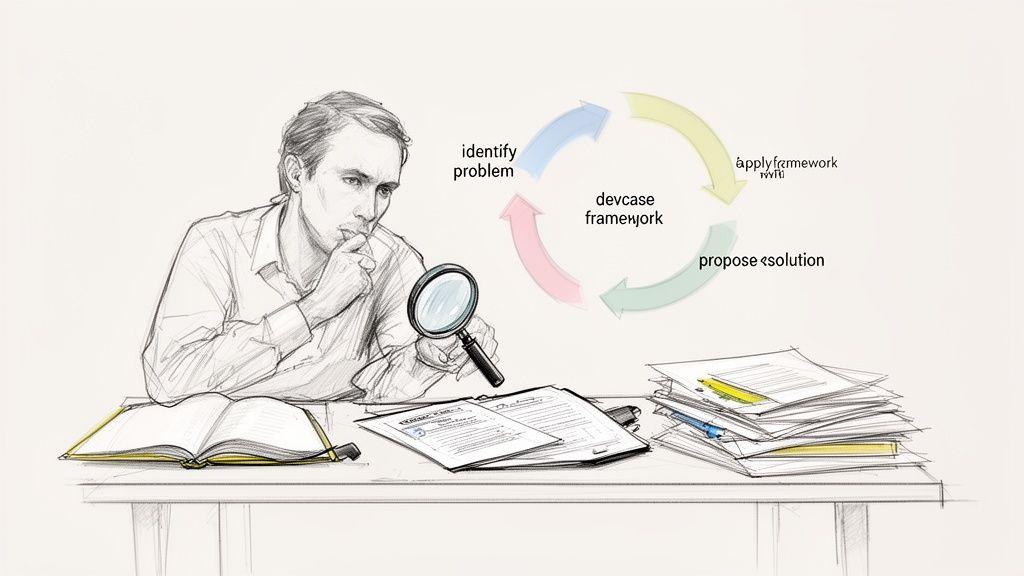
Let's be clear: a case study analysis isn't a book report. It’s a deep dive where you take apart a situation—maybe a business that fumbled a product launch or a historical event with complex causes—to truly understand why things unfolded the way they did and what the next steps should be.
This is a vital skill, whether you're in a classroom or a boardroom. An MBA student digging into a company's failed international expansion uses the same critical thinking as a marketing manager trying to understand a sudden dip in sales. It's all about evidence-based reasoning.
Your job is to get past the obvious and uncover the hidden drivers and consequences.
More Than Just a Summary
The single biggest trap students fall into is simply retelling the case study's narrative. A real analysis demands that you interpret the information, form an opinion, and then build a solid argument to back it up. You'll use evidence from the case, of course, but also pull in relevant theories and outside research.
This shifts you from being a passive reader to an active problem-solver. You’re essentially putting yourself in the shoes of the person who had to make the tough call, but with the added advantage of analytical tools and a bit of hindsight.
A great analysis doesn’t just answer the questions; it questions the answers. It challenges assumptions, explores alternatives, and provides a rationale for its conclusions that can withstand scrutiny.
Key Components for Success
Before we get into the nitty-gritty of writing, it helps to see the big picture. Think of these components as the building blocks of your analysis. Each one has a specific job to do, and together, they create a logical and persuasive argument. Knowing them upfront gives you a solid roadmap.
To get us started, here’s a quick-reference table that breaks down the essential parts of any strong case study analysis.
Key Components of a Powerful Case Study Analysis
| Component | Purpose | Key Focus Area |
| Introduction | Grab the reader's attention and briefly introduce the central problem. | Clearly stating the main issue and why it matters. |
| Background | Provide essential context and relevant facts from the case. | Setting the scene without retelling the entire story. |
| Problem Statement | Explicitly define the single most critical issue that needs solving. | A concise, focused declaration of the core challenge. |
| Analysis | Dissect the problem using frameworks, theories, and evidence. | Applying models like SWOT or digging for the root cause. |
| Recommendations | Propose specific, actionable, and justified solutions. | Providing a clear "what," "why," and "how" for your solutions. |
| Conclusion | Summarize your key findings and reiterate the main takeaway. | Reinforcing the strength of your analysis and recommendations. |
Think of this table as your checklist. As you build out your analysis, you can keep coming back to it to make sure every piece is pulling its weight and contributing to a powerful final product.
Your Pre-Writing Research and Discovery Phase

A powerful case study analysis is built long before you write a single paragraph. This pre-writing stage is your intelligence-gathering mission, where you need to shift from being a passive reader to an active investigator. The goal isn't just to follow the story—it's to deconstruct it, piece by piece.
Think of it like an initial diagnosis. You wouldn't recommend a treatment without first examining the patient, running tests, and understanding their history. In the same way, your final recommendations will only be as strong as the evidence you dig up at the very start.
Actively Dissecting the Case Materials
Your first job is to read the case study with a purpose. A common mistake is to read it like a novel, from start to finish, and just absorb the plot. Instead, you need to dissect it with a critical eye, almost like an attorney reviewing evidence before a trial.
On your first pass, just get the lay of the land—a general sense of the situation. Then, on your second and third reads, start actively engaging with the text. Go ahead and highlight key facts, scribble questions in the margins, and start identifying the main actors or stakeholders.
What drives them? What's holding them back? Often, the most important information isn't stated directly; it’s hidden between the lines. A single sentence about a company’s rigid culture might be the key to understanding why a perfectly logical strategy completely fell apart in practice.
Identifying Key Players and Constraints
Every case involves people making decisions under specific circumstances. Your task is to map this out clearly. Create a simple list or even a quick diagram of the key individuals, departments, or organizations involved.
Next to each one, jot down their apparent goals and the limitations they're up against. These constraints often fall into a few buckets:
- Financial: Limited budgets or serious cash flow problems.
- Operational: Outdated technology or inefficient processes that cause bottlenecks.
- Market-based: Intense competition or a sudden shift in consumer demand.
- Cultural: A deep-seated resistance to change within the organization itself.
Pinpointing these elements early helps you understand the why behind the events, which is the absolute core of a strong analysis.
The real story in a case study isn't just what happened, but why it happened and what forces prevented other outcomes. Your research phase is about uncovering those hidden forces.
Gathering External Evidence and Context
A case study doesn't exist in a vacuum. To truly get what's going on, you have to look outside the provided text. This is the step that separates a good analysis from a great one.
If the case is about a company's marketing failure in the early 2000s, for example, researching the economic climate and competitor actions from that specific era provides crucial context that the case itself might leave out.
This external research builds a richer, more complete picture. For instance, you could use:
- Market Data: Look up industry reports or market trends from the period to either validate or challenge the company's assumptions.
- Historical Archives: For political or historical cases, news articles or public records can reveal public sentiment or previously unmentioned factors.
- Academic Theories: Connect the situation to established business or social theories. Does the company's failure illustrate a classic example of disruptive innovation?
This process isn't about collecting random facts; it’s about finding external evidence that will directly support the arguments you'll make later.
Organizing Your Findings for Clarity
As you gather all this information, it can get overwhelming—fast. You need a simple system to keep everything organized before you even think about writing. Trust me, a chaotic research process almost always leads to a confusing final paper. To get started, you can explore several proven techniques for how to organize research notes effectively.
Consider using one of these practical methods:
- Mind Mapping: Start with the central problem in the middle and branch out with key themes, stakeholders, evidence, and questions. This visual method is fantastic for seeing connections you might otherwise miss.
- Simple Spreadsheet: Create columns for "Key Fact," "Source (Case or External)," "Relevance," and "My Initial Thoughts." This structured approach ensures you track every piece of evidence.
- Thematic Notes: Create separate documents or pages for different themes like "Leadership Issues," "Financial Problems," or "Market Environment." Then, just drop your findings into the relevant buckets as you go.
This organizational work is your final step before you start building an outline. It transforms your raw intelligence into a solid foundation, ensuring you're ready to build an airtight and persuasive analysis.
Building Your Analysis for Maximum Impact
A great case study analysis isn't just a collection of facts; it's a story. You're guiding the reader from a complex problem to a clear, convincing solution. Without a solid structure, your best ideas can get lost, and your argument will fall flat.
Think of it as building a case, piece by piece. Each section should logically flow into the next, creating momentum that makes your final recommendations feel both brilliant and inevitable. Let's walk through how to build that structure.
Crafting an Introduction That Grabs Your Reader
Your intro is your first impression—make it count. Forget the generic warm-up. Jump right into the core conflict or the most interesting question the case presents.
Briefly introduce the company or situation, but immediately pivot to the central problem they're facing. This isn’t the place for a deep dive into the backstory; it's a quick, high-level snapshot to establish the stakes. You need to make the reader care about what happens next.
It's like the opening scene of a movie. You set the scene, introduce the main character, and reveal the challenge they have to overcome, all in the first few minutes.
Setting the Scene with a Concise Background
Once you've hooked them, you need to provide some context. The background section is where you lay out the essential facts, history, and market conditions that led to the current situation.
The key here is concise. Don't just dump every detail from the case study onto the page. Your job is to be a curator, picking out only the information that’s truly relevant to the problem at hand.
- Who are the key players? Briefly introduce the main stakeholders.
- What's the environment? Note the industry, market, or historical context.
- How did we get here? Summarize the critical events that created the problem.
This section gives your reader the foundation they need to follow your analysis. A good outline is your best friend here. If you need a hand with that, our guide on how to write a research paper outline has some practical tips that translate perfectly to case studies.
Clearly Defining the Problem Statement
This might be the single most important sentence in your entire analysis. Your problem statement is a sharp, focused declaration of the core issue you're going to solve.
A weak statement sounds like, "The company has marketing issues." A strong one is specific and measurable: "The company's reliance on outdated print advertising has resulted in a 15% decline in market share among the 18-35 demographic over the last two years." See the difference?
Your problem statement is your North Star. It keeps your analysis on track and ensures every part of your paper is working toward solving one central challenge.
The Analysis: Where You Connect the Dots
Now it’s time to dissect the problem. The analysis section is where you bring in frameworks like SWOT (Strengths, Weaknesses, Opportunities, Threats) or Root Cause Analysis to dig deeper.
This is not a summary; it's an interpretation. You have to connect the dots between the background information and the problem statement. Show your reader how and why certain factors led to this outcome. For example, you could use a SWOT analysis to show how a company's internal weakness (like outdated tech) prevented it from seizing an external market opportunity (like the rise of e-commerce).
This approach, where you combine different pieces of evidence, is a proven method for strengthening your argument. In formal research, it’s known as triangulation, and it’s widely used in business and health studies to boost a study's validity.
Writing Actionable Recommendations
Your recommendations have to be a direct result of your analysis. Each one should be a specific, practical solution to the problem you just dissected. Vague suggestions like "improve marketing" are worthless.
Get concrete. For every recommendation, you need to lay out:
- The Specific Action: What exactly should they do? (e.g., "Launch a targeted social media campaign on Instagram and TikTok.")
- The Justification: Why is this the right move? (e.g., "This directly targets the 18-35 demographic where we've seen market share losses.")
- The Implementation: What's the first step? (e.g., "Reallocate $50,000 from the print budget and hire a social media manager.")
Good recommendations are practical, supported by evidence, and tied directly to your analysis.
Your Conclusion: Reaffirming Your Insights
Finally, the conclusion brings everything together. It’s your closing argument.
Start by briefly restating the problem. Then, quickly recap your main findings from the analysis. End by reiterating your key recommendations, reinforcing why they are the best path forward. Your conclusion should leave the reader with no doubt about the problem, your diagnosis, and the solution you've proposed.
Applying Frameworks to Deepen Your Insights
You've done the legwork—you have the facts, you understand the context, and you’ve pinned down the central problem. Now, it’s time to shift from just describing the situation to truly analyzing it. This is where you bring in the heavy hitters: analytical frameworks. These tools are what separate a simple summary from a powerful, evidence-backed argument.
Think of frameworks as different lenses. Each one lets you view the problem from a unique angle, revealing hidden forces and connections you might otherwise miss. They give your analysis structure and make sure you’re not overlooking a critical piece of the puzzle.
Moving Beyond a Standard SWOT Analysis
A SWOT analysis is a great place to start, but it's often just scratching the surface. To really get to the heart of the matter, you need to dig deeper into the company’s competitive world and the broader forces shaping its reality.
This is where more specialized frameworks come in handy.
- PESTLE Analysis: This is your go-to for understanding the big picture. It forces you to examine the Political, Economic, Social, Technological, Legal, and Environmental factors at play. A sudden change in trade policy (Political), for example, could be the real culprit behind a company's supply chain nightmare.
- Porter's Five Forces: When competition is the name of the game, this is the framework you want. It helps you dissect the industry by looking at the threat of new players, the power of buyers and suppliers, the risk of substitutes, and the overall intensity of rivalry. You might discover that a company's sagging profits aren't from bad management but from brutal, industry-wide price wars.
The key is choosing the right tool for the job. A tech startup that’s suddenly irrelevant might get the most mileage out of a PESTLE analysis, zeroing in on technological shifts. A struggling retail chain, on the other hand, would benefit more from using Porter's Five Forces to map out its competitive landscape.
This decision tree can help you figure out where to begin.
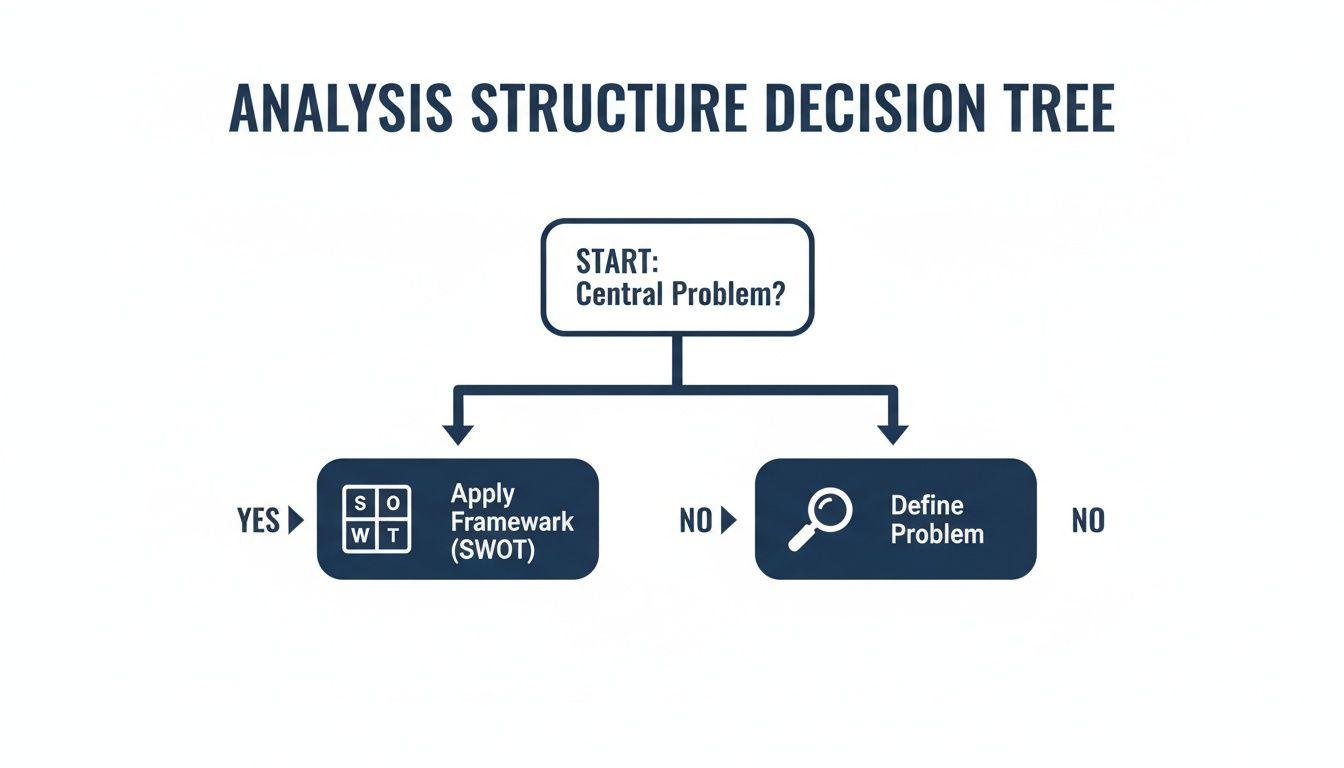
As you can see, once the problem is clear, applying a framework is the natural next step to start breaking it down.
Weaving Quantitative and Qualitative Evidence Together
The most convincing analysis always marries hard numbers with human context. Quantitative data—like financial reports or market share figures—tells you what is happening. But it’s the qualitative evidence—quotes from interviews, descriptions of company culture—that explains why.
For instance, you might find that a company’s sales have plummeted by 25% (quantitative). That’s an alarming number, but it's just a number. Now, imagine you pair that with quotes from the sales team complaining that a new, buggy CRM system is crashing three times a day (qualitative). Suddenly, you have a story. The data proves the problem is real, and the stories reveal its source.
The most powerful arguments are built at the intersection of data and narrative. Use quantitative evidence to establish the facts and qualitative evidence to give those facts meaning and context.
The Power of Cross-Case Comparisons
Sometimes, the most brilliant insights emerge when you put two situations side-by-side. If the assignment allows, comparing your case to a similar one can make your conclusions incredibly robust. By looking at how two different companies handled the same market shift, you can spot patterns that would be invisible in a single case.
It’s also a more statistically sound approach. Research has shown that cross-case comparisons can lead to findings with up to 50% stronger analytical generalization than single-case studies. When you can draw lines between multiple examples, you’re not just solving one problem—you're uncovering broader strategic truths. You can discover more about these advanced research methodologies to see how they create more robust findings.
Let's say you're looking at two airlines during a massive spike in fuel prices.
- Airline A went into survival mode, cutting routes and laying off staff.
- Airline B played the long game, investing in more fuel-efficient aircraft and hedging its fuel costs.
By comparing their performance five years down the line, you can make a much more powerful, evidence-based argument for long-term strategy over short-term fixes. This comparative lens elevates your analysis from a one-off diagnosis to a valuable, widely applicable business lesson.
Sidestepping Common Traps in Your Analysis
It’s one thing to understand the steps, but it’s another to execute them well. Knowing the most common pitfalls is one of the fastest ways to elevate your work from good to great. Even the most thoroughly researched case studies can fall flat because of a few simple, avoidable errors.
Think of this as your final quality check. Before you even think about submitting your work, run through these common mistakes to make sure your analysis is sharp, credible, and truly insightful. The two biggest culprits? Simply retelling the story instead of analyzing it, and offering up vague solutions that sound nice but aren't tied to reality.
Mistake 1: Summarizing Instead of Analyzing
This is, without a doubt, the number one trap students fall into. It’s easy to do. A summary just retells the story: "First, the company did this, and then that happened." An analysis, on the other hand, digs deeper to explain why it happened and what it all means.
The goal is to connect the dots, apply relevant business concepts, and form a judgment backed by evidence.
A simple trick to stay on track is to constantly ask yourself, "So what?" after every point you make. If you write that a company's sales dropped by 20%, don't just leave it there. Ask, "So what?" This forces you to explore the reasons. Was it a new competitor? A disastrous marketing campaign? A fundamental shift in consumer behavior? That investigation is the heart of your analysis. If you find you're just rephrasing facts from the case, it might be a good time to review some strategies on how to paraphrase without plagiarizing to spark more original thinking.
Mistake 2: Ignoring the Theoretical Backbone
A strong analysis never exists in a vacuum. It uses established theories and models to make sense of the situation. For instance, if a company is struggling after a huge competitor entered its market, you could use a framework like Porter's Five Forces to explain the intense competitive pressures at play.
Without this theoretical grounding, your analysis is just a string of personal opinions.
But here’s the key: use these models as a lens, not a script. Trying to force the facts to fit a theory is just as bad as ignoring theory completely. The best analyses let the evidence shape their thinking. In a fascinating study on international paper mills, researchers used six case studies and found their initial hypotheses evolved by 20% as new data came in. This shows just how crucial it is to stay flexible. You can read more about how those international comparative case studies adapted during the research process.
Mistake 3: Offering Vague or Unrealistic Recommendations
Your recommendations are the grand finale—the culmination of all your hard work. They must be specific, actionable, and flow directly from your analysis. A generic suggestion like "improve marketing" is a completely wasted opportunity.
A weak recommendation tells a company what it should want (e.g., "increase profits"). A strong recommendation gives them a concrete, defensible plan for how to get there.
Let's look at the difference.
- Vague: "The company needs to innovate more to stay competitive."
- Actionable: "The company should allocate 10% of its R&D budget to developing a subscription model for its B2B software. This will build a recurring revenue stream and reduce dependency on volatile one-time sales."
The second example is powerful. It’s specific, measurable, and provides a clear strategic path forward. It directly solves a problem you've already identified, making your entire case study feel more compelling and valuable.
Your Top Case Study Analysis Questions, Answered
Even with the best game plan, you're bound to hit a few roadblocks. It happens to everyone. This section is all about tackling those nagging questions that pop up when you're deep in the weeds of a case study analysis.
Think of this as your go-to reference for those final sticking points, from nailing the right length to figuring out where AI fits into the picture.
How Long Should My Analysis Be?
This is, without a doubt, the question I hear most often. And the answer is always the same: focus on depth, not length.
Sure, some assignments might specify a 1,500-word target, but most instructors care far more about the quality of your thinking than the number of pages. A sharp, insightful 5-page analysis will always beat a rambling 15-page report that just rehashes the case details.
Instead of chasing a word count, ask yourself these three questions:
- Have I completely broken down the core problem?
- Is every single claim I've made backed up with solid evidence?
- Are my recommendations specific, actionable, and directly tied to my analysis?
If you can confidently say "yes" to all three, your analysis is probably the right length. Don't add fluff. It waters down your argument and tells your reader you're not confident in what you've found.
What's the Difference Between a Case Study and a Case Study Analysis?
It's incredibly common to mix these two up, but understanding the difference is the first real step to getting your analysis right.
Here's the simplest way to think about it: the case study is the raw material. It’s the story—the collection of facts, interviews, data, and events that lay out a specific situation. It presents what happened without passing judgment or offering a fix.
Your case study analysis is where you come in. It's your evaluation, your interpretation, and your proposed solution. You take the raw material from the case and build a compelling argument with it.
This little table should help keep it straight:
| Element | Case Study (The Story) | Case Study Analysis (Your Work) |
| Purpose | To present a real-world scenario. | To dissect that scenario, find the root problems, and propose solutions. |
| Voice | Objective and descriptive. | Analytical and persuasive. |
| Content | Facts, data, quotes, and a narrative. | Your arguments, frameworks, and recommendations. |
| End Goal | To provide a problem to be examined. | To provide a well-reasoned solution to that problem. |
In short, you’re given the case study so you can perform the case study analysis. Your job isn't to retell the story; it's to use it as evidence for your own insights.
Can I Use AI for My Analysis?
With the rise of AI, this question is more relevant than ever. The short answer is yes, but you have to be smart and ethical about it. Firing up a tool like ChatGPT and asking it to write your analysis isn't just plagiarism—it also cheats you out of developing the very critical thinking skills the assignment is designed to teach.
However, when used correctly, AI can be a fantastic assistant.
Think of AI as a brilliant but very junior research assistant. It can gather information, summarize complex topics, and help you brainstorm, but you are the strategist. You have to direct the work, verify every fact, and make the final call.
Here’s how you can use AI effectively without crossing any lines:
- Brainstorming: Ask it to suggest a few analytical frameworks (like a PESTLE or Porter's Five Forces) that might fit your case.
- Initial Research: Use it to get a quick overview of the industry or the company's history to build context.
- Outlining: Have it help you organize your thoughts into a logical structure based on the key components of an analysis.
- Proofreading: It’s a great tool for catching grammar mistakes, typos, and awkward phrasing in your final draft.
The bottom line is maintaining intellectual ownership. Your insights, your arguments, and your final recommendations have to be yours. Let AI handle some of the grunt work so you can spend your time on what really matters: deep, critical thinking.