Crafting a research paper introduction is all about guiding your reader. You start with the big picture, then zoom in on a specific problem or unanswered question, and finally, present your research as the key to solving it.
The 4 Essential Components of a Research Paper Introduction
Your introduction is so much more than a warm-up; it's the first and best chance you have to convince readers your research is worth their time. It’s your roadmap, the thing that establishes your credibility and sets the stage for the entire argument to follow. A weak start can cause even the most brilliant research to fall flat.
Ultimately, the intro must answer the reader's unspoken question: "Why should I care?" To pull this off, it has to juggle a few key tasks. It needs to give just enough background for someone new to the topic to get their bearings, but without turning into a full-blown literature review. It’s a delicate balance.
The Funnel: From Broad to Specific
I always tell my students to think of their introduction as a funnel. You start wide, at the top, with the general landscape of your field. From there, you gradually narrow the focus, zeroing in on the specific, unanswered question your paper is built to address. This structure makes your contribution feel both logical and essential.
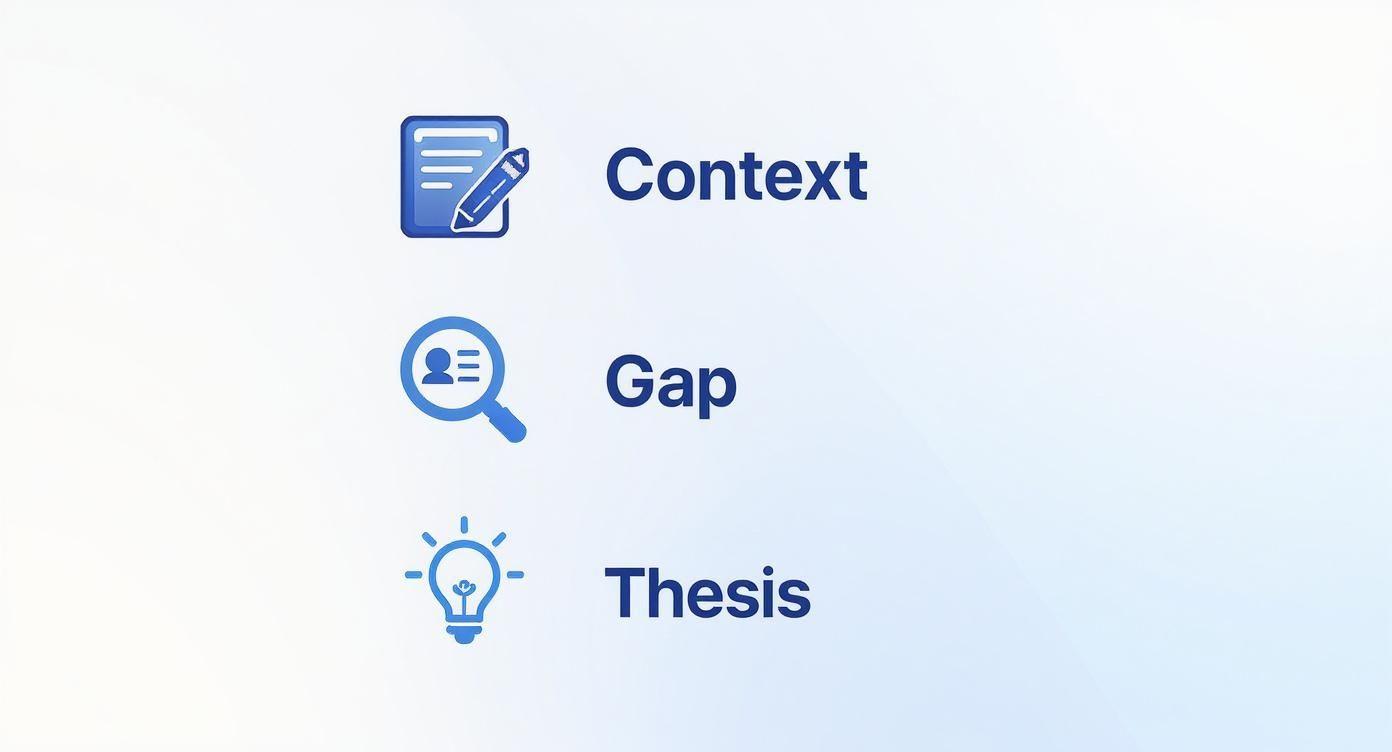
This funnel approach ensures each element flows logically into the next, leading your reader from a general understanding right to the core of your work. It's the foundation for a clear and persuasive argument.
To make this structure concrete, let's break it down into four essential components. Each part has a distinct job to do in building your case.
The Four Essential Components of a Research Paper Introduction
| Component | Purpose | Key Question to Answer |
| The Hook | Grab the reader’s attention and introduce the broad topic. | Why is this topic interesting or important right now? |
| Context | Provide necessary background information and set the scene. | What does my reader need to know to understand the problem? |
| The Gap | Identify what’s missing or wrong with existing research. | What problem has the field overlooked or failed to solve? |
| Objective/Thesis | State your specific research question, hypothesis, or goal. | What will my paper do to address this gap? |
By hitting each of these four points, you create a complete and compelling narrative that justifies why your research needs to exist.
Why It Matters for Citations and Impact
Getting the introduction right isn't just about making a good first impression; it actually affects how your work is perceived and used by other academics. Studies have shown that articles with clear, well-structured introductions can be cited up to 25% more often than those with confusing or vague openings.
A polished intro doesn't just make your paper easier to read—it signals to your peers that your research is important, which helps it find a much wider audience.
A strong introduction doesn't just introduce your topic; it sells your research. It convinces the reader that the problem you are tackling is significant and that your approach is worth their time.
In the end, mastering the introduction is about framing your work for maximum impact. It’s the foundation for everything that follows. If you're looking for help organizing your thoughts before you even start writing, our guide on crafting an essay outline example offers a great framework.
Hooking Your Reader From the First Sentence
Your first sentence is a promise. A dull opening promises a long, tedious read, basically inviting your reader to skim. But a sharp, compelling one? That grabs their attention and refuses to let go. This is your one shot to convince the reader that your work isn't just another academic exercise—it's genuinely interesting.

Learning how to write an introduction that pops starts with mastering the hook. A great opening sentence has to be relevant, concise, and just a little bit provocative. It needs to tie directly into your paper's core theme while immediately sparking some curiosity.
Finding the Right Hook for Your Field
What works in one academic discipline can fall completely flat in another. The best hooks are tailored to your field's conventions and your audience's expectations. This isn't about being formulaic; it's about establishing credibility from the get-go.
- For STEM and Social Sciences: Go for a powerful statistic or a bold, factual statement. A surprising number instantly frames the scale and importance of the problem. A sociology paper, for instance, could start with: "Globally, over 2.1 billion people lack access to safe drinking water, a crisis that disproportionately affects rural communities in developing nations." It's direct, impactful, and sets the stage perfectly.
- For Humanities and Arts: An excellent strategy here is to open with a provocative question, a short and relevant anecdote, or a compelling quote. Imagine a philosophy paper asking, "If artificial intelligence can create art indistinguishable from a human's, what does this reveal about the nature of creativity itself?" This approach immediately invites the reader to think and frames the intellectual space you're about to explore.
- For Clinical or Applied Fields: Nothing beats a brief, anonymized case study or a real-world scenario. A medical research paper might begin: "A 45-year-old patient presented with recurring symptoms that defied conventional diagnostic protocols, highlighting a critical gap in our understanding of autoimmune responses." This immediately grounds your research in a tangible, human problem.
Key Takeaway: Your hook isn't just for show. It has to create an instant connection between your reader and why your research matters. It must feel earned and lead logically into the broader context you’re about to build.
From Hook to Context: A Seamless Transition
Once you've landed the hook, the very next sentence has to start building the bridge to your broader topic. This transition needs to feel effortless, guiding the reader from that initial spark of interest into the ongoing scholarly conversation. A jarring jump from a dramatic statistic to a dry literature review will kill any momentum you've just built.
Think of your hook as the opening shot of a film. If you start with a tight close-up on a critical detail (your statistic or question), the next shot needs to pull back smoothly to show the wider scene.
Here's how that flow looks in practice:
- The Hook (Statistic): "Despite record-level investments in renewable energy, residential energy consumption in urban areas has increased by 15% over the last decade."
- The Transition (Connecting Sentence): "This paradoxical trend suggests that technological advancements alone are insufficient to curb energy use without a corresponding shift in consumer behavior."
- The Context (Broader Issue): "Current research has extensively documented the efficacy of smart-grid technologies, yet far less attention has been paid to the sociological factors that influence household energy decisions."
This sequence walks the reader from a startling fact directly to the specific research area your paper will tackle. Nailing these first few sentences can be tough, which is why some writers use an advanced AI paragraph writer to brainstorm a few opening drafts and find a smooth, logical flow.
Ultimately, the start of your introduction is all about strategic persuasion. You're persuading someone to give you their most valuable asset—their time. A powerful hook followed by a masterful transition makes that an easy choice.
Setting the Stage and Finding Your Opening
Once you've grabbed your reader's attention with a solid hook, it's time to guide them toward the core of your research. This next step is all about building context—giving your audience just enough background to understand why your work matters. Think of it as painting a picture of the current academic conversation surrounding your topic.
This isn't the place for an exhaustive literature review. Instead, you're offering a curated overview of the most critical studies and established ideas. Your goal is to construct a narrative that leads to one clear, powerful conclusion: there’s a crucial piece of the puzzle missing. This is how you lay the groundwork for your research gap.
The Funnel: From Broad to Specific
One of the most effective ways to structure this section is to use what’s often called the funnel technique. You start broad, with widely accepted knowledge in your field, and then deliberately narrow your focus with each sentence. This approach builds a natural momentum, pulling the reader along from what’s already known to what remains a mystery.
Let’s say you're researching how remote work impacts employee creativity. You could build your funnel like this:
- Start Broad: Kick off by acknowledging a simple truth—that remote work has become a standard practice in many industries since 2020.
- Narrow a Bit: Next, touch on the wealth of existing research that has already looked into productivity and work-life balance for remote teams.
- Get More Specific: Now, pivot to the smaller collection of studies that have examined team collaboration and communication in virtual settings.
- Find the Gap: Finally, you deliver the punchline: while productivity has been studied to death, the specific effects on spontaneous, creative problem-solving are still a huge blind spot.
See how that works? The funnel doesn't just list facts; it constructs an argument. Each layer methodically tightens the focus, making your research question feel like the obvious and necessary next step.
What is a Research Gap, Really?
The research gap is the entire reason your paper exists. It's the unanswered question, the unresolved debate, or the missing link in the literature that your study is designed to fill. Being able to articulate this gap clearly is what justifies your entire project.
You’re essentially saying, "Here's what the field has accomplished, and here's the one critical piece they've overlooked." This isn't about tearing down previous work; it's about building on it. You’re showing respect for the scholarship that came before while carving out a unique and necessary space for your own contribution.
The way we frame this has changed over time. If you look at papers from before the mid-20th century, introductions were often shockingly brief. But as academic writing became more standardized, style guides started insisting that a strong introduction must pinpoint a problem, review the literature to expose a gap, and then state the study's purpose. You can actually dig into the history and structure of this evolution in this detailed guide on writing research paper introductions.
Your research gap is your paper's reason for being. If you can't state it in a single, clear sentence, you may need to refine your research question. A strong gap makes your work necessary, not just interesting.
Phrasing That Signals the Gap
Pointing out the research gap requires deliberate, precise language. You need to use phrases that act like signposts, letting the reader know you're shifting from what's known to the uncharted territory your research is about to explore. Vague statements just won't cut it here.
Here are a few powerful ways to frame your gap:
- Highlighting a Lack of Focus: "While a significant body of literature has explored X, far less attention has been paid to Y."
- Pointing Out a Contradiction: "Previous studies on Z have produced conflicting results, leaving the role of [variable] uncertain."
- Identifying an Unexplored Area: "Despite the growing interest in [topic], no research has yet investigated the long-term effects of [specific condition]."
- Questioning an Assumption: "The prevailing assumption is that A leads to B; however, this relationship has not been tested in the context of C."
For example, in a psychology paper, you might write: "While numerous studies have documented the link between social media use and anxiety, the specific cognitive mechanisms that mediate this relationship remain poorly understood." That one sentence does so much work. It acknowledges the existing research and then cleanly defines the unique contribution your paper is about to make. It's a confident, precise way to justify why your study needs to exist.
Declaring Your Purpose with a Clear Thesis Statement
You've set the stage, shown the reader the landscape, and pointed out a crucial missing piece. Now it's time for the main event of your introduction. This is the moment you pivot from "here's the problem" to "here's how I'm going to tackle it." Your thesis statement, research question, or hypothesis is, without a doubt, the most important sentence you'll write in this section. It’s your promise to the reader—a direct statement of what your paper will argue, investigate, or prove.
Think of this statement as the anchor for your entire paper. It's not just a topic; it’s a specific, debatable claim that gives your research a clear direction and a strong sense of purpose. Without it, a paper can feel like a random collection of facts, wandering aimlessly without a central point. A solid thesis keeps everything focused.
From Vague Idea to Sharp Argument
One of the most common pitfalls I see is a thesis that simply describes a topic rather than making an argument about it. A descriptive statement just announces what you’ll talk about. An analytical statement, on the other hand, makes a specific, defensible claim. It’s the difference between being a tour guide pointing out landmarks and a detective building a case.
- Descriptive (Weak): "This paper will discuss the effects of remote work on employee productivity."
- Analytical (Strong): "This paper argues that while remote work initially boosted self-reported productivity, it has led to a measurable decline in cross-departmental innovation due to reduced spontaneous communication."
The second example is far more powerful. It’s specific, someone could reasonably disagree with it, and it immediately sets up a clear path for the rest of the paper. Your reader knows exactly what you intend to prove. The goal is always to move beyond just stating facts and into the realm of interpretation and argument.
Transforming a vague idea into a precise thesis is a critical skill. It forces you to clarify your thinking before you even start writing the body of your paper.
Here’s a look at how to sharpen a weak statement into a compelling one.
Comparison of Vague vs. Precise Thesis Statements
| Weak/Vague Statement | Strong/Precise Statement | Why It's Better |
| Social media has a negative impact on teenagers. | The rise of algorithm-driven content on platforms like TikTok and Instagram has correlated with a 30% increase in reported anxiety symptoms among users aged 13-17. | It narrows the focus to specific platforms, a specific age group, and a quantifiable outcome (anxiety symptoms), making it testable and arguable. |
| Climate change is a global problem. | This paper contends that current international climate agreements are fundamentally flawed because they fail to hold transnational corporations accountable for their carbon footprints. | It moves from a broad, undeniable fact to a specific, debatable critique of existing policy, providing a clear argumentative stance. |
| Shakespeare's plays are timeless. | In Hamlet, Shakespeare uses the theme of feigned madness not merely as a plot device, but as a sophisticated critique of Elizabethan court politics. | It focuses on a single play, a specific literary device, and proposes a unique interpretation that requires textual evidence to support. |
As you can see, a strong thesis doesn't just state a topic; it takes a stand. It gives you a clear target to aim for throughout your paper.
Tailoring Your Thesis to Your Discipline
The exact form your purpose statement takes can and should change depending on your field. Each academic discipline has its own shorthand for signaling research intent. Speaking that language shows you understand the conventions and expectations of your audience.
- Humanities: You'll often see an interpretive thesis statement that puts forth a unique argument about a text, historical event, or concept. For example: "This essay contends that Shakespeare's The Tempest uses the character of Caliban not as a colonial allegory, but as a critique of the inherent flaws in utopian philosophy."
- Social Sciences: It's common to use a formal research question or an arguable thesis. For instance: "This study investigates how the 'gig economy' has altered traditional notions of career progression among millennials in urban centers."
- STEM: Papers in the hard sciences almost always state a clear, testable hypothesis. A classic example: "We hypothesize that the introduction of CRISPR-Cas9-edited gene X into plant Y will result in a 20% increase in drought resistance compared to the unmodified control group."
No matter the format, the underlying goal is identical: be precise, be confident, and leave no room for ambiguity about what you plan to accomplish.
Providing a Roadmap for Your Reader
The final, and often overlooked, step in a brilliant introduction is to give your reader a quick "roadmap." This is usually a single sentence that briefly outlines the structure of your paper. Think of it as a mini-table of contents woven directly into your prose. This simple addition helps manage your reader's expectations and makes your argument much easier to follow.
This roadmap sentence typically comes right after your thesis.
For example, following the strong thesis about remote work, you might add: "To support this claim, this paper will first analyze productivity data from 2019-2023, then present findings from employee interviews on collaborative practices, and finally, propose a model for fostering innovation in remote environments."
It’s a small touch, but it signals to your reader that you are in complete control of your material. You’re not just exploring a topic; you’re guiding them through a well-structured and compelling argument.
Spotting (and Fixing) Common Introduction Mistakes
Knowing the theory behind a great introduction is one thing, but actually writing one is where the real challenge lies. Even seasoned researchers can fall into a few common traps that take the punch out of their opening paragraphs.
Think of what follows as a quick field guide to diagnosing and fixing the most frequent missteps. Catching these during your editing process can be the difference between a good introduction and one that truly grabs your reader.
Mistake 1: The View from 30,000 Feet
This is easily the most common pitfall: an introduction that stays way too general for way too long. Sentences like "Technology has changed society" are so broad they're almost meaningless. They don't give your reader any real clue about your paper's specific focus.
This kind of vagueness usually comes from a fear of getting to the point too soon. But in academic writing, your reader is busy. They appreciate precision and clarity right from the get-go.
How to Fix It
Get specific, and get specific fast. Anchor your opening statements in concrete details that immediately frame your research.
- Before (Too Broad): "Social media has had a major impact on politics."
- After (Specific): "The rise of algorithm-driven news feeds on platforms like Facebook and Twitter has fundamentally altered how local political campaigns in the United States engage with potential voters."
See the difference? The revised version instantly narrows the focus to specific platforms, a geographic area, and a particular action (political campaigning). The reader knows exactly where they are.
Here's a simple gut check: If a sentence could easily fit into a dozen different papers on your topic, it’s too vague for yours. Challenge every general statement by asking, "How can I make this more precise?"
Mistake 2: The "Laundry List" of Facts
Another classic blunder is just dumping a list of disconnected facts or summaries of previous studies onto the page. It reads less like a paragraph and more like a set of bullet points that haven't been properly connected. It tells the reader what other people have found, but not why it matters for your study.
Your introduction needs to be a narrative. Every piece of information you include should build on the last, guiding the reader from the general context straight to your specific research gap. It should tell the story of a problem that needs solving.
How to Fix It
Your job is to be the narrator, connecting the dots for your reader. Focus on creating a logical flow with strong transitions, using each study to build your case.
- Before (Laundry List): "Smith (2020) found that remote work increases productivity. Jones (2021) showed that it improves work-life balance. A study by Chen (2022) indicated potential issues with team collaboration."
- After (Narrative): "While early research celebrated remote work for its boosts to productivity (Smith, 2020) and work-life balance (Jones, 2021), a more complicated picture is now emerging. Recent findings suggest these benefits may come at the cost of effective team collaboration (Chen, 2022), pointing to an unresolved tension that this study aims to explore."
The second example doesn't just list findings; it weaves them into a story of an evolving academic conversation, leading perfectly to the gap you intend to fill.
Mistake 3: The Buried Thesis
Your thesis statement (or research question, or hypothesis) is the single most important sentence in your entire introduction. It's the whole point. But so often, it gets buried in the middle of a paragraph or phrased so timidly that the reader can easily miss it.
When that happens, the reader is left adrift, unsure of the paper’s main purpose. Your thesis should be a bright, clear signpost that says, "Here! This is the core argument I'm going to prove." Hiding it just undermines your entire paper.
How to Fix It
Make your thesis the climax of your introduction. Place it right at the end of your opening section, typically as the final sentence, and use direct, unambiguous language.
- Use Signal Phrases: Kick it off with clear signposts like, "This paper argues that...," "This study investigates...," or "We hypothesize that..."
- Be Confident: Ditch weak phrasing like "I think..." or "It seems that..." and state your claim assertively.
By making your thesis statement the grand finale of your intro, you ensure it has maximum impact and leaves absolutely no doubt about where your paper is headed.
Answering Your Top Questions About Introductions
Even with a solid plan, a few questions always pop up when it's time to actually start writing. Getting these sorted out beforehand can save you a ton of stress and make the whole process feel much more manageable. Let’s clear up some of the most common hurdles people face with research paper introductions.
How Long Should a Research Paper Introduction Be?
I've always found the 10% rule to be a great starting point. The idea is to aim for your introduction to be about 10% of your paper's total word count. This simple guideline helps keep things balanced—it gives you enough room to set the stage without stealing the show from your core arguments.
For a clearer picture, think of it like this:
- A 3,000-word paper would have an introduction around 300 words.
- A hefty 10,000-word dissertation chapter would need a more substantial intro of about 1,000 words.
But remember, this is a guideline, not a hard-and-fast rule. The real goal is to make sure you’ve covered all your bases: the hook, context, gap, and your thesis. If you've done that effectively, the length is probably right. Always, always check the specific submission guidelines from your professor or journal, as their rules trump everything else.
Your introduction is done when it has successfully hooked the reader, explained the problem, and clearly stated what your paper will do. Let that be your guide, not just a word count.
Can I Write My Introduction After the Rest of the Paper?
Not only can you, but I'd strongly recommend it. It might sound backward, but this is a pro-level tip that many seasoned academics swear by.
Think about it: when you finish your paper, you have a perfect, crystal-clear understanding of your arguments, your evidence, and your final conclusions. Writing the introduction at the end lets you craft a precise, accurate roadmap for your reader that perfectly matches the journey you've laid out. It’s your best shot at making the entire paper feel cohesive and intentional.
What Is the Difference Between an Abstract and an Introduction?
This one trips up a lot of people, but the distinction is actually pretty simple. The abstract is a "movie trailer" for your entire paper. The introduction is the opening scene.
Here’s a quick breakdown of their different jobs:
| Feature | The Abstract | The Introduction |
| Purpose | To give a super-condensed summary of the whole study. | To set the stage and explain why the research matters. |
| Scope | Covers everything: background, methods, results, and conclusion. | Focuses on background, the problem, the research gap, and your thesis. |
| Length | Extremely short—usually capped at 150–250 words. | Much longer, typically about 10% of the total word count. |
| Placement | Sits on its own, right before the main paper kicks off. | It is the first main section of the paper. |
The abstract tells the reader what you found. The introduction tells them why they should care about the problem in the first place. An introduction builds the case for your research but never gives away the ending—it leaves the reader wanting to find out what you discovered.
For writers looking to get their initial thoughts and outlines down quickly, some of the modern tools can be a big help. For example, exploring the best AI for writing papers might offer ways to structure your ideas and summaries more efficiently.