If you want to write product descriptions that actually sell, you have to nail the fundamentals first. The secret isn't some magic formula; it's about knowing your audience inside and out, focusing on the real-world benefits of your product, and making your copy incredibly easy to read. Get this right, and you'll turn casual browsers into paying customers.
Laying the Groundwork for Descriptions That Convert
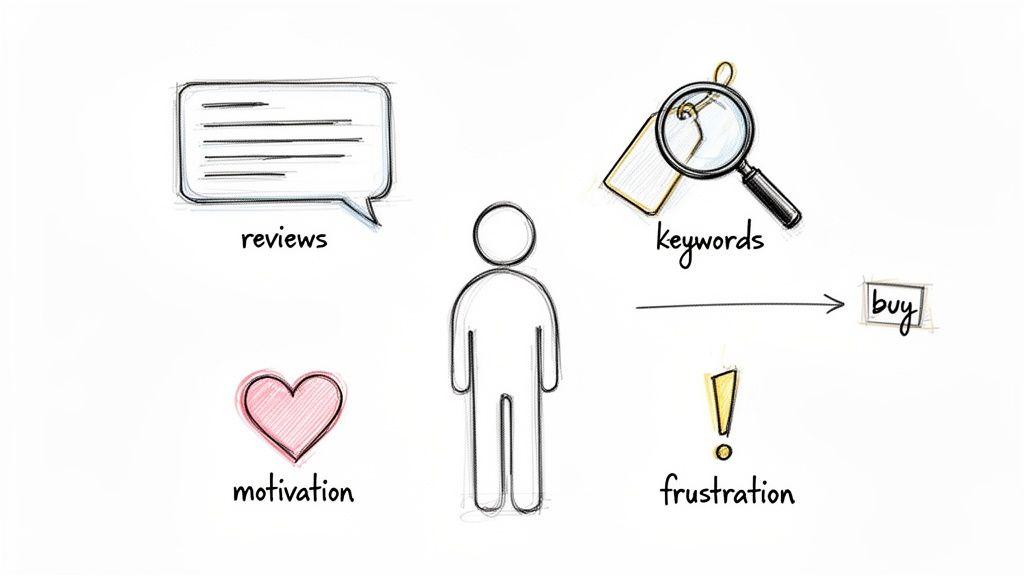
Before you write a single word, the real work begins. Great copy isn't about being clever—it’s the direct result of understanding who you’re talking to and what they actually need from you. Generic descriptions miss the mark because they try to appeal to everyone and end up connecting with no one.
The entire foundation of a high-converting product page rests on a sharp, clear picture of your ideal customer. I'm talking about more than just basic demographics. You need to get inside their head. What's keeping them up at night? What are their biggest frustrations? What does a "win" look like for them?
Building a Practical Customer Persona
Creating a customer persona can feel like a stuffy corporate exercise, but it doesn't have to be. Just think of it as sketching out a profile of a real person. Give them a name, a job, and a core challenge that your product helps solve.
Let's say you sell a project management tool. Your persona might be "Marketing Manager Maria."
- Her Frustration: Maria is drowning in a sea of scattered communication—emails, Slack messages, and spreadsheets. Projects are slipping through the cracks because her team has no single source of truth.
- Her Aspiration: She's dreaming of a streamlined workflow where everyone is aligned, deadlines are hit, and she can finally focus on strategy instead of just chasing down updates.
- Her Language: She’s likely using terms like “bottlenecks,” “improving visibility,” and “team alignment.”
This simple profile gives you the exact emotional hooks and vocabulary to write a description that speaks directly to Maria. Suddenly, you're not just selling software; you're selling her a less stressful workday and a more successful team.
The most powerful product descriptions don’t just describe the item; they articulate the customer's problem better than the customer can. When a shopper feels truly understood, you build instant trust, and the sale becomes a natural next step.
Mining for Customer Language and Pain Points
The best copy is often just borrowed directly from your customers. You don't have to guess what their pain points are or what words they use—they're already telling you. Your job is just to listen.
Dive into these goldmines of authentic feedback:
- Product Reviews (Yours and Competitors'): Look for patterns in 5-star reviews to see what people absolutely love. Then, scour the 1-star reviews to pinpoint the exact frustrations your product is designed to solve.
- Online Forums and Communities: Places like Reddit or niche Facebook groups are filled with raw, unfiltered conversations. Search for topics in your product category and pay close attention to the questions, complaints, and wishes people share.
- Customer Support Tickets: Your support team is on the front lines. Ask them about the most common questions and problems they hear every day. These are the very issues you need to address head-on in your description.
By gathering these real-world phrases and concerns, you can build a "swipe file" of language that you know resonates. Using this vocabulary makes your copy feel authentic and relatable, not like another canned sales pitch.
Finding Keywords That Signal Purchase Intent
Once you have a deep understanding of your customer, you can start finding the keywords they use when they're actually ready to buy. This is how you bridge the gap between their problem and your solution. Product page SEO isn't just about getting traffic; it's about attracting the right kind of traffic.
You'll want to focus on long-tail keywords that show purchase intent. For instance, a search for "shoes" is incredibly broad. But a search for "women's waterproof trail running shoes size 8" comes from someone who knows exactly what they want and is likely ready to buy.
Use keyword research tools to uncover these highly specific phrases. This targeted approach ensures that when your ideal customer is ready to make a decision, your product is the one they find. If you want to go deeper on organizing your content strategy around these keywords, check out our guide on how to create a content calendar; it’s a great resource for planning out your SEO efforts.
Crafting Headlines and Hooks That Stop the Scroll
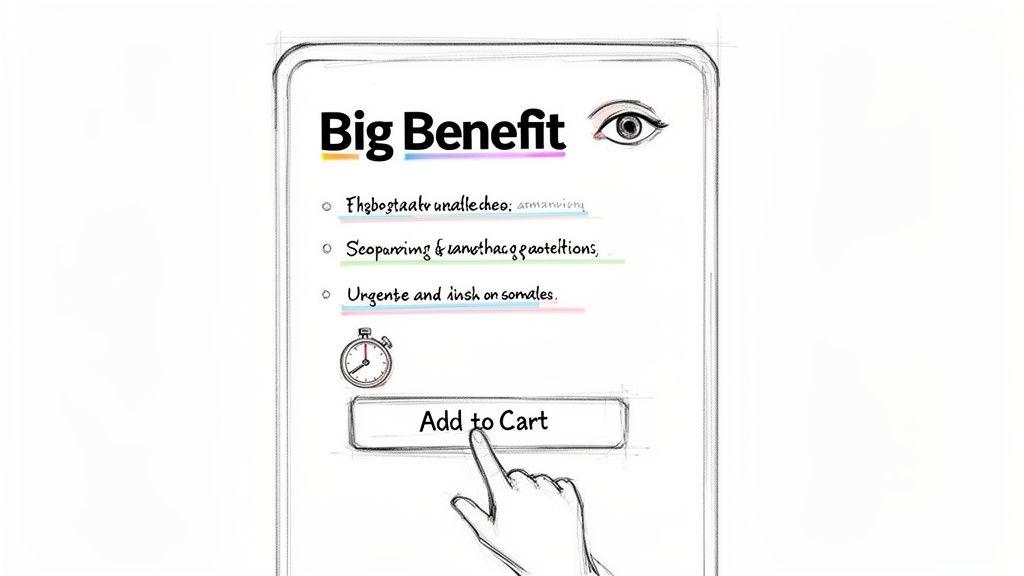
Think of your headline as the digital equivalent of a storefront window. If it isn't interesting enough to make someone pause their endless scroll, it doesn't matter how incredible the product is. Your entire description just became invisible.
This is where so many product descriptions go wrong right out of the gate. A boring, feature-first title gets skimmed and forgotten in a heartbeat. The real trick is to write a headline and an opening line—your "hook"—that grabs your customer by the shoulders and says, "Hey, this is for you."
You have just a few seconds to make an impression. It's a tough pill to swallow, but research consistently shows that only 20% of people read past the headline. That single line is a make-or-break moment. It's also why leveraging a tool like 1chat to rapidly brainstorm magnetic headlines can give small businesses a massive leg up. You can dig into more copywriting stats over at Wordlead.
The Psychology of an Irresistible Headline
A great headline does more than just describe; it persuades. It taps into a real human emotion or a tangible benefit that makes the reader immediately think, "I need that." The best headlines don't sell products—they sell feelings, solutions, and better versions of ourselves.
Let’s break it down with a simple example for a portable power bank.
- Bland Headline: "10,000mAh Portable Power Bank"
- Compelling Headline: "Never See 1% Again. Your All-Day Power Solution."
The first one is just a spec. It’s dry and forgettable. The second one hits on a universal frustration—the sheer panic of a dying phone battery—and instantly positions the product as the hero. It connects. Your goal is to shift the focus from what your product is to what it does for the customer.
Formulas for Powerful Headlines and Hooks
You don't have to stare at a blank screen and hope for inspiration. There are proven formulas that give you a solid foundation for writing headlines that actually work. The key is to adapt them to your specific product and who you're talking to.
Here are a few of my go-to approaches:
- The "Problem-Agitate-Solve" Hook: Name the pain point, poke it a little, then offer the cure. For noise-canceling headphones, you might try: "Distractions Ruining Your Focus? Find Your Quiet Zone."
- The "Benefit-Driven" Promise: Lead with the absolute best thing your product delivers. A meal prep service could say: "Enjoy Healthy, Home-Cooked Dinners in Under 5 Minutes."
- The "Target Audience" Call-Out: Speak directly to your ideal buyer so they feel like you're reading their mind. For an ergonomic office chair: "For Remote Workers Who Refuse to Settle for Back Pain."
Think of your headline as the single most important promise you make. It needs to answer your customer's unspoken question: "What's in it for me?" Nail that in a few words, and they'll be hooked.
Using AI as Your Brainstorming Partner
Let's be real—coming up with killer headlines for dozens of products is a grind. This is the perfect job to hand off to an AI assistant like 1chat. Think of it less as a writer and more as a creative partner who can spitball dozens of ideas in seconds.
For example, you can feed it a basic product summary and your target audience, then ask it to get creative.
Example Prompt for an Insulated Water Bottle: "Generate 10 benefit-driven headlines for an insulated water bottle. The target audience is active, eco-conscious professionals. Focus on the benefits of all-day temperature control and reducing plastic waste."
Using a prompt like this lets you see a whole spectrum of angles, from the super practical to the more aspirational. You can then pick the best parts, mix and match, and polish them into a headline that perfectly fits your brand. It’s a huge time-saver and often uncovers powerful ideas you might have missed on your own.
Turning Product Features Into Customer Wins
Let’s get one thing straight: customers don't buy products; they buy better versions of themselves. They aren't interested in the technical specs of your waterproof jacket. They're invested in the feeling of staying warm and dry on a rainy hike.
This is the most critical shift you need to make when writing product descriptions that actually sell. Your job isn't to list what your product is. It's to paint a vivid picture of the customer's life, but better, thanks to your product. People make buying decisions with their hearts, and raw features are emotionally sterile. Benefits, on the other hand, are all about solving problems and creating happiness.
This emotional connection isn't just fluffy marketing talk—it's everything. A staggering 87% of consumers say product descriptions are a huge factor in their online buying decisions, according to ConvertCart's research. Why? Because your words have to bridge the gap since they can't physically touch or see the item. This is why so many small businesses and families rely on smart, privacy-focused AI writing tools to craft descriptions that resonate on a human level.
The "So What?" Test: Your Secret Weapon
Every time you write down a feature, I want you to ask yourself a simple question: "So what?"
This little test is how you turn a boring list of specs into a compelling story of value. It forces you to connect the dots for the customer, explaining why they should care.
Let's walk through a real-world example for a project management tool aimed at small businesses.
- Feature: "Real-time task synchronization."
- Ask: So what?
- Answer: "Everyone on the team always sees the latest updates."
- Ask: So what?
- Answer: "That means no more working on outdated information or duplicating efforts."
- Ask: So what?
- Answer: "You save hours of wasted time, slash frustrating miscommunications, and keep projects moving forward smoothly."
That final answer is pure gold. It’s not just a feature; it's the promise of a more efficient, less stressful workday.
The real goal is to get from what your product is to what your customer gets. When you can clearly articulate the 'after' state—the relief, the success, the joy—the price tag starts to look like an investment, not an expense.
Building Your Feature-to-Benefit Bridge
Think of this process as building a bridge. On one side, you have the dry, technical features. On the other, the customer's desired outcome. Your description is the bridge connecting them.
To show you what I mean, I've put together a few examples of how this transformation works in practice. It's all about finding that "So What?" for different types of products.
Feature vs Benefit Transformation Examples
| Product Type | Boring Feature | Compelling Benefit (The 'So What?') |
| Waterproof Hiking Jacket | "Gore-Tex fabric with sealed seams." | "Stay completely dry and comfortable, no matter how bad the storm gets." |
| Premium Coffee Beans | "100% Arabica beans, medium roast." | "Start your morning with a perfectly smooth, rich cup of coffee—no bitterness." |
| Ergonomic Office Chair | "Adjustable lumbar support." | "Work for hours without the nagging back pain that kills your focus." |
See the difference? The benefits are tangible and relatable. They speak directly to a pain point or a desire, making the product feel like the obvious solution.
Weaving Benefits into Your Copy Naturally
Once you've uncovered your core benefits, the final step is to weave them into your description so it feels authentic and persuasive, not like a sales pitch.
Don't just list them out. Instead, integrate them into a story.
- Your headline should scream your most powerful benefit. Think: "Finally, a Project Tool That Ends the Chaos."
- Your opening paragraph can tell a mini-story about the problem your benefit solves.
- Bullet points are perfect for making benefits easy to scan. Each bullet should focus on a clear win for the customer.
Of course, the features still matter—they provide the proof and credibility behind your benefit claims. A fantastic structure is to state the benefit first, then briefly mention the feature that makes it possible.
For example: "Enjoy all-day power for work and play thanks to the high-capacity 10,000mAh battery."
This approach gives your customers the emotional hook first, followed by the logical reason to believe it. It's a key part of crafting copy that feels both human and convincing. For more on striking this balance, check out our guide on how to humanize AI text.
Writing for Search Engines and Real People
A great product description has to pull double duty. It needs to speak the language of search engines so people can find your product, but it also has to grab the attention of a real human who’s probably scrolling on their phone. Nail this balance, and you'll turn casual browsers into actual customers.
The trick is to write for people first. Always. A description crammed with keywords that sounds like a robot wrote it will never convert. The real goal is to make your copy sound natural and persuasive, while subtly including the exact phrases people are typing into Google.
How to Weave in Keywords Without Sounding Robotic
You’ve done your keyword research, so you know what terms to use. The art is in how you use them. Fight the urge to stuff your main keyword into every sentence. That old-school tactic, called keyword stuffing, not only sounds terrible but can actually hurt your search rankings.
Instead, think about where your keyword would pop up in a normal conversation about the product. Aim for these high-impact spots:
- Your headline or product title: This is prime real estate for both shoppers and search engines.
- The first paragraph: Get it in early, ideally in the first sentence or two, when you're introducing the product.
- Subheadings: Using keywords here helps break up the page and reinforces what each section is about.
- Image alt text: Describe your product images accurately using your keyword. It's great for both SEO and accessibility.
From there, sprinkle in synonyms and related long-tail keywords. If your main keyword is "noise-canceling headphones," you could also work in phrases like "headphones for focus" or "quiet earbuds for travel." This approach tells search engines what you're about in a much more sophisticated way and keeps your writing from sounding repetitive.
A well-optimized description reads like it was written for a person, not a machine. Search engines are smart enough to understand context, so focus on being clear and helpful above all else.
Formatting for People Who Scan, Not Read
Let's be honest: nobody reads product descriptions word-for-word. We scan. With over 50% of web traffic coming from mobile devices, a giant block of text is the fastest way to lose a sale.
How you format your description is just as important as the words you choose. It's all about guiding the reader's eye to the good stuff. Think visual hierarchy, white space, and making the page ridiculously easy to digest. Every formatting choice should pull the shopper closer to that "Add to Cart" button.
A Quick Checklist for Scannable Copy
Before you publish anything, give it a quick once-over with these formatting rules in mind. This is especially crucial for mobile shoppers.
- Keep Paragraphs Super Short: Aim for 1-3 sentences, max. This is the golden rule of online readability. Each little paragraph should focus on one single idea.
- Use Benefit-Focused Bullet Points: Bullets are a scanner's best friend. They cut through the noise and let shoppers quickly see what's in it for them. Don't just list features; frame each point as a win for the customer.
- Bold with a Purpose: Use bold text to make your most important benefits, phrases, or power words jump off the page. Used sparingly, it's an incredibly effective way to draw the eye to your core message.
- Use Subheadings to Break Things Up: Organize your description into clear sections with descriptive subheadings (like H3s). This lets shoppers jump right to the info they care about most, whether that's "Tech Specs" or "How It Works."
When you combine this kind of scannable design with natural keyword placement, you get a product page that does its job perfectly. It gets found, it keeps people engaged, and it actually converts.
Let AI Be Your Creative Co-Pilot
Staring at a blank page when you have dozens of products to list? It's a daunting task. The sheer volume of writing can quickly lead to burnout and, even worse, generic copy that fails to connect with anyone. This is exactly where an AI tool like 1chat becomes an indispensable part of your workflow—think of it as a tireless creative partner.
Instead of trying to replace your expertise, AI is here to multiply it. In just a few minutes, you can generate a dozen different angles for a single product. This is perfect for smashing through writer's block and discovering fresh ideas you might have overlooked. The trick is to stop thinking of AI as an author and start treating it like a brilliant, lightning-fast assistant that you direct.
From First Drafts to Fresh Angles
Think of AI as your ultimate idea generator. Just feed it a few key points, and it can spin up a complete first draft, giving you a solid foundation to edit and refine. This approach alone can easily cut your writing time in half, freeing you up to focus on the bigger picture—strategy, brand voice, and polishing the final copy until it shines.
But where it really excels is in brainstorming. Let's say you're trying to sell a reusable coffee cup, but the product is starting to feel a bit stale. A simple prompt can unlock entirely new perspectives:
- Generate 5 product descriptions for an eco-friendly coffee cup. Focus one on saving money, another on style, and a third on the environmental impact.
Boom. You instantly have multiple mini-campaigns ready to go. You can use these different angles to target specific customer segments, breathing new life into a product that felt played out.
It's no surprise that more businesses are catching on. Recent content marketing stats show that AI helps 79% of businesses improve their content quality, a massive shift for small teams and solopreneurs who need to produce great work efficiently. With a projected 74% of all new web content being AI-generated by 2025, learning how to guide these tools is no longer optional. You can dive deeper into these trends in Semrush's full report.
Crafting the Perfect AI Prompt
Here's the deal: the quality of your AI output is a direct reflection of the quality of your input. Vague prompts get you vague, generic results. If you want exceptional copy, you need to give clear, detailed instructions. You're the director, and the AI is your actor—give it a script to work from.
A great prompt always includes three key things:
- Context: Who is this product for? What problem does it solve? Give a quick summary of its core features and who your ideal customer is.
- Voice and Tone: How should it sound? Be specific about your brand voice. Is it playful and witty, professional and authoritative, or warm and friendly?
- Task and Format: What, exactly, do you want the AI to do? "Write three bullet points that turn features into benefits" is way better than just "write a description."
Pro Tip: Don't be afraid to tell the AI what not to do. Add constraints like, "Avoid clichés like 'high-quality'" or "Do not use overly technical jargon." This is how you really fine-tune the output to match your brand.
This whole process—from research to final formatting—is all about making your copy easy for people to scan and digest.
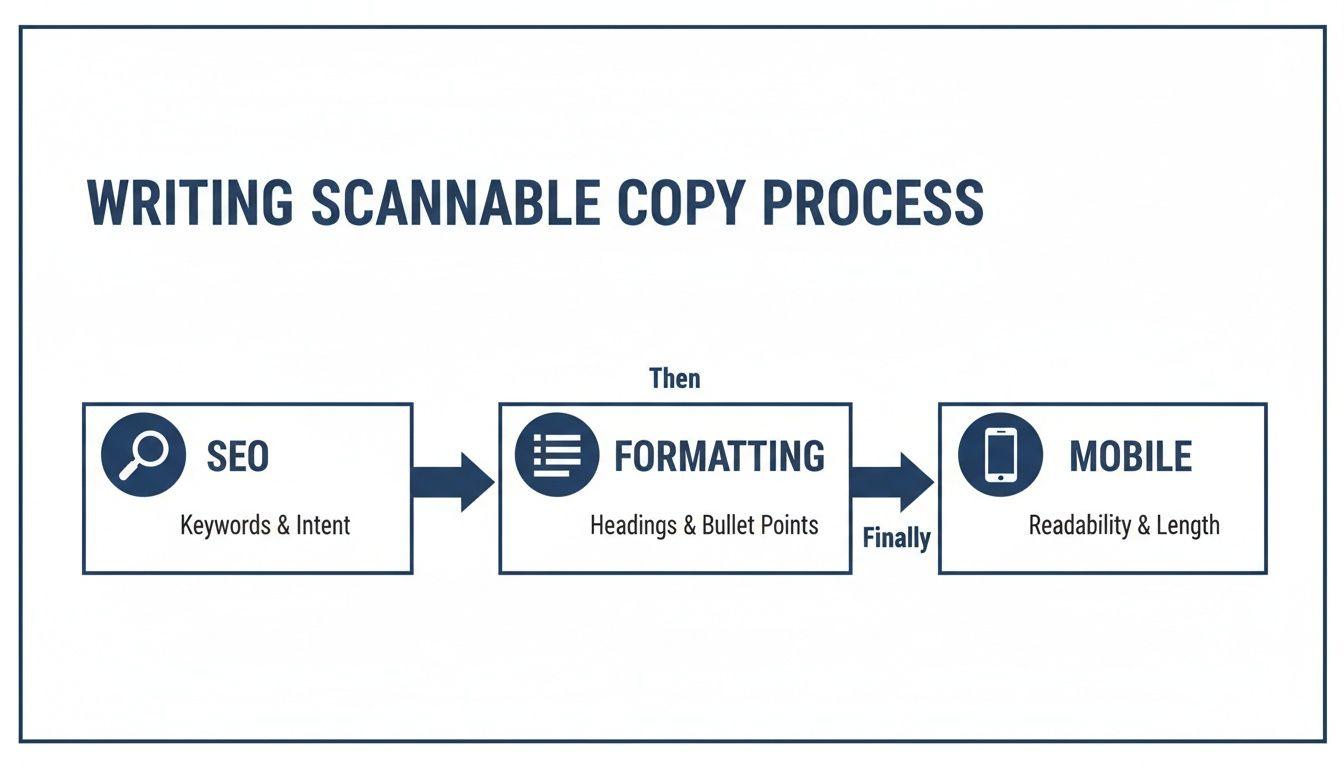
As you can see, things like SEO, clear formatting, and mobile-friendliness aren't separate tasks. They're all interconnected parts of creating a description that actually works.
The Human Touch Is Non-Negotiable
Once the AI has done the heavy lifting, your role shifts to that of a skilled editor. This final step is absolutely crucial. It's where you turn good AI-generated text into a great, authentic product description that truly sounds like your brand.
Always, always review the output. Check it for accuracy, make sure the tone is right, and inject that special spark of human connection that only you can provide. AI can get you 90% of the way there, but it’s your expertise and brand knowledge that add the final, persuasive polish. For more on this, check out our post about using our AI paragraph writer to refine AI-generated content.
Answering Your Toughest Product Description Questions
Even when you have a plan, writing product descriptions can feel like you're constantly making tiny, crucial decisions. Questions always pop up, and it's easy to get stuck. Let's tackle some of the most common hurdles I see writers face and give you some quick, practical answers to get you moving again.
How Long Should a Product Description Be?
There’s no magic number here. The best length really depends on your product's complexity and how much it costs. Your goal should always be to give a shopper just enough information to feel confident in their purchase without completely overwhelming them.
For a simple, low-cost item—like a fun coffee mug—a short and sweet description of 50-100 words usually does the trick. Think a catchy sentence or two, followed by three or four bullet points that zero in on the benefits. You don't need to write a novel; just be clear and compelling.
Now, if you're selling a high-ticket or technical product, like a professional drone or a piece of sophisticated software, you're going to need more room to work. A more detailed description of 300+ words might be necessary. People are doing serious research for these kinds of purchases, and your copy needs to answer all their questions, build trust, and handle any potential objections.
A great way to handle this is with a layered approach. Start with a powerful, easy-to-scan summary at the top (think headline, hook, and bullets) for the people who just skim. Then, for the shoppers who need to know every last detail, add more in-depth paragraphs below.
What Are the Biggest Mistakes to Avoid?
I see the same mistakes trip people up time and time again. The good news is that avoiding these common pitfalls will instantly make your copy stand out from the crowd. Once you know what to look for, they're surprisingly easy to sidestep.
Here are the top offenders that can kill your sales:
- Listing Features, Not Benefits: This is the cardinal sin of product copy. Don't just say a backpack has a “20L capacity.” Instead, say it “comfortably fits your laptop, gym clothes, and lunch.” You have to connect the feature to how it makes the customer's life better.
- Using Vague Language: Phrases like “excellent quality” or “innovative design” are just empty filler. They mean nothing without proof. Instead of telling people it’s high-quality, show them by describing the durable materials or the meticulous stitching.
- Forgetting About SEO: What’s the point of writing a brilliant description if no one ever finds it? If you're not including the keywords your customers are actually typing into search engines, you're basically invisible.
- Building a "Wall of Text": Nobody wants to read a huge, dense block of text, especially on a phone. Use short paragraphs, bullet points, and bold text to break things up and make your copy easy to scan.
- Writing for Everybody: When you try to appeal to everyone, you end up resonating with no one. A description written in the language of your ideal customer, speaking directly to their specific needs, will always be more effective.
How Can I Make My Descriptions Sound More Authentic?
Authenticity isn’t some marketing trick; it comes from having real empathy for your customer and communicating clearly. It's about sounding like a helpful person, not a faceless company.
A great way to do this is to tell a mini-story. Instead of just listing what a product does, frame it around the problem it solves. Talk about the "before" state of frustration and the "after" state of relief the customer will feel. This simple narrative makes your product feel much more relatable.
Next, lean on sensory words. Words like smooth, crisp, velvety, or rich help the reader imagine what it's like to actually hold or use the product. You should also weave in direct quotes from customer reviews. That kind of social proof is one of the most powerful ways to build trust and credibility.
Finally, just be yourself. Write in a natural, conversational tone that reflects your brand’s personality. If you're a fun, playful brand, let that shine. If you're more serious and technical, that's fine too. A confident, helpful tone builds far more trust than a pushy, over-hyped one.
Should I Let AI Write My Descriptions Entirely?
Think of an AI tool like 1chat as your co-pilot, not the pilot. It’s an incredible assistant for getting things done faster and sparking new ideas, but it can't replace your unique understanding of your brand and customers.
Use AI for the heavy lifting. It's fantastic for blasting through writer's block, generating a dozen different angles in seconds, or brainstorming a completely fresh pitch for an old product. But the final edit? That has to be human. You're the one who can make sure the tone is spot-on, the technical details are correct, and the copy has that unique spark that only you can provide.
The winning formula is simple: AI for speed, human for soul.