Welcome to your definitive guide on mastering the art of learning in higher education.Welcome to your definitive guide on mastering the art of learning in higher education. The transition to college-level academics is a significant one, demanding more than just late nights spent passively rereading textbooks. True academic success requires a strategic toolkit of proven methods designed to maximize comprehension and long-term retention. It’s about replacing inefficient habits with powerful, evidence-backed strategies that help you learn more effectively in less time.
This article moves beyond generic advice like "study more" to provide a comprehensive roundup of 10 of the most effective study techniques for college students. We'll deconstruct each method, exploring the cognitive science that makes it work and providing clear, step-by-step implementation guides. You won't just learn what to do; you'll understand why it's effective and how to integrate it into your daily routine.
Inside, you'll find practical applications, sample schedules, and specific use-cases tailored for various academic disciplines, from STEM to the humanities. We'll cover everything from the structured focus of the Pomodoro Technique to the deep conceptual understanding fostered by the Feynman Technique. Whether you're a freshman building foundational habits or a senior aiming to optimize your performance for final exams and beyond, these strategies are engineered to help you reduce stress, deepen your knowledge, and unlock your full academic potential. This is your blueprint for studying smarter, not just harder.
1. The Pomodoro Technique
The Pomodoro Technique is a powerful time management method designed to break down overwhelming tasks into manageable, focused intervals. Developed by Francesco Cirillo in the 1980s, this approach uses a timer to structure work into 25-minute sprints, known as "pomodoros," separated by short breaks. This cycle is one of the most effective study techniques for college students because it combats mental fatigue, minimizes distractions, and enhances concentration.
The core idea is to foster intense focus for a short period, followed by a brief recovery. This prevents the burnout often associated with long, unstructured study sessions, making it easier to start and maintain momentum on challenging assignments.

How It Works: A Step-by-Step Guide
Implementing the Pomodoro Technique is straightforward. Following this simple structure can dramatically improve your productivity.
- Choose a Single Task: Decide what you will work on (e.g., outlining an essay, solving a problem set).
- Set Your Timer for 25 Minutes: Start the timer and commit to working only on that task until it rings.
- Work with Uninterrupted Focus: Ignore all distractions. If a thought pops into your head, jot it down and return to your task.
- Take a Short Break (5 minutes): When the timer goes off, mark one pomodoro as complete and step away from your work. Stretch, get water, or look out a window.
- Repeat and Take a Longer Break: After completing four pomodoros, take a longer break of 15-30 minutes. This extended rest helps you recharge before the next round.
Practical Applications and Tips
This technique is incredibly versatile. A political science major might use a pomodoro to research a specific policy with an AI tool like 1chat, while a computer science student could dedicate a sprint to debugging a piece of code.
- Use a Dedicated Timer: Apps like Forest or a physical kitchen timer create a tangible commitment.
- Pair with AI Tools: Dedicate a pomodoro to drafting an essay outline with an AI writing assistant, then use the next one for focused writing.
- Visualize Progress: Keep a tally of your completed pomodoros to see how much focused work you've accomplished.
By breaking work into smaller pieces, this method makes even the most daunting projects approachable. For more strategies on maximizing your study time, explore these essential time management tips for students.
2. Active Recall and Spaced Repetition
Active Recall and Spaced Repetition are a scientifically-backed duo that transforms how you learn and retain information. Instead of passively rereading notes, active recall forces your brain to retrieve information from memory, while spaced repetition dictates when you should review that material. This combination is one of the most powerful study techniques for college students because it directly combats the "forgetting curve," moving knowledge from short-term to long-term memory with incredible efficiency.
The core principle is that struggling to remember information strengthens the neural pathways associated with it. When you review that information at increasing intervals over time, you signal to your brain that it is important, making it much easier to recall during an exam.
How It Works: A Step-by-Step Guide
Combining these two methods creates a highly effective study loop. Here’s how to put it into practice.
- Create Your Study Materials: Develop flashcards, summaries, or practice questions for a specific topic. This is the "encoding" phase.
- Practice Active Recall: Put away your notes and try to answer your questions or define your terms from memory. Speaking the answers aloud can be particularly effective.
- Check and Correct: Review your answers against the source material. Pay close attention to what you got wrong or couldn't remember.
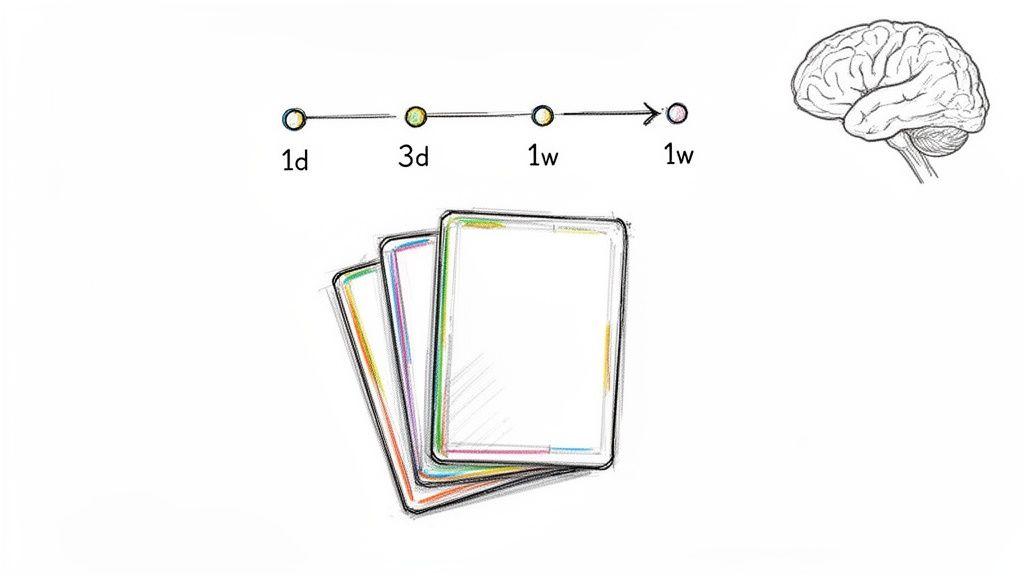
- Schedule Reviews Using Spaced Repetition: Review the material again at strategic intervals. A common schedule is 1 day, 3 days, 1 week, and then 2 weeks later.
- Adjust Based on Difficulty: If you easily recall a concept, extend the time until the next review. If you struggle, shorten the interval.
Practical Applications and Tips
This method is adaptable to nearly any subject. An organic chemistry student might use the Anki app to create spaced repetition decks for reaction mechanisms, while a history major could self-test on essay concepts throughout the semester.
- Use Digital Tools: Apps like Anki and Quizlet have built-in spaced repetition algorithms that automate your review schedule.
- Generate Practice Questions: Use an AI tool like 1chat to generate a list of practice questions on a chapter you've just read. Test yourself on them a few days later.
- Start Early: This technique thrives on time. Begin practicing recall at the start of a semester, not just cramming before finals.
By actively retrieving information over time, you build a deeper and more durable understanding of the material. To dive deeper into similar methods, check out these active learning strategies for students.
3. The Cornell Note-Taking System
The Cornell Note-Taking System is a highly structured method for organizing lecture notes to maximize learning and retention. Developed by Cornell University professor Walter Pauk in the 1950s, this system divides a single page into distinct sections for notes, cues, and a summary. It is one of the most enduring study techniques for college students because it transforms passive note-taking into an active learning process, making review and self-testing seamless.
This method encourages you to process and synthesize information rather than just transcribing it. By creating a built-in study guide as you take notes, you save time later and engage more deeply with the material from the start.

How It Works: A Step-by-Step Guide
Setting up your page for the Cornell system is simple and lays the foundation for effective studying.
- Divide Your Page: Draw a horizontal line about two inches from the bottom of the page. Then, draw a vertical line about 2.5 inches from the left edge, creating three sections.
- Take Notes (Right Column): During the lecture, take notes in the main, wider right-hand column. Focus on capturing key ideas, concepts, and examples.
- Formulate Cues (Left Column): Shortly after the lecture, review your notes and create questions or keywords in the narrow left-hand column that correspond to the information on the right. This step is crucial for active recall.
- Write a Summary (Bottom Section): Within 24 hours, write a one or two-sentence summary of the page's content in the bottom section. This forces you to synthesize the main points.
- Review and Recite: To study, cover the right column and try to answer the questions or define the terms in the cues column. This self-quizzing method is a powerful way to reinforce memory.
Practical Applications and Tips
The Cornell system is adaptable for any subject, from history lectures to biology seminars. A sociology student can use the cues column for key theorists and concepts, while an engineering student can use it for formulas and problem types.
- Prioritize During Lectures: Focus only on the main notes column while in class. The cues and summary sections are for post-lecture processing.
- Leverage AI for Cues: If you struggle to formulate questions, paste your notes into an AI tool like 1chat and ask it to generate potential study questions for your cues column.
- Use Digital Tools: Apps like OneNote, Notion, and Evernote have templates or can be easily formatted to replicate the Cornell system for digital note-taking.
- Collaborate with Peers: Share Cornell-formatted notes with a study group on a platform like Teams to create a comprehensive, collaborative study guide.
4. Feynman Technique (Learning by Teaching)
The Feynman Technique is a powerful mental model for learning that transforms passive review into active understanding. Developed by Nobel Prize-winning physicist Richard Feynman, the method is based on a simple premise: to truly understand a concept, you must be able to explain it in simple terms. This process is one of the most robust study techniques for college students because it quickly exposes gaps in your knowledge and forces you to rebuild concepts from the ground up.
At its core, this technique challenges you to move beyond mere memorization. By articulating complex ideas as if teaching them to someone else, you are forced to simplify, connect, and clarify information, leading to deeper, more durable learning.
How It Works: A Step-by-Step Guide
Implementing the Feynman Technique involves a clear, four-step process that dismantles complexity and builds true comprehension.
- Choose a Concept: Start with a specific topic you are studying, like "cellular respiration" or "Keynesian economics," and write it at the top of a blank page.
- Teach It to a Novice: Explain the concept in your own words, using simple language. Pretend you are teaching it to a high school student or someone with no prior knowledge.
- Identify Your Knowledge Gaps: As you explain, you will inevitably stumble or use vague language. These are your knowledge gaps. Circle them and return to your source material to fill them in.
- Review and Simplify: Once you have filled the gaps, refine your explanation. Read it aloud, and if any part sounds confusing or relies on jargon, simplify it further until it is crystal clear.
Practical Applications and Tips
This technique is highly adaptable across all disciplines. A biology major can use it to teach the process of mitosis to a study partner, while a history student could write a summary of a historical event for a younger sibling.
- Record Yourself: Use your phone to record your explanation and listen back. You will quickly hear where your understanding is weak.
- Use AI to Test Your Knowledge: Explain a concept to an AI tool like 1chat and ask it to pose follow-up questions as a novice would. This simulates a real teaching scenario.
- Create Simple Analogies: Challenge yourself to create analogies or metaphors for complex ideas. This forces simplification and deepens your understanding.
By forcing you to deconstruct and reconstruct knowledge, the Feynman Technique ensures you are not just memorizing facts but truly grasping the underlying principles.
5. Mind Mapping
Mind Mapping is a visual thinking tool used to capture, organize, and structure information. Popularized by Tony Buzan, this technique involves creating a diagram that starts with a single, central concept and branches out into related ideas and subtopics. This non-linear approach mirrors how the brain naturally makes connections, making it one of the most intuitive study techniques for college students for brainstorming, outlining complex subjects, and improving memory retention.
By visually organizing information, mind mapping transforms dense, linear notes into a more digestible format. This method leverages spatial organization, color, and imagery to engage different parts of the brain, leading to a deeper and more lasting understanding of the material.
How It Works: A Step-by-Step Guide
Creating a mind map is a creative and flexible process. Follow these fundamental steps to build a powerful visual study aid.
- Start with a Central Idea: Write your main topic (e.g., "The French Revolution") in the center of a blank page and circle it.
- Create Main Branches: Draw thick branches extending from the central idea for each major subtopic (e.g., "Causes," "Key Figures," "Major Events," "Outcomes").
- Add Sub-Branches: From your main branches, draw thinner sub-branches for specific details, facts, or concepts. For example, under "Key Figures," you could have branches for "Robespierre" and "Louis XVI."
- Use Keywords and Images: Write single keywords or short phrases on each branch. Incorporate symbols, colors, and simple drawings to make the map more memorable.
- Expand and Connect: Continue adding branches as you think of new ideas. Draw lines or arrows to show connections between different parts of the map.
Practical Applications and Tips
Mind mapping is adaptable to almost any subject. A literature student can map out character relationships and thematic developments in a novel, while a biology major can visualize the interconnected processes of cellular respiration.
- Use Digital or Physical Tools: Digital tools like MindMeister or Coggle are great for collaboration, while colored pens and paper can enhance hands-on learning.
- Generate Ideas with AI: If you get stuck, use an AI tool like 1chat to help you brainstorm potential branches or expand on existing subtopics for your mind map.
- Keep It Simple: Use one word per branch whenever possible to encourage concise thinking and easy recall.
- Plan Essays and Projects: Use a mind map to structure your essay outline, with the thesis as the central idea and each main argument as a primary branch.
6. Interleaving Study
Interleaving is a sophisticated learning strategy where you mix, or interleave, multiple related subjects or topics during a single study session. Instead of studying one topic to completion before moving to the next (known as "blocked practice"), interleaving involves switching between them. This approach is one of the more counterintuitive study techniques for college students, as it can feel more difficult in the moment but leads to more robust, long-term learning.
The core principle is that by forcing your brain to constantly switch gears, you strengthen your ability to differentiate between concepts and choose the correct solution strategy from memory. This process improves problem-solving skills and the transfer of knowledge to new contexts, preventing the "cram and forget" cycle.
How It Works: A Step-by-Step Guide
Implementing interleaving requires a shift away from traditional, single-topic study blocks. Here’s how to structure your sessions for maximum effect.
- Identify Related Topics: Select two to four related but distinct topics or problem types you need to study (e.g., different chemical bond types, various poetic meters, or multiple statistical tests).
- Plan Your Mixed Session: Instead of dedicating an hour to Topic A, then an hour to Topic B, break it up. Spend 20-25 minutes on Topic A, then switch to Topic B for the same duration, and then to Topic C.
- Shuffle Your Practice Problems: Create problem sets that are intentionally jumbled. Mix questions from different chapters or concepts together rather than completing them in order.
- Circle Back: After cycling through your chosen topics once, return to the first one. This reinforces the initial learning and challenges your brain to retrieve information it hasn't just seen.
- Embrace the Challenge: Interleaved practice will feel harder than blocked practice, and your performance might dip during the session itself. This is a sign that effective, deeper learning is occurring.
Practical Applications and Tips
Interleaving is highly effective in subjects that involve problem-solving and concept discrimination, like math, science, and economics, but it can be adapted for any field. A history major could alternate between studying the causes of the French Revolution and the American Revolution, forcing their brain to compare and contrast the events.
- Mix Problem Types: When studying for a calculus exam, mix problems on derivatives, integrals, and limits into one practice set.
- Use AI for Variety: Ask an AI tool like 1chat to "create a 10-question practice quiz that mixes concepts from chapters 3, 5, and 7 of my biology textbook."
- Alternate Skills: A foreign language student could alternate between vocabulary drills, grammar exercises, and translation practice in a single session.
By challenging your brain to make connections and distinctions, interleaving builds a more flexible and durable understanding of the material.
7. Elaboration and Deep Processing
Elaboration and Deep Processing is a cognitive technique that moves beyond simple memorization to create lasting, meaningful connections with new material. Instead of just reading or repeating facts, this method requires you to actively question, analyze, and link new information to your existing knowledge base. This approach is one of the most powerful study techniques for college students because it builds a rich, interconnected web of understanding, making information easier to recall and apply.
The core principle, based on the Levels of Processing theory, is that memory recall is a function of how deeply information is processed. By asking "why" and "how" questions and connecting concepts to personal experiences or other subjects, you create stronger neural pathways than you would through shallow, rote memorization.
How It Works: A Step-by-Step Guide
Engaging in deep processing transforms passive learning into an active, intellectual exercise. Here is a simple framework to apply it to your studies.
- Read and Inquire: After reading a chapter or section, stop and ask probing questions. Don't just ask "what," but "why is this important?" and "how does this relate to what I already know?"
- Connect to Existing Knowledge: Actively search for links between the new concept and things you have already learned, whether in the same class, a different subject, or from your own life.
- Explain It in Your Own Words: A true test of understanding is being able to teach the concept. Try explaining it aloud to a friend, or write a summary as if you were teaching it to someone completely new to the topic.
- Explore Real-World Applications: Consider how the theory or concept applies to current events, a real-world problem, or your future career. This step solidifies the material's relevance.
Practical Applications and Tips
This technique can be adapted for any major. A history student can use it to explore the long-term consequences of a treaty instead of just memorizing its date, while a nursing student can connect a new drug's mechanism of action to physiological processes they've already mastered.
- Use the "Why" Method: For every new fact you learn, ask yourself "why" at least three times to drill down to its core significance.
- Create Concept Maps: Visually map out how new ideas connect to a central topic and to each other.
- Leverage AI for Deeper Questions: Use an AI tool like 1chat to ask, "What are the real-world implications of this theory?" or "Explain the connection between X and Y."
- Form Study Groups: Discussing and debating concepts with peers naturally forces you to elaborate on your understanding and consider different perspectives.
By actively engaging with your study materials, you transform them from a list of isolated facts into a cohesive and durable body of knowledge.
8. Retrieval Practice and Practice Testing
Retrieval Practice is a powerful learning strategy that shifts the focus from passively reviewing material to actively recalling it from memory. Instead of rereading notes or textbooks, this method involves frequent, low-stakes quizzing and testing. Research by cognitive scientists like Henry Roediger III has shown that the act of retrieving information strengthens neural pathways, making memories more durable and easier to access in the future.
This approach is one of the most effective study techniques for college students because it directly mimics the mental process required during an actual exam. It moves beyond simple recognition of concepts to a deeper level of understanding and long-term retention, combating the common problem of forgetting information shortly after a test.
How It Works: A Step-by-Step Guide
Integrating retrieval practice into your study routine involves turning your learning materials into active recall opportunities.
- Consolidate Your Notes: After a lecture or reading session, summarize the key concepts in your own words.
- Create Practice Questions: Turn these key concepts into questions. You can create flashcards, write out short-answer prompts, or formulate multiple-choice questions.
- Test Yourself Regularly: Set aside time each week to answer these questions without looking at your notes.
- Check Your Answers and Identify Gaps: After quizzing yourself, immediately review your answers. Pay close attention to what you got wrong, as this highlights areas needing more focus.
- Repeat and Space It Out: Revisit the material over increasing intervals (e.g., one day later, then three days, then a week). This spaced repetition enhances long-term memory.
Practical Applications and Tips
This technique is adaptable for any subject. A biology student can use flashcards to recall the stages of mitosis, while a history major can write out short summaries of key historical events from memory.
- Generate Practice Tests with AI: Use an AI tool like 1chat to instantly create practice quizzes based on your lecture notes or textbook chapters.
- Simulate Exam Conditions: Take practice tests under a time limit and without access to your notes to prepare for the pressure of the real exam.
- Focus on Understanding: When you review incorrect answers, don't just memorize the right one. Take time to understand why it is correct.
- Mix It Up: Create cumulative quizzes that include material from previous weeks to reinforce older concepts alongside new ones.
By consistently pulling information out of your brain, you train it to perform when it counts, making this a cornerstone of effective studying.
9. The SQ3R Method (Survey, Question, Read, Recite, Review)
The SQ3R Method is a comprehensive reading system that transforms passive skimming into active, engaged learning. Developed by Francis P. Robinson in the 1940s, it breaks down the reading process into five distinct stages: Survey, Question, Read, Recite, and Review. This structured approach is one of the most enduring study techniques for college students because it systematically improves reading comprehension and long-term retention of complex material.
Instead of simply reading a textbook from start to finish, SQ3R forces you to interact with the content, build a mental framework for the information, and continuously check your understanding. This active engagement makes it easier to process and recall information from dense academic texts.
How It Works: A Step-by-Step Guide
Implementing the SQ3R method requires a deliberate, step-by-step approach that ensures you are actively processing the material, not just passively consuming it.
- Survey: Before reading, quickly skim the chapter. Look at headings, subheadings, bolded terms, images, and the summary. This takes about 5-10 minutes and gives you a mental map of the content.
- Question: Turn each heading and subheading into a question. For example, a heading like "The Process of Photosynthesis" becomes "What is the process of photosynthesis?" This primes your brain to look for specific answers.
- Read: Actively read the section with the goal of answering the questions you just formulated. Pay close attention to information that directly addresses your queries.
- Recite: After reading a section, look away from the book and try to answer your question from memory, in your own words. You can say it aloud or write it down. This step is crucial for moving information from short-term to long-term memory.
- Review: Once you've finished the entire chapter, go back over your notes and questions. Reread your recited answers to solidify your understanding and see how all the concepts connect.
Practical Applications and Tips
This method is particularly effective for STEM or social science courses with dense, information-heavy textbooks. A biology student could use it to master a chapter on cellular respiration, while a history major could apply it to deconstruct a complex historical analysis.
- Use AI for Deeper Questions: During the "Question" phase, use an AI tool like 1chat to generate more insightful questions based on the chapter headings.
- Combine with Note-Taking: Integrate the "Recite" phase with the Cornell Note-Taking System by writing your recited answers in the main notes section.
- Break It Down: Don't try to apply SQ3R to an entire textbook at once. Work through one chapter, or even just one major section, at a time.
By turning reading into an active investigation, SQ3R ensures you are not just seeing the words but truly understanding them. To further enhance your ability to absorb written material, explore these proven strategies on how to improve reading comprehension skills.
10. Collaborative Learning and Study Groups
Collaborative learning is a social study method where students work together to discuss concepts, solve complex problems, and teach one another. By forming study groups, you can leverage peer knowledge to gain new perspectives and reinforce your own understanding. This is one of the most dynamic study techniques for college students because it transforms passive learning into an active, engaging dialogue that boosts retention and accountability.
The core principle is that explaining a concept to someone else is one of the best ways to master it yourself. This approach addresses gaps in your knowledge, provides emotional support, and keeps you motivated, especially when tackling difficult course material.
How It Works: A Step-by-Step Guide
Forming an effective study group requires structure and commitment. Follow these steps to create a collaborative learning environment that yields results.
- Form a Small, Dedicated Group: Aim for 3-5 members to ensure everyone can participate actively. Choose classmates who are serious about their studies.
- Schedule Regular Meetings: Consistency is key. Set a recurring time each week, whether in person at the library or virtually via Zoom.
- Create a Clear Agenda: Before each session, decide on specific topics or chapters to cover. This keeps the group focused and productive.
- Engage in Active Discussion: Don't just review notes. Quiz each other, work through problems on a whiteboard, and debate different interpretations of the material.
- Assign Roles and Rotate: To ensure equal participation, rotate roles like "discussion leader," "note-taker," or "quiz master" for each meeting.
Practical Applications and Tips
Study groups are adaptable to nearly any subject. An engineering group could collaborate on solving a challenging problem set, while a history group could create a shared timeline of key events and debate their significance.
- Establish Ground Rules: Agree on basic rules from the start, such as arriving on time, staying off phones, and contributing equally.
- Use Shared Documents: Create a shared Google Doc or Notion page to compile group notes, key definitions, and practice questions.
- Incorporate AI Tools: Use a tool like 1chat to generate discussion questions or explain a complex theory that the group is stuck on, facilitating deeper conversation.
By working together, you not only improve your academic performance but also develop valuable teamwork and communication skills essential for your future career.
10 Study Techniques Comparison
| Method | 🔄 Complexity | ⚡ Resources & Speed | 📊 Expected outcomes | ⭐ Key advantages | 💡 Ideal use cases |
| The Pomodoro Technique | Low — simple timer cycles | Minimal tools (timer/app); fast short bursts | Steady productivity; reduced procrastination | ⭐⭐⭐ — Easy to adopt, measurable focus | Short study sprints, drafting, focused research |
| Active Recall & Spaced Repetition | Medium — requires scheduling and card design | Moderate (Anki/Quizlet); slower setup, high long-term efficiency | Excellent long-term retention; less total study time | ⭐⭐⭐⭐⭐ — Evidence-based, durable memory gains | Vocabulary, facts, cumulative exam prep |
| Cornell Note-Taking System | Medium — practice to master layout | Minimal (paper/digital); moderate during lectures | Organized notes ready for review and testing | ⭐⭐⭐ — Structured notes, built-in cues for recall | Lectures, note review, study material creation |
| Feynman Technique (Learning by Teaching) | Medium–High — iterative self-testing | Minimal tools (peer/AI/recording); time-consuming | Deep conceptual understanding; gap detection | ⭐⭐⭐⭐ — Reveals true comprehension, transferable understanding | Complex concepts, presentations, exam prep |
| Mind Mapping | Low–Medium — simple to start, can get complex | Low (paper/digital); visual but time-consuming for large topics | Better idea organization and creative connections | ⭐⭐⭐ — Visual planning, aids memory and creativity | Essay planning, brainstorming, project outlines |
| Interleaving Study | Medium — needs deliberate planning | Minimal tools; cognitively demanding, feels slower | Improved transfer and discrimination between concepts | ⭐⭐⭐⭐ — Enhances application and problem selection | Mixed-problem practice, math/skill integration |
| Elaboration & Deep Processing | Medium–High — requires active reflection | Low tools; time-intensive cognitive work | Stronger meaningful memory and transfer | ⭐⭐⭐⭐ — Deep understanding, critical thinking gains | Essays, conceptual courses, applied learning |
| Retrieval Practice & Practice Testing | Medium — needs quality question design | Moderate (AI/tools); efficient in retention gains | Superior long-term retention; clear gap ID | ⭐⭐⭐⭐⭐ — Highly effective for memory and feedback | Weekly quizzes, pre-exam simulations, cumulative review |
| SQ3R Method | Medium–High — multi-step discipline required | Low tools; time-consuming but systematic | Better textbook comprehension and structured notes | ⭐⭐⭐ — Systematic reading, combines retrieval & review | Dense textbook chapters, structured reading assignments |
| Collaborative Learning & Study Groups | Medium — coordination and structure required | Moderate (scheduling, shared tools); variable speed | Improved understanding, motivation, diverse perspectives | ⭐⭐⭐⭐ — Peer explanation, accountability, varied strategies | Group problem-solving, peer teaching, projects |
Building Your Personalized Study System
You've just navigated a comprehensive toolkit of ten powerful, evidence-backed study techniques for college students. From the focused sprints of the Pomodoro Technique to the deep conceptual understanding fostered by the Feynman Technique, each method offers a unique pathway to more effective and efficient learning. The journey, however, doesn't end with reading this list. The real transformation begins now, as you move from simply knowing these strategies to actively implementing them.
The goal isn't to become a master of all ten techniques overnight. That approach would be overwhelming and counterproductive. Instead, the most crucial takeaway is the principle of intentional experimentation. Your academic workload, personal learning preferences, and even your energy levels on a given day will dictate which tool is right for the job. The true art of studying lies in building a flexible, personalized system that works for you.
Your Action Plan: From Theory to Practice
Think of yourself as a scientist and your study habits as the experiment. The objective is to discover the optimal combination of strategies that maximizes your comprehension and minimizes your stress. Here’s a simple, actionable framework to get you started:
- Select Your Starting Pair: Don't try to juggle everything at once. Choose just two techniques that seem most applicable to your immediate needs. A great starting combination is pairing a time management method with a content-focused one. For example:
- Pomodoro Technique + Active Recall: Use focused 25-minute blocks to create and drill flashcards. This is perfect for foundational courses heavy on terminology, like Biology or a foreign language.
- Cornell Notes + Feynman Technique: During a lecture, take notes using the Cornell method. Later that day, use the "cue" column to explain the concepts out loud as if teaching them to someone else. This is ideal for complex, conceptual subjects like Philosophy or Economics.
- Schedule a Two-Week Trial: Commit to using your chosen pair consistently for the next two weeks. Integrate them into your calendar. Instead of just blocking out "Study for Psych," schedule "Pomodoros: Psych Ch. 4 Flashcards" or "Mind Map: History Essay Outline." This specificity creates a clear intention and makes it easier to follow through.
- Track and Reflect: At the end of each study session, take two minutes to reflect. Ask yourself simple questions:
- Did I feel focused and engaged?
- Do I feel more confident about this material than I did before?
- What was the biggest challenge in using this technique?
- How could I adjust it to work better next time?
This simple feedback loop is the engine of improvement. It allows you to pivot, adjust, or even discard a technique that isn't serving you, rather than blindly forcing a method that doesn't fit.
The Bigger Picture: Why This Matters
Mastering these study techniques for college students is about more than just getting better grades. It’s about fundamentally changing your relationship with learning. When you have a reliable system, you replace anxiety with confidence, procrastination with productivity, and passive reading with active engagement. You start working smarter, not just harder, freeing up valuable time for other aspects of college life- clubs, friendships, and your own well-being.
Key Insight: Effective studying is not an innate talent; it is a learned skill. By deliberately practicing and refining your methods, you are investing in a skill that will serve you long after you've graduated, in any career you pursue.
You are now equipped with the strategies used by the most successful students. The path forward is clear: start small, be consistent, and listen to what works for you. Experiment with combining Mind Mapping and Interleaving for a creative project, or use the SQ3R method for a dense textbook chapter. The power is in your hands to build a system that not only helps you excel academically but also empowers you to become a more effective, confident, and lifelong learner. Begin your experiment today.