Think about trying to unscramble an egg. Once it's cooked, you can't turn it back into a raw, liquid yolk and white. A password hash works on a similar principle: it’s a one-way, irreversible scramble of your password into a unique string of characters.
This scrambled version, the hash, is what gets stored on a server—not your actual password. It's a fundamental security practice that protects your credentials.
What Are Password Hashes
When you sign up for a service and choose a password, the system doesn't just save P@ssword123! in its database. That would be incredibly risky. Instead, it runs your password through a special mathematical function known as a hashing algorithm.
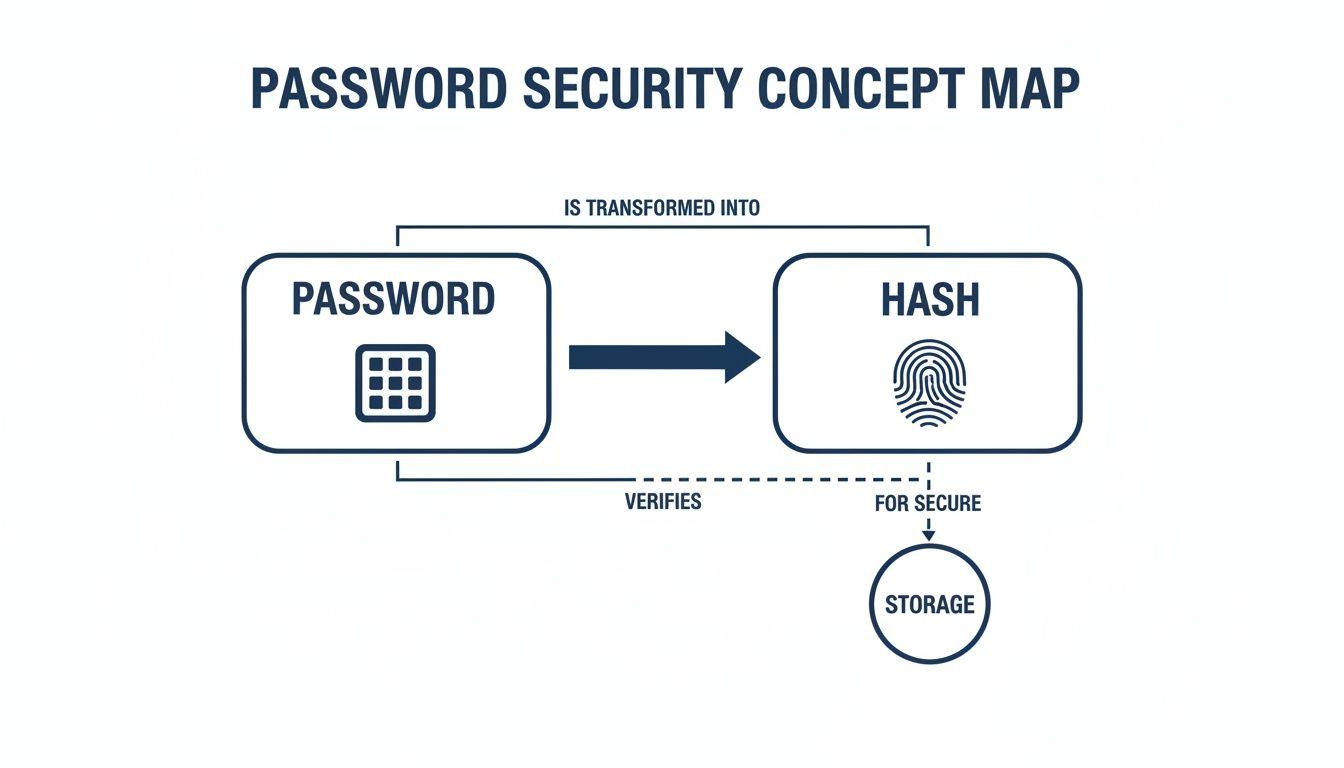
This process transforms your password into a long, fixed-length string of garbled text that looks completely random. That's the hash. When you log in later, the system takes the password you just entered, runs it through the very same algorithm, and compares the result to the hash it has on file. If they match, you're in.
The Security Advantage of Hashing
The magic of this process is that it’s a one-way street. You can easily turn a password into a hash, but you can’t turn the hash back into the original password.
This means that even if attackers breach a company’s database, they won’t walk away with a list of everyone’s passwords. They’ll just have a bunch of useless, scrambled hashes.
Key Takeaway: A password hash is like a digital fingerprint. It lets a system confirm your identity without ever needing to know or store your actual password, keeping your secret safe even if the system is compromised.
This one-way function is a world apart from storing passwords in plain text or even using reversible encryption. A quick comparison really highlights the difference. And as passwords become more complex, knowing how password managers work is a smart way to manage them all without sacrificing security.
Password vs Hash vs Encrypted Data A Quick Comparison
To put it all into perspective, here's a simple breakdown of what your password looks like in different states.
| Data Type | Example Value | Key Characteristic |
| Plain Text | P@ssword123! | Easily readable and completely insecure. |
| Encrypted | U2FsdGVkX1+... | Scrambled but can be reversed with the correct key. |
| Hashed | $2b$12$... | Scrambled and designed to be irreversible. |
As you can see, only a hash provides the one-way protection needed to truly secure a password at rest.
How Password Hashing Works Under the Hood
So, what’s really going on when a system hashes your password? Think of a hashing algorithm as a highly specific mathematical recipe. You give it one ingredient—your password—and it performs a complex series of transformations to produce a fixed-length, scrambled string of characters. That final string is the hash.
This entire process is deterministic, which is just a fancy way of saying it’s predictable. The same password will always produce the exact same hash. That predictability is the secret sauce that allows a system to check if you’ve entered the right password without ever needing to store the password itself. When you log in, the system just hashes what you typed and sees if it matches the hash it has on file.
The Hashing Process Step by Step
Let’s walk through what happens when you create a new account. The whole dance is designed to keep your original password out of the database from the very beginning.
- You Enter Your Password: You type your new password,
MyS3cureP@ssword!, into the sign-up form. - The Algorithm Gets to Work: The moment you hit "submit," the system doesn't save your password. Instead, it feeds it into a modern hashing algorithm like Argon2. This function immediately begins performing thousands of complex calculations.
- A Unique Hash Is Created: After all that work, the algorithm spits out a unique string that looks something like
$argon2id$v=19$m=65536,t=3,p=4.... This is your password's hash. - Only the Hash Is Stored: This hash is the only piece of information that gets saved in the user database. Your original password,
MyS3cureP@ssword!, is never stored and is immediately discarded.
This is a one-way street by design. The system can confirm your password is correct by re-running the process, but there's no way to turn that scrambled hash back into your original password.
The Magic of One-Way Functions
The combination of being both deterministic (predictable) and a one-way function is what makes hashing so powerful for security. Without a predictable output, a system could never reliably check your login. And without the one-way design, a data breach would mean every user's password would be exposed.
A good hashing algorithm creates a one-way dead end for your data. You can put a password in, but you can’t get it back out. This is the core principle that keeps your credentials safe from prying eyes.
This is a fundamental shift from older, now-insecure methods. For years, some systems used algorithms like MD4 (which formed the basis for Windows NTLM hashes) that were built for speed. That speed, however, has become a massive liability. Today’s password-cracking hardware can test billions of guesses per second against these weak hashes, making them trivial to break.
This is exactly why modern security standards demand intentionally slow and resource-intensive algorithms. The goal isn't just to scramble the password; it's to make the scrambling process so difficult and time-consuming that it’s completely impractical for an attacker to even try guessing it.
Hashing vs. Encryption: Understanding the Difference
People often use hashing and encryption interchangeably, but they're fundamentally different tools built for completely different jobs. The easiest way to think about it is this: encryption is a two-way process, and hashing is a one-way street. That single distinction changes everything.
Encryption is like putting a secret message in a locked box. The whole point is to protect the message while it's in transit or sitting in storage, but you fully intend for someone to unlock it and read it later. As long as you have the right key, you can always open the box and get the original, readable message back. This makes it perfect for things like encrypted document sharing or securing data on a hard drive.
Hashing, on the other hand, is a different beast entirely. It’s designed to be a one-way trip, creating a unique digital fingerprint for a piece of data, like a password.
Why Reversible Encryption Fails for Passwords
You can't "un-hash" something to get the original password back. The goal isn't to hide the password for later retrieval; it's to create a verifiable fingerprint that proves you know the original password without ever revealing it.
A hash proves you know the secret without you—or anyone else—ever having to see the secret itself. It’s a tool for verification, not concealment.
This is exactly why you should never, ever store passwords using reversible encryption. It would be a catastrophic security flaw. If an attacker managed to steal your database of encrypted passwords and also found the decryption key (which often has to be stored somewhere nearby), they could instantly unlock every single user's password.
That creates a single point of failure that’s just too tempting for attackers. LinkedIn learned this the hard way back in 2012 when a breach exposed 6.5 million of its user password hashes, which weren't even properly protected with modern techniques.
Hashing as a Protective Dead End
Because password hashes are a one-way dead end, they offer a much more robust defense. When you try to log into an account, the system doesn't need your original password. It simply takes the password you just typed, runs it through the same hashing function, and checks if the new hash matches the one stored in the database. If the two "fingerprints" are a match, you're in.
Now, if an attacker steals a database full of properly hashed passwords, they don't get a master key to everyone's account. All they have is a list of gibberish. Reversing that gibberish back into the original passwords is an incredibly difficult and time-consuming task, especially when you use the right hashing algorithms. This is why hashing isn't just a good idea for password storage—it's the non-negotiable industry standard.
Why Salts and Peppers Are Essential for Security
So, we've hashed our passwords. We're secure, right? Not quite. While hashing is a huge leap forward from storing plain text, there's a major flaw in this simple approach: if two people choose the exact same password, they'll end up with the exact same hash.
That predictability is a goldmine for attackers. It allows them to use pre-computed lists of common password hashes, known as rainbow tables, to find matches almost instantly. This is where two extra ingredients, salts and peppers, turn a good defense into a great one.
What Is a Password Salt?
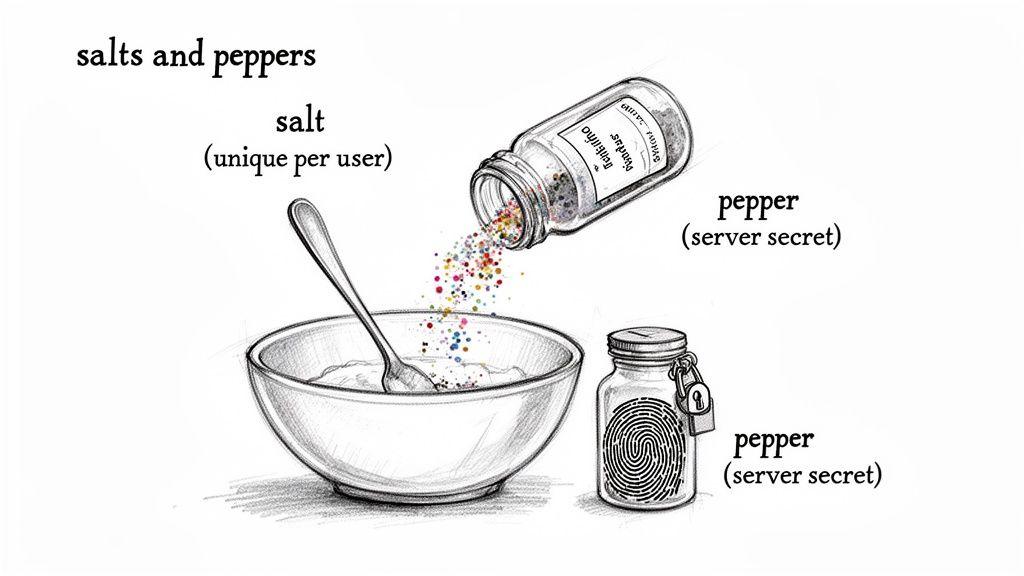
Let's stick with our cooking analogy. A salt is like a unique, random seasoning that’s added to each person's individual password before it gets put through the blender (hashed). This salt is a long string of random characters, and it's different for every single user.
Once created, the salt is stored right next to the user’s final hash in the database.
The result? Even if ten users have the password "P@ssword123!", each one will have a completely different hash stored in the system. This single step renders rainbow tables completely useless.
Because an attacker can no longer just look up a stolen hash in their pre-built list, they are forced back to square one. They have to try and crack every single password, one by one, which is an incredibly slow and expensive process.
What Is a Password Pepper?
If the salt is a unique ingredient for each user, the pepper is like a top-secret "house spice blend" that gets added to every password before hashing. It's a static, secret string of characters that's the same for all users on your application.
The most important thing about the pepper is that it's never stored in the database. It’s kept completely separate, usually in a protected configuration file or a secure environment variable on the server itself.
- Salt: Unique for every user. Stored publicly in the database alongside the hash.
- Pepper: The same for all users. Stored privately and kept far away from the database.
This adds a powerful, final layer of defense. Imagine an attacker successfully breaches your server and steals your entire user database. They have the usernames, the salts, and the final hashes. But without the pepper, they're missing a critical piece of the recipe. They can't replicate the hashing process to check their password guesses, stopping their attack cold.
Using a salt makes password cracking inefficient. Adding a pepper can make it impossible, even after a database theft. Together, they form the backbone of modern, robust password security.
Choosing the Right Hashing Algorithm for Modern Threats
When it comes to hashing passwords, the algorithm you choose makes all the difference. What was considered a strong choice a decade ago is now dangerously obsolete, and the reason comes down to one thing: speed.
Older hashing algorithms like MD5 and SHA-1 were designed for raw efficiency. Back then, the goal was simple—compute a hash as quickly as possible. This was great for file integrity checks, but for passwords, that speed has become a massive security flaw.
The Problem with Speed
As computers have gotten exponentially faster, the speed of these old algorithms works directly against us. An attacker with a modern graphics card (GPU) can cycle through billions of potential passwords per second, checking them against a stolen hash.
One benchmark showed a high-end GPU making 4.18 billion guesses per second against an unsalted hash based on the outdated MD4 algorithm. At that rate, cracking even a complex password is no longer a matter of if, but when.
This isn't just a theoretical threat. The infamous 2012 LinkedIn breach is a perfect real-world example. Attackers got their hands on 6.5 million password hashes, all created using the outdated and unsalted SHA-1 algorithm. They were trivial to crack, putting millions of accounts at risk.
Modern Algorithms Are Intentionally Slow
This is why modern password hashing functions—like bcrypt, scrypt, and the current champion, Argon2—are built completely differently. They are designed to be deliberately slow.
Think of them as a digital speed bump. They're engineered to be resource-intensive, demanding a lot of memory and processing time to create just one hash. This slowness is their greatest strength.
It completely changes the economics of an attack. Instead of blasting through billions of guesses a second, an attacker might only manage a few thousand. An attack that might have taken minutes now stretches into centuries, making it completely impractical.
Better yet, these modern algorithms are adaptive. They have a "work factor" or "cost" parameter you can tune. As computers get faster over the years, you can simply increase the cost to keep the hashing process just as slow and secure. It’s like being able to raise the height of your speed bump whenever cars get faster.
Hashing Algorithm Comparison MD5 vs bcrypt vs Argon2
Let's put these algorithms side-by-side to see just how stark the difference is. The choice you make here has a direct impact on your security posture for years to come.
| Algorithm | Key Feature | Security Level | Recommendation for 2026 |
| MD5 / SHA-1 | Extremely fast | Broken | Never use for passwords. |
| bcrypt | Intentionally slow and adaptive | Strong | A good, well-tested option. |
| Argon2 | Slow, memory-hard, and adaptive | Excellent | The current recommended standard. |
Looking at this, the path forward is pretty clear. Argon2, which won the official Password Hashing Competition back in 2015, is now considered the gold standard. It was specifically designed to be resistant to GPU-based cracking and even custom hardware attacks, giving you the best protection available today.
So, for any new project or system update, the decision is simple. Using an old algorithm like MD5 for passwords is like locking a bank vault with a screen door. For real security that holds up against modern attacks, you need an adaptive, resource-hungry algorithm like Argon2.
How Hashing Defeats Common Password Attacks
So, how does all this hashing stuff actually stop the bad guys? To see why modern hashing is so critical, you have to look at the kinds of attacks it’s designed to shut down. Hackers have a few go-to methods for cracking passwords, and proper hashing foils them at every turn.
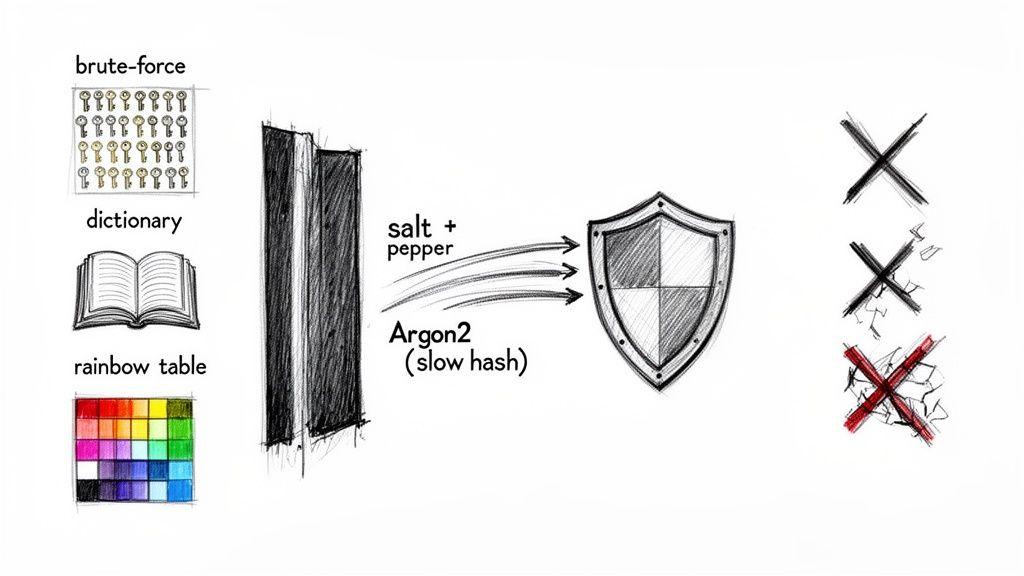
The most straightforward methods are brute-force and dictionary attacks. A brute-force attack is just what it sounds like: a relentless assault trying every possible character combination. A dictionary attack is a bit smarter, using a massive list of common words, phrases, and passwords from previous data breaches.
For an attacker, both of these methods are a race against the clock. Their entire game plan relies on making as many guesses as they can, as fast as they can.
This is exactly where slow, modern algorithms like Argon2 become the MVP. They are deliberately designed to be slow and use up a lot of computing power, acting like a giant speed bump for attackers. An attack that might take a few hours against an old, fast algorithm like MD5 could take centuries against Argon2, making it completely pointless to even try.
Defeating Pre-Computed Hash Attacks
But attackers have more advanced tricks up their sleeves, like rainbow tables. Think of these as massive, pre-made cheat sheets that map millions of common passwords to their already-calculated hashes. If a hacker steals a database of unsalted hashes, they don't have to crack anything—they just look up the stolen hash in their table and instantly find the password.
This is where unique salts save the day. A salt is just a random bit of data added to your password before it gets hashed. Because every user gets their own unique salt, even two people with the exact same password will have completely different hashes stored in the database.
That one simple step makes a hacker's giant rainbow table totally useless. They can no longer just look up a hash. Instead, they're forced back to square one, trying to crack every single password one by one against a slow algorithm. It's a powerful one-two punch:
- Slow Algorithms (like Argon2): Make brute-force guessing so slow and costly that it's no longer a viable option.
- Unique Salts: Make pre-computed rainbow tables obsolete by ensuring every single hash is unique.
Real password security isn't just about using a hash; it’s about using the right hash with the right techniques. For more on creating stronger credentials in the first place, check out our guide on the differences between a passphrase vs a password. By layering these defenses, a system can build a powerful shield that keeps user accounts safe, even if the database itself is compromised.
Frequently Asked Questions About Password Hashing
Even with a good grasp of the basics, a few questions about password hashing tend to pop up all the time. Let's clear the air and tackle some of the most common ones.
Is My Hashed Password Still Safe After a Hack?
For the most part, yes. If a service has done its job right—using a modern, slow algorithm like Argon2 and a unique salt for every user—your original password remains incredibly difficult to uncover. While no system is ever 100% foolproof, proper hashing is the best defense we have.
It turns a simple data grab into a massive, expensive project for an attacker. They can't just look up your password; they have to launch a dedicated cracking effort against your specific hash, which often isn't worth the time or money.
Can Two Different Passwords Create the Same Hash?
This is what's known as a hash collision, and while it's theoretically possible, the odds are so astronomically low with modern algorithms that it’s not a practical concern. For a secure function like SHA-256 or Argon2, you have a better chance of winning the lottery several times in a row.
Key Insight: These algorithms are built specifically to make collisions a mathematical fantasy. It's a theoretical risk, not something that happens in the real world of password security.
Why Do I Still Need a Strong Password if It Gets Hashed?
Because hashing is designed to slow attackers down, not stop them completely. A weak password is still a major liability.
Think about it: attackers don't start from scratch. They use massive lists of the most common and simple passwords, like "123456" or "password." Even with a salt, your weak password will be at the top of their list to try, making it far easier to crack. A long, complex, and unique password makes their job exponentially harder, buying your account—and the service provider—precious time.