At its most basic, a book summary is a short, straightforward overview of a book’s main content. It’s not a review loaded with your personal opinions, but a faithful retelling of the author's work, just in your own words.
Beyond Plot: What Is a Summary of a Book, Really?

When most people hear "book summary," they think of a simple plot recap—a shorter version of the story. And while that's not entirely wrong, a truly great summary goes much deeper. It’s an analytical tool that helps you understand the text on a whole new level.
Think of it this way: you wouldn't mistake a building's blueprint for a photograph of the finished house. The photo shows you the surface, but the blueprint reveals the essential structure—the foundation, the support beams, and the overall design that holds it all together. A well-crafted summary does the same for a book.
An effective summary doesn't just retell the story; it reconstructs the author's core argument. It's about identifying the logical structure of the book, not just its narrative sequence.
This shift in perspective is crucial. Instead of just passively following the plot, you're actively searching for the fundamental pieces the author used to build their world or argument. This process helps you create a mental model of the book's architecture, which is a massive step toward developing stronger reading comprehension strategies. The goal is to move beyond knowing what happened to truly understanding why it all matters.
The Building Blocks of a Summary
A powerful summary doesn't just list events in order. It pulls out the book's most critical elements and organizes them to show how they connect. These are the foundational ideas that give the book its meaning and purpose.
- The Author’s Core Argument: This is the book's foundation. For a non-fiction work, it’s the central thesis the author is trying to prove. For fiction, it’s the primary theme or message woven into the narrative.
- Main Plot Points or Evidence: Think of these as the structural beams. In fiction, they are the essential events that drive the story forward. In non-fiction, they are the key pieces of data or supporting points that uphold the core argument.
- Key Themes and Tone: This is the book's personality. A good summary captures the recurring ideas and the author’s attitude, making sure the condensed version still feels like the original.
Drawing the Line Between Summary and Review
Let's clear up one of the most common mix-ups out there: confusing a book summary with a book review. It’s an easy mistake to make, but they serve completely different functions. Getting this right is the first step to writing a piece that truly hits the mark, whether it's for a class or for your own website.
The best way to think about it is to picture two different professions: a journalist and a critic.
A summary writer is the journalist. Their job is to report the facts of the book—what happens, who's involved, and what the author’s core message is. It’s all about objectivity and accuracy, presented without a trace of personal bias.
A review writer, on the other hand, is the critic. Their entire purpose is to step into the spotlight and share their own judgment. They evaluate the book's quality, discuss its strengths and weaknesses, and ultimately argue whether it's worth the reader's time.
This isn't just a minor point of confusion; it's a major hurdle for many. Educational studies have shown that nearly 70% of students initially blur these lines, treating a summary as a space for their own opinions. In fact, this became such a widespread issue that universities began formally teaching the distinction in their writing programs around the early 2000s. If you're curious, you can see how this is still taught in modern university writing guidelines.
Summary vs Review: What's the Difference?
So, if a summary isn't the place for your hot takes, what is it? Think of it as a clean, concise distillation of the original work. A review is the opposite—it’s a personal, thoughtful evaluation. The core difference boils down to whose voice is front and center. A summary quiets your voice to amplify the author's, while a review is all about making your voice heard.
This table breaks it down even further.
| Element | Book Summary | Book Review |
| Core Purpose | To objectively inform the reader about the book's content. | To subjectively persuade the reader with an assessment. |
| Tone | Neutral, detached, and unbiased. | Opinionated, personal, and evaluative. |
| Key Components | The author's main ideas, plot points, and structure. | Your personal critique, analysis, and recommendations. |
To see this in action, imagine you're writing about a novel.
A summary would state the facts: "The protagonist confronts three moral dilemmas that force him to question his allegiances."
A review would offer an opinion: "The protagonist's moral dilemmas felt forced and did little to advance an already unconvincing character arc."
See the difference? One reports, the other judges. Keeping these roles separate is the key to mastering both forms of writing.
Anatomy of a Powerful Book Summary
Every great summary, whether for a sprawling novel or a dense business book, is built from the same core components. Think of these elements as the blueprint for the book—they outline its fundamental structure, purpose, and message. If you can identify them, you can build a summary that's both accurate and genuinely insightful.
Before we start building, it's crucial to understand what a summary is and what it isn't. A summary is objective reporting. A review is subjective judgment. Getting this distinction right is the foundation of a solid summary.
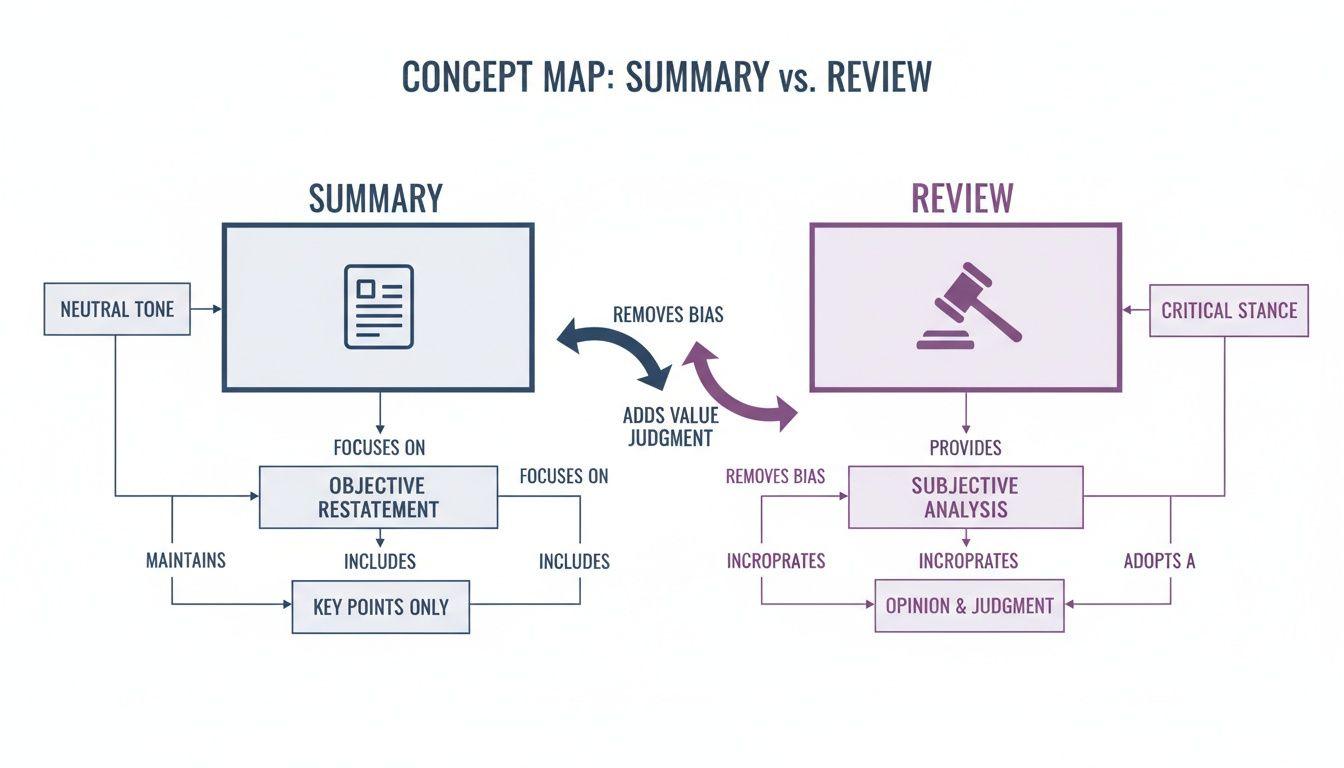
As the map shows, your job is to stick to the facts of the book. Save your opinions for a review.
The Four Pillars of an Effective Summary
Your task is to act like an architect, identifying the four structural pillars holding the entire book up. Once you've found them, you have everything you need to construct a faithful miniature of the original work.
- Main Idea or Thesis: This is the book's North Star—the single, overarching message or argument it’s trying to make. For a nonfiction book like Sapiens, it's the core theory that our cognitive evolution is what let humans dominate the planet. In a novel like 1984, it's the central warning against totalitarianism. Your first job is always to find and state this main point clearly.
- Key Plot Points or Supporting Arguments: These are the beams and columns that support the main idea. In fiction, they are the critical events that drive the plot forward—not every little detour, but the essential turning points that define the story's arc. In nonfiction, these are the primary arguments, case studies, or evidence the author presents to prove their thesis.
- Major Themes: If the plot is what happens, themes are why it matters. These are the recurring concepts that bubble just beneath the surface, giving the work its depth. Think of "love and sacrifice" in A Tale of Two Cities or "innovation vs. tradition" in a modern business book. Highlighting these shows you understand the soul of the book, not just its skeleton.
- Tone and Style: Finally, a truly good summary captures the feel of the original. Was the author's voice academic and serious? Witty and informal? Poetic and reflective? Your summary should echo that tone. It ensures the reader gets a sense of the author's personality, making your summary feel like the original work in miniature.
A Simple 4-Step Process for Writing Your Summary
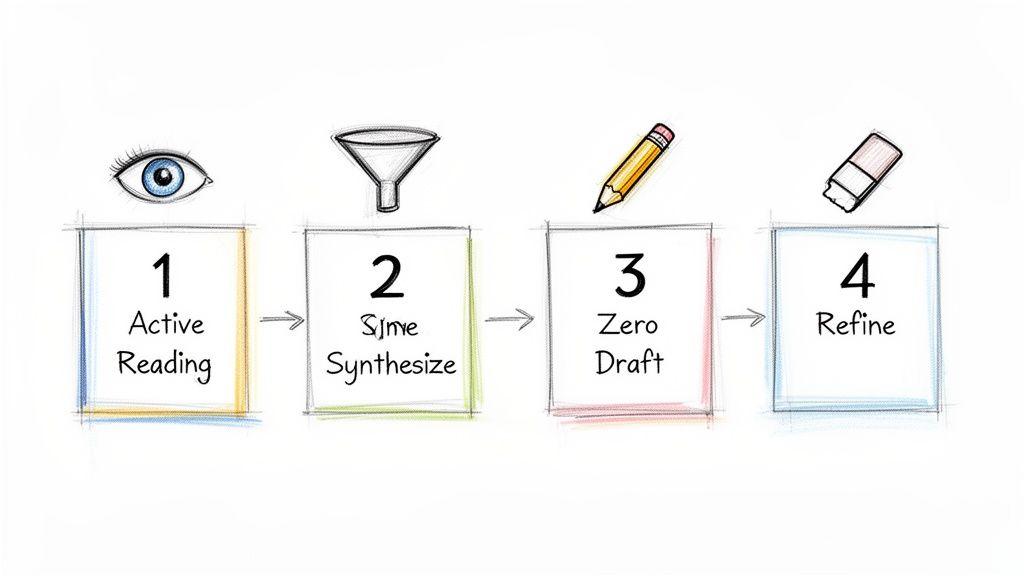
Knowing what goes into a summary is one thing, but actually writing it is another. Let’s walk through a repeatable 4-step process that takes the guesswork out of the equation. Think of this as your reliable roadmap for summarizing any book, whether it's a dense historical account or a sprawling fantasy epic.
The real work of summarizing a book starts long before you ever write a single sentence. It begins with how you read.
1. Active Reading and Note-Taking
You can't summarize what you don't absorb. So, don't just let the words wash over you—read with a purpose. This is what we call active reading. Grab a pen or open a notes app and go on a hunt for the author's central argument, the major plot turns, and the themes that keep popping up.
Your goal here isn't to transcribe the book. It’s to capture the skeleton. Look for the cause-and-effect moments that push the narrative forward or the key evidence that supports the author's big ideas. These notes are your raw materials.
2. Synthesize and Find the Core Message
Once you're done reading, it's time to sift through your notes and connect the dots. Look for the golden thread—that one big idea holding the entire book together. I always ask myself this simple question: "If I could only tell someone one thing about this book, what would it be?"
The answer to that question is the heart of your summary. It’s your north star.
This core idea becomes your thesis statement. It’s the central pillar that the rest of your summary will be built around, making sure every sentence you write has a clear purpose.
3. Create a Zero Draft
With your core message in hand, it's time to write. But here's the key: write without judgment. The Zero Draft is all about getting the ideas down on the page, no matter how messy or imperfect they seem. Don't worry about elegant phrasing or finding the perfect word. Just write.
Here's a simple structure to follow:
- Start with your core message or thesis.
- Lay out the main plot points or supporting arguments you found.
- Briefly touch on the most important characters, themes, and the author's tone.
This draft is just for you. Think of it as a brain dump that turns your abstract thoughts into something tangible you can work with. Learning to put complex ideas into your own words is a crucial skill, and our guide on how to paraphrase without plagiarizing is a great resource for this.
4. Refine and Polish
Now, put on your editor's hat. This is where you carve your rough draft into a clean, powerful summary. Be ruthless. If a detail doesn't directly support the book's core message, it has to go.
Read through and check for objectivity—did any of your own opinions sneak in? Make sure the language is clear and that you've captured the author's original tone accurately. I find that reading it aloud is the best way to catch awkward sentences. Trim, tighten, and polish until only the absolute essentials remain.
How AI Tools Can Make Your Summaries Smarter
So, what about AI? It’s almost impossible to talk about summarizing anything these days without bringing it up. And I get it—using an AI tool like 1chat to help with a book summary can feel a bit like cheating.
But it’s not. Think of AI less as a machine that does your homework and more as a very capable assistant. It’s fantastic at the grunt work, but it still needs you to be the brains of the operation.
Imagine you're tackling a dense chapter of a history book. You could ask an AI to pull out the main argument and list every piece of evidence the author uses to support it. The AI sifts through the text in seconds, but you're the one who has to look at the results and ask, "Is this a strong argument? Did the AI miss any nuance?" You’re still doing the critical thinking, just much, much faster.
The real magic happens when you pair AI's speed with your own judgment. The tool handles the heavy lifting of finding information, freeing you up to do the uniquely human work of interpreting it.
This is a game-changer for beating writer's block. If you’re just staring at a blinking cursor, ask the AI to generate a first-draft summary. It probably won't be perfect, but it gives you something to work with—a rough sketch you can start molding, editing, and refining. Suddenly, that huge task feels a lot more manageable.
Smarter Summaries Through AI Collaboration
Working with an AI is a partnership. It's about using the tool to make your own work better, not letting it do everything for you. You can ask it to clarify a complex theme, point out recurring symbols you might have missed, or even review your summary to see if you’ve introduced any unintentional bias.
This approach is how you get from a simple book report to a genuinely insightful analysis. In fact, research shows that summaries built on this kind of multi-layered thinking can boost comprehension retention by 40-50% compared to just recapping the plot. You can discover more insights about these academic writing findings.
It all comes down to guiding the AI to get the raw materials you need, then applying your own expertise to shape the final product. As you practice, you can even learn how to humanize AI text to ensure the summary truly reflects your voice. By combining machine efficiency with human insight, you create smarter, more effective summaries in a fraction of the time.
Your Book Summary Questions Answered
Even when you feel you've got the hang of writing summaries, a few nagging questions always seem to pop up right when you're about to start. Think of this as a quick chat to clear up those final sticking points so you can write with confidence.
Probably the first question on everyone's mind is: how long should a book summary be? There’s no magic word count. The right length is all about your goal. A summary for your personal study notes might stretch to a full page, while a marketing blurb for a website has to get the job done in a single, tight paragraph.
If you need a solid rule of thumb, a good starting point is 5-10% of the original book's length. For a 300-page book, that would mean a 15 to 30-page summary, which is perfect for something like a detailed academic analysis. But if you’re writing a one-page executive summary of that same book, you're aiming for a much leaner 250-500 words.
Common Summary Writing Hurdles
Getting the length right is one thing, but a few other details can trip you up. Let's tackle the ones that writers wrestle with the most.
For starters, should you use direct quotes? Yes, but treat them like a potent spice: use them sparingly and for a specific purpose. A fantastic quote can perfectly bottle the author’s voice or nail their main argument in a way paraphrasing just can't match.
The point of a quote isn't to fill space. It’s to use the author's own words when they're more powerful or precise than anything you could write. Too many quotes and your summary stops being a summary—it just becomes a list of excerpts.
So, what's the single biggest mistake people make? Hands down, it's letting personal opinions bleed into the text. A summary is all about objectivity. Your job is to report what the author said, not what you think about what they said. Keep asking yourself: "Is this my take, or is this a faithful representation of the book's core message?" That discipline is what separates a true summary from a review.
Quick Tips for Better Summaries
As you put the finishing touches on your draft, run through this final mental checklist. It's a great way to ensure your summary is sharp, clear, and does its job effectively.
- Focus on the "Why": Don't just give a laundry list of events or points. Explain why they matter to the plot or the author's argument. This is the difference between a simple outline and a truly insightful summary.
- Write in the Present Tense: When summarizing fiction or other narratives, stick to the literary present tense (e.g., "The protagonist finds the key," not "found the key"). It pulls the reader in and makes the action feel more immediate.
- Attribute the Ideas: Constantly give credit where it's due. Phrases like "the author argues," "the book explains," or "according to their research" reinforce your role as an objective reporter and show respect for the source material.